

Why a 2 Carat Lab Grown Oval Diamond Ring Is the Smartest Choice Today
Why a 2 Carat Lab Grown Oval Diamond Ring Delivers More Value
A 2 carat lab grown oval diamond ring is often the smart value choice for shoppers who want a large, bright center stone without paying the much higher price typically attached to a comparable natural diamond. Lab-grown diamonds have the same carbon structure, durability, and diamond sparkle as mined diamonds, but their lower cost can leave more room in the budget for a better cut, higher color or clarity, or a premium setting.
When comparing rings, focus on more than carat weight:
- Choose an independently graded diamond, ideally with an IGI or GIA report.
- Prioritize cut quality and light performance to reduce a visible bow-tie shadow.
- Look for an eye-clean clarity grade and a color that suits your chosen metal.
- Compare the full ring price, including the setting, warranty, and return terms.
The oval shape is especially popular because its longer outline can make a 2-carat diamond look larger on the finger than many round or square shapes of the same weight. It also works beautifully in classic solitaires, hidden halos, and three-stone designs. For a broader look at how laboratory-created stones compare with mined options, the synthetic diamond entry provides useful background on growth methods and gemological classification.
I am Morris Mervis, and in this guide, I will help you compare quality, price, and setting details with confidence.
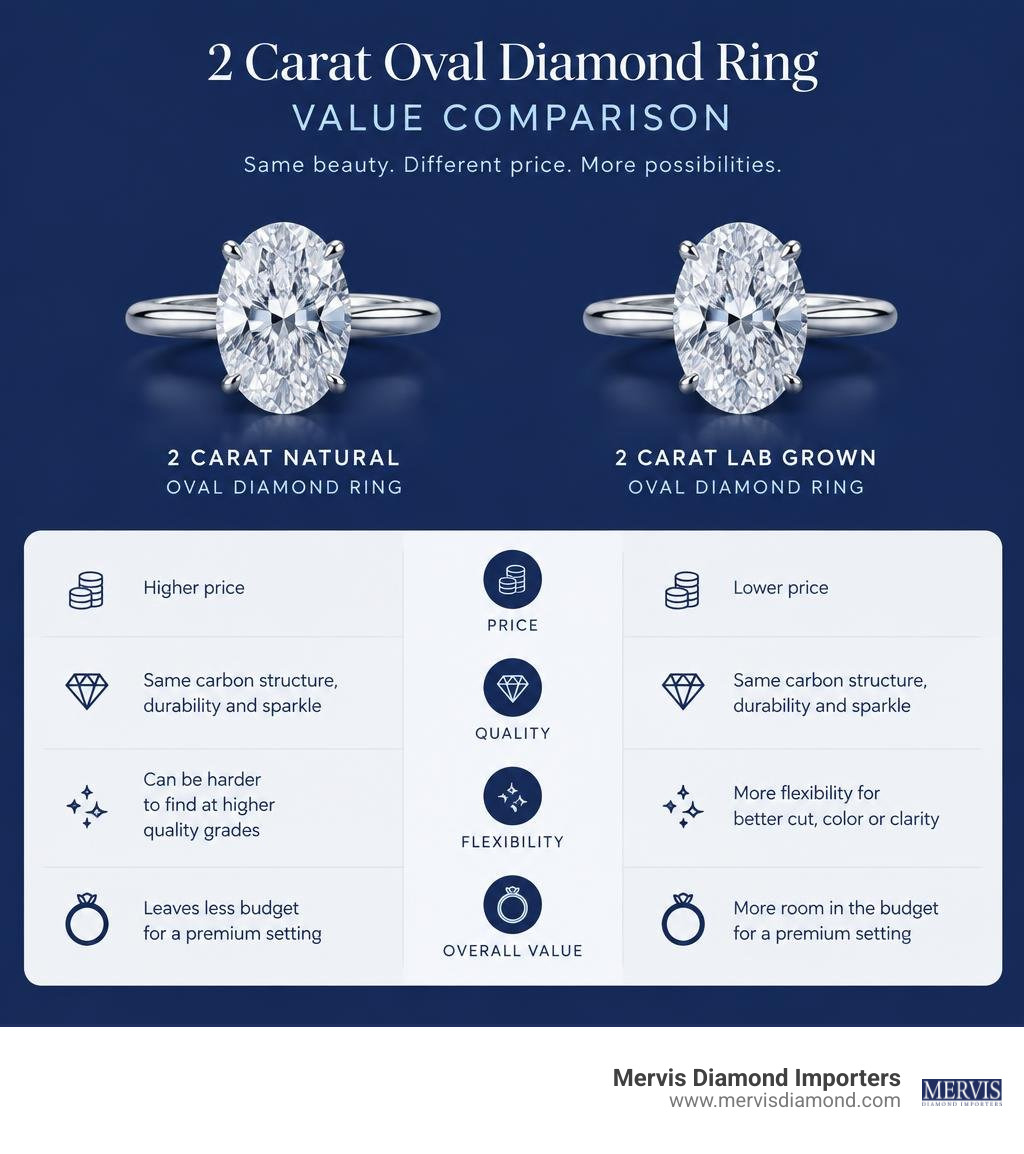
The Value Proposition: Natural vs. 2 Carat Lab Grown Oval Diamond Ring Pricing
When shopping for an engagement ring in September 2026, the question of price inevitably shapes the conversation. The price divergence between mined and laboratory-created diamonds provides an unprecedented opportunity to maximize diamond size and quality while staying comfortably within your budget.
| Feature / Metric | 2 Carat Natural Oval Diamond Ring | 2 Carat Lab Grown Oval Diamond Ring |
|---|---|---|
| Typical Price Range (F–G, VS1–VS2) | $18,000 – $32,000+ | $2,200 – $4,500 |
| Average Savings | Baseline | 80% to 90% Savings |
| Chemical Composition | Pure Carbon (Crystalline) | Pure Carbon (Crystalline) |
| Mohs Hardness Scale | 10 (Extremely Durable) | 10 (Extremely Durable) |
| Refractive Index & Sparkle | 2.42 | 2.42 |
| Origin Verification | Mined via Geological Sourcing | Grown via Advanced CVD / HPHT |
| Visual Finger Coverage | Approx. 10.0 × 7.0 mm footprint | Approx. 10.0 × 7.0 mm footprint |
Choosing a laboratory-created gem allows you to redirect funds toward heirloom-quality metalwork, custom design nuances, or simply starting married life on solid financial footing.
Cost Breakdown: What You Pay for a 2 Carat Lab Grown Oval Diamond Ring
The final cost of your engagement ring depends on two major factors: the loose center stone and the mounting.
Because laboratory diamond production has matured and scaled efficiently, the price per carat for manufactured stones has reached a highly consumer-friendly plateau. Where a top-tier 2-carat natural oval diamond commands tens of thousands of dollars, an identically graded lab stone allows you to secure exceptional metrics—such as D or E color and VVS clarity—for a fraction of that investment.
Whether you opt for an elongated lab grown oval diamond or balance your choice with other classic cuts like a round brilliant diamond, our selection ensures you never have to sacrifice brilliance for price.
Chemical, Optical, and Physical Equivalence
A common point of confusion is whether laboratory-created stones are "real" diamonds. The answer from scientific, gemological, and regulatory perspectives is an unequivocal yes. The Federal Trade Commission (FTC) defines a diamond by its mineral structure—pure carbon in an isometric-hexoctahedral crystal lattice—not its geographical origin.

Whether created via Chemical Vapor Deposition (CVD) or High Pressure High Temperature (HPHT), these gems exhibit:
- Identical Hardness: Scoring a 10 on the Mohs scale, they resist scratches exactly like earth-mined gems.
- Identical Light Performance: A refractive index of 2.42 produces the fiery dispersion and scintillation diamond lovers cherish.
- Type IIa Purity: Most lab-grown diamonds fall into the rare Type IIa category, signifying nearly zero nitrogen impurities—a purity level found in less than 2% of mined stones.
Quality Guide: Selecting the Best Cut, Color, and Clarity for an Oval Diamond
Oval diamonds are "fancy shapes," meaning they lack a standardized cut grade from major gemological laboratories like the Gemological Institute of America (GIA) or International Gemological Institute (IGI). Evaluating an oval requires evaluating its proportions and symmetry with a trained eye.
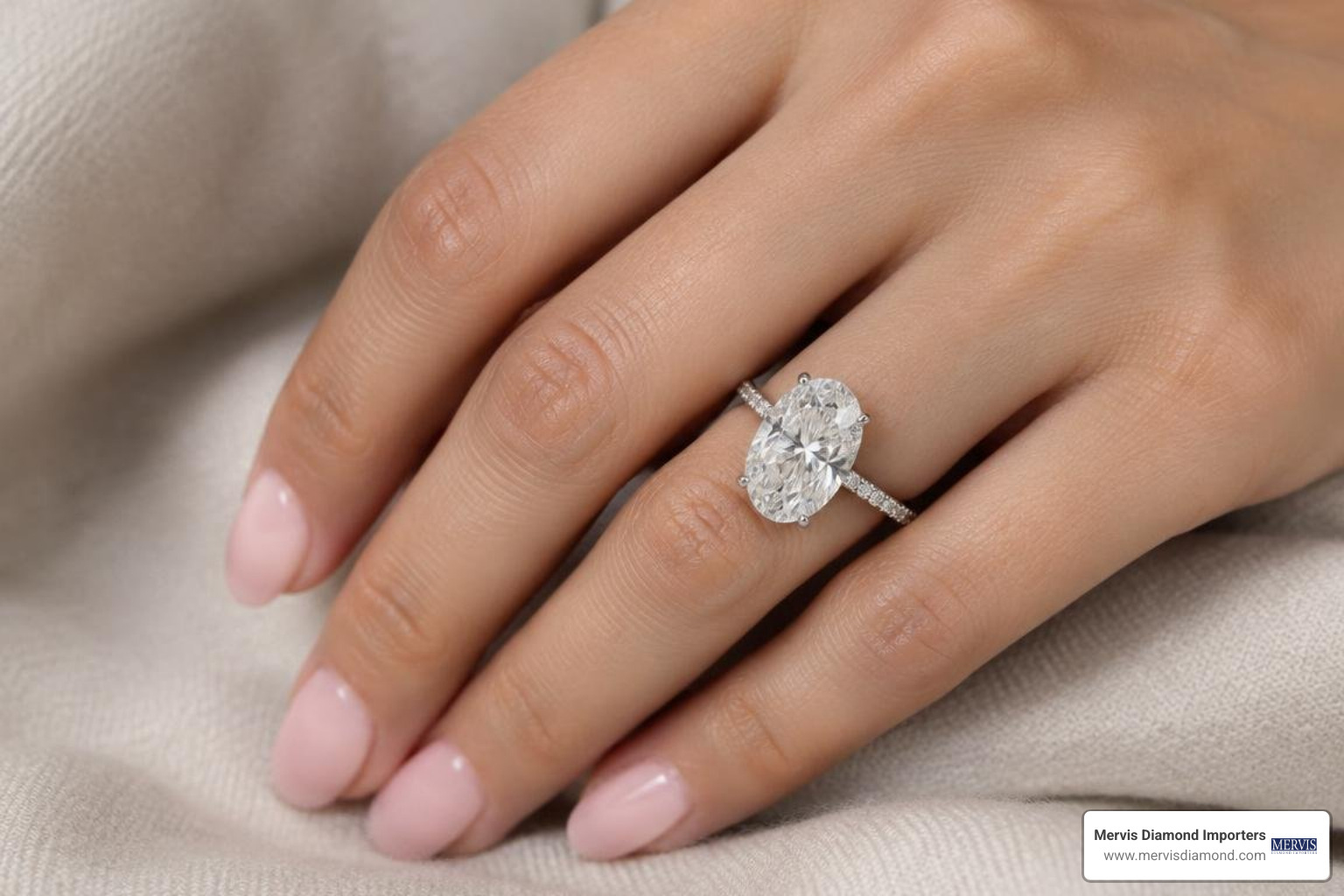
When selecting an oval diamond, the length-to-width (L/W) ratio determines its overall aesthetic:
- 1.30 to 1.39: A plumper, rounder oval offering balanced width.
- 1.40 to 1.50: The classic sweet spot providing an elegant balance of finger coverage and graceful elongation.
- 1.51 to 1.60+: A sleek, slender silhouette that dramatically elongates the wearer's hand.
Maximizing Sparkle and Avoiding the Bow-Tie Effect
Because of the facet distribution along an oval's elongated shape, nearly every oval cut diamond displays some degree of a dark shadow across its center, known as the "bow-tie effect."
While a subtle shadow is normal and provides visual contrast, an excessively prominent dark bow-tie indicates poorly angled facets that leak light rather than bouncing it back to your eye. To ensure maximum brilliance:
- Depth Percentage: Look for depths between 58% and 63%.
- Table Percentage: Target tables between 53% and 63%.
- Symmetry & Polish: Insist on Excellent symmetry to keep facet junctions aligned and light traveling evenly across the stone.
Ideal Color and Clarity Grades for a 2 Carat Lab Grown Oval Diamond Ring
Because lab-grown pricing is accessible, there is no need to settle for visibly included stones. However, overspending on flawless grades that look identical to the naked eye is unnecessary.
- Color Grades: For platinum or white gold mountings, choose D, E, or F (Colorless) grades to keep the gem icy and bright. For yellow or rose gold settings, a G or H stone offers exceptional value, as the warmer precious metal naturally complements near-colorless diamonds.
- Clarity Grades: Fancy cuts like ovals disguise microscopic inclusions far better than step cuts (such as emeralds). Aim for VS1 or VS2 clarity for an eye-clean stone, or step up to VVS2 for total peace of mind.
Pairing an eye-clean center stone with a sleek solitaire oval engagement ring creates a timeless piece of fine jewelry where diamond quality takes center stage.
Top Setting Styles for 2 Carat Oval Center Stones
A 2-carat oval center diamond commands attention, occupying roughly 10 millimeters in vertical finger length. Selecting the proper setting ensures both structural protection and stunning design harmony.
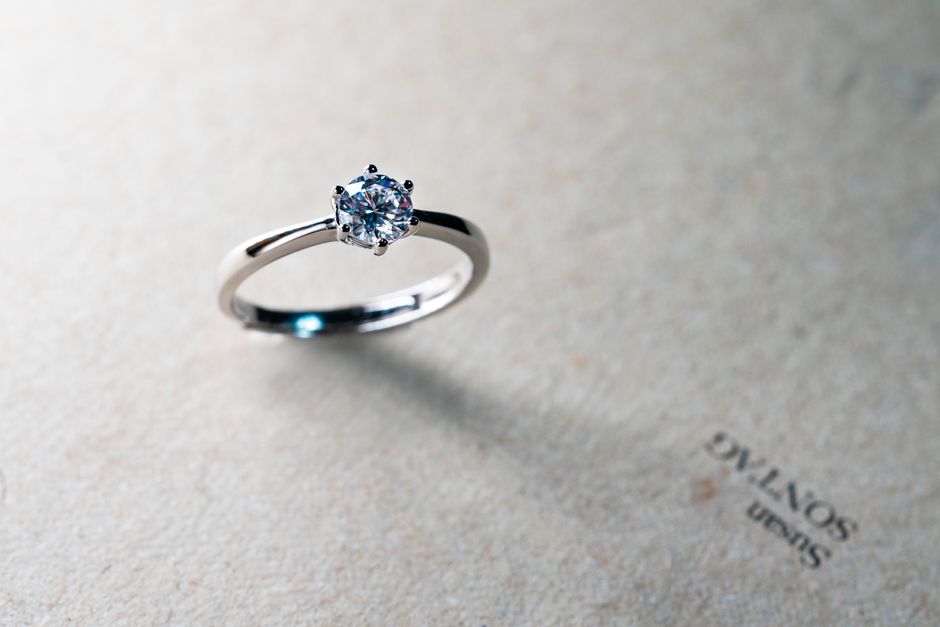
Classic Solitaire and Hidden Halo Designs
For those who love clean lines and timeless elegance, a solitaire mounting remains unmatched. Minimalist bands allow the oval's curves to stand out unhindered.
- Four vs. Six Prongs: Four prongs give the oval an open, contemporary look, while six prongs offer added security and round out the stone's profile.
- Hidden Halos: Adding a delicate row of micro-pave diamonds underneath the center stone introduces unexpected sparkle from the ring's profile view.
Discover how a timeless oval solitaire engagement ring balances clean simplicity with radiant focal appeal.
Three-Stone and Halo Bloom Settings
If you prefer extra finger coverage or vintage-inspired sparkle, multi-stone settings frame a 2-carat oval center stone beautifully:
- Three-Stone Designs: Flanking your center stone with tapered baguettes, pear shapes, or half-moons creates an elegant, graduated silhouette. An oval three-stone engagement ring symbolizes a couple's past, present, and future with sophistication.
- Halo Bloom Accents: A surrounding halo amplifies the outer perimeter, making your 2-carat center stone appear even more prominent. An oval bloom halo engagement ring delivers vintage romance and head-turning brilliance.
Frequently Asked Questions About 2 Carat Lab Grown Ovals
Do lab grown oval diamonds test as real diamonds?
Yes. Handheld diamond testers measure thermal and electrical conductivity. Because lab diamonds share identical physical and chemical properties with mined diamonds, they test as genuine diamonds. Specialized gemological lab equipment is required to detect the microscopic growth patterns that distinguish lab-grown from natural stones.
How large does a 2 carat oval diamond look on the finger?
An oval diamond appears approximately 10% larger than a round diamond of the identical carat weight. A 2-carat round brilliant measures roughly 8.1 mm in diameter, whereas a standard 2-carat oval measures around 10.0 mm by 7.0 mm. This elongated spread maximizes "face-up" surface area on the finger.
Which diamond grading lab is best for lab grown ovals?
IGI and GIA are the leading grading institutions for lab-grown gems. Both provide comprehensive grading reports covering cut proportions, carat weight, color, clarity, and laser inscription verification. At Mervis Diamond Importers, we ensure all our lab diamonds carry reputable independent certification.
Conclusion
A 2-carat lab-grown oval diamond ring combines classic elegance, modern technology, and smart value. By focusing on cut quality, ideal length-to-width proportions, and an eye-clean clarity grade, you can choose a ring that will sparkle brilliantly for generations.
At Mervis Diamond Importers, our family has guided couples through diamond buying for decades. We hand-select high-quality natural and lab-grown stones to ensure that every diamond in our showroom meets our strict standards for light performance and beauty. Whether you visit us in Tysons, VA, Rockville, MD, or Washington, DC, our team offers pressure-free guidance to help you craft your dream ring.
Ready to begin? Schedule a private appointment or explore trending lab-grown diamonds with our specialists today.