

Affordable 3 Carat Diamonds and How to Get the Most Sparkle for Your Buck
Find an Affordable 3 Carat Diamond Without Sacrificing Sparkle
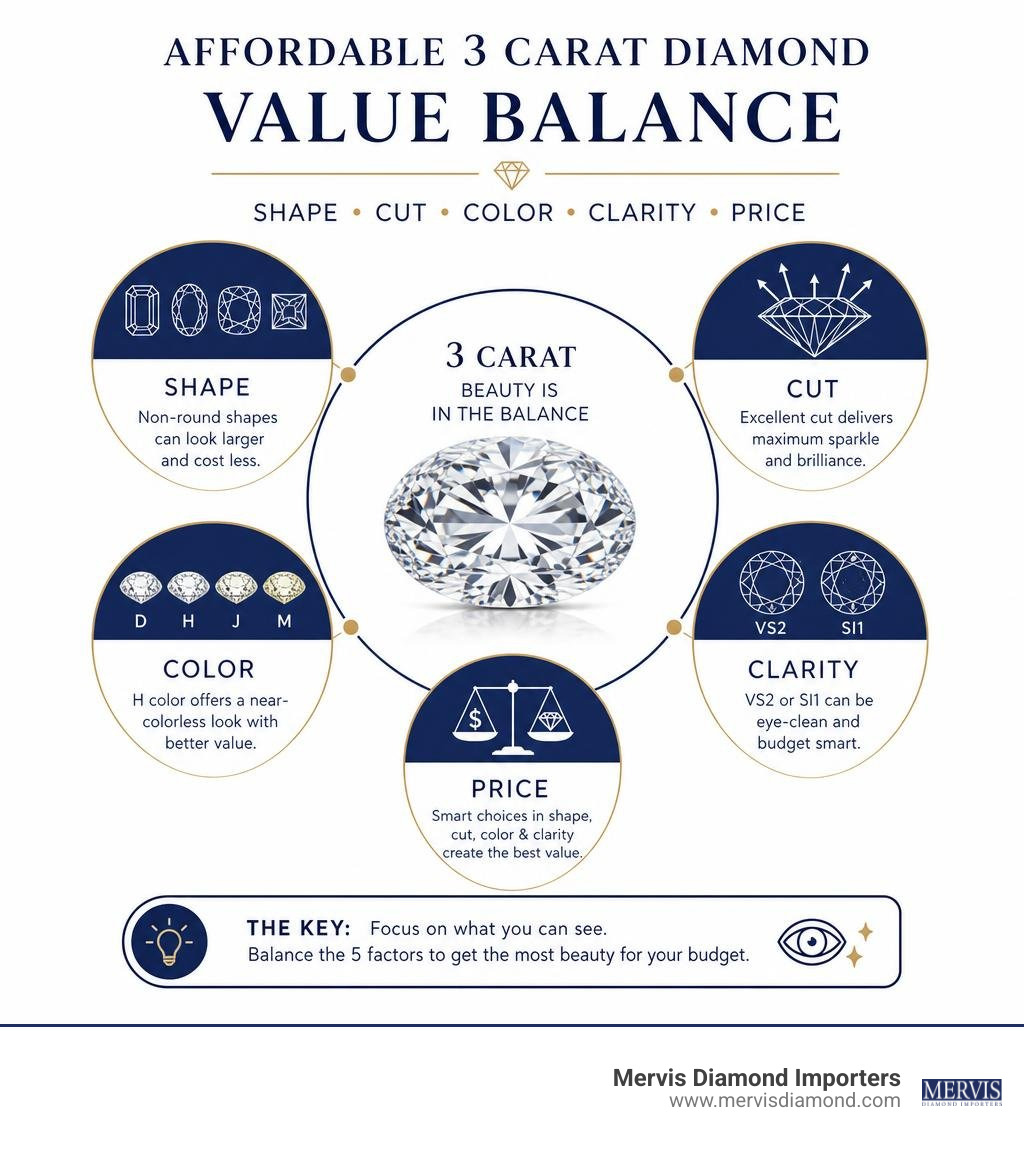
Yes, a 3 carat diamond can be affordable when you focus on what the eye sees most: cut, shape, and a smart quality range. For a natural diamond, buyers on a tighter budget can often target an eye-clean H color and VS2 or SI1 clarity, consider a non-round shape, or shop just below the 3.00-carat threshold. Lab-grown 3 carat diamonds offer an even lower entry point, often around $7,000 to $11,000.
A 3 carat natural diamond averages about $41,094, but prices span widely, from roughly $13,497 to $96,288. The difference is not simply size. A well-cut oval, cushion, princess, or emerald-cut diamond can look large and bright while costing less than a comparable round brilliant. Princess cuts, for example, can cost about 27% less than round diamonds of the same weight.
The goal is not to buy the lowest-grade stone. It is to avoid paying for differences that are difficult to see once the diamond is on your hand.
I'm Morris Mervis, and in this guide, I'll show you how to balance carat weight, visible beauty, certification, and budget with confidence.
Understanding What Makes a 3 Carat Diamond Affordable: Pricing and Market Dynamics
When stepping up to a 3-carat center stone, you enter an exclusive tier of diamond buying. Only a tiny fraction of rough gem diamonds mined worldwide are large enough to yield a finished gem of three carats or greater. This natural rarity drives the diamond market to price gems exponentially rather than linearly.
A 3 carat natural diamond does not simply cost three times more than a 1 carat stone; depending on the quality tier, it can easily cost up to ten times as much. Tracking live 3 Carat Diamond Prices illustrates how quickly price tags scale as cut, color, and clarity climb toward gemological perfection.
Understanding the market structure allows you to navigate these price jumps strategically rather than paying arbitrary premiums.
Current 3 Carat Diamond Price Ranges and Carat Weight Breakpoints
Natural diamond pricing follows distinct tiers based on quality grades:
- Low-End Tier ($20,000 – $25,000): Natural stones in the I–J color and SI1–SI2 clarity ranges. These can provide incredible value if carefully vetted to ensure they are visually eye-clean.
- Average / Value Sweet Spot ($28,000 – $44,000): Gems sitting in the G–H color and VS2–SI1 clarity brackets. These diamonds deliver a brilliant, colorless appearance to the unaided eye.
- High-End Tier ($50,000 – $125,000): D–F colorless diamonds with VVS1–VS1 clarity grades.
- Premium Collection Tier ($125,000 – $240,000): Rare, internally flawless, D-color collector specimens.
One of the most effective strategies for finding a 3 carat diamond affordable on a realistic budget is taking advantage of "magic weights." Diamond prices jump significantly at round benchmark weights such as 1.00 ct, 2.00 ct, and 3.00 ct. Buying an "under-size" diamond—such as a 2.80 ct or 2.90 ct—yields substantial savings with no perceptible reduction in visual surface area.
| Diamond Weight | Average Natural Market Price | Typical Round Diameter | Visual Size Difference vs 3.00ct |
|---|---|---|---|
| 2.80 Carat | $37,552 | ~9.15 mm | Imperceptible (< 0.25 mm) |
| 2.90 Carat | $38,900 | ~9.28 mm | Virtually Identical (< 0.12 mm) |
| 3.00 Carat | $41,094 | ~9.40 mm | Baseline Reference |
| 3.25 Carat | $53,484 | ~9.65 mm | Marginal Gain (+ 0.25 mm) |
As shown above, moving from a 2.80 ct diamond to an exact 3.00 ct diamond introduces an average price increase of nearly $3,500 for a fraction of a millimeter in table width. Moving up to a 3.25 ct stone causes prices to jump past $53,000.
Recent 2026 Price Drops and Market Factors
As of August 2026, the diamond market presents favorable opportunities for luxury buyers. Over the past 6 months, natural 3 carat diamond benchmark prices have eased by approximately 9.78%, with natural diamond inventory slightly expanding.
This market adjustment has been driven by broader macroeconomic shifts, increased availability of fine rough crystals, and the growing mainstream popularity of lab-created alternatives. For natural diamond buyers, these price corrections mean you can secure a larger, higher-performing 3 carat gem for the same budget that might have only secured a 2.5 carat stone a couple of seasons ago.
Maximizing Value Through Diamond Shape and Visual Carat Size
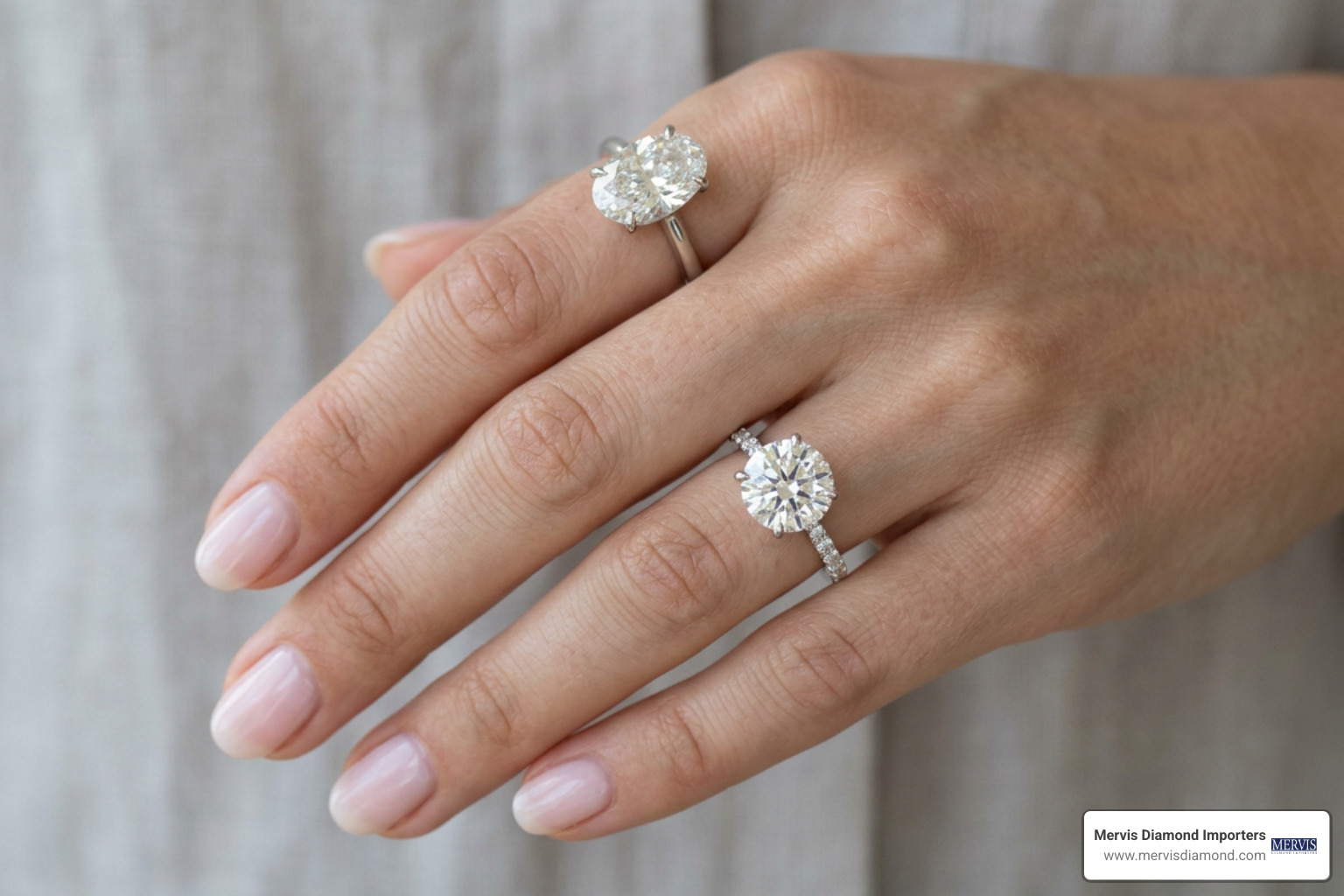
Carat is a measure of weight, not physical dimensions. Two diamonds weighing exactly 3.00 carats can look completely different in physical size depending on their cut geometry. How that weight is distributed—whether hidden in a deep pavilion or spread across a broad, shallow table—directly governs how large the stone appears on the finger.
How Shape and Dimensions Impact a 3 Carat Diamond Affordable Price Point
A classic 3 carat round brilliant diamond cut to Ideal proportions measures approximately 9.40 mm in diameter. Because round cuts require symmetrical depth to optimize light reflection, a substantial portion of their carat weight remains tucked beneath the setting.
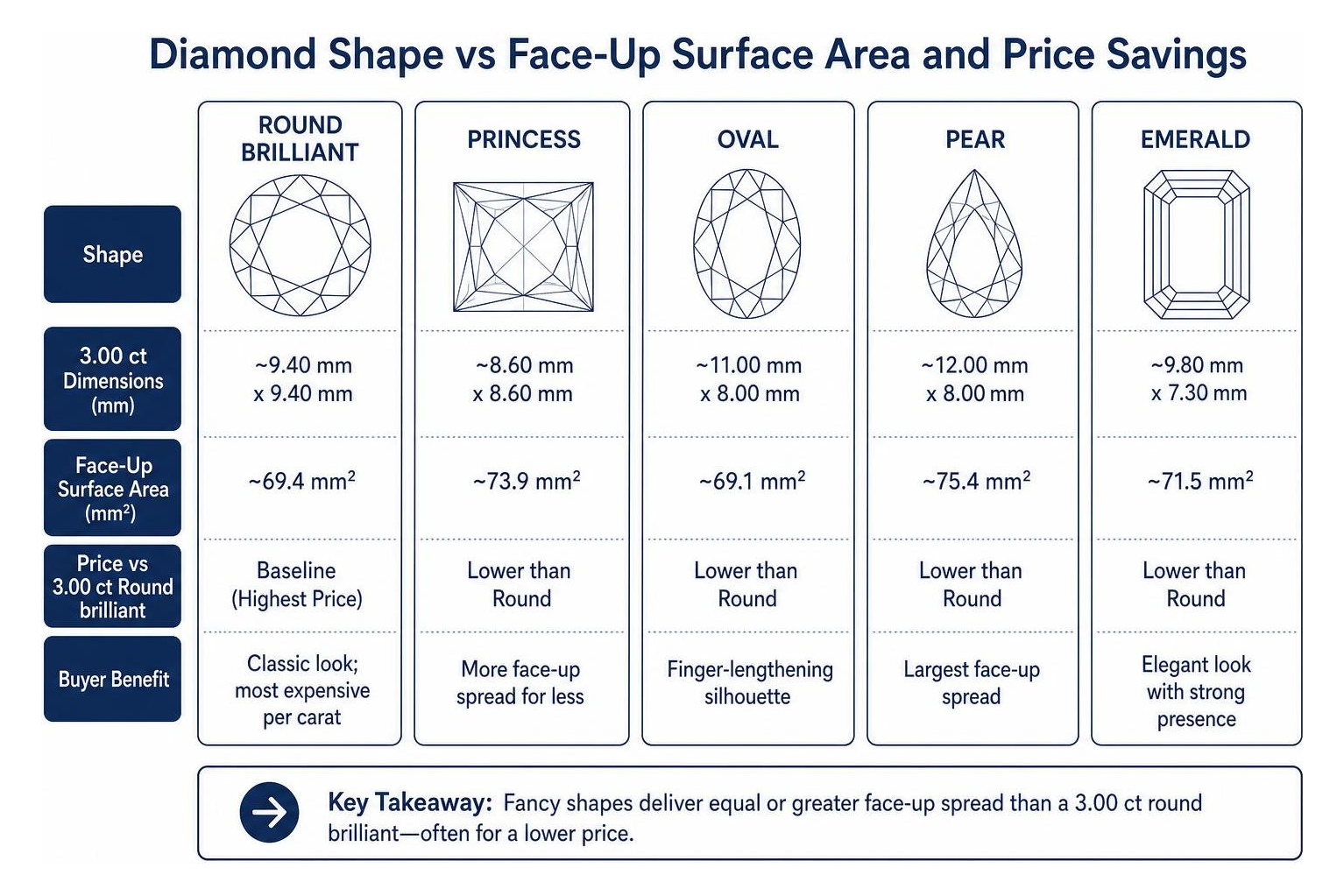
In contrast, elongated fancy shapes distribute weight across a greater top-surface area (often called "face-up spread"):
- Round Brilliant (3.00 ct): ~9.40 mm x 9.40 mm (Surface Area: ~69.4 mm²)
- Princess Cut (3.00 ct): ~8.60 mm x 8.60 mm (Surface Area: ~73.9 mm²)
- Oval Cut (3.00 ct): ~11.00 mm x 8.00 mm (Surface Area: ~69.1 mm² + finger-lengthening silhouette)
- Pear Shape (3.00 ct): ~12.00 mm x 8.00 mm (Surface Area: ~75.4 mm²)
- Emerald Cut (3.00 ct): ~9.80 mm x 7.30 mm (Surface Area: ~71.5 mm²)
You can utilize tools like a 3 Carat Diamond Price Calculator - calculattor.com to check how altering shape and dimensions affects your bottom line while achieving maximum presence on your hand.
Why Fancy Cuts Offer Huge Savings Over Round Brilliants
Round brilliant diamonds are the most expensive diamond shape per carat. Cutting a round diamond from rough octahedral crystals results in losing up to 50% to 60% of the raw stone during the cutting process. Fancy cuts (such as princess, cushion, radiant, and emerald cuts) follow the natural crystal growth patterns much more closely, preserving far more rough yield.
These manufacturing efficiencies translate directly into consumer savings:
- Princess & Asscher Cuts: Up to 27% less expensive than round brilliants (Average 3ct Princess: ~$32,015).
- Emerald Cuts: Roughly 23% less expensive (Average 3ct Emerald: ~$38,083). Explore stunning elongated step-cuts like this 3.77 ct GIA Certified Emerald Cut Diamond Engagement Ring in Platinum.
- Cushion Cuts: Around 18% less expensive (Average 3ct Cushion: ~$38,747). For larger statement pieces, consider heirloom styles like the Timeless 6.51 ct Cushion Cut Diamond Engagement Ring in Platinum.
- Radiant Cuts: Deliver fiery brilliance at significant discounts (Average 3ct Radiant: ~$36,702), seen in masterworks like this 3.50 ct GIA Certified Radiant Cut Diamond Ring with Tapered Baguettes.
- Oval & Pear Cuts: Approximately 14% less expensive than round diamonds per carat.
Choosing a fancy shape allows you to either lower your overall purchase price significantly or reallocate those savings into a higher color or clarity grade.
The Smart Buyer's Formula for 4Cs Quality and Certification
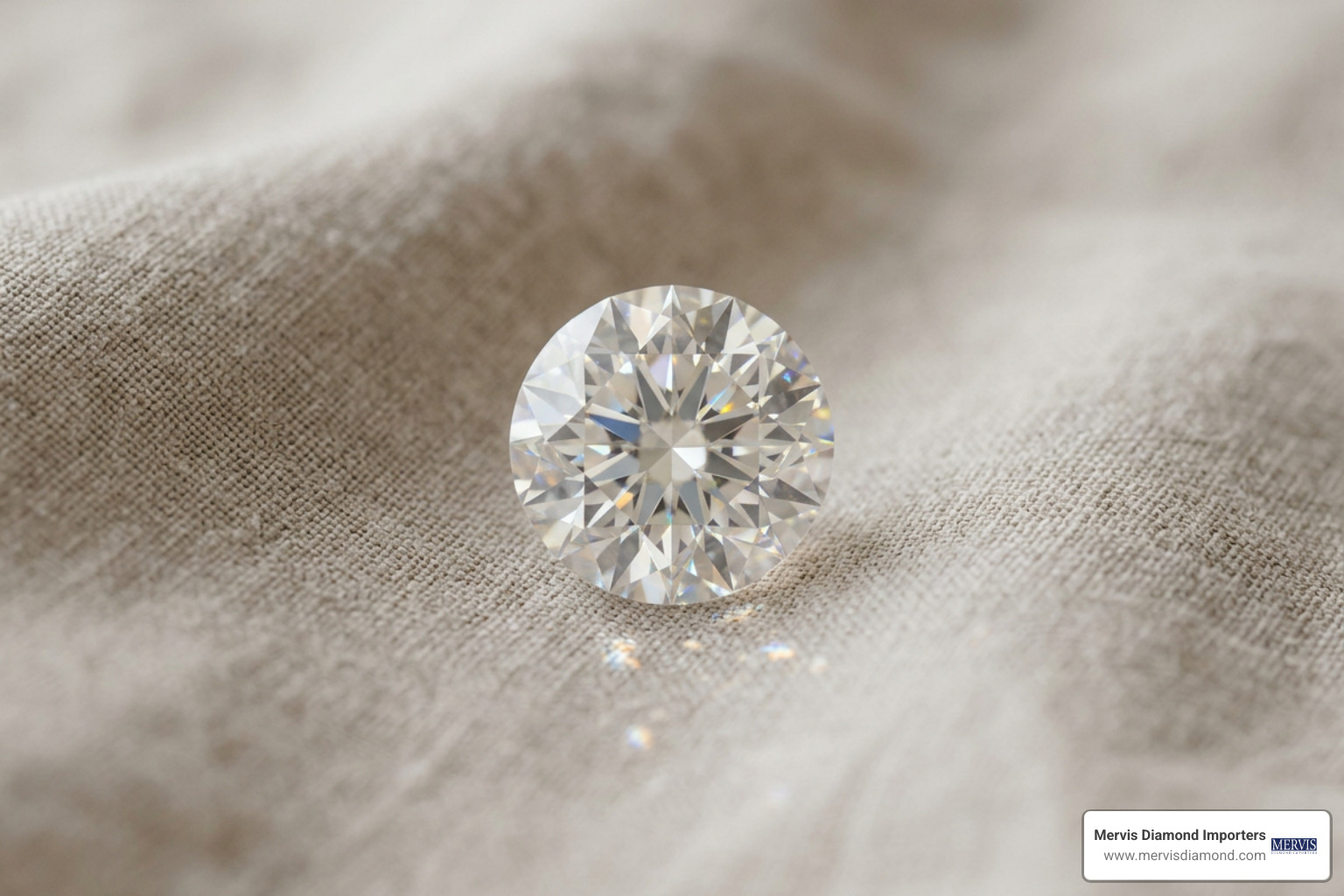
Purchasing an impressive stone without overspending requires understanding where diamond grades matter and where they simply add cost on paper.
Choosing the 4Cs Sweet Spot for a 3 Carat Diamond Affordable Budget Under $30,000
If your goal is to acquire a natural 3 carat diamond while keeping your investment near or under $30,000, smart spec targeting is essential:
- Color Sweet Spot (G–H Grade): Diamonds graded D, E, and F carry steep rarity premiums. An H color diamond appears bright white when set in platinum or white gold, while costing thousands less than an F or E grade. If you choose a yellow gold or rose gold setting, you can comfortably drop to an I or J color, as the warm metal masks subtle body color.
- Clarity Sweet Spot (VS2–SI1 Grade): In a 3-carat diamond, facets are larger, making inclusion placement critical. However, paying for VVS or Flawless clarity means paying for microscopic cleanliness invisible to the naked eye. A curated VS2 or eye-clean SI1 diamond has no inclusions visible without a 10x jeweler’s loupe.
- Cut Quality (Never Compromise): Always select an Excellent or Ideal cut. Cut is what creates brilliance, dispersion, and fire. A poorly cut 3 carat diamond will look dull, dark, and smaller than its actual weight. An expertly proportioned cut maximizes edge-to-edge light return.
The Crucial Role of GIA Certification and Cut Precision
Never buy a significant natural diamond without an independent, premier grading report from the Gemological Institute of America (GIA).
Less stringent grading laboratories often overstate diamond grades by one to two full tiers in color or clarity. A diamond marketed as an "E / VS1" by a lenient lab might only receive a "G / SI1" from the GIA. Third-party GIA certification ensures you receive the exact physical asset you paid for, protecting both the beauty of your ring and its long-term appraisal value.
Natural vs. Lab-Grown: Evaluating Quality, Trade-Offs, and Costs
For buyers seeking maximum size and purity at accessible price tiers, lab-grown diamonds represent a modern alternative.
Lab-grown diamonds are chemically, physically, and optically identical to mined diamonds. They are made of pure crystallized carbon in a cubic diamond lattice, featuring identical hardness (10 on the Mohs scale), refractive index (2.42), and sparkle.

The primary difference lies in rarity and origin:
- Natural Diamonds: Formed billions of years ago deep within the Earth's mantle under extreme heat and pressure. They possess intrinsic rarity and historical value retention. A natural 3 carat stone with great specs typically ranges from $28,000 to $45,000+.
- Lab-Grown Diamonds: Cultivated inside advanced technology laboratories utilizing Chemical Vapor Deposition (CVD) or High Pressure High Temperature (HPHT) processes. Because supply is scalable, a lab-grown 3 carat diamond with top-tier specs (such as D–F color and VVS–VS clarity) ranges between $7,000 and $11,000.
If your priority is obtaining the absolute largest, highest-clarity diamond possible within a budget of under $12,000, lab-grown gems provide an option without aesthetic compromise. Consider high-color, high-clarity specimens like this Lab Grown Diamond E VS1 3.52 ct Round Report XLTK177650 or this Lab Grown Diamond D VS1 3.59 ct Round Report XLTK178861.
Frequently Asked Questions About 3 Carat Diamonds
What is the most affordable shape for a 3 carat diamond?
Princess cuts and Asscher cuts are the most affordable diamond shapes for a 3 carat stone, averaging approximately 27% lower in price than round brilliants of equivalent quality. An average 3 carat Princess cut diamond costs around $32,015 compared to roughly $39,559 for a round diamond. Their squarish shape yields minimal raw material waste during cutting, passing direct cost savings on to you.
Can you find an eye-clean 3 carat diamond with SI clarity?
Yes, but it requires individualized inspection. Because 3 carat diamonds feature large table facets, inclusions located dead center under the table can be visible to the unaided eye. However, SI1 and select SI2 diamonds with inclusions located around the outer perimeter—such as light feathering or microscopic crystals near the girdle—can be 100% eye-clean once set under prongs, saving you thousands over higher clarity grades.
Is it smarter to buy a 2.9 carat diamond instead of an exact 3 carat stone?
In almost every scenario, yes. A 2.90 carat diamond costs substantially less per carat than a diamond that hits the benchmark 3.00-carat mark. Visually, the diameter difference between a 2.90 ct round diamond (~9.28 mm) and a 3.00 ct round diamond (~9.40 mm) is approximately 0.12 millimeters—less than the thickness of a single sheet of paper. You get the visual presence of a 3-carat ring while saving between 5% and 15% on the stone.
Conclusion
Securing an exceptional 3 carat diamond ring does not require paying top-tier prices for theoretical grades you cannot see. By prioritizing an Excellent cut, focusing on the visual sweet spot of H color and VS2 clarity, considering elongated fancy shapes like princess or emerald cuts, or exploring premium lab-grown options, you can maximize sparkle while staying well within your budget.
At Mervis Diamond Importers, our master gemologists hand-select every diamond to ensure unmatched brilliance and value. We invite you to visit our showrooms in Tysons, VA, Rockville, MD, and Washington, DC for a relaxed, pressure-free consultation.
For a complete breakdown of total ring costs, custom settings, and mounting considerations, explore our detailed guide on how much a 3 carat diamond ring costs to plan your dream engagement ring today.