

The Modern Couple's Roadmap to Custom Lab Grown Engagement Rings
The Allure and Science Behind Custom Lab Grown Engagement Rings
Custom lab grown engagement rings are bespoke rings built around a laboratory-created diamond, giving couples a fully personalized design with the same chemical, physical, and optical properties as a mined diamond. The process combines a certified lab grown center stone with a made-to-order setting, so you can choose the diamond shape, metal, and hidden details while typically spending 70-85% less than a comparable mined diamond. A common misconception is that lab grown diamonds are diamond simulants, like cubic zirconia or moissanite. In reality, lab grown diamonds are chemically, physically, and optically identical to mined diamonds. They are comprised of a pure, crystallized carbon lattice, which earns them a solid 10 on the Mohs hardness scale—the hardest mineral known on Earth.
Scientists create these gemstones using two advanced methods:
- Chemical Vapor Deposition (CVD): A microscopic diamond seed is placed inside a vacuum chamber filled with carbon-rich gases (such as methane and hydrogen). When heated to extreme temperatures, the gases break apart, allowing carbon atoms to rain down onto the diamond seed and crystallize layer by layer.
- High Pressure High Temperature (HPHT): This process replicates the exact conditions found deep within the Earth’s mantle. A diamond seed is subjected to pressures exceeding 1.5 million pounds per square inch and temperatures above 2,700°F, melting pure carbon around the seed to form a rough diamond.
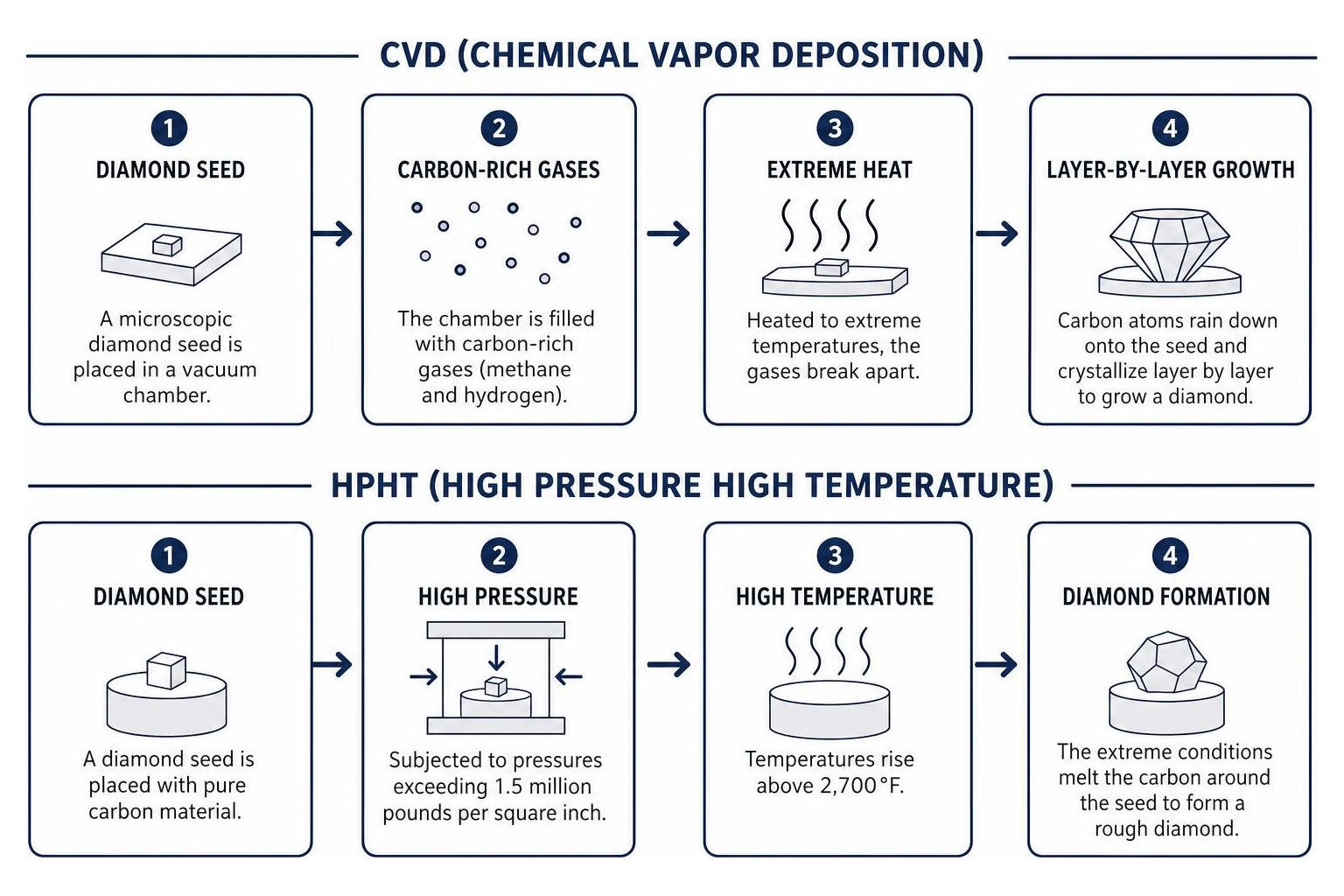
Both methods produce authentic, brilliant rough diamonds that master diamond cutters shape and polish with the same precision applied to mined gems.
| Feature | Lab Grown Diamonds | Mined Diamonds | Diamond Simulants (CZ/Moissanite) |
|---|---|---|---|
| Chemical Composition | 100% Pure Carbon | 100% Pure Carbon | Zirconium Dioxide / Silicon Carbide |
| Mohs Hardness | 10 | 10 | 8.5 (CZ) / 9.25 (Moissanite) |
| Refractive Index | 2.42 | 2.42 | 2.15 – 2.69 |
| Origin | Advanced laboratory environment | Earth's upper mantle | Factory synthesized |
| Permanence & Sparkle | Indefinite (Will never cloud) | Indefinite (Will never cloud) | Tends to scratch/cloud over time |
Ethical and Cost Advantages of Lab Created Diamonds
One of the greatest benefits of creating custom engagement rings with lab-created gems is value. Lab-grown diamonds can cost 70-85% less than mined diamonds of comparable cut, color, clarity, and carat weight. This pricing advantage allows you to maximize your budget—whether that means investing in a larger center stone, selecting a more intricate custom setting, or keeping savings set aside for your wedding and honeymoon.
Beyond value, sustainability and ethical peace of mind play a major role in modern bridal decisions. Nearly 70% of millennials consider lab-grown diamonds for engagement rings due to ethical and cost reasons. Because lab diamonds bypass large-scale earth extraction, they offer a transparent, conflict-free history from growth to setting.
Grading, 4Cs, and Independent Diamond Certification
Every custom ring starts with choosing the right gem, and lab-created diamonds are evaluated using the exact same standard as natural diamonds: the 4Cs.
- Cut: The most important factor for sparkle. A masterfully cut diamond reflects light internally and returns it to your eye with high brilliance and fire.
- Color: Graded from D (completely colorless) down to Z. For white metals like platinum or white gold, diamonds in the D–F (colorless) or G–H (near-colorless) range offer crisp, bright looks.
- Clarity: Evaluates internal characteristics (inclusions) and surface blemishes. Grades range from Flawless (FL) to Included (I). Selecting an "eye-clean" diamond in the VS1–VS2 range often balances purity with exceptional value.
- Carat Weight: Measures the diamond’s weight (1 carat = 200 milligrams). Because lab diamonds offer significant cost efficiency, couples can explore 2-carat, 3-carat, or larger options comfortably within their target investment.
To verify quality, always ensure your diamond is graded by an independent gemological laboratory such as the International Gemological Institute (IGI) or the Gemological Institute of America (GIA). These certificates provide an unbiased blueprint of your stone's specifications, cut proportions, and microscopic laser inscription. For broader context on how lab grown diamonds are made and evaluated, see the synthetic diamond overview.
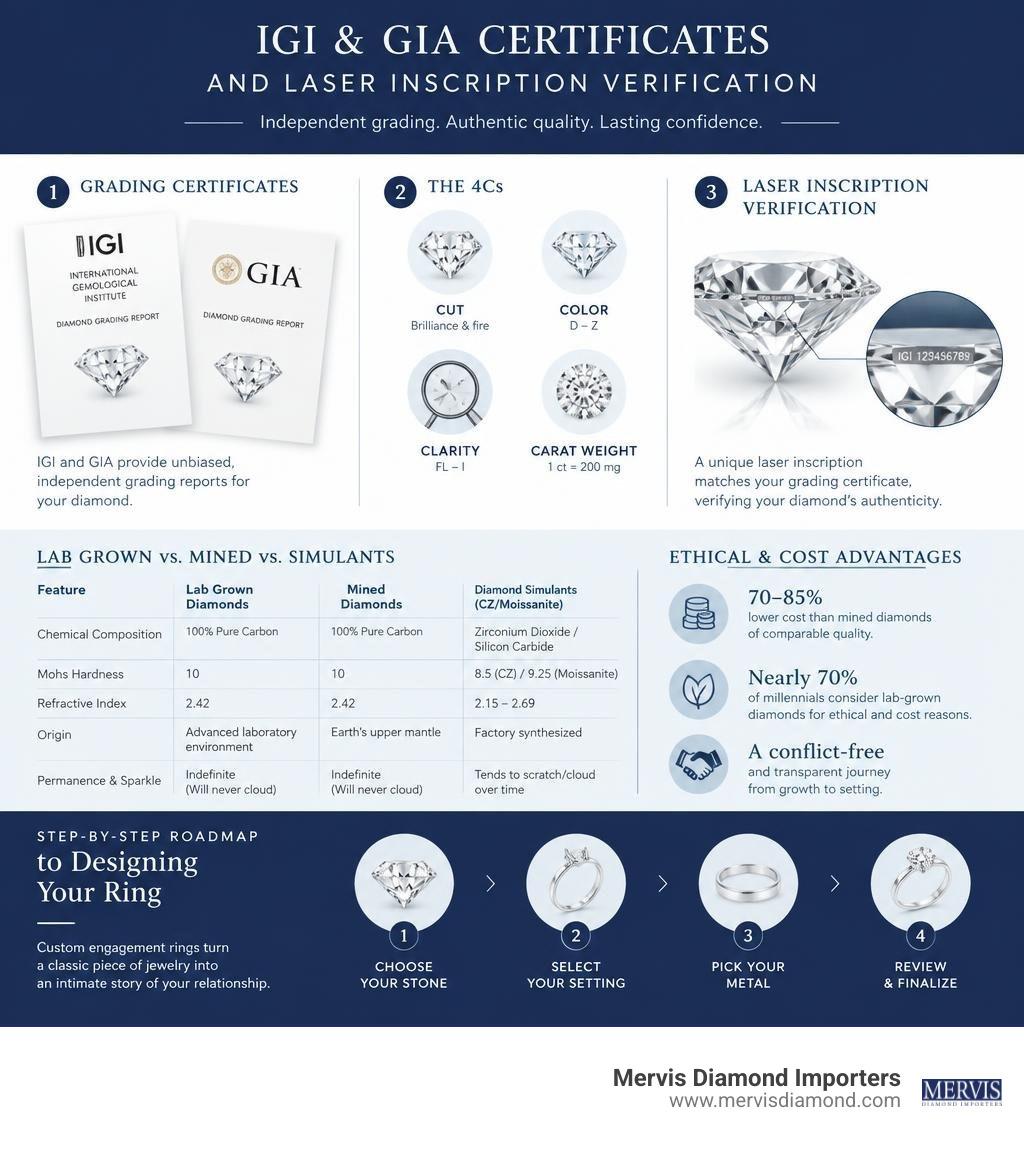
Step-by-Step Roadmap to Designing Your Ring
Custom engagement rings account for approximately 30% of all engagement ring sales in the U.S., reflecting a desire for one-of-a-kind designs. Designing your own ring transforms a classic piece of jewelry into an intimate story of your relationship.
Here is how the bespoke custom journey unfolds:
- Initial Style & Budget Consultation: We begin by discussing your inspiration, lifestyle, aesthetic tastes, and price comfort zone.
- Selecting the Loose Center Diamond: You examine certified lab grown diamonds side by side under magnification to choose the exact sparkle and proportions you love.
- Designing the Ring Architecture: Together, we sketch the profile, prongs, shank width, and metal type.
- CAD Modeling & Revisions: Our master designers construct a digital 3D model, allowing you to view and adjust the ring from every angle.
- Casting, Setting, and Polishing: Once approved, the ring is cast in solid precious metal, hand-set by expert jewelers, and polished to a mirror finish.

Selecting Setting, Precious Metals, and Hidden Details
Your choice of precious metal establishes the foundational tone and durability of the design:
- Platinum: Naturally white, hypoallergenic, and exceptionally dense. It holds stones with unmatched security and develops a soft satin patina over time.
- 18k & 14k Yellow Gold: Warm, classic, and radiant. Yellow gold complements vintage-inspired silhouettes and warmer skin tones.
- 18k & 14k White Gold: Rhodium-plated for a bright, mirror-white sheen that amplifies diamond brilliance.
- Rose Gold: Romantic and modern, offering a distinctive blush hue created by blending pure gold with copper alloys.
Beyond the main setting, custom work lets you integrate subtle, intimate accents:
- Hidden Halos: A delicate collar of micro-pavé diamonds tucked directly beneath the center stone, visible from the ring's side profile.
- Bezel Settings: A sleek metal rim that encases the perimeter of the diamond, offering contemporary styling and snag-free protection for active lifestyles.
- Personal Engravings: Roman numerals, secret initials, or meaningful phrases etched along the inner band.
- Peek-a-Boo Gemstones: Hidden birthstones set within the under-gallery as a private detail shared between partners.
From CAD Renderings to Finished Custom Lab Grown Engagement Rings
The transition from concept to tangible reality relies on computer-aided design (CAD). A 3D CAD rendering allows you to review photorealistic images of your custom lab grown engagement rings before any metal is cast.
During this phase, you inspect the prong placement, gallery height, and diamond proportions on a true-to-scale digital mockup. If you want the band made slightly thinner or the center stone set lower to sit flush with a wedding band, adjustments are simple to make at this step. Once you give final design approval, our master bench jewelers cast the metal, hand-set each individual accent stone, and complete the final inspection.
Latest Design Trends Shaping Modern Bridal Jewelry
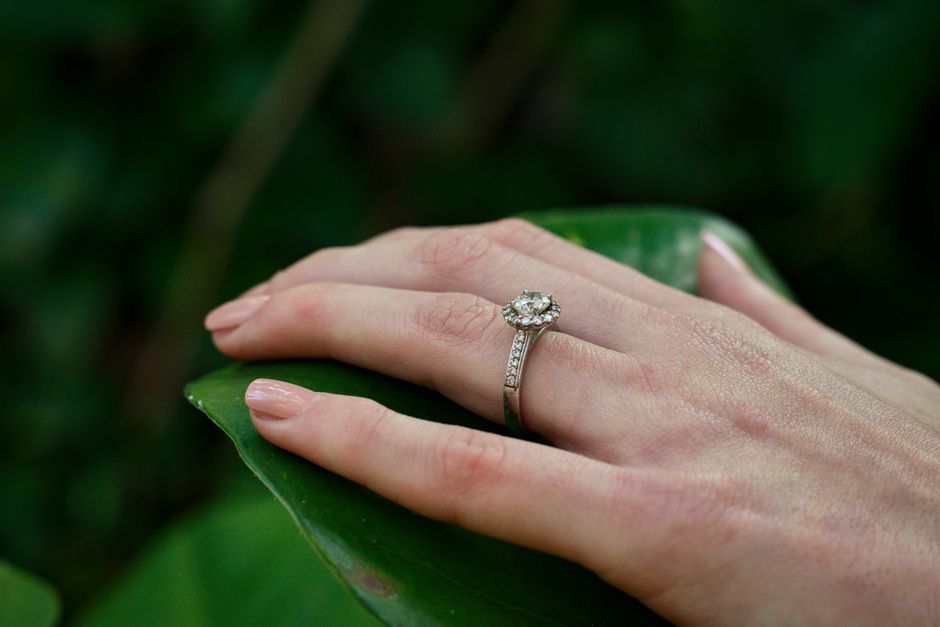
Today's couples are reimagining classic bridal silhouettes, using the flexibility of lab-grown diamonds to experiment with distinctive proportions and metal pairings.
Emerging Trends in Custom Lab Grown Engagement Rings
- Toi et Moi (Two-Stone Rings): Symbolizing the union of two distinct souls, these designs pair complementary cuts side by side, such as an emerald cut paired with a pear cut, or an oval diamond set beside a vibrant colored gemstone.
- East-West Settings: Rather than orienting elongated stones vertically along the finger, diamonds are mounted horizontally across the band. This creates a bold, geometric statement that feels fresh yet timeless.
- Chunky & Low-Profile Bezels: Combining modern minimalism with practical security, thick bezel settings protect the center diamond while providing an architectural aesthetic.
- Mixed Metal Bands: Two-tone designs, such as platinum prongs mounted on an 18k yellow gold band, create visual contrast while keeping the center diamond bright and colorless.
Unconventional Shapes and Bespoke Diamond Cuts
While the classic round brilliant remains beloved, elongated fancy shapes have surged in popularity for bespoke designs:
- Oval Cuts: Renowned for their soft curves and finger-elongating visual effect, offering expansive surface area per carat.
- Emerald Cuts: Featuring step-cut facets that create a "hall of mirrors" look, celebrating clean symmetry and vintage elegance.
- Marquise & Pear Cuts: Dramatic cuts that maximize visible surface area and flatter the hands with their tapered points.
- Elongated Cushions: Combining the soft corners of a cushion with the length of an oval, delivering brilliant sparkle with contemporary proportions.
- Antique Cuts (Old European & Old Mine): Cut with broader facets and high crowns to produce warm, romantic light dispersion reminiscent of heirloom Victorian jewelry.
Long-Term Care and Maintenance for Custom Diamond Rings
Because a lab grown diamond rates a 10 on the Mohs hardness scale, it can withstand everyday wear without dulling, clouding, or scratching. However, everyday lotions, soaps, and natural skin oils will coat the diamond's facets, temporarily muting its light performance.
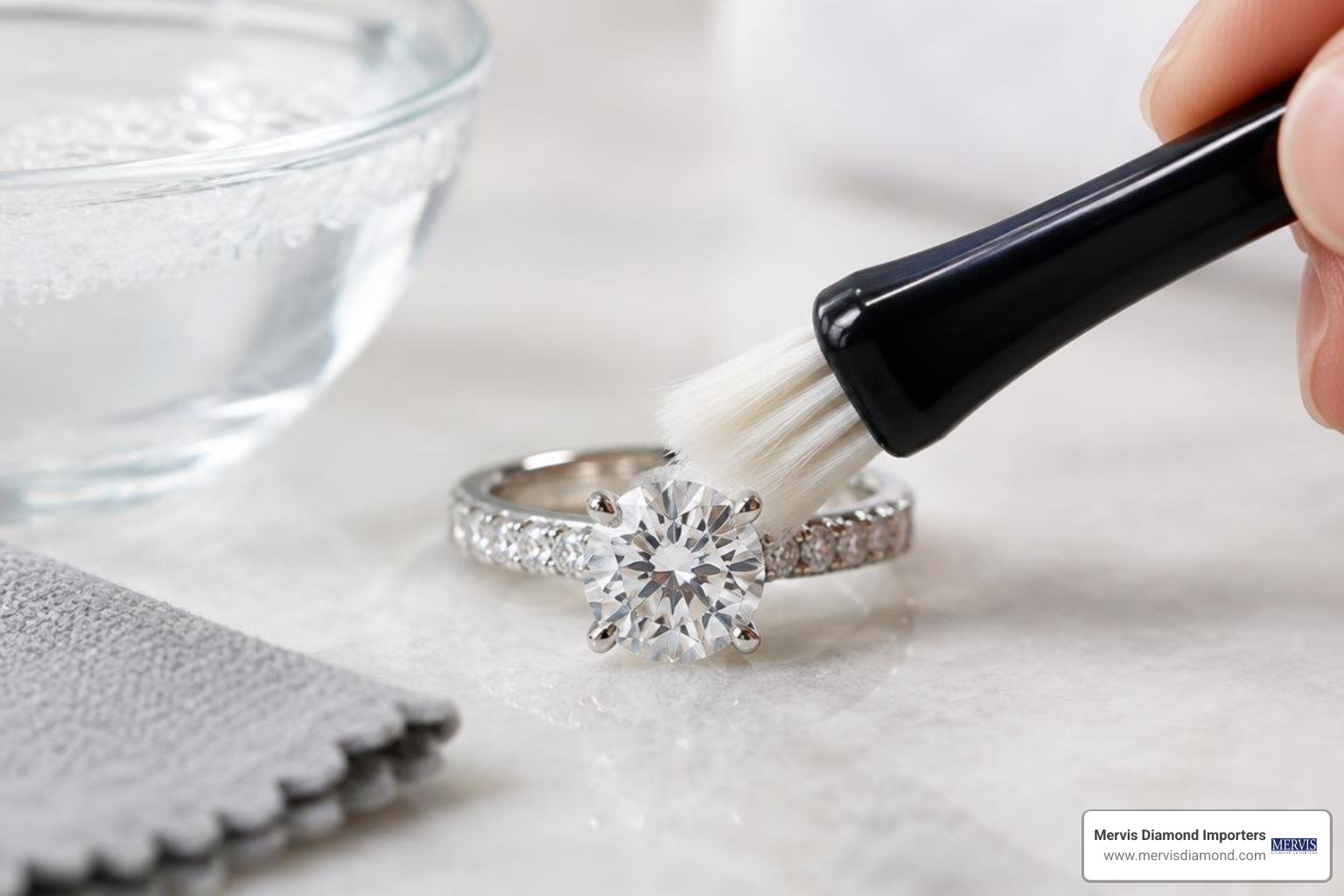
To maintain your ring's sparkle, follow these practical care practices:
- Routine At-Home Cleaning: Soak your ring in warm water mixed with a few drops of mild dish soap for 15 minutes. Gently brush around the stones and under-gallery using a soft-bristled baby toothbrush, rinse under warm running water (with the drain plugged), and dry with a lint-free microfiber cloth.
- Avoid Harsh Chemicals: Remove your ring before using household bleach, chlorine swimming pools, or abrasive cleaning scrubs, which can erode precious metals like gold alloys over time.
- Mind High-Impact Activities: Take off your fine jewelry before rock climbing, heavy weightlifting, or intense gardening to protect delicate prongs from bending under pressure.
- Schedule Annual In-Store Inspections: Have a professional bench jeweler examine your prongs, channel walls, and pavé micro-settings annually to verify stone security and receive professional ultrasonic deep cleaning.
Frequently Asked Questions About Custom Lab Diamond Rings
Do lab grown diamonds hold their beauty and durability forever?
Yes. Lab grown diamonds are pure crystallized carbon with identical physical, optical, and thermal properties to mined diamonds. They will never lose their fire, turn cloudy, or fade in brilliance over time. They are true heirloom-quality gemstones that can be passed down for generations.
How long does the custom ring design process take?
The bespoke design journey typically takes between 3 to 6 weeks from your initial consultation to final delivery. This allows dedicated time for loose stone curation, CAD model rendering, client approval, precise precious metal casting, hand setting, and rigorous quality control.
Can jewelers identify a lab grown diamond without specialized tools?
No. Standard thermal diamond testers and standard jewelers' loupes cannot distinguish a lab grown diamond from a mined diamond because their chemical and structural composition is identical. Identification requires advanced spectroscopic laboratory equipment capable of detecting subtle trace elements and growth patterns. Additionally, certified lab diamonds feature a microscopic laser inscription on the girdle noting their unique laboratory report number.
Conclusion
Designing a custom engagement ring should be an enjoyable, transparent, and creative experience. By choosing a lab-grown diamond, you pair modern technology and responsible sourcing with bespoke craftsmanship—allowing you to build an heirloom that perfectly reflects your personal aesthetic and values.
At Mervis Diamond Importers, we are proud to offer hand-selected, premium natural and lab-created diamonds alongside custom design services with zero sales pressure. Whether you are seeking inspiration in our showrooms across Washington DC, Tysons VA, and Rockville MD, or exploring trending lab-grown diamonds in Washington DC, our master jewelers are here to bring your vision to life. Schedule an appointment with our team today to begin your custom design journey.