

The Modern Rules for Wearing Black Diamond Tennis Bracelets
Raw vs. Polished Styles: Choosing the Right Diamond Bracelet Black Design
When exploring modern jewelry collections, finding the perfect diamond bracelet black arrangement begins with deciding between two distinctly different aesthetics: the earthy, tactile presence of raw uncut beads or the geometric, high-shine sophistication of faceted stones. Both styles showcase natural black diamonds, yet they communicate entirely different design sensibilities.
Traditional white diamonds are prized for their transparency and high refractive dispersion (the colorful sparkle known as "fire"). Black diamonds operate on an inverted optical principle: light absorption. Featuring a dense polycrystalline structure packed with graphite inclusions, black diamonds absorb ambient light and reflect it across their surface with a sleek, metallic graphite-like luster.
To help evaluate the nuances between these two designs, consider how their construction and aesthetic traits differ:
| Feature | Raw Black Diamond Beaded Bracelet | Polished Black Diamond Tennis Bracelet |
|---|---|---|
| Stone Cut & Shape | Uncut, tumbled, or micro-faceted rough beads (2–2.5 mm) | Precision-cut round brilliant stones (AAA quality) |
| Surface Finish | Matte, organic, lightly textured | Mirror-polished, high surface luster |
| Mounting Style | High-tensile stainless steel wire or woven cord | Articulated precious metal links (18k Gold or Platinum) |
| Primary Visual Vibe | Bohemian, understated, rugged luxury | Modern architectural, sleek, black-tie formal |
| Clasp Mechanism | Lobster clasp, toggle, or macramé pull | Integrated box clasp with double safety figure-eight latches |
| Style Versatility | Casual streetwear, leather pairing, organic stacks | Solo statement, tailored suits, evening wear, mixed-metal stacks |
| Price Point Factor | Moderate (lower gem-cutting labor requirements) | Luxury investment (intensive calibration, individual prong settings) |
If you are drawn to a sharp, symmetrical aesthetic, an exquisite round black diamond tennis bracelet design highlights how uniform prongs elevate faceted stones into a fluid, wearable ribbon of midnight color.
Raw Black Diamond Beads vs. Articulated Mountings
The core structural difference between these variations comes down to the architecture holding the stones together.
Raw black diamond bracelets frequently string tumbled or rough micro-faceted stones along a flexible, coated stainless steel wire core. Because raw stones retain their natural crystal habits and organic contours, they sit directly against one another. This arrangement produces a rhythmic texture against the skin, delivering a tactile, grounded weight. The silhouette is irregular, subtle, and effortless.
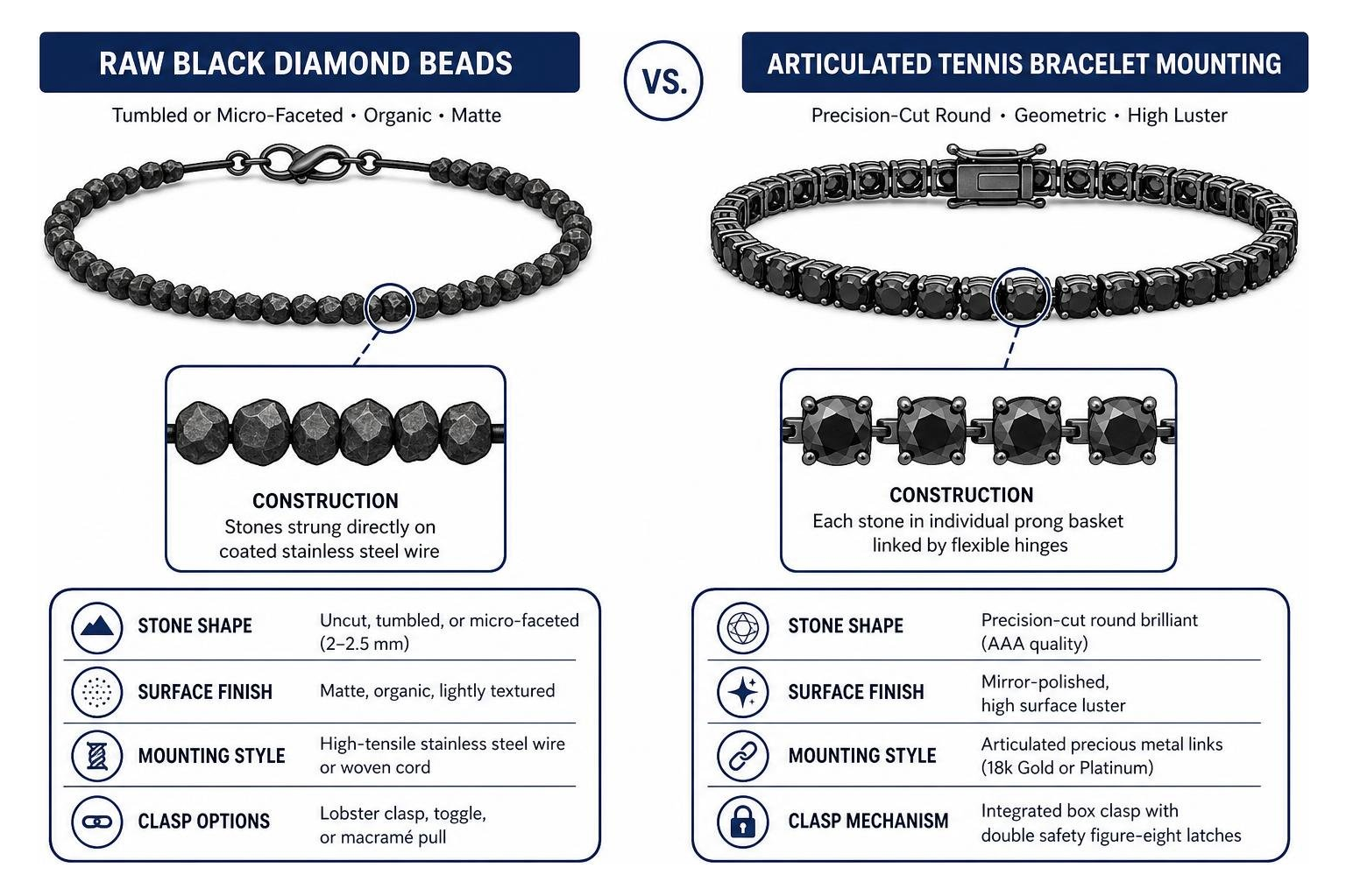
In contrast, a polished black diamond tennis bracelet relies on fully articulated cast mountings—typically forged in 18k gold or platinum. Each AAA-quality round black diamond is nested into an individual basket, secured by three or four precision-calibrated prongs, and joined to adjacent links via tiny, flexible hinges. This allows the bracelet to drape like silk around the wrist, preventing twisting while ensuring each stone remains perpetually face-up to catch overhead light.
Everyday Durability and Style Versatility
One of the great advantages of black diamonds is their remarkable adaptability. Because black is the ultimate neutral, it effortlessly bridges the gap between casual daywear and formal evening attire.
- Monochromatic Daywear: Paired with an all-black wardrobe, a dark cashmere sweater, or a crisp white linen button-down, black diamonds lend a sharp, contemporary edge.
- Metal Stacking: Pairing a black diamond bracelet alongside a classic white diamond line bracelet or an unadorned gold cuff creates high visual contrast. The dark stones ground the stack, keeping it balanced rather than overly ostentatious.
- Formal Sophistication: Under formal lighting, black diamonds project understated refinement. Instead of competing with a tuxedo or an evening gown, the deep midnight hue complements tailoring seamlessly.
In terms of surface resilience, black diamonds possess the same fundamental crystalline hardness as any natural diamond, rating at a 10 on the Mohs hardness scale. They resist surface scratching from everyday contact with desks, keyboards, and steering wheels, making them suitable companions for daily wear.
Craftsmanship, Metals, and Security Features
Fine diamond jewelry must balance beauty with everyday engineering. Because a tennis bracelet rests on a high-motion part of your body, its lifespan depends directly on the quality of its metallurgy, link flexibility, and closure mechanisms.
A high-grade black diamond bracelet utilizes substantial 18k gold or 925 sterling silver mountings. The mountings must be engineered with enough structural thickness to resist bending or warping over time. Premium designs feature calibrated prongs that hold each stone flush without uneven gaps, preventing the stones from snagging delicate fabrics such as silk or knits.
Security at the closure point is equally paramount. An heirloom-quality tennis bracelet features an integrated box clasp that clicks into place with a clear tactile snap, flanked by dual exterior figure-eight safety catches. This double safety lock system ensures that even if the main clasp catches against a coat cuff or bag strap, the bracelet remains securely anchored to your wrist.
Sizing and Fit for Your Custom Diamond Bracelet Black
Achieving the proper fit ensures both daily comfort and the long-term safety of the bracelet's links. A piece that is too tight places continuous tensile pressure on the internal hinge pins, while a bracelet that is excessively loose risks catching on door handles or sliding awkwardly down the hand.
Follow these steps to find your ideal wrist measurement:
- Measure the Base: Wrap a flexible tailor’s tape snugly around your wrist just above the wrist bone (towards the elbow). Alternatively, wrap a non-stretching piece of string around your wrist, mark the overlap point, and lay the string flat against a rigid ruler.
-
Select Your Desired Fit Allowance:
- Tight Fit (Add 0.25 to 0.5 inches / ~0.6 to 1.3 cm): The bracelet stays stationary against the skin with almost no shifting. Best for those who wear bracelets under structured shirt cuffs or dislike movement while working.
- Standard Fit (Add 0.75 to 1.0 inch / ~1.9 to 2.5 cm): The classic drape. The bracelet rests comfortably near the wrist bone and glides gently with movement without sliding onto the palm.
- Loose Fit (Add 1.25 inches / ~3.2 cm): A relaxed, bangle-style drape that moves freely up and down the lower forearm.
Most custom-crafted designs range from 14 cm (XXS) up to 23 cm (XXXL), allowing you to millimeter-calibrate your order to your exact anatomy.
Metal Choices and Structural Integrity
The metal you choose frames the personality of your black diamonds while providing the structural skeleton for the piece:
- 18k White Gold: Offers high-contrast brilliance. The cool, silvery sheen of white gold acts as a bright border around each dark gem, emphasizing stone symmetry and making individual round cuts stand out crisply.
- 18k Yellow Gold: Provides vintage warmth. The rich yellow hue softens the starkness of the black stones, delivering a regal contrast reminiscent of antique jewelry.
- 18k Rose Gold: Delivers a romantic aesthetic. The warm copper tones blend with black diamonds to create an artistic, fashion-forward palette.
- Black Rhodium Plating (Black Gold): Provides total blackout styling. By applying an electroplated layer of rare black rhodium over gold, the prongs visually disappear into the diamonds, creating an uninterrupted ribbon of dark luxury.
Regardless of your metal preference, look for articulated links with smooth interior finishes. High-polish internal surfaces prevent skin irritation and allow the bracelet to flex smoothly across the natural curves of the wrist.
The Meaning, Origin, and Sourcing of Black Diamonds
Black diamonds carry an intriguing history that sets them apart from virtually every other precious gemstone.
Ancient civilizations held all diamonds in deep reverence. The ancient Greeks referred to diamonds as Adamas, translating to "the unconquerable" or "indomitable"—a nod to their impenetrable hardness. Roman historians wrote that diamonds could dispel irrational fears and impart courage to those who carried them into battle.

Natural black diamonds—historically known as carbonados—possess a unique structural makeup. Unlike single-crystal white diamonds, natural black diamonds are polycrystalline aggregates. They are composed of millions of microscopic diamond crystals fused together alongside natural graphite, amorphous carbon, and magnetite inclusions. This dense matrix absorbs almost all light entering the crystal, transforming what would be transparency into an alluring, opaque darkness.
Authenticity and Sourcing Standards for a Diamond Bracelet Black
When shopping for black diamond fine jewelry, discerning provenance and treatment is an essential step in making an informed purchase:
- Natural vs. Treated Diamonds: Natural fancy black diamonds owe their color entirely to dense clusters of natural mineral inclusions formed deep within the Earth over billions of years. Other black diamonds begin as natural white diamonds with heavy internal inclusions that are subsequently subjected to high-pressure, high-temperature (HPHT) treatment or irradiation to convert their color to a deep black. Both are genuine diamonds, but natural untreated fancy stones command higher rarity value.
- Conflict-Free Guarantees: Responsible fine jewelers adhere strictly to the Kimberley Process Certification Scheme and maintain verified supply chains. This ensures that every rough and polished stone is sourced ethically from non-conflict zones under transparent labor conditions.
- Certificates of Authenticity: Any investment-grade piece should be accompanied by documentation detailing total carat weight, precious metal purity (e.g., 18k / 750 or 925), and stone quality indicators (such as AAA surface luster and cut consistency).
Pricing Factors, Shipping, and Care Expectations
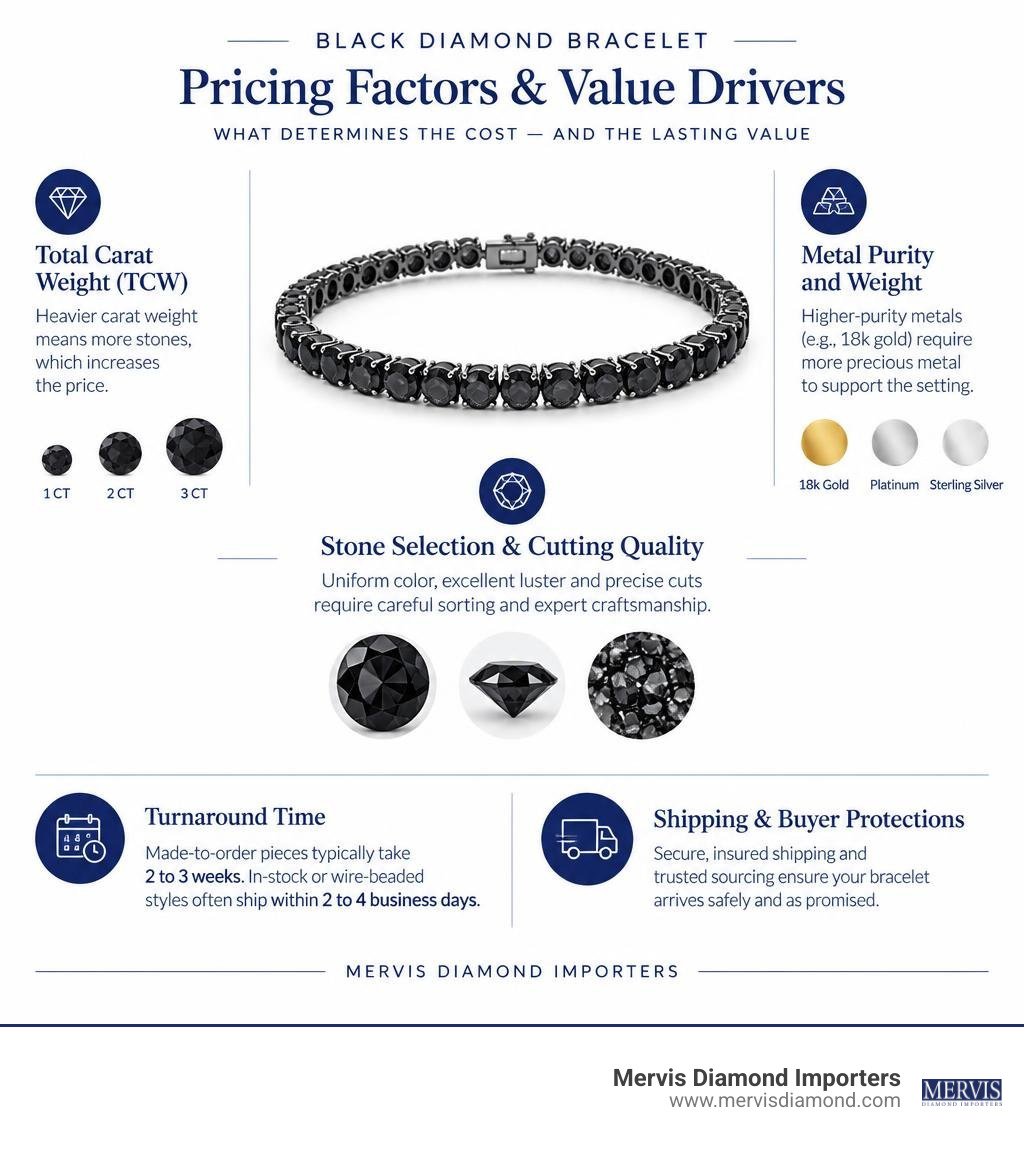
Several distinct craftsmanship factors dictate the total cost of a custom black diamond bracelet:
- Total Carat Weight (TCW): Because black diamonds are dense, a 3-carat black diamond tennis bracelet will feature slightly different millimeter dimensions than a 3-carat white diamond bracelet. As total stone weight increases, prices scale accordingly.
- Metal Purity and Weight: A solid 18k gold bracelet requires substantial precious metal mass to support individual prong mountings, whereas sterling silver or wire-strung rough beads require fewer metal resources.
- Stone Selection and Cutting Quality: Selecting dozens of uniformly matched AAA-grade round black diamonds requires sorting through large parcels of stones to match color uniformity, table proportions, and surface smoothness.
Turnaround, Shipping, and Buyer Protections
Because fine tennis bracelets are frequently made to order to match exact wrist dimensions, production timelines reflect the careful hand-setting of dozens of stones.
- Bespoke Craftsmanship Timeline: Made-to-order tennis bracelets typically require a production window of 2 to 3 weeks to cast, hand-set, polish, and calibrate. In-stock or wire-beaded pieces often ship more rapidly, typically within 2 to 4 business days.
- Insured Express Delivery: High-value fine jewelry is dispatched via secured, tracked courier services (such as UPS Express). Delivery within the United States generally takes 1 to 4 business days, while international routes take 1 to 5 business days.
- Guarantees and Warranties: Look for jewelers offering a 30-day satisfaction guarantee with returns on unworn pieces in original packaging, alongside a 1-year warranty that covers craftsmanship defects and includes a complimentary initial repair or sizing adjustment.
Caring for Your Black Diamond Bracelet
While black diamonds possess exceptional scratch resistance, their unique polycrystalline matrix makes them sensitive to sudden sharp impacts or harsh chemicals. Keep your bracelet radiant with these essential care practices:
- Clean with Gentle Suds: Soak the bracelet in warm water mixed with a few drops of mild dish soap for 10–15 minutes. Use a soft-bristled baby toothbrush to gently brush away accumulated skin oils, lotions, and dust from behind the stone baskets.
- Avoid Ultrasonic Cleaners: Because black diamonds contain natural graphite inclusions and micro-fractures, the high-frequency vibrations of commercial ultrasonic cleaners should be avoided. Steam cleaning or gentle hand-washing is safest.
- Store Separately: Store your bracelet in a fabric-lined jewelry box compartment or soft pouch. Because diamonds can scratch all other metals—and even other diamonds—keep pieces separated when not in use.
- Remove During Heavy Activities: Take off your bracelet before lifting weights at the gym, doing heavy gardening, or doing household chores involving abrasive bleach or chlorine.
Frequently Asked Questions About Black Diamond Bracelets
How should a black diamond tennis bracelet fit on the wrist?
A black diamond tennis bracelet should fit with enough ease to drape naturally against the wrist without sliding past the heel of the hand. The traditional guideline is the "one-finger rule": you should be able to slide one index finger comfortably between the fastened bracelet and your wrist. This provides adequate breathing room for natural wrist swelling throughout the day while ensuring the bracelet does not snag during movement.
Are black diamonds durable enough for daily wear?
Yes. Black diamonds share the same Mohs hardness rating of 10 as traditional colorless diamonds, making them superior to gemstones like emeralds, opals, or tanzanite for everyday wear. However, because their opacity comes from dense graphite inclusions, you should avoid subjecting them to direct, hard impacts against unyielding surfaces (like granite countertops or metal gym equipment) to prevent chipping along internal grain boundaries.
What factors determine the price of a black diamond bracelet?
The price of a black diamond bracelet is determined by the total carat weight of the stones, the quality grade of the gems (AAA stones with clean surface lusters command premium pricing), the metal alloy used in the setting (such as 18k solid gold versus sterling silver), and the complexity of the link articulation and clasp mechanism.
Conclusion
Choosing a black diamond bracelet offers an exciting departure from conventional jewelry styling. Whether you prefer the raw, organic strength of uncut diamond beads or the sharp, architectural elegance of an 18k gold articulated tennis bracelet, these dark gems make a confident statement of individuality, timeless resilience, and refined taste.
At Mervis Diamond Importers, our family has dedicated generations to helping clients select exceptional, hand-curated diamonds across our showrooms in Washington DC, Tysons, VA, and Rockville, MD. We take pride in delivering master-crafted fine jewelry, personalized guidance, and conflict-free sourcing tailored to your personal aesthetic.
Discover more about the timeless appeal of continuous diamond lines by exploring the rich origin of the tennis bracelet, or visit one of our private consultation suites to try on these distinctive designs in person.