

The Smart Buyer Guide to Lab Grown Diamond Authenticity
Verify Lab Grown Diamond Authenticity Before You Buy
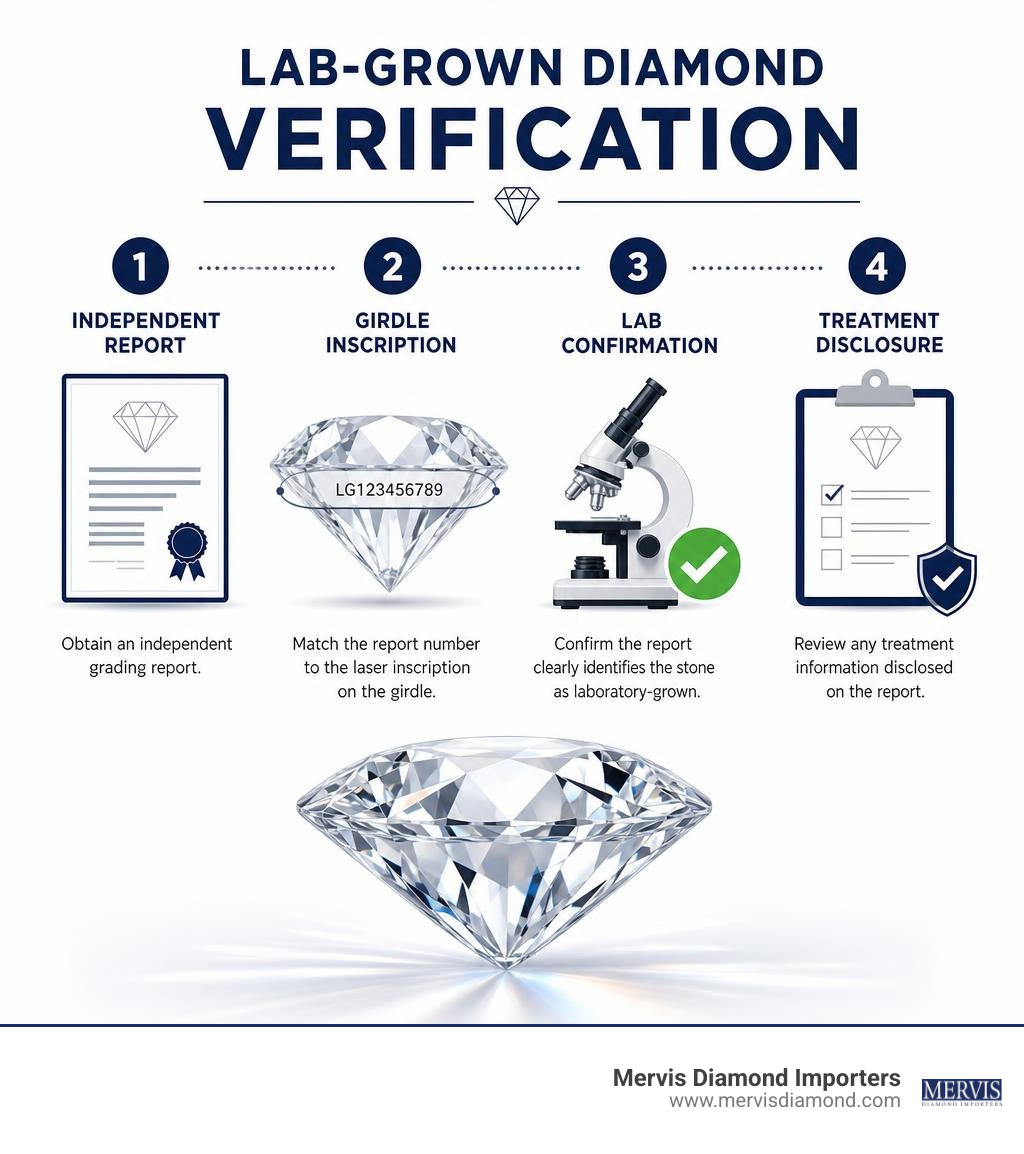
To verify lab grown diamond authenticity, ask for an independent grading report, match its report number to any laser inscription on the diamond's girdle, and confirm the report clearly identifies the stone as laboratory-grown. A qualified gemological laboratory can also distinguish a lab-grown diamond from a mined diamond or a simulant such as moissanite or cubic zirconia.
A real lab-grown diamond is still a diamond. It has the same carbon composition and crystal structure as a natural diamond, but it is grown through HPHT or CVD technology rather than formed underground. The key is not whether it is "real," but whether its origin, quality, and any treatments have been disclosed accurately.
For an engagement ring buyer, a reliable report and clear disclosure protect you from paying diamond prices for a simulant, receiving a stone with an inaccurate grade, or buying a treated diamond without knowing it.
I am Morris Mervis, and in this guide I will show you the practical checks that help you buy a lab-grown diamond with confidence.
How Laboratory-Grown Diamonds Are Created: HPHT vs. CVD
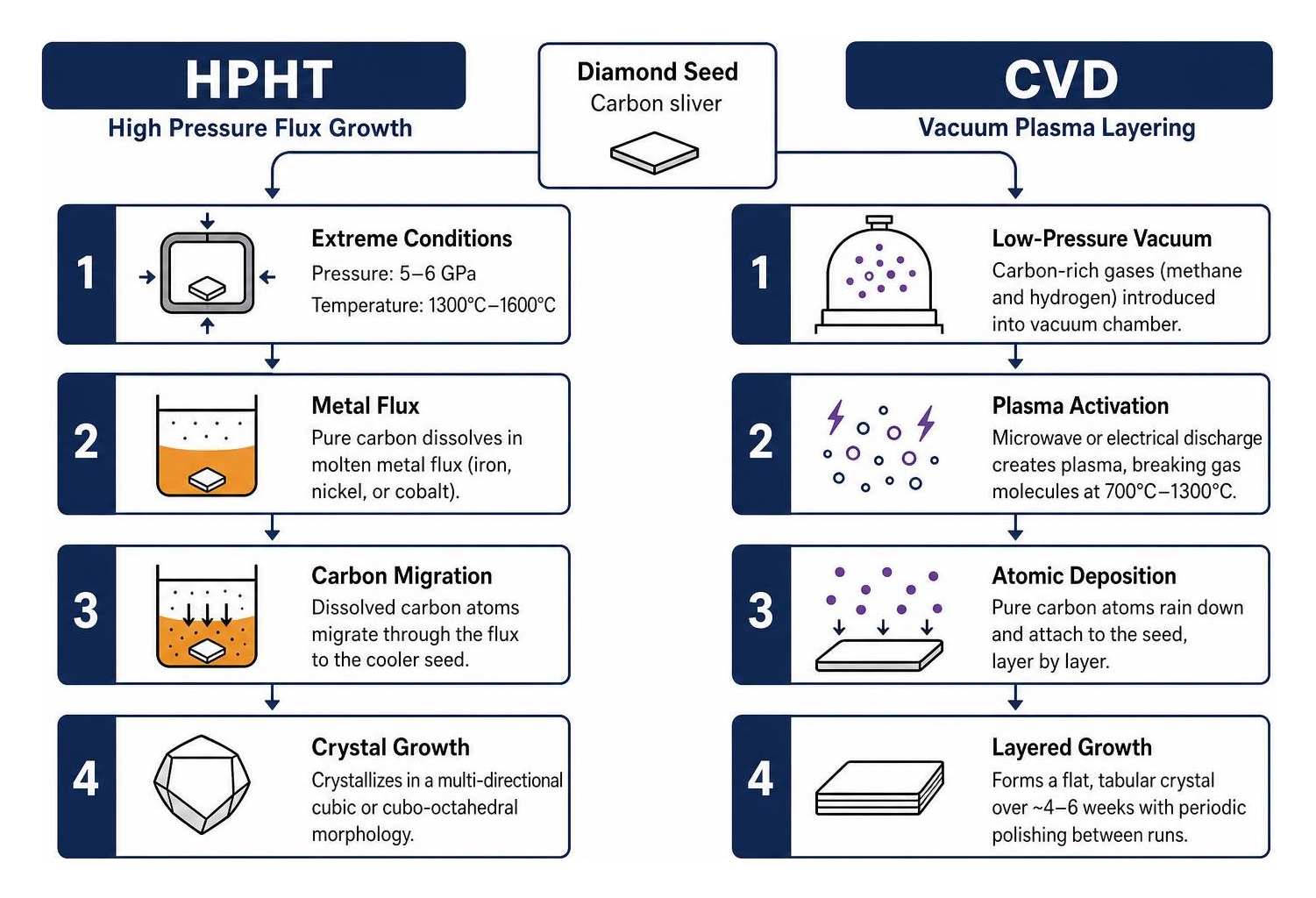
When we talk about creating diamonds in a laboratory, we are not talking about synthetic glass or imitation gemstones. We are discussing the authentic replication of geological conditions or advanced atomic deposition. Every laboratory-grown diamond begins with a sliver of carbon known as a diamond seed. From that microscopic foundation, master technicians utilize one of two advanced scientific methods to cultivate a full-sized rough crystal.
High-Pressure High-Temperature (HPHT) Growth
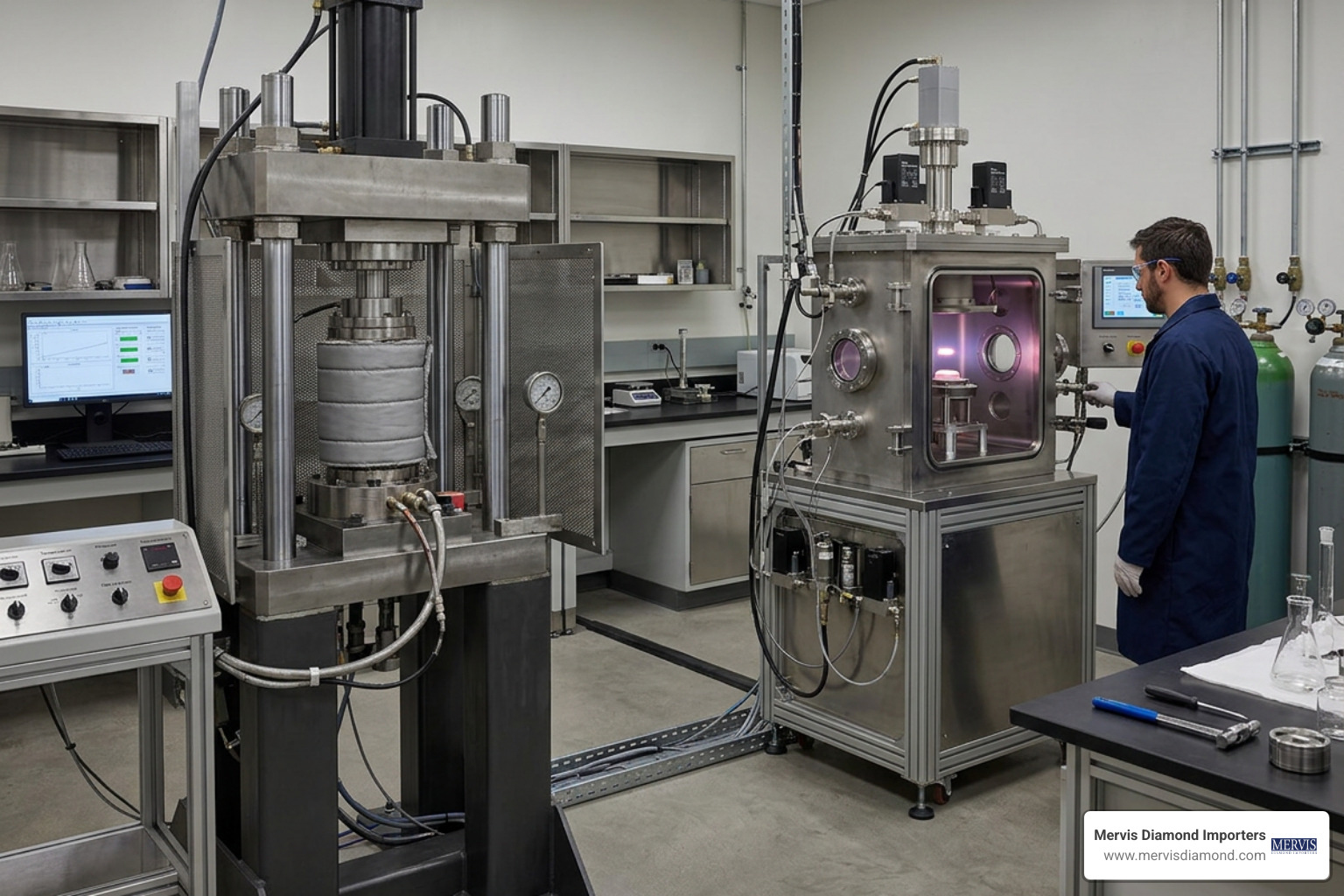
The High-Pressure High-Temperature (HPHT) method directly recreates the extreme underground environment of the Earth's mantle inside a specialized growth chamber.
To achieve this, the apparatus generates pressures between 5 and 6 GPa (gigapascals) alongside temperatures ranging from 1300°C to 1600°C. To put that staggering pressure into perspective, it is roughly equivalent to balancing an entire commercial jet airliner on the tip of your index finger!
Within this chamber, pure carbon dissolves into a molten metal flux (typically composed of iron, nickel, or cobalt). The dissolved carbon atoms then migrate through the flux toward the cooler diamond seed, crystallizing in a multi-directional cubic or cubo-octahedral morphology.
Modern HPHT technology has achieved remarkable milestones. HPHT crystals regularly exceed 100 carats in rough form—most notably highlighted by a historic 115.81-carat rough crystal grown in Ukraine.
Chemical Vapor Deposition (CVD) Growth
Chemical Vapor Deposition takes a different, physics-driven approach. Instead of crushing pressure, CVD relies on a low-pressure vacuum chamber where carbon-rich gases (such as methane mixed with hydrogen) are introduced.
A microwave beam or electrical discharge creates a high-energy plasma, breaking the molecular bonds of the hydrocarbon gas at temperatures between 700°C and 1300°C. The liberated pure carbon atoms then rain down onto flat diamond seed plates, settling layer by microscopic layer like crystalline snowfall.
A typical CVD growth cycle spans roughly 4 to 6 weeks. Because non-diamond carbon can develop during this run, technicians often pause the reaction to remove the crystals and polish away dark graphite layers before resuming growth. This layered growth results in a tabular, flat crystal habit that carries distinct microscopic signatures compared to HPHT or natural stones.
How Gemological Labs Confirm Lab Grown Diamond Authenticity
Because laboratory-grown diamonds share identical chemical, physical, and optical properties with natural diamonds, standard jewelry testing techniques cannot separate them. Instead, major gemological institutions rely on sophisticated analytical instrumentation and non-destructive screening protocols certified by programs like Assure Testing.
Optical and Inclusions Analysis
Under advanced gemological microscopes, our gemologists and laboratory scientists inspect internal characteristics:
- Metallic Flux Inclusions: HPHT stones often trap tiny remnants of the metal catalyst. Under magnification, these appear as opaque, highly reflective metallic pinpoints or rods that can even cause the diamond to react to strong magnets.
- Graphitic and Pinpoint Inclusions: CVD diamonds do not contain metal flux; instead, they may show dark graphitic inclusions, micro-pinpoint clouds, or tabular growth planes.
- Strain and Birefringence Patterns: Natural, HPHT, and CVD diamonds experience different strain environments during crystallization. Viewed between crossed polarizing filters, CVD diamonds display distinct "banded" or "mosaic" birefringence patterns, while HPHT diamonds typically show low strain due to uniform pressure.
Spectroscopy and Deep-UV Fluorescence
When optical magnification is not definitive, spectroscopic analysis reveals atomic-level defects:
- Photoluminescence (PL) Spectroscopy: PL analysis detects minute optical centers, such as silicon-vacancy ($Si-V$) defects, which are classic indicators of CVD growth chambers where quartz components are present.
- Fourier-Transform Infrared (FTIR) Spectroscopy: FTIR measures how a crystal absorbs infrared radiation, identifying diamond types (Type Ia, Ib, IIa, or IIb) based on nitrogen aggregation. Most lab-grown diamonds are Type IIa (free of measurable nitrogen), a rarity among mined diamonds where over 95% are Type Ia.
- Deep-UV Fluorescence Imaging: Under ultra-short wavelength UV light, HPHT diamonds display characteristic hourglass or cross-shaped fluorescence zoning. CVD diamonds exhibit distinct horizontal striations resembling stacked pancakes.
Evaluating Certification and Lab Grown Diamond Authenticity Reports
You should never purchase any diamond without an independent, verifiable grading report. A certification report acts as the stone’s immutable passport, detailing its origin, dimensional measurements, and 4Cs assessment.
At our showrooms, every stone we feature—from an exquisite Lab-Grown Diamond D-VS1 3.04 Report to a striking Lab-Grown Diamond D-VVS2 2.01 Rad Report—comes with full documentation from premier independent gemological laboratories.
Reading Certification Standards for Lab Grown Diamond Authenticity
The International Gemological Institute (IGI) pioneered the full grading of lab-grown diamonds in 2005 and remains a major grading entity worldwide. The Gemological Institute of America (GIA) provides complete 4Cs assessments through the digital Laboratory-Grown Diamond Report (LGDR) by GIA.
When reviewing a certificate, look for:
- Specific 4Cs Grades: Precise Color (D through Z), Clarity (Flawless to I3), Cut Grade, and exact Carat Weight.
- Growth Technique Disclosure: Clear specification of whether the diamond was grown via HPHT or CVD.
- Treatment Indications: An explicit notation stating whether the diamond has undergone post-growth color enhancement or is an as-grown specimen.
Laser Inscription Verification
To guarantee that a loose stone matches its paperwork, laboratories use micro-laser technology to engrave the girdle. GIA laser inscribes each stone with the words "Laboratory-Grown" alongside its unique report number. IGI utilizes its Laserscribe system to engrave the registry digits directly onto the outer edge.
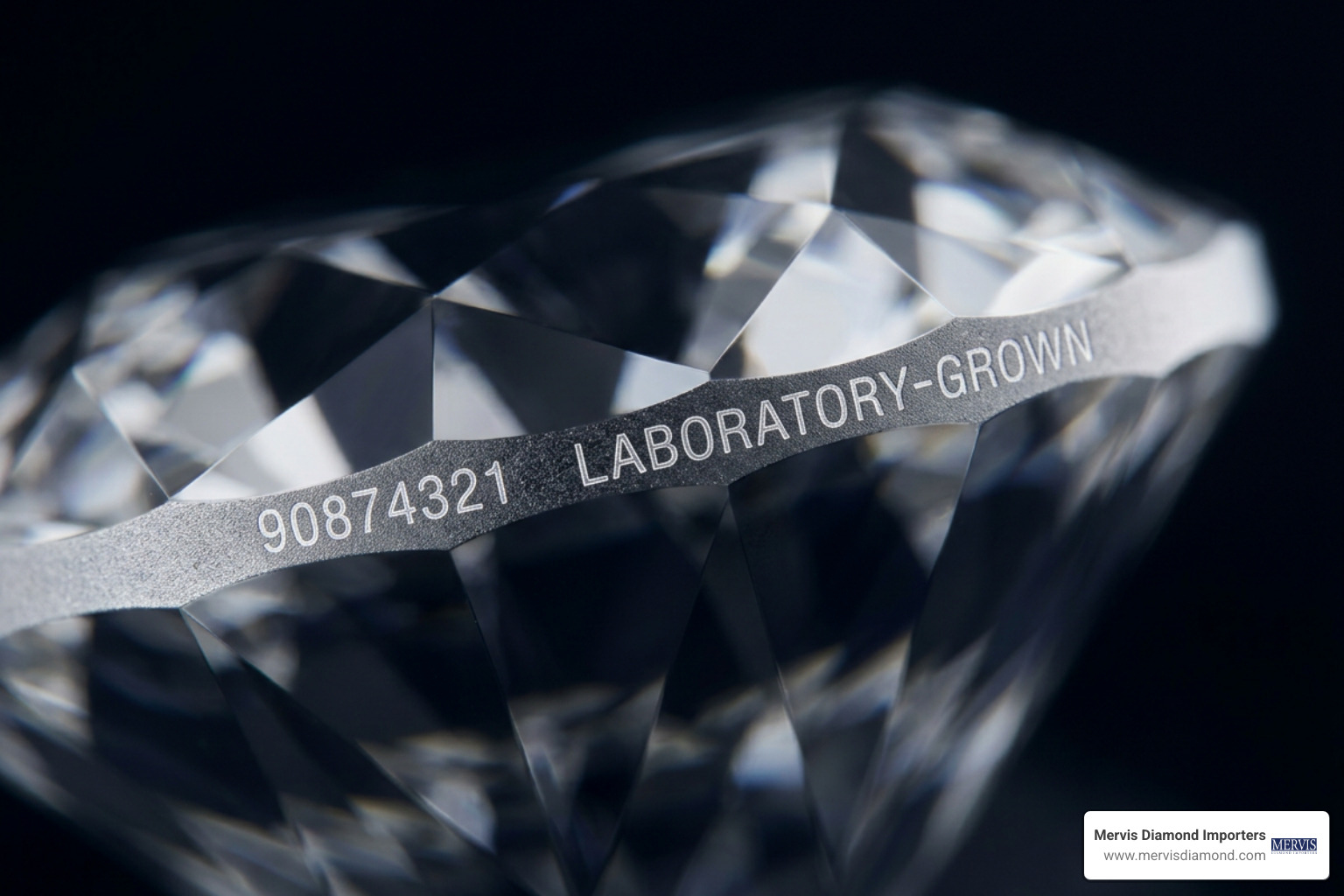
During your private consultation with us, we place the diamond under a microscope or 20x jeweler's loupe so you can match the micro-inscription to the physical certificate.
Legal Standards, Treatments, and Simulant Detection
Maintaining consumer trust requires clear legal boundaries between genuine diamonds (mined and lab-grown) and non-diamond simulants.
Industry Guidelines and Legal Disclosure for Lab Grown Diamond Authenticity
The Federal Trade Commission (FTC) in the United States and global trade bodies mandate that laboratory-grown diamonds must always be sold with unambiguous qualifiers such as "laboratory-grown," "laboratory-created," or "[manufacturer-name] created diamond."
The World Jewellery Confederation establishes international best practice in The Laboratory-Grown Diamond Guidelines. CIBJO mandates that loose laboratory-grown diamonds should be held in distinct, designated colored envelopes or boxes to eliminate stock mixing.
Furthermore, CIBJO guidelines recommend:
- Affixing an "LG" prefix before grading metrics (e.g., "LG D" for color or "LG VVS1" for clarity).
- Mandatory inclusion of Harmonized System customs codes on global commercial invoices (HS 7104.21 for unworked synthetic diamonds and HS 7104.91 for cut/worked synthetic diamonds).
- Prohibiting terms like "authentic," "genuine," or "real" when used in isolation without the mandatory "laboratory-grown" descriptor.
Post-Growth Treatments and Eco-Claims Verification
Some CVD-grown diamonds display a faint brownish or grayish tint due to crystal lattice strain. To correct this, growers often subject them to post-growth HPHT annealing (heating under pressure) to remove internal vacancies and bring the color grade to colorless (D-F). While standard and permanent, this post-growth treatment must be formally documented on all laboratory reports.
Similarly, when evaluating marketing terms like "carbon-neutral" or "eco-friendly," buyers should look for verified third-party sustainability audits rather than unsubstantiated greenwashing claims.
Step-by-Step Guide to Verifying Lab Diamond Authenticity Before Buying
Before purchasing your lab-grown diamond, follow this systematic verification checklist:
- Demand an Independent Report: Insist on an unedited report from IGI or GIA.
- Match the Girdle Inscription: Check the girdle with a 10x or 20x loupe to ensure the serial number matches the certificate.
- Inspect the Physical Properties: Confirm you are buying pure crystalline carbon, not a simulant.
| Characteristic | Authentic Lab-Grown Diamond | Natural Mined Diamond | Moissanite (Simulant) | Cubic Zirconia (Simulant) |
|---|---|---|---|---|
| Chemical Composition | Pure Carbon ($C$) | Pure Carbon ($C$) | Silicon Carbide ($SiC$) | Zirconium Dioxide ($ZrO_2$) |
| Mohs Hardness | 10 | 10 | 9.25 | 8.5 |
| Refractive Index | 2.417 (Singly Refractive) | 2.417 (Singly Refractive) | 2.65–2.69 (Doubly Refractive) | 2.15–2.18 (Singly Refractive) |
| Thermal Conductivity | Extremely High | Extremely High | High | Very Low (Insulator) |
| Standard Certificate | IGI / GIA Lab Report | GIA / IGI Diamond Dossier | Authenticity Card | None / Retailer Card |
If you are exploring stunning fancy cuts, you can view our verified inventory specimens, such as this Lab-Grown Diamond E-VS1 2.53 PEA Report.
Whether you are shopping for Lab-Grown Diamonds in Alexandria VA, visiting our flagship galleries in Tysons, VA, Rockville, MD, or Washington, DC, we ensure complete provenance on every stone. We also help buyers understand long-term market factors, addressing practical questions like Do Lab-Grown Diamonds Have Resale Value? with straightforward transparency.
Frequently Asked Questions About Lab Diamond Authenticity
Can standard handheld diamond testers distinguish lab diamonds from natural diamonds?
No. Standard handheld pen testers measure thermal and electrical conductivity. Because authentic lab-grown diamonds possess the identical chemical structure and thermal conductivity as mined diamonds, they test as "Diamond" on basic pen testers. Separating lab from mined requires dedicated spectroscopic screening devices that evaluate UV transmission and crystal strain.
How does an authentic lab-grown diamond differ from moissanite or cubic zirconia?
Moissanite is silicon carbide ($SiC$), and cubic zirconia is zirconium dioxide ($ZrO_2$). Neither is a diamond. Moissanite is doubly refractive (giving it a disco-ball rainbow flash and visible facet doubling) and softer (9.25 on the Mohs scale). Cubic zirconia is significantly heavier, softer (8.5 Mohs), and scratches easily over time. Authentic lab diamonds are pure carbon, single-refractive, and hold a perfect 10 on the Mohs hardness scale.
What wording must appear on an authentic lab diamond grading report?
An authentic grading report will explicitly state "Laboratory-Grown Diamond" or "Laboratory-Created Diamond" in the primary header. It will list the growth method (HPHT or CVD), indicate whether post-growth treatments were applied, and provide a numbered record that corresponds to the laser inscription on the stone.
Conclusion
A lab-grown diamond offers the brilliance, beauty, and durability of crystalline carbon. True authenticity comes from complete transparency, rigorous third-party grading, and buying from trusted gemological experts who stand behind every stone they offer.
At Mervis Diamond Importers, we take pride in helping you select the perfect center stone across our Washington DC, Tysons, VA, and Rockville, MD showrooms. Whether you are deciding between mined vs. lab-grown diamonds or searching for a masterfully cut laboratory diamond, our team is here to provide an educational, pressure-free experience. Schedule an appointment with us today to view our verified diamond collection in person.