

Smart Sparkle: A Savvy Shopper's Guide to Lab Grown Diamond Studs
Are Lab Grown Diamond Studs a Smart Buy?
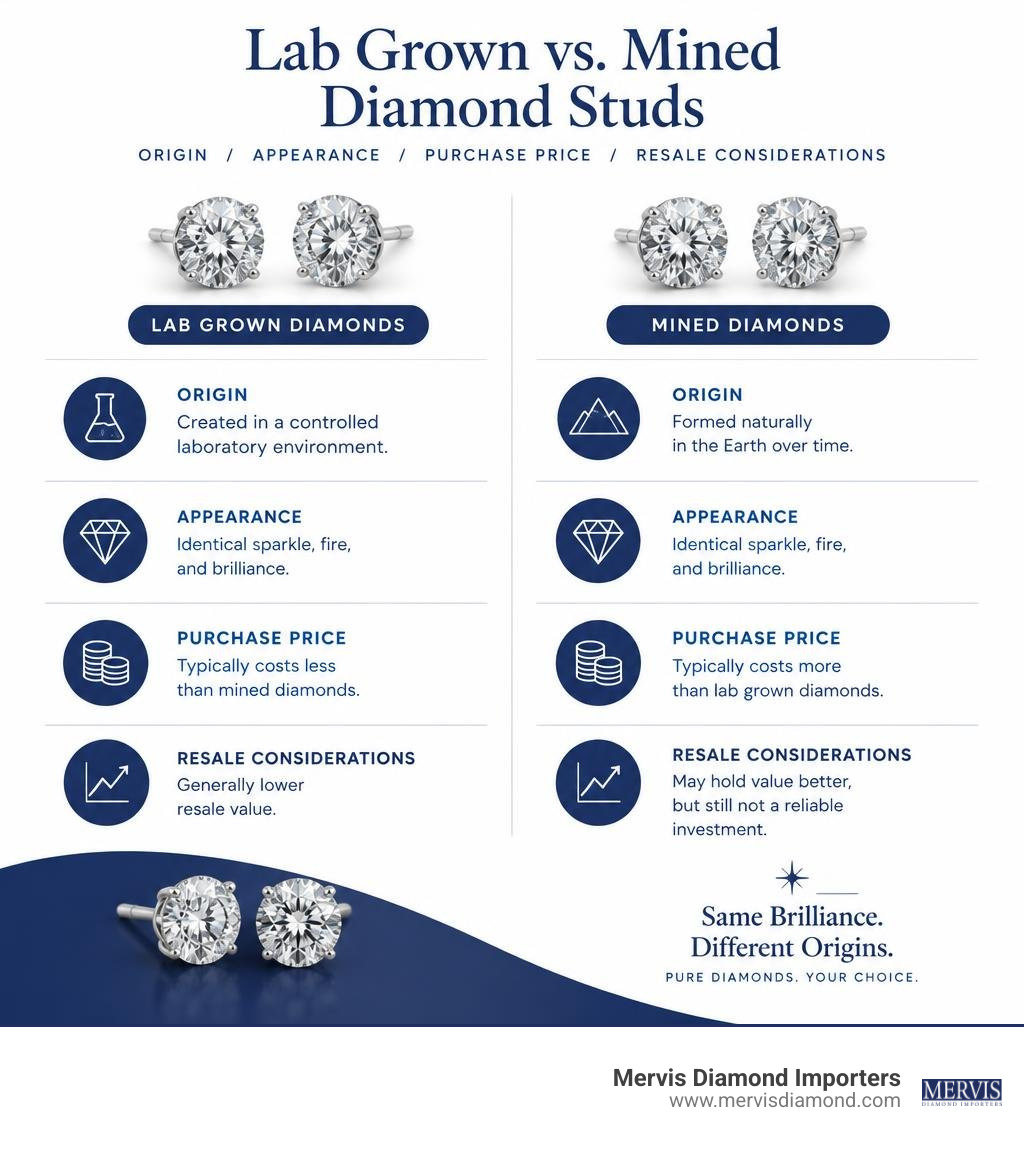
Yes, if you want larger diamonds for your budget. Lab grown diamond studs are real diamonds, with the same sparkle and hardness as mined ones. When comparing pairs, check the total carat weight, cut quality, an independent grading report, and how securely the stones are set. A 2-carat total-weight pair has roughly one carat in each ear, not two.
The main trade-off is value after purchase. Lab grown studs usually cost less than comparable mined studs, but neither is a reliable investment, and lab grown diamonds may have a lower resale value. Buy the pair you love wearing, not the one you hope to sell later.
I'm Morris Mervis, and I'll walk you through the quality checks and price comparisons that make choosing a pair easier. For a broader look at how these stones are created and graded, the synthetic diamond entry on Wikipedia explains the scientific processes behind laboratory growth.
Why Choose a Lab Grown Diamond Stud Pair Over Mined Diamonds?
When you look at diamond stud earrings across a dinner table or in the mirror, your eye perceives one thing: pure light performance. Lab grown diamonds share the exact chemical composition, crystal lattice structure, and physical properties of mined diamonds. They are not cubic zirconia or moissanite; they consist entirely of pure crystallized carbon.
Because they share identical optical properties, lab grown diamonds offer the exact same refractive index (2.42) and dispersion of light (fire). They also register a solid 10 on the Mohs hardness scale, making them the hardest known mineral on Earth.
Beyond optical performance, choosing a lab grown diamond stud pair offers peace of mind regarding origin. Modern buyers value transparent sourcing and sustainable luxury. While mined diamonds require massive earth displacement, lab diamonds are cultivated in specialized laboratories using advanced technological processes like Chemical Vapor Deposition (CVD) or High Pressure High Temperature (HPHT).
The most striking difference between the two origins remains the price tag. By eliminating intensive mining logistics, laboratory diamonds allow you to maximize your budget without sacrificing size or sparkle.
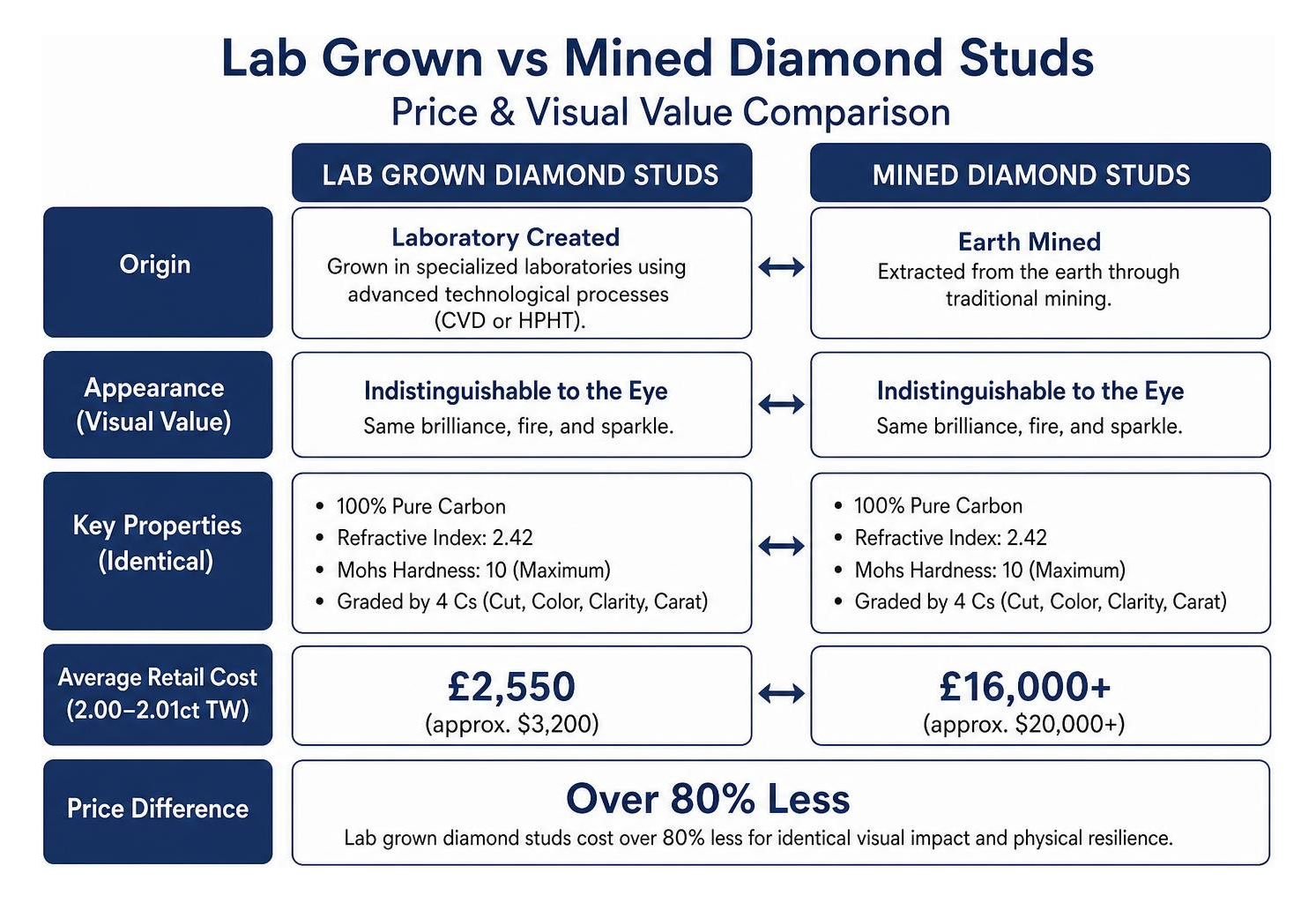
| Feature | Lab Grown Diamond Studs (2.00–2.01ct TW) | Mined Diamond Studs (2.00–2.01ct TW) |
|---|---|---|
| Chemical Composition | 100% Pure Carbon | 100% Pure Carbon |
| Mohs Hardness | 10 (Maximum Durability) | 10 (Maximum Durability) |
| Refractive Index | 2.42 | 2.42 |
| Grading Standards | 4 Cs (Cut, Color, Clarity, Carat) | 4 Cs (Cut, Color, Clarity, Carat) |
| Average Retail Cost | £2,550 (approx. $3,200) | £16,000+ (approx. $20,000+) |
| Primary Advantage | Maximum size & quality for budget | Traditional provenance & historical rarity |
Price Breakdown: 2ct Diamond Studs Compared
To understand the price advantage, consider a classic pair of round brilliant earrings with a 2.01ct total weight (roughly 1.00ct per ear) set in solid 18ct white gold.
In today's jewelry landscape, a stunning 2.01ct lab grown diamond stud set in 18ct white gold retails for approximately £2,550. In contrast, sourcing two loose 1.00ct mined diamonds with identical colour (F–G) and clarity (VS) grades can easily push the price past £16,000.
That represents an over 80% price difference for identical visual impact and physical resilience. This cost advantage allows you to invest in higher cut grades, larger stones, or premium metal settings without stretching your finances.
Authenticity and Performance
A common misconception is that lab diamonds perform differently over time. Because lab grown diamonds exhibit the same thermal conductivity and atomic structure as earth-mined gems, their brilliance is permanent.
They will never turn cloudy, change color, or lose their fire. Whether you wear them daily to the office or save them for black-tie galas, their performance remains steadfast for generations.
Key Factors to Consider When Buying Diamond Studs
Choosing diamond studs involves unique considerations compared to buying an engagement ring. Since earrings sit on moving earlobes and are viewed from various angles, certain factors take priority.
Evaluating Quality: The 4 Cs of a Lab Grown Diamond Stud
When selecting your pair, balance the traditional 4 Cs to get the most dazzling look:
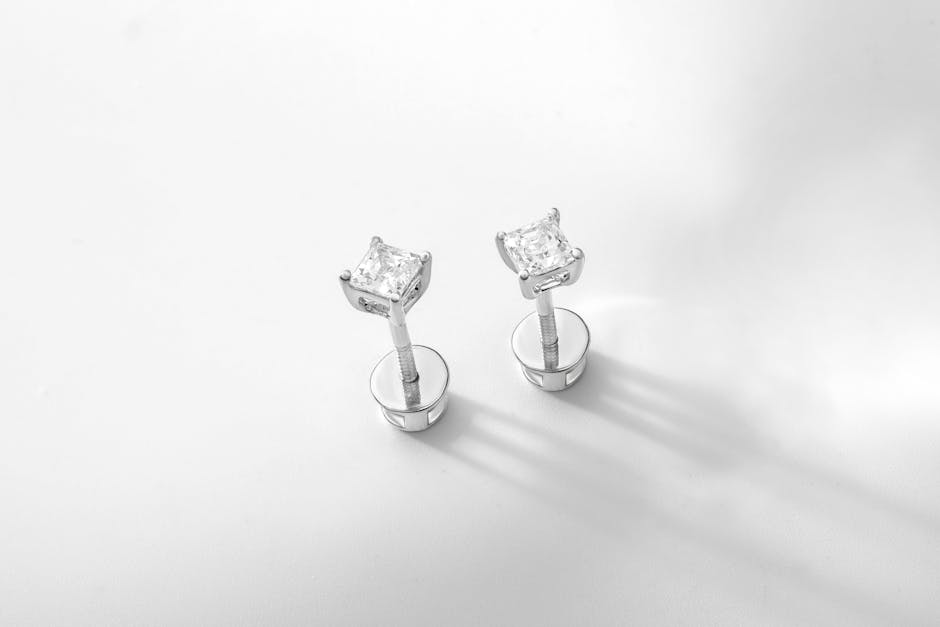
- Cut (The Most Critical C): Cut dictates how light travels through the stone and reflects back to the eye. We recommend prioritizing an Ideal or Excellent cut. A well-cut diamond masks minor inclusions and makes the stone appear larger and brighter. Round brilliant cuts remain the timeless gold standard for light return, though princess, cushion, and emerald cuts offer distinctive geometric charm.
- Color: For studs set in white gold or platinum, stones in the Near-Colorless range (F, G, or H) appear bright white against the skin. If you prefer yellow or rose gold, you can comfortably select I or J color grades, as the warm metal complements the stone.
- Clarity: Unlike rings held close to the face, earrings are viewed from conversational distance. An eye-clean VS2 or SI1 clarity grade offers pristine visual appeal without the premium price of Flawless grades. Inclusions at this level are invisible to the naked eye.
- Carat Weight (Total Weight Distribution): Always check whether the listing refers to individual stone weight or Total Carat Weight (TCW/TW). A 2.00ct TW pair consists of two 1.00ct diamonds. Ensure both stones match closely in millimeter diameter and table proportions for a balanced look.
Popular Settings and Metals for Your Lab Grown Diamond Stud
The setting secures the diamond while showcasing its shape:
- 4-Claw (4-Prong) Setting: The classic square-basket silhouette. It holds the diamond securely with minimal metal coverage, maximizing light entry from all sides.
- 3-Prong Martini Setting: Tapered like a martini glass, this style sits flush against the earlobe, minimizing drooping and keeping the diamond upright.
- Bezel Setting: A sleek rim of metal encircles the diamond's perimeter. It offers maximum protection against snags and provides a modern, architectural aesthetic.
- Earring Back Options: To protect your investment, pair your studs with the right backing mechanism. Standard friction push backs are convenient for quick wear, while threaded screw backs offer enhanced security. For premium diamonds, locking La Pousette (protector) backs provide positive-locking security with effortless push-button release.
For metals, solid 18ct white gold and platinum provide a classic, silvery backdrop that enhances diamond whiteness. Warm 14ct or 18ct yellow gold delivers rich vintage contrast.
Certification and Grading Reports
Never purchase fine diamond jewelry without independent gemological verification. Reputable lab grown diamonds are certified by respected laboratories such as the International Gemological Institute (IGI) or the Gemological Institute of America (GIA).
These reports detail precise measurements, color, clarity, and cut proportions. Additionally, laboratories laser-inscribe a microscopic report number onto the diamond's girdle, confirming its authenticity and origin.
Care, Maintenance, and Resale Reality
Keeping your diamond studs brilliant is straightforward. Lotions, hair products, and natural skin oils form a thin film over diamonds, reducing their refractive ability.

- Routine Home Cleaning: Soak your studs in warm water mixed with mild dish soap for 15 minutes. Gently brush around the prongs and behind the setting using a soft-bristled baby toothbrush, rinse thoroughly under lukewarm water, and pat dry with a lint-free microfiber cloth.
- Ultrasonic Cleaners: Periodic ultrasonic cleaning at home or at your jeweler is completely safe for untreated lab grown diamonds set in solid gold or platinum, effectively shaking loose trapped debris behind the basket.
- Professional Checkups: Bring your earrings to a professional jeweler once a year to verify prong tension, setting symmetry, and metal integrity. Regular maintenance ensures you never lose a stone due to a worn claw.
- Resale Value: While mined diamonds historically carry higher trade-in retention, diamond jewelry should rarely be purchased as a speculative financial asset. The true value of a lab grown stud lies in its everyday wearability, exceptional craftsmanship, and the immediate savings achieved at checkout.
Frequently Asked Questions About Lab Grown Diamond Earrings
Can a jeweler tell if diamond studs are lab grown?
A jeweler cannot distinguish a lab grown diamond from a mined diamond using standard magnification or basic thermal diamond pens. Because both share identical physical, chemical, and optical profiles, specialized gemological spectrometers are required to analyze growth patterns and nitrogen aggregation. Gemologists also look for microscopic laser inscriptions on the girdle corresponding to the diamond's grading report.
Do lab grown diamond studs lose their sparkle over time?
No. Because lab grown diamonds possess an identical cubic carbon lattice to mined diamonds, they do not degrade, fade, or become cloudy over time. Any loss of brilliance is caused by surface residue like soap, dust, or skin oils, which easily washes away with gentle cleaning.
Is a 4-claw setting secure for daily wear?
Yes. The 4-claw setting is an industry standard because it balances structural security with optical performance. The four prongs grasp the diamond at equidistant points along the girdle, keeping the stone locked in place while allowing light to enter freely from the sides.
Conclusion
Choosing fine jewelry is an intimate decision that balances beauty, craftsmanship, and personal values. Lab grown diamond studs deliver brilliance, durable daily wear, and accessible pricing.
If you are exploring your diamond options, our expert team at Mervis Diamond Importers provides pressure-free guidance to help you select stones that match your style. Read our detailed mined vs lab grown diamonds guide to find the perfect pair for your collection.