

Everything to Know Before Buying a 1 Carat Oval Shaped Diamond Ring
Understanding Diamond Carat Weight and History
When shopping for a 1 carat oval shaped diamond ring, focus on a length-to-width ratio between 1.33 and 1.50, a depth percentage of 58% to 63%, and a table percentage of 53% to 63%. An oval cut typically appears 8% to 10% larger than a round brilliant of the same carat weight due to its elongated shape. For the best value, choose an eye-clean SI1 or VS2 clarity grade and a near-colorless F, G, or H color grade. These specifications ensure a brilliant, well-proportioned stone that maximizes visual size without unnecessary premium.
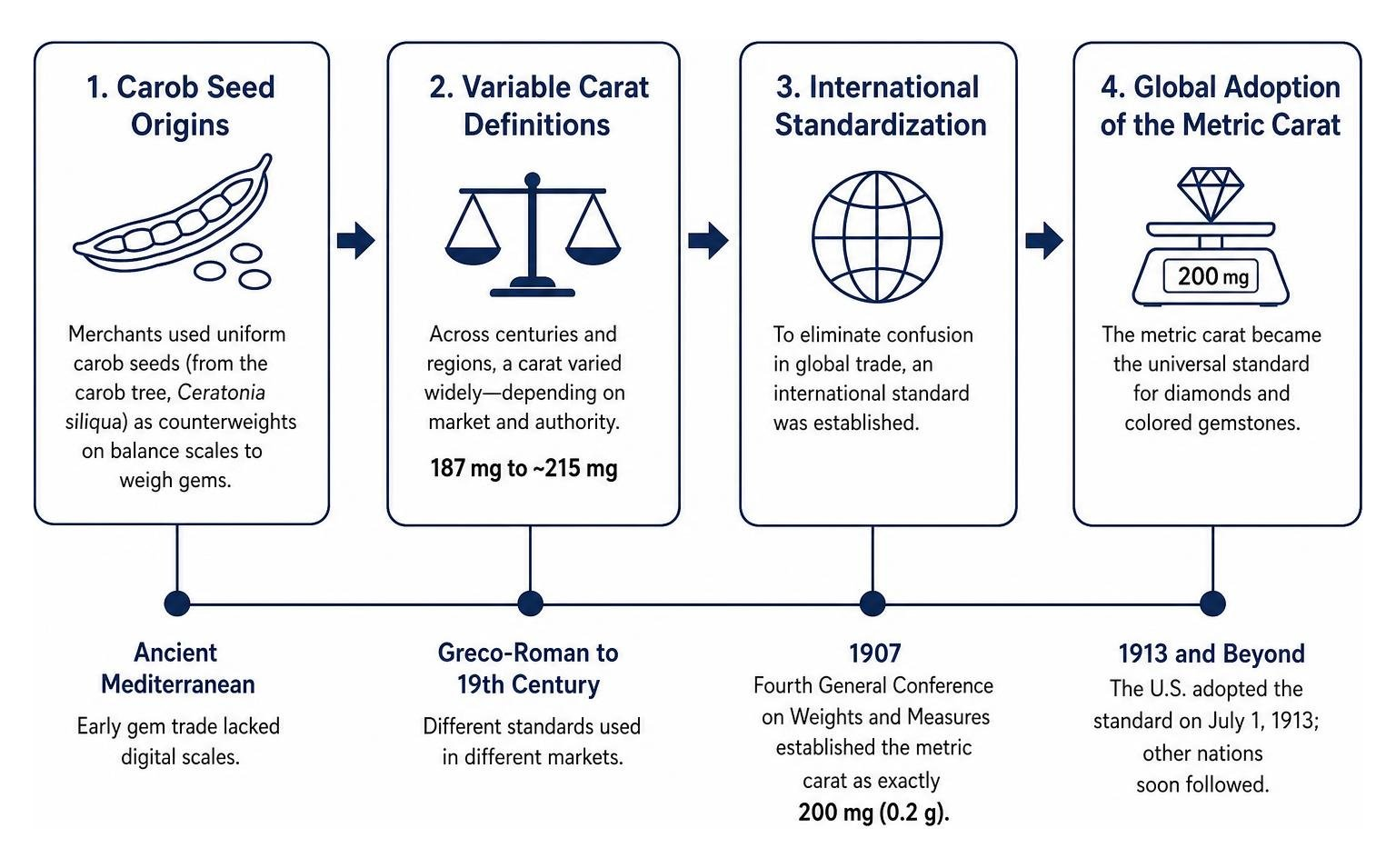
Carat weight refers strictly to mass, not geometric dimensions. The word itself traces back to ancient Mediterranean trade, where merchants used the uniform seeds of the carob tree (Ceratonia siliqua) as counterweights on balance scales. Because early gem trading lacked digital scales, these seeds provided a reliable baseline for weighing valuable gems.
Across centuries and regions, the exact definition of a carat shifted considerably. Depending on whether you traded gems in Greco-Roman markets or through the 19th-century UK Board of Trade, a carat could weigh anywhere from 187 milligrams to roughly 215 milligrams. To eliminate confusion across global markets, international trade bodies standardized the measurement. In 1907, the Fourth General Conference on Weights and Measures officially established the metric carat as exactly 200 milligrams (0.2 grams). The United States formally adopted this standard on July 1, 1913, and other nations soon followed. (While modern marketing agencies like Carat Global share the name, in gemology, the term remains strictly tied to this metric weight.)
To put that in perspective, a 1.00-carat diamond weighs about the same as a standard small paperclip. In gemological grading, each carat is divided into 100 points, meaning a 0.50-carat stone is 50 points, and a 1.08-carat diamond is described as "one point oh eight carats." When planning your purchase and determining how many carats an engagement ring should be, understanding this point system helps you evaluate subtle weight differences that influence price.
Carat Weight vs. Karat Purity
A frequent point of confusion is the distinction between carat (ct) and karat (k or kt). While they sound identical, they describe two entirely different properties of fine jewelry:
- Carat (ct): A measure of weight for diamonds and colored gemstones (1 ct = 200 mg).
- Karat (k): A measure of purity for gold alloys, based on a 24-part scale.
Pure gold is 24 karats, but it is too soft for everyday engagement ring wear. Jewelers alloy gold with metals like copper, silver, zinc, or nickel to increase durability. For example:
- 18K Gold: 18 parts pure gold and 6 parts alloy (75% pure gold).
- 14K Gold: 14 parts pure gold and 10 parts alloy (58.3% pure gold), offering excellent scratch resistance.
- Platinum: A naturally white, dense metal measured by purity percentages (typically 90% to 95% pure) rather than karats.
Knowing the difference ensures that when you discuss setting metals and diamond weights with an expert, you understand precisely how each component contributes to quality and price.
Why a 1 Carat Oval Shaped Diamond Ring Looks Larger Than Other Cuts
Carat weight tells you how heavy a diamond is, not how wide it looks on your finger. Different diamond shapes distribute their mass in different ways. Deeply cut stones hide significant weight in their base (pavilion), while elongated cuts spread more weight across the visible upper surface (table).
An oval diamond features an elongated shape with shallow proportions relative to its surface area. When evaluating choices while finding the best diamond cut for an engagement ring, many buyers favor ovals because they deliver roughly 8% to 10% more visible surface area than a round brilliant of the exact same carat weight. Furthermore, the vertical orientation of an oval creates a slenderizing optical effect on the finger.
| Diamond Shape (1.00 Carat) | Typical Face-Up Dimensions | Approximate Surface Area | Visual Spread Perception |
|---|---|---|---|
| Oval Cut | 7.70 mm x 5.50 mm | ~33.2 mm² | Significantly Larger |
| Round Brilliant | 6.45 mm x 6.45 mm | ~32.7 mm² | Baseline Standard |
| Princess Cut | 5.50 mm x 5.50 mm | ~30.2 mm² | Compact / Deep |
| Cushion Cut | 5.80 mm x 5.80 mm | ~30.5 mm² | Compact / Soft |
| Emerald Cut | 6.80 mm x 4.80 mm | ~32.6 mm² | Elongated / Moderate |
Key Factors When Evaluating a 1 Carat Oval Shaped Diamond Ring
Unlike round brilliant diamonds, which receive standardized cut grades (such as Excellent or Ideal) from major grading laboratories like the GIA, fancy shapes such as ovals do not receive an overall cut grade on grading certificates. Instead, reports evaluate Polish and Symmetry, leaving the assessment of proportions and light performance to visual examination. (Just as structural standards exist in data assessment via resources like OVAL, diamonds require structured criteria to evaluate light return accurately.)
When evaluating a center stone, such as a certified 1.00 Carat D SI1 Oval Diamond, focus on these three core structural elements:
- Length-to-Width Ratio (L/W): This ratio determines whether an oval appears wide and chubby or sleek and elongated. The classic range is between 1.33 and 1.50. Ratios around 1.35 feel slightly softer and rounder, while ratios near 1.45 to 1.50 provide a distinctly elongated profile.
- Table and Depth Percentages: Look for a depth percentage between 58% and 63% and a table percentage between 53% and 63%. Diamonds cut too deep look smaller than their weight suggests, while diamonds cut too shallow suffer from light leakage.
- The Bow-Tie Effect: Every oval diamond features a natural pattern of darker facet reflections across its center width that resembles a bow tie. A subtle bow tie adds contrast and brilliance. However, an overly dark or prominent bow tie blocks light return and distracts from the stone's sparkle.
Color and Clarity Recommendations for Oval Diamonds
Because oval diamonds share the modified brilliant facet pattern of round diamonds, their many small facets disperse light and mask minor imperfections well. However, their larger table and elongated ends can concentrate body color slightly more than a round brilliant stone.
- Color: If you are setting your diamond in white gold or platinum, stones in the F, G, or H range provide an icy, bright white appearance without the price premium of D or E flawless color grades. If you prefer yellow gold or rose gold bands, an I or J color diamond blends naturally with the warm metal tones.
- Clarity: For maximum value, target VS2 or eye-clean SI1 clarity grades. An eye-clean stone has no inclusions visible to the naked eye at standard viewing distance (roughly 8 to 12 inches). Always verify that inclusions are located toward the outer edges (girdle) rather than directly under the center table facet.
Pricing and Budgeting for a 1 Carat Oval Shaped Diamond Ring
Diamond pricing does not climb in a straight line with carat weight; it jumps at key milestone weights (0.50 ct, 0.75 ct, 1.00 ct, 1.50 ct, 2.00 ct). Diamond cutters aim to hit the 1.00-carat mark whenever possible, which creates high demand and a pricing step at that threshold.
A natural 1 carat oval diamond generally ranges from $3,500 to $8,500+ depending on cut balance, color, and clarity. Lab-grown diamonds offer identical physical and optical properties at a lower price point, generally ranging from $800 to $2,000 for a 1 carat oval stone.
| Quality Tier | Color Grade | Clarity Grade | Typical Cut Proportions | Estimated Natural Price Range |
|---|---|---|---|---|
| Collector / Premium | D – E | VVS1 – VVS2 | Excellent Symmetry / Optimal Depth | $6,500 – $9,000+ |
| Balanced Sweet Spot | F – G | VS1 – VS2 | Excellent Polish / Minimal Bow-Tie | $4,200 – $6,500 |
| Value Conscious | H – I | SI1 (Eye-Clean) | Good–Very Good Symmetry | $3,200 – $4,400 |
Popular Ring Settings for 1 Carat Oval Diamonds
Choosing the right setting complements the elongated shape of an oval diamond while protecting its curved edges. To explore your options in detail, review our guide to diamond engagement ring settings.
Solitaire and Cigar Band Settings
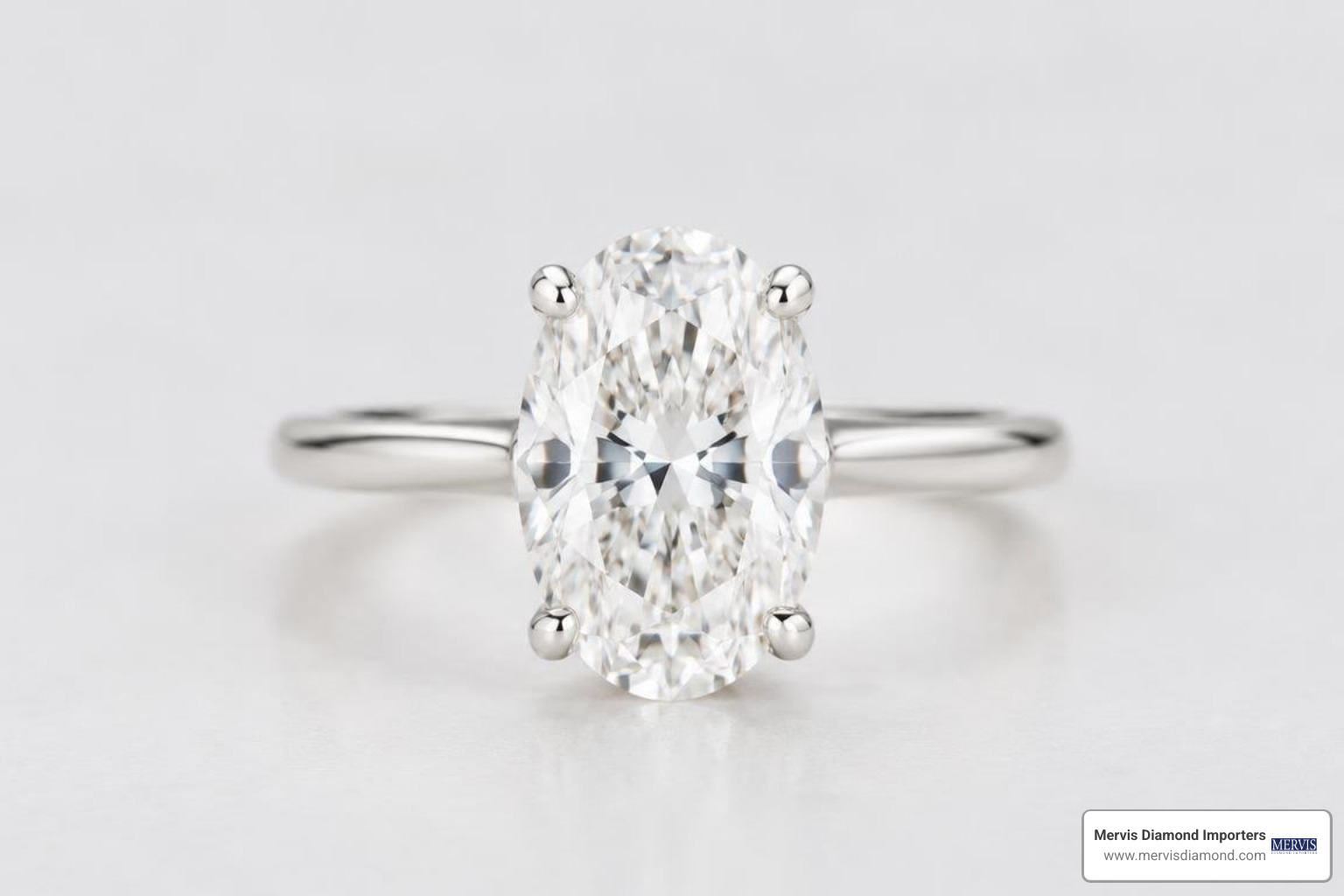
A solitaire design keeps attention on the center stone. Because an oval is elongated, standard four-prong mounts place prongs at the corners of the curve, while six-prong settings offer extra security against daily knocks.
- Classic Solitaire: A delicate, tapering band emphasizes the diamond's size and lets maximum light enter from all angles, as seen in our Oval Solitaire Engagement Ring.
- Cigar Band: For a modern look, wide metal bands create striking contrast with a center gem. The Oval Solitaire Cigar Band Engagement Ring pairs clean lines with substantial metal presence.
Halo and Multi-Stone Designs
If you want extra finger coverage or vintage-inspired detail, halo and three-stone settings frame the center diamond effectively:
- Vintage Halo: A perimeter of pavé diamonds accents the oval's curves, creating the visual impression of a much larger stone. The Vintage-Inspired Oval Halo Diamond Engagement Ring highlights these intricate details.
- Double Halo: For maximum sparkle, designs like the 14K White Gold Oval Double Halo Diamond Engagement Ring frame the oval center stone with two rows of micro-pavé gems.
- Three-Stone Setting: Flanking the center oval with pear, round, or tapered baguette side stones creates balanced horizontal proportions. The Oval 3-Stone Engagement Ring provides classic balance across the hand.
- For broader styling inspiration and carat comparisons, read our comprehensive Oval Diamond Ring Guide.
Frequently Asked Questions About 1 Carat Oval Diamonds
What are the standard millimeter dimensions of a 1 carat oval diamond?
A well-proportioned 1 carat oval diamond typically measures approximately 7.70 mm in length by 5.50 mm in width, with a depth of roughly 3.30 mm to 3.45 mm. Stones with longer ratios (1.45–1.50) may measure closer to 8.00 mm x 5.30 mm, while shorter ratios (1.30–1.35) measure around 7.40 mm x 5.60 mm.
Does an oval diamond show inclusions more easily than other cuts?
No. Oval diamonds use a brilliant facet arrangement that reflects light in multiple directions, creating lively sparkle that disguises minor inclusions better than step-cut shapes like emerald or Asscher cuts. An eye-clean SI1 or VS2 oval diamond will look clear to the naked eye.
How do you minimize the bow-tie effect in an oval cut?
All oval diamonds show some degree of contrast down the center axis due to how their facets reflect light. To minimize an overly dark bow tie, look for stones with depth percentages between 59% and 63%, balanced pavilion facet angles, and Very Good to Excellent symmetry grades. Evaluating the diamond under multiple lighting conditions confirms that the center reflects bright light rather than showing a static dark shadow.
Conclusion
A 1 carat oval diamond offers a flattering balance of classic brilliance, finger coverage, and value. By focusing on an eye-clean clarity grade (VS2–SI1), a near-colorless range (F–H), and balanced proportions (1.35–1.45 L/W ratio), you can choose a center stone that sparkles from every angle.
At Mervis Diamond Importers, our family has hand-selected diamonds across the Washington DC, Tysons VA, and Rockville MD areas for generations. We invite you to explore our curated collection of oval engagement rings and work with our specialists to find your ideal diamond.