

Sizing Up Success with Your 1 Ct Oval Diamond Ring
What a 1 Ct Oval Diamond Costs and Why It Looks Bigger
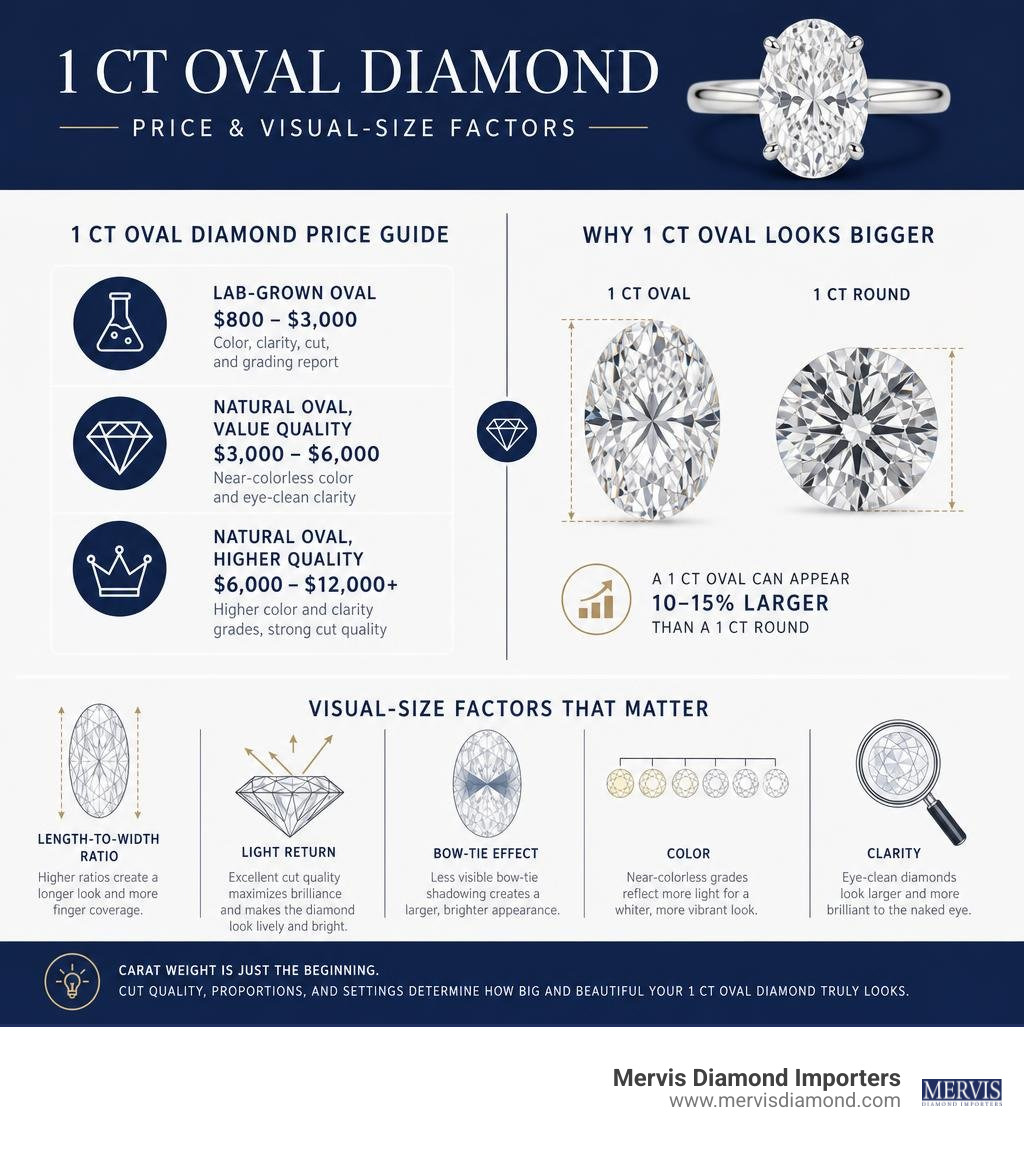
A 1 ct oval diamond typically costs less than a comparable round diamond while often looking larger on the finger because of its stretched outline. As a broad 2026 guide, price depends most on whether the diamond is natural or lab-grown, then on color, clarity, cut quality, and certification.
| 1 ct oval diamond type | Typical price range | What drives the price |
|---|---|---|
| Lab-grown oval | $800-$3,000 | Color, clarity, cut, and grading report |
| Natural oval, value quality | $3,000-$6,000 | Near-colorless color and eye-clean clarity |
| Natural oval, higher quality | $6,000-$12,000+ | Higher color and clarity grades, strong cut quality |
Oval diamonds are a smart choice for buyers who want strong finger coverage without moving up in carat weight. A well-proportioned 1 carat oval can appear roughly 10-15% larger than a round diamond of the same weight. But carat alone does not determine value. The shape's length-to-width ratio, light return, and any visible bow-tie shadow can make a major difference in how bright and large the diamond appears.
This guide will help you compare prices, judge oval cut quality, and choose a setting that makes your diamond look its best without paying for details you cannot see.
I am Morris Mervis, and I will walk you through the practical details that help make a 1 carat oval diamond purchase feel clear and confident.
Comparing Diamond Shapes: Oval vs. Round and Princess Cuts
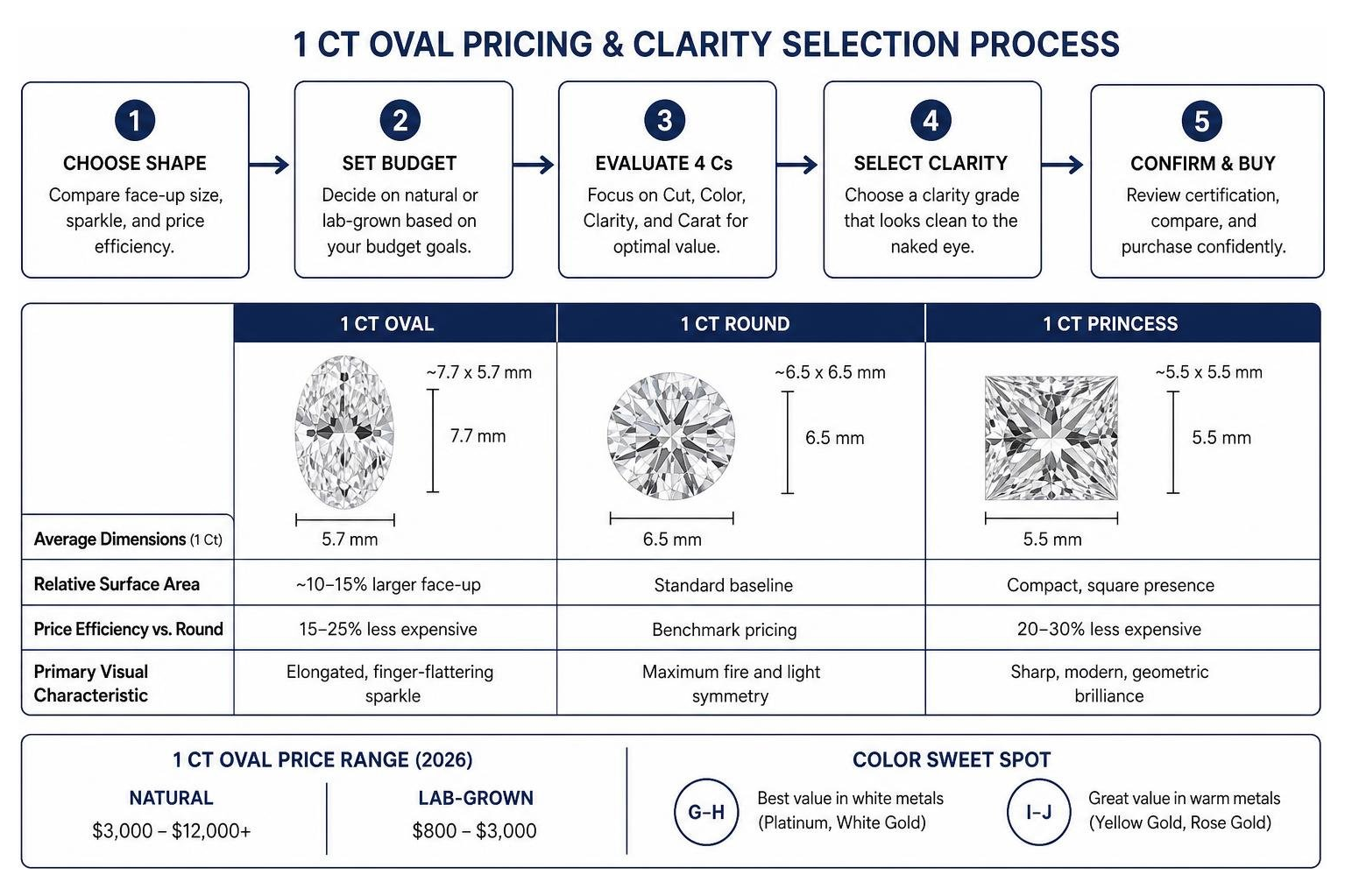
When choosing a diamond shape, buyers often balance three major elements: visual size on the finger, brilliance (sparkle), and price efficiency. While the round brilliant diamond has long held the title of the most traditional shape, oval and princess cuts offer compelling alternatives with distinct personalities.
The key advantage of a 1 ct oval cut diamond is its surface area distribution. Because a round brilliant diamond distributes its weight equally in all directions, a significant portion of its total mass remains hidden in its depth. Princess cuts, with their square profile and deep pavilions, also store a noticeable percentage of weight below the surface. An oval diamond, by contrast, spreads its weight across an elongated table and crown.
This elongated footprint creates a stunning optical presence. In addition to visual size, oval diamonds feature brilliant faceting similar to round cuts, allowing them to deliver exceptional sparkle when properly proportioned.
| Cut Style | Average Dimensions (1 Ct) | Relative Surface Area | Price Efficiency vs. Round | Primary Visual Characteristic |
|---|---|---|---|---|
| 1 Ct Oval | ~7.7 x 5.7 mm | ~10–15% larger face-up | 15–25% less expensive | Elongated, finger-flattering sparkle |
| 1 Ct Round | ~6.5 x 6.5 mm | Standard baseline | Benchmark pricing | Maximum fire and light symmetry |
| 1 Ct Princess | ~5.5 x 5.5 mm | Compact, square presence | 20–30% less expensive | Sharp, modern, geometric brilliance |
Why a 1 Ct Oval Diamond Looks Larger
The reason a 1 ct oval diamond appears bigger than its round or square counterparts comes down to geometry and finger coverage. Because an oval diamond stretches lengthwise down the finger, it creates an optical illusion that accentuates both the diamond and the wearer's hand.
When viewed from the top, an oval's surface dimensions—typically around 7.7 mm long by 5.7 mm wide—cover more linear space on the finger than a 6.5 mm round diamond. This expanded length gives the impression of a significantly heavier gemstone without requiring you to pay for extra carat weight.
Furthermore, the table percentage (the flat top facet) and crown height of a well-cut oval work together to maximize face-up spread. By spreading the diamond's mass horizontally and vertically rather than concentrating it purely in depth, an oval achieves optimal finger coverage that makes your investment work harder.
Understanding 1 Ct Oval Pricing and Value
Pricing for a 1 ct oval diamond involves balancing the classic "4 Cs"—Carat, Cut, Color, and Clarity—while deciding between natural and lab-grown options. In 2026, buyers have unprecedented flexibility to find a breathtaking diamond that fits their exact budget goals.
Natural oval diamonds derive their value from rarity. Formed over billions of years deep beneath the earth's surface, each natural gem is unique. A high-quality natural 1 ct oval diamond generally ranges between $3,000 and $12,000+, depending heavily on color, clarity, and overall cut symmetry.
Lab-grown oval diamonds, created using advanced technological processes that replicate natural growth conditions, possess identical physical, chemical, and optical properties. Because they can be produced efficiently, lab-grown options allow buyers to acquire a flawless, highly bright 1 ct oval at a fraction of the price—typically ranging from $800 to $3,000.
To explore how carat weight scales across larger oval sizes and shapes, you can review our comprehensive 3 Carat Oval Diamond Cost Guide.
Evaluating Color and Clarity for a 1 Ct Oval
Because oval diamonds feature brilliant facet patterns, they are remarkably forgiving when it comes to hiding microscopic inclusions. However, their broad, shallow table can retain slightly more body color than a round diamond. Finding the value "sweet spot" means choosing grades that look flawless and bright to the naked eye without paying extra for microscopic perfection.
- Color: The G to H color range offers fantastic value for a 1 ct oval. In these grades, the diamond appears crisp and bright white once mounted in platinum or white gold, without the premium price tag of D, E, or F colorless stones. If setting your diamond in yellow gold or rose gold, you can comfortably drop to an I or J color grade, as the warm metal setting naturally complements the slight color tone.
- Clarity: Aiming for an "eye-clean" clarity grade—where no inclusions are visible to the unaided eye—is the best way to stretch your budget. An SI1 or VS2 clarity grade almost always provides a clean, clear visual appearance.
For instance, options like a 1.00 Carat D SI1 Oval Diamond offer an exceptional combination of top-tier colorless appearance with value-focused clarity. If you prefer higher clarity and colorless purity in a lab-grown creation, stones such as a 1.16 Carat Lab Grown Oval Diamond deliver maximum brilliance and flawless visually clean facets.
Cut Quality, Proportions, and Length-to-Width Ratio
While the oval diamond silhouette was originally modernized in the 1960s by master cutter Lazare Kaplan, standard grading entities like the Gemological Institute of America (GIA) do not assign an official overall cut grade for oval diamonds as they do for round brilliants. Consequently, evaluating cut quality requires looking closely at proportions, symmetry, and depth ratios.
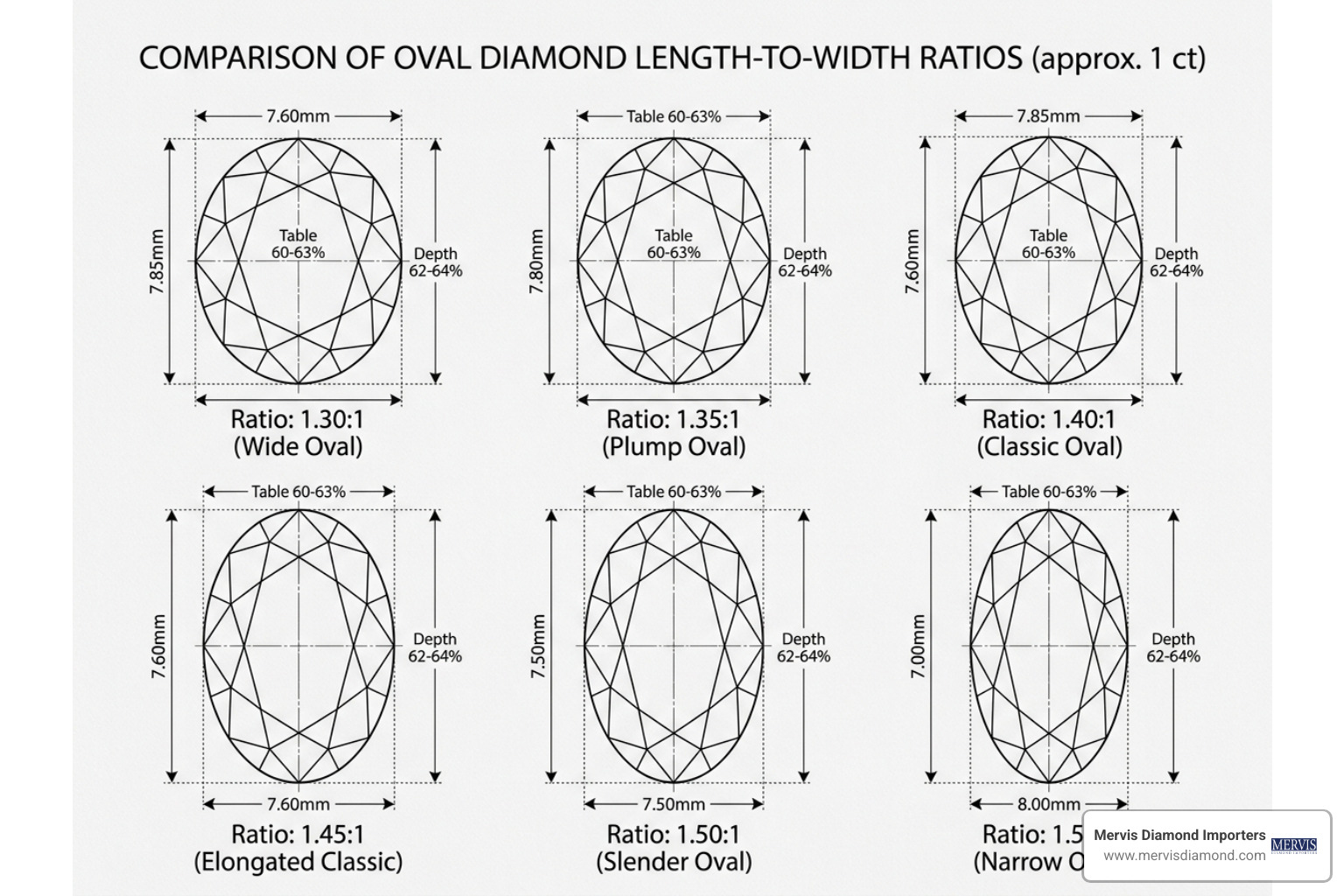
When assessing a 1 ct oval, key geometric benchmarks include:
- Total Depth Percentage: Aim for 58% to 63%. Diamonds that are too shallow let light leak out the bottom; diamonds that are too deep look smaller and absorb light improperly.
- Table Percentage: Seek a range between 53% and 63% for optimum light reflection and balance.
- Girdle Thickness: Extremely thin girdles increase chip risks, while extremely thick girdles hide unnecessary weight inside the stone.
Finding the Ideal Oval Ratio: Classic vs. Elongated
The length-to-width (L/W) ratio defines an oval diamond's shape, determining whether it looks classic and rounded or slender and elongated. You can calculate this by dividing the diamond's length by its width.
- Classic Proportion (1.35 to 1.50 L/W): This is the most popular, traditional range for a 1 ct oval. It creates a harmonious balance—slender enough to elongate the finger, yet wide enough to maintain soft, classic curves.
- Elongated Proportion (1.50 to 1.65+ L/W): For buyers seeking a modern, dramatic look, higher ratios yield a noticeably longer silhouette. An elongated oval maximizes perceived size and creates a slender profile on the hand, though higher ratios require extra attention during cut inspection to minimize potential light leakage along the sides.
How to Avoid the Bow-Tie Effect and Maximize Sparkle
One of the defining characteristics of fancy elongated cuts—such as ovals, marquise, and pears—is the "bow-tie effect." This refers to a dark, bow-tie-shaped shadow cast across the center width of the diamond when light fails to bounce back directly to the viewer's eye.
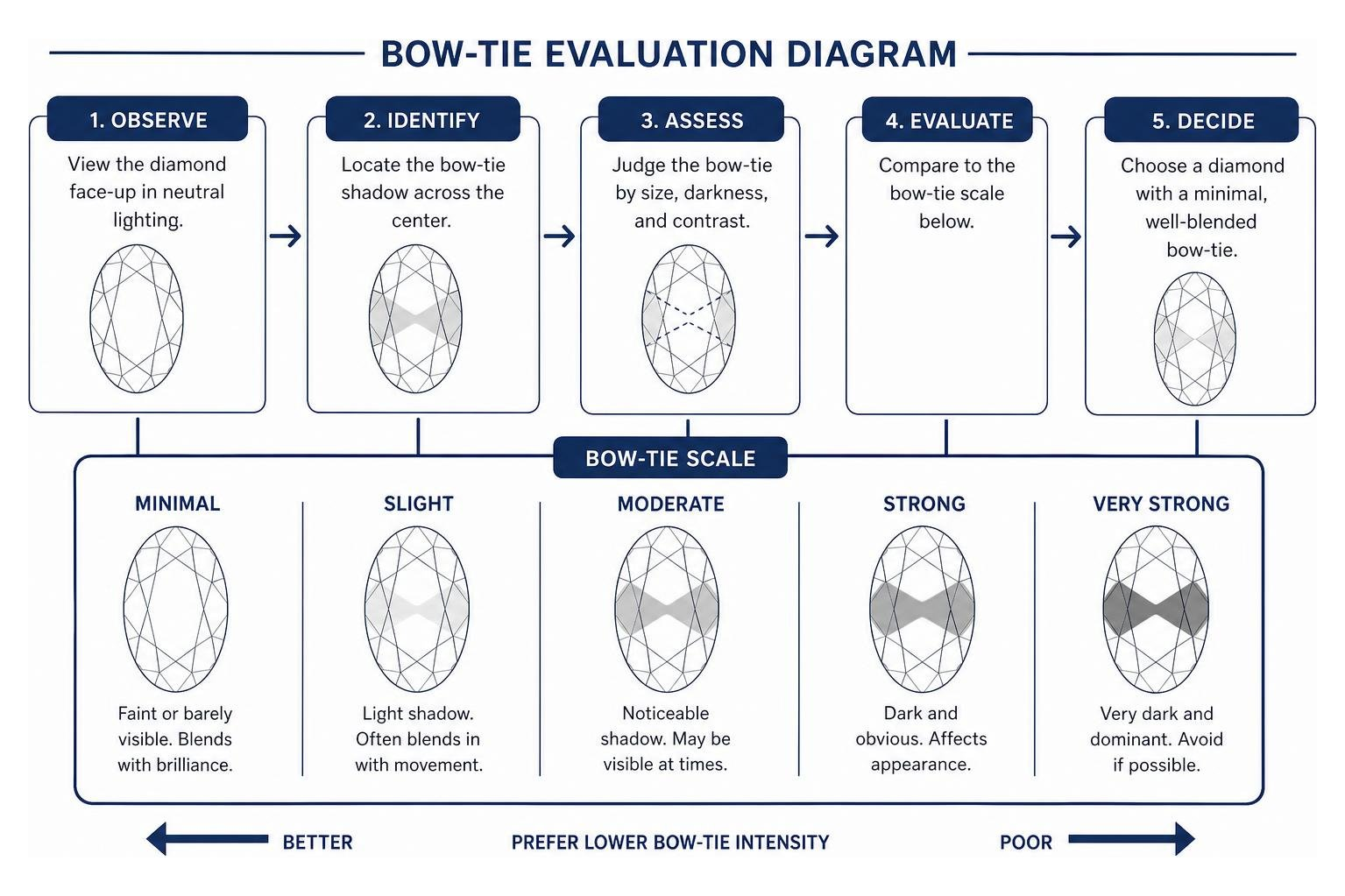
Almost every oval diamond possesses some degree of a bow-tie due to how its facets align in the center. The key is finding a diamond where the bow-tie is minimal, soft, or blends naturally into the diamond's sparkle during movement.
Tips for Identifying a Well-Cut Oval Diamond
- Inspect Under Multiple Lighting Environments: View the stone in natural daylight, warm indoor lighting, and spotlighting. A bow-tie that seems invisible under bright retail lights may show up indoors if cut improperly.
- Observe the Stone in Motion: Slowly tilt and rock the diamond. A high-performing oval will exhibit lively flashes of light (scintillation) across its center, masking any minor contrast shadow.
- Beware of Heavy Darkness: Avoid diamonds with a thick, permanent black band across the middle that fails to flash with light as the stone moves.
- Work with Expert Gemologists: Because laboratory grading certificates do not evaluate bow-tie severity, relying on experienced eyes at Mervis Diamond Importers ensures you select a hand-picked stone free from distracting central dark zones.
Assessing Light Performance in Oval Cuts
A great 1 ct oval diamond delivers a balanced mix of three light performance metrics:
- Brilliance: White light returned to the eye.
- Fire: Colorful spectral flashes emitted from the diamond's upper facets.
- Scintillation: Dynamic alternating patterns of bright and dark reflections created as the diamond or wearer moves.
Because diamond grading reports provide measurements but cannot fully detail optical beauty, inspecting high-definition video or viewing the loose stone in person is critical to confirming full light return across the entire surface.
Choosing the Best Engagement Ring Setting for Your Oval Cut
The right setting not only protects your 1 ct oval diamond but also complements its visual proportions and elevates its overall aesthetic. Whether you want to accentuate the diamond's natural size or create a sleek, minimalist look, your choice of setting frame plays a huge role.

Setting Style Comparisons
- Solitaire Settings: A classic solitaire highlights the oval's unique shape without distraction. Thin, delicate bands draw full focus to the center stone, accentuating finger coverage.
- Halo Settings: Adding a halo of delicate pavé diamonds around a 1 ct oval can make the center gem appear visually equivalent to a 1.50 or 1.75 carat diamond while adding immense overall sparkle.
- Three-Stone Settings: Framing an oval with side stones—such as delicate pear cuts, tapered baguettes, or small rounds—creates a classic, balanced frame that accentuates the center diamond's length.
Popular Settings for Oval Cut Diamonds
At Mervis Diamond Importers, we offer hand-crafted mountings engineered specifically to protect and showcase oval cuts. Excellent choices include:
- 14K White Gold Oval Diamond Engagement Ring: A refined setting featuring delicate side accent diamonds that bring maximum light to the central oval.
- Oval Solitaire Engagement Ring: Timeless simplicity with slender prongs designed to allow maximum light entry into the stone from all angles.
- Oval Wide Band Solitaire Engagement Ring: A bold, contemporary choice offering rich metal presence that creates a striking visual contrast against the elongated oval center stone.
Weighing the Pros and Cons of an Oval Cut Ring
Before making your final choice, it helps to weigh the clear advantages of a 1 ct oval diamond engagement ring alongside a few practical considerations.
Pros:
- Superior Finger Coverage: Appears roughly 10–15% larger than round diamonds of identical carat weight.
- Finger-Slimming Effect: The elongated profile creates an elegant, slenderizing visual effect on the wearer's hand.
- Exceptional Value: Generally costs 15–25% less than a round brilliant diamond of equivalent carat, color, and clarity.
- No Sharp Corners: Unlike princess or marquise cuts, an oval has smooth, rounded edges that do not easily catch or snag on clothing.
Cons:
- Bow-Tie Sensitivity: Requires careful visual inspection to avoid stones with dark central shadows.
- Higher Cut Variability: Because there is no single standardized GIA cut grade for ovals, selecting a bright stone requires expert hand-selection.
Frequently Asked Questions about 1 Carat Oval Diamonds
What length-to-width ratio is best for a 1 carat oval diamond?
The most popular ratio for a classic 1 ct oval diamond is between 1.35 and 1.50. This range achieves an ideal visual balance between slenderness and soft side curves. If you prefer a noticeably longer, modern profile, ratios between 1.50 and 1.60 offer a beautiful elongated look.
How much does a 1 carat oval diamond typically cost?
In 2026, a high-quality lab-grown 1 ct oval diamond generally costs between $800 and $3,000, depending on color and clarity. A natural 1 carat oval diamond usually ranges from $3,000 to $6,000 for attractive value grades, and $6,000 to $12,000+ for higher color and clarity combinations.
How do you prevent the bow-tie effect when buying an oval diamond?
Because certificates do not measure bow-tie intensity, the best protection is evaluating high-resolution video or viewing loose stones in person under varied lighting. Look for stones where the central facets return bright light as the diamond moves, rather than displaying a static dark bar.
Conclusion
A 1 ct oval diamond is one of the smartest, most beautiful choices for an engagement ring. Offering substantial visual presence, elegant finger coverage, and lower cost per carat than traditional round brilliants, it combines practical value with timeless elegance.
At Mervis Diamond Importers, we personally hand-select each natural and lab-grown diamond to ensure optimal proportion, brilliant light performance, and minimal bow-tie contrast. Whether you visit our showrooms in Tysons, VA, Rockville, MD, or Washington, DC, our expert team provides pressure-free guidance to help you craft your perfect ring.
Ready to explore handcrafted settings and discover your ideal oval diamond? Explore our complete Oval Engagement Rings Guide or schedule a private consultation with our diamond specialists today!