

Decoding the 10 Carat Diamond: What You Need to Know Before You Buy
Why 10 Carat Diamond Education Matters Before You Spend Six Figures
10 carat diamond education is essential for anyone considering one of the rarest and most significant jewelry purchases they'll ever make.
Here's a quick snapshot of what you need to know:
| Factor | Key Takeaway |
|---|---|
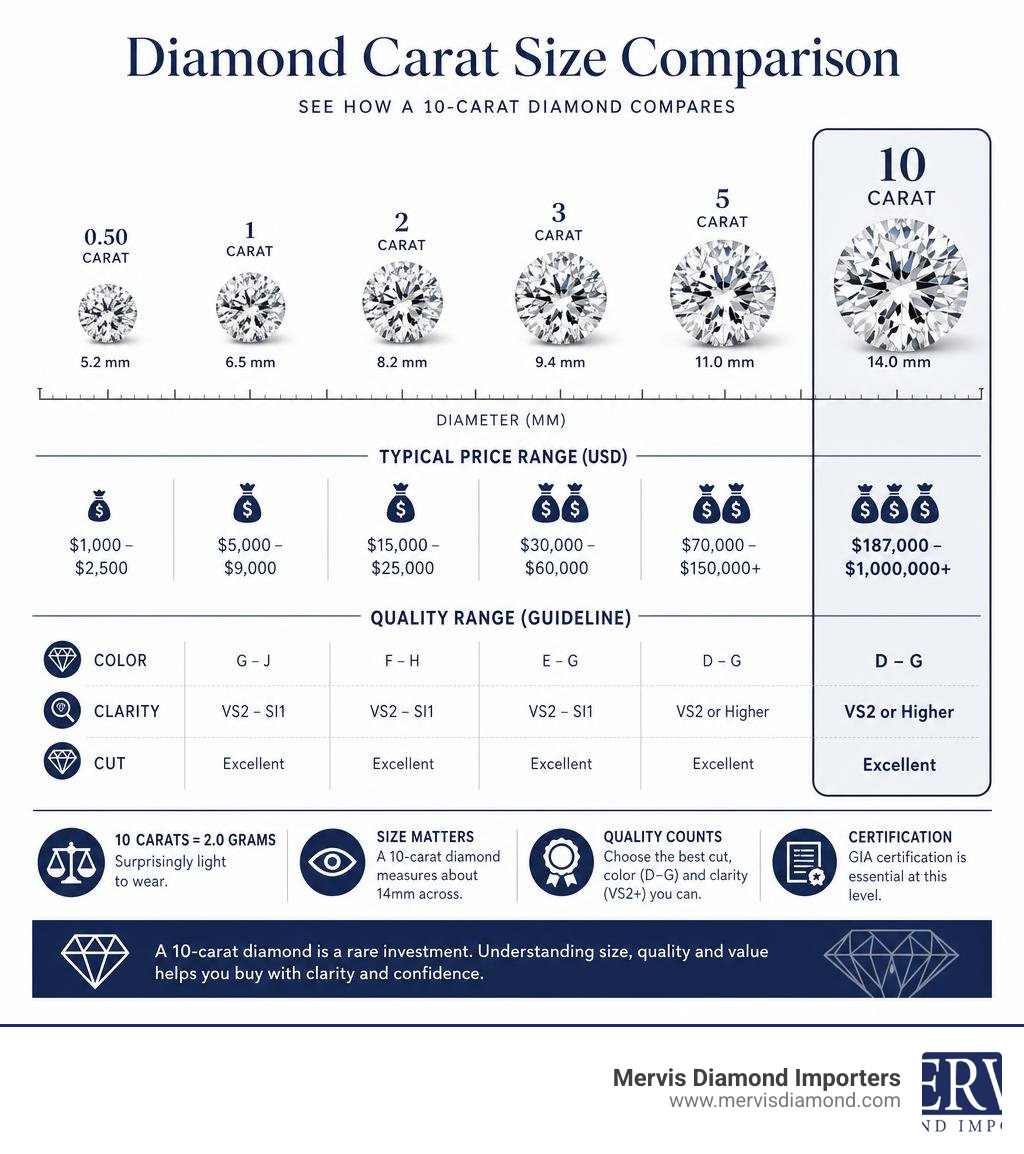
| Size | A well-cut round 10-carat diamond measures roughly 14mm across — about 10x the face-up area of a typical 1-carat engagement ring |
| Weight | 10 carats = just 2 grams — lighter than you'd expect to wear |
| Price range | Quality examples typically start around $187,000–$321,000; top-grade stones can exceed $1 million |
| Cut | The single most important factor — never compromise on it at this size |
| Color | D–G recommended; larger facets make color more visible |
| Clarity | VS2 or higher advised; inclusions are easier to spot in large stones |
| Certification | GIA certification is non-negotiable at this price point |
| Lab vs. natural | Lab-grown options exist but are limited at this size; significant price difference |
A 10-carat diamond isn't just a piece of jewelry. It's one of nature's rarest objects — and one of the most complex purchases you can make.
Most buyers at this level aren't new to diamonds. But even experienced shoppers find that everything changes at 10 carats. The Four Cs behave differently. Pricing jumps are dramatic. And the stakes of getting it wrong are enormous.
This guide breaks it all down clearly — no jargon, no pressure — so you can walk into this decision with confidence.
What is a 10-Carat Diamond and How Big is It?
When most people think of a 10-carat diamond, they imagine a heavy, almost industrial-sized rock that could double as a paperweight. In reality, the physical weight of a 10-carat diamond is surprisingly light: exactly 2.0 grams. Because diamonds are composed of carbon—a relatively low-density element—they pack incredible visual volume into very little physical mass.
To understand why we measure gemstones this way, we have to look back at the historical origins of gem trading. The term "carat" actually originates from the carob tree. In ancient Mediterranean markets, gem dealers used the remarkably uniform seeds of the carob bean as counterweights on their balancing scales. To learn more about how this ancient practice evolved into our modern, ultra-precise metric system, you can explore our detailed guide on Carats of Diamonds: A History Lesson.
In modern gemology, one carat is standardized at exactly 200 milligrams. This means a 10-carat diamond is equivalent to 2,000 milligrams (or 2 grams). While 2 grams sounds tiny on paper, the visual presence of a 10-carat diamond on a human hand is absolutely jaw-dropping.
A well-cut round brilliant diamond of this weight will measure approximately 14 millimeters to 14.3 millimeters in diameter. To put that in perspective, the average engagement ring diamond in the United States hovers around 1.0 carat, which measures about 6.5mm across. A 10-carat diamond doesn't just look ten times larger; its face-up surface area and overall visual impact dominate the hand, turning heads in any room.
Understanding the Physical Size in 10 Carat Diamond Education
When diving deep into 10 carat diamond education, it is vital to understand that carat is a measure of weight, not visual size. Two diamonds with the exact same weight of 10.0 carats can look vastly different in physical size depending on how they are cut.
If a diamond is cut too deep, a significant portion of its 2-gram weight is hidden in the "belly" or pavilion of the stone beneath the band. This results in a diamond that looks much smaller from the top than its carat weight suggests. Conversely, if a diamond is cut too shallow (often called a "spready" cut), it might look massive from above, but it will lack the necessary angles to reflect light, leaving you with a dull, lifeless stone.
To ensure you are getting a stone with ideal proportions that balance weight and visual dimensions, refer to the GIA Diamond Grading Guide. The table below illustrates how different diamond shapes distribute their 10-carat weight, showing typical millimeter dimensions and face-up surface areas:
| Diamond Shape | Typical Millimeter Dimensions | Visual Surface Impact |
|---|---|---|
| Round Brilliant | ~14.0mm – 14.3mm (Diameter) | Standard baseline for maximum sparkle |
| Oval Cut | ~17.5mm x 12.0mm | Elongated shape makes the finger look longer |
| Marquise Cut | ~21.5mm x 11.0mm | Offers up to 16% larger face-up area than round |
| Emerald Cut | ~15.0mm x 11.0mm | Elegant "hall of mirrors" aesthetic |
| Cushion Cut | ~13.0mm x 13.0mm | Soft, romantic pillowy look with deep fire |
The Core of 10 Carat Diamond Education: Applying the Four Cs
When evaluating a diamond of standard size, minor variations in quality can easily hide from the naked eye. However, when you scale up to a 10-carat gemstone, those tiny details are magnified. Every facet is larger, every angle is longer, and any structural or optical flaw has nowhere to hide.
To make an informed purchase, you must master Understanding the 4Cs and learn how they apply specifically to ultra-large diamonds.
At 10 carats, the pricing of a diamond is subject to an extreme "rarity premium." Because finding a gem-quality rough diamond capable of yielding a polished 10-carat stone is an extraordinarily rare event in nature, the price-per-carat increases exponentially. A 10-carat diamond isn't just ten times more expensive than a 1-carat diamond of the same quality—it can easily be fifty to one hundred times more expensive.
Prioritizing Cut and Sparkle
If there is one golden rule in 10 carat diamond education, it is this: never compromise on the cut.
The cut of a diamond is the only factor directly controlled by human hands, and it has the greatest impact on how the stone interacts with light. To understand the science behind how a master cutter transforms a dull rough stone into a blazing beacon of light, read our exploration of What Makes a Diamond Sparkle.
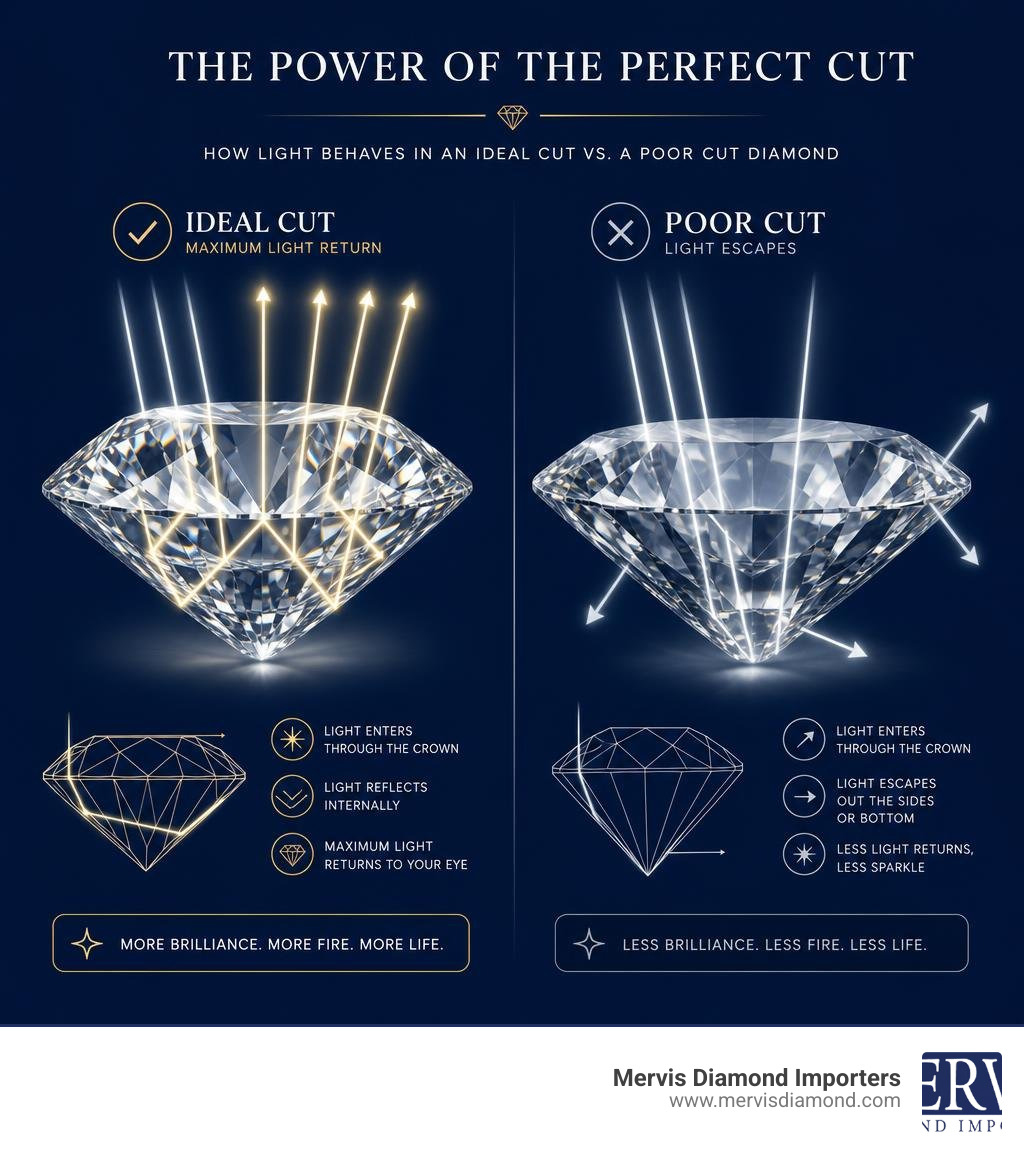
A round brilliant diamond features 58 precisely placed facets. When cut to ideal proportion percentages—often matching the industry's famous "60-60 rule" for table and depth percentages—light enters through the crown, reflects internally from facet to facet, and bounces back out through the top in an explosion of brilliance (white light sparkle) and fire (colored light flashes).
If a 10-carat diamond is poorly cut, its massive size will only highlight its lack of life. It will look like a large, cloudy piece of glass on the hand. Prioritizing an "Excellent" or "Ideal" cut grade ensures that your investment delivers the breathtaking light performance a stone of this magnitude deserves.
Selecting Color and Clarity for Large Diamonds
In smaller diamonds, you can often drop down to an SI1 clarity or an H color grade and still have a beautiful, "eye-clean" stone. At 10 carats, however, the rules change completely.
- Color: The GIA grades diamond color on a scale from D (completely colorless) to Z (light yellow or brown). Because a 10-carat diamond has a massive physical volume, it acts like a prism, trapping and body-tinting light. Any trace of yellow or brown color is much more apparent. For a bright, icy-white look, we highly recommend staying within the D to G color range.
- Clarity: The clarity scale measures internal inclusions and surface blemishes. Because the facets on a 10-carat stone are incredibly broad, they act like open windows. Inclusions that would be invisible in a 1-carat stone can easily be seen with the naked eye in a 10-carat stone. We advise selecting a clarity grade of VS2 or higher to guarantee the stone is eye-clean.
For those seeking the absolute pinnacle of optical purity, you may want to look for Type IIa diamonds. Representing less than 2% of all natural diamonds mined from the earth, Type IIa stones contain virtually no measurable nitrogen impurities. This chemical purity gives them an extraordinary transparency and exceptional brilliance that is immediately visible to the naked eye.
Choosing the Perfect Shape and Setting for a 10-Carat Stone
Selecting the right shape and setting for a 10-carat diamond is a balancing act between personal style, visual impact, and structural safety. A stone of this size requires a design that not only highlights its beauty but also protects your physical investment for generations to come.
Popular Shapes and Their Visual Impact
Different diamond shapes create entirely different visual profiles on the hand.
- Round Brilliant: The classic choice. It offers the absolute maximum level of sparkle and has a timeless appeal.
- Oval and Pear Cuts: These elongated shapes are incredibly popular because they create an elegant, slimming effect on the finger.
- Marquise Cut: Boasting a football-shaped silhouette, the marquise has the largest face-up surface area of any shape, making your 10-carat investment look even larger than its physical weight.
- Emerald and Asscher Cuts: These step-cut shapes feature long, parallel facets that create a sophisticated "hall of mirrors" effect. Because they do not have the intense, splintered sparkle of brilliant cuts, they require very high clarity grades (VVS2 or higher) to ensure no inclusions are visible.
- Princess and Cushion Cuts: These square and soft-cornered shapes offer a modern, bold look with deep, blocky flashes of fire.
A 10-carat diamond ring is the ultimate milestone piece, often chosen to celebrate major anniversaries, generational achievements, or personal triumphs. To read about the historical and cultural significance of these legendary jewelry pieces, check out The 10 Carat Diamond Ring: The Ultimate Milestone Ring | Jewelry | Sotheby’s .
Secure Settings for a Heavy Gemstone
A 10-carat diamond is a valuable asset, and securing it to your hand requires expert engineering.
A classic four-prong setting is often insufficient for a stone of this scale. Instead, we highly recommend a six-prong or eight-prong setting, preferably crafted from platinum. Platinum is denser and far more durable than gold, meaning its prongs are much less likely to bend or snap if the ring is accidentally bumped against a hard surface.
When designing the ring, consider these setting styles:
- Solitaire: A timeless choice that keeps all the focus on the main stone. For safety, the band width should be at least 2.5mm to support the top-heavy weight of the diamond.
- Three-Stone: Flanking your 10-carat center stone with two smaller side stones (such as tapered baguettes or half-moons) helps distribute the visual weight across the finger and provides excellent balance.
- Halo: Surrounding the center stone with a delicate border of micro-pavé diamonds can add extra sparkle, though a 10-carat stone rarely needs help standing out!
Natural vs. Lab-Grown 10-Carat Diamonds
In recent years, the rise of lab-grown diamonds has completely transformed the jewelry industry. If you are shopping for a 10-carat diamond, deciding between a natural (mined) stone and a lab-grown alternative is one of the most important decisions you will make.
For a detailed breakdown of how these two types of stones are created and how they compare under a microscope, read our comprehensive guide on Mined vs Lab Grown Diamonds.
| Feature | Natural (Mined) 10-Carat Diamond | Lab-Grown 10-Carat Diamond |
|---|---|---|
| Origin | Formed deep within the Earth over billions of years | Grown in a high-tech laboratory over several weeks |
| Chemical Composition | Pure carbon crystal lattice (identical) | Pure carbon crystal lattice (identical) |
| Rarity | Extremely rare; highly limited global supply | Highly controlled production; theoretically unlimited |
| Price (High Quality) | Typically starts at $200,000 and can exceed $1,000,000 | Significantly lower entry price point |
| Resale Value Retention | High historical value retention | Very low to no long-term resale value |
While lab-grown diamonds are chemically, physically, and optically identical to natural diamonds, their market dynamics are vastly different. Because lab-grown stones can be manufactured in unlimited quantities, they do not carry the same organic rarity as natural diamonds.
Investment Value and Resale Considerations
Before purchasing, it is crucial to understand the long-term financial implications of your choice. A natural 10-carat diamond is an incredibly rare asset. Because of its extreme scarcity, it behaves like a fine work of art or rare collectable, making it a potential store of value. To explore this topic further, read our article on Are Diamonds a Good Investment.
On the other hand, lab-grown diamonds do not hold their value over time. Because manufacturing technology continues to improve and production costs continue to fall, the market price of lab-grown diamonds has steadily declined. If you buy a 10-carat lab-grown diamond today, its future replacement cost will likely be much lower, meaning its secondary market value is minimal. For an honest look at this reality, see our articles on Do Lab Grown Diamonds Have Resale Value and How Much Can You Resell a Diamond Ring For.
Buying Guide: Certification, Insurance, and Care
When purchasing an asset of this caliber, protecting your investment is just as important as selecting the stone itself.
Essential Certification and Buying Tips in 10 Carat Diamond Education
The golden rule of high-end diamond buying is simple: never buy a 10-carat diamond without a GIA grading report.
The Gemological Institute of America (GIA) is the world's most respected independent grading authority. Their reports provide an unbiased, scientific assessment of the diamond’s Four Cs, fluorescence, and structural measurements. To learn how to navigate this process safely, read our guide on How to Buy a Loose Diamond and refer to the official GIA Diamond Carat Weight Guide.
If you are shopping in our local areas, we highly recommend working with established, trusted experts who can guide you through the process in person. For those in the Washington metropolitan area, Maryland, and Virginia, consulting with a professional appraiser can help you understand valuation standards and ensure you are making a secure investment.
Just as monumental milestones in history protect and define our communities—such as the historic legal victories celebrated in Celebrating Mills and the Families Who Won This Important Case —acquiring a 10-carat diamond is a legacy-defining moment for your family. Ensure it is protected with a bulletproof grading report and a comprehensive jewelry insurance policy from a specialized provider like Jewelers Mutual.
Long-Term Care and Maintenance
Owning a 10-carat diamond ring comes with a responsibility to care for it properly. Because of its large surface area, the stone will naturally collect oils from your skin, lotion, and everyday dust, which can quickly dull its sparkle.
- Weekly Cleaning: Soak your ring in a bowl of warm water mixed with a few drops of mild, degreasing dish soap. Gently scrub the stone—especially underneath the pavilion—using a soft-bristled baby toothbrush. Rinse thoroughly with clean water and dry with a lint-free microfiber cloth.
- Professional Inspections: Visit your jeweler at least twice a year to have the prongs checked. A stone of this size exerts significant leverage on its setting, and even a minor knock can loosen a prong.
- Safe Habits: Never remove your ring in a public restroom or near an open drain. If you are doing hands-on activities like gardening, weightlifting, or deep cleaning, leave your ring securely locked in a home safe.
Frequently Asked Questions about 10-Carat Diamonds
How much does a high-quality 10-carat diamond ring cost?
The price of a high-quality, natural 10-carat diamond ring typically starts around $200,000 to $400,000 for stones with eye-clean clarity (VS1–VS2) and near-colorless grades (G–I). However, if you are looking for an exceptional, museum-quality stone—such as a D-color, Flawless or VVS1 clarity diamond—the price quickly climbs past the $1 million mark.
Is a 10-carat diamond too heavy for daily wear?
At exactly 2.0 grams, the diamond itself is not physically heavy. However, because a 10-carat stone sits high off the finger, it can feel top-heavy and may spin if the ring band is not fitted perfectly. Many owners find they naturally adjust their hand movements over time to avoid knocking the stone against doors, desks, or car interiors.
What is the rarest type of 10-carat diamond?
The rarest 10-carat diamonds are Type IIa colorless diamonds and natural fancy colored diamonds (such as fancy vivid pink, blue, or green). Because nitrogen impurities are absent in Type IIa stones, they possess an icy, liquid-like transparency that is incredibly rare. Fancy colored diamonds of this size are even scarcer, often appearing only at major international auction houses and commanding multi-million dollar prices.
Conclusion
Acquiring a 10-carat diamond is a thrilling, once-in-a-lifetime journey. It is a purchase that demands the highest standards of quality, verification, and expert guidance.
At Mervis Diamond Importers, we specialize in sourcing the world's finest hand-selected natural and lab-grown diamonds. Across our locations in Tysons, VA, Rockville, MD, and Washington, DC, our experienced team is dedicated to providing a warm, pressure-free environment. We will help you navigate the complexities of diamond education, select the perfect stone, and custom-design a secure, breathtaking setting that beautifully showcases your investment.
Ready to take the next step or curious about current pricing options? Read our deep dive into How Much is a 10 Carat Diamond Ring or book a private, personalized consultation with one of our diamond experts today.