

Why Radiant Cut Lab Grown Diamonds Are Taking Over Engagement Ring Trends
Why a 2 Carat Radiant Cut Lab-Grown Diamond Ring Stands Out
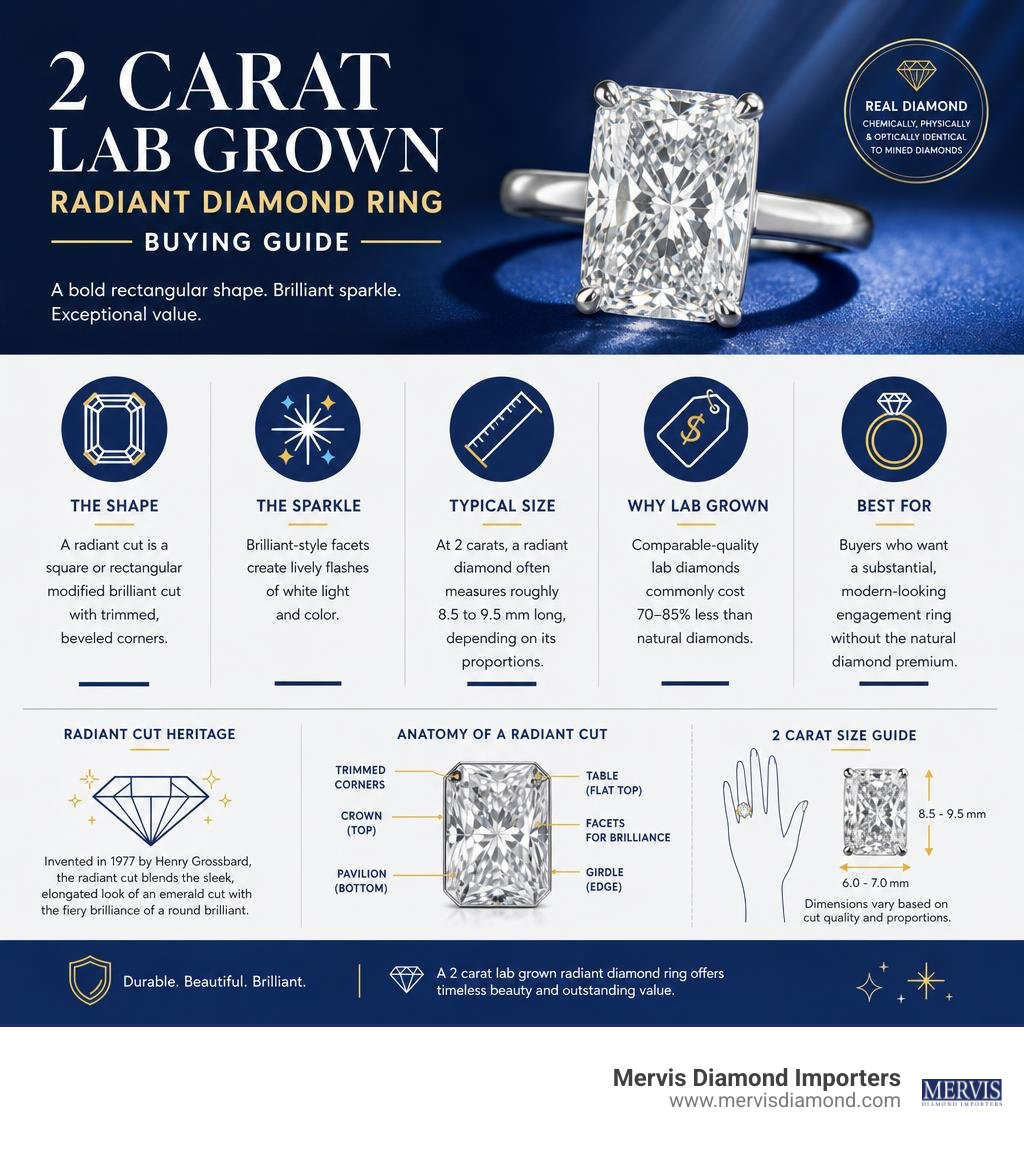
A 2 carat radiant cut diamond ring lab grown pairs the bold size and crisp rectangular shape many buyers want with the value, beauty, and physical durability of a real diamond. Lab-grown diamonds are chemically, physically, and optically the same as mined diamonds, including a 10 rating on the Mohs hardness scale.
| Quick answer | What it means |
|---|---|
| Diamond shape | A radiant cut is a square or rectangular modified brilliant cut with trimmed, beveled corners. |
| Why it sparkles | Its brilliant-style facets create lively flashes of white light and color. |
| Typical size | At 2 carats, a radiant diamond often measures roughly 8.5 to 9.5 mm long, depending on its proportions. |
| Why choose lab-grown | Comparable-quality lab diamonds commonly cost 70-85% less than natural diamonds. |
| Best for | Buyers who want a substantial, modern-looking engagement ring without paying a natural-diamond premium. |
Invented by Henry Grossbard in 1977, the radiant cut blends the clean, elongated look of an emerald cut with the brighter faceting associated with round brilliant diamonds. Its clipped corners also give the shape a polished look and add protection compared with pointed-corner styles.
For an engagement ring, this combination is hard to ignore: a 2-carat center stone has strong finger coverage, while lab-grown origin can leave more room in the budget for a better setting, metal, or diamond quality. The right stone still matters, especially its cut, proportions, color, clarity, and visible light performance.
I am Morris Mervis, and in the sections ahead, I will help you understand what to look for before choosing a radiant lab-grown diamond ring with confidence.
Understanding the Radiant Cut: History, Facets, and Shape
To appreciate why a 2 carat radiant cut diamond ring lab grown has become such a sought-after choice in modern engagement ring design, it helps to understand the engineering behind the cut. Prior to 1977, buyers who desired a rectangular or square diamond outline were primarily limited to step-cut diamonds like the emerald cut. While emerald cuts offer breathtaking transparency and subtle "hall-of-mirrors" reflections, they lack the intense sparkle and fire of brilliant cuts.
Master diamond cutter Henry Grossbard revolutionized the industry by inventing the radiant cut. His vision was to merge the sophisticated silhouette of an emerald cut with the fiery optical brilliance of a traditional round brilliant diamond. By applying a modified brilliant facet pattern to a rectangular outline with carefully trimmed, beveled corners, Grossbard created a stone that delivers maximum light refraction without sacrificing its sleek structural lines.
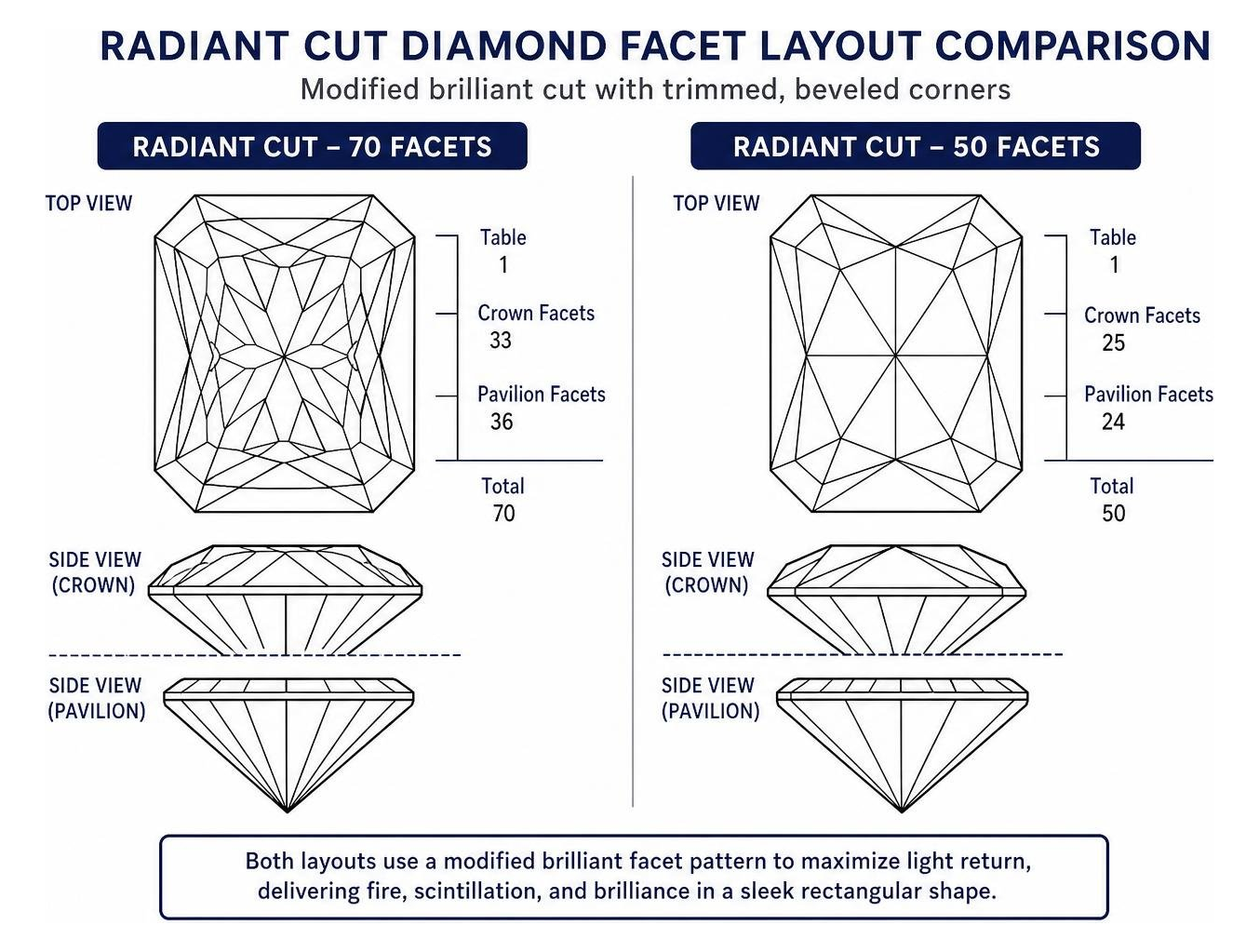
The facet arrangement of a radiant cut diamond is intricate. Depending on the exact cut design, a radiant cut features either 70 or 50 facets. The crown and pavilion facets are arranged specifically to bounce light inside the crystal structure, breaking white light into rainbow dispersion (fire) and high-frequency flashes (scintillation).
When evaluating a radiant cut, the overall outline is dictated by its length-to-width ratio:
- Elongated Rectangular (1.20 to 1.35): The most trending shape for engagement rings, providing an elegant lengthening effect on the wearer's finger.
- Classic Rectangular (1.15 to 1.19): A balanced rectangular shape with pronounced structural symmetry.
- Square Radiant (1.00 to 1.05): Offers a brilliant alternative to traditional square cuts like the princess cut, featuring cropped corners that bolster structural integrity.
One optical characteristic to keep in mind when viewing elongated fancy cuts is the bow-tie effect. This is a subtle dark shadow shaped like a bow-tie across the center of the diamond caused by light leaking through the bottom when viewed straight on. In expertly cut radiant diamonds, master cutters minimize this effect so that light refraction remains continuous across the entire table.
| Feature | Radiant Cut | Round Brilliant Cut | Princess Cut |
|---|---|---|---|
| Facet Style | Modified Brilliant (50 or 70 facets) | Standard Brilliant (58 facets) | Modified Brilliant (50+ facets) |
| Corner Structure | Beveled / Trimmed | Round (No corners) | Sharp 90-Degree Corners |
| Sparkle Style | High Scintillation & Fiery Flashes | Maximum Balanced Brilliance | Intense Sharp Sparkle |
| Finger Coverage | High (especially elongated) | Moderate | Moderate to High |
| Durability | Exceptional (protected corners) | High (no sharp points) | Vulnerable at sharp corners |
Radiant Cut vs. Round Brilliant and Princess Cuts
When clients visit our showrooms in Washington DC, Tysons, VA, or Rockville, MD, they frequently ask how radiant cuts stack up against round brilliants and princess cuts.
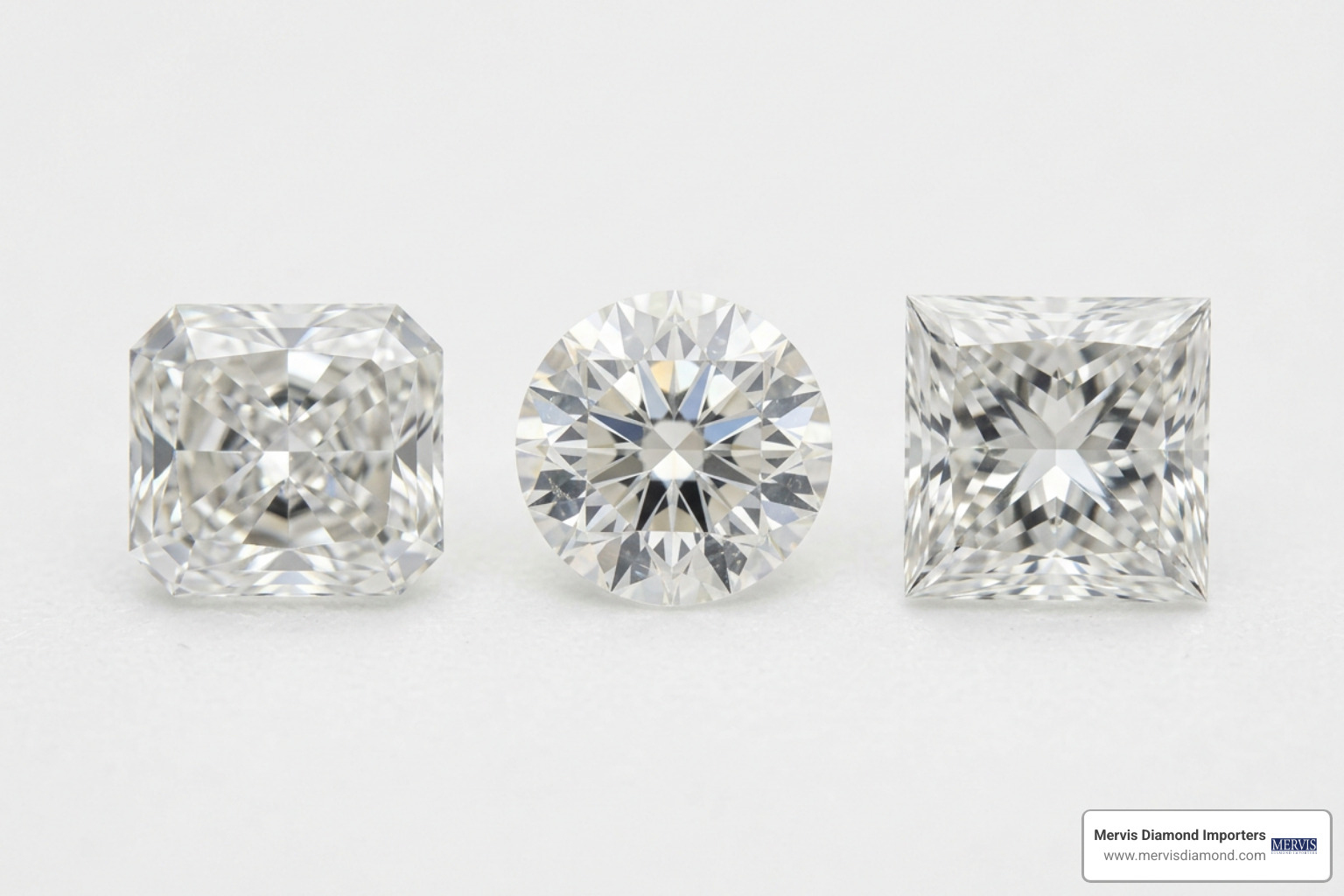
While the round brilliant cut holds the highest theoretical brilliance index, the radiant cut is uniquely engineered to trick the eye. Because of its elongated table surface, a 2 carat radiant cut diamond ring lab grown often appears visually larger than a 2-carat round brilliant diamond of the exact same carat weight.
Compared to the princess cut, which features sharp 90-degree corners prone to chipping if struck against hard surfaces, the radiant cut features four distinct beveled corners. These clipped corners fit securely into protective prongs, making the radiant cut far superior in structural durability for active daily wear.
Why Choose a 2 Carat Radiant Cut Diamond Ring Lab Grown?
Understanding the origin of your diamond is just as important as choosing its cut. Lab-grown diamonds are authentic diamonds. They possess the exact chemical composition (pure crystallized carbon), physical structure, and optical properties of mined diamonds. On the Mohs scale of mineral hardness, both lab-grown and natural diamonds score a perfect 10, ensuring your ring will maintain its scratch resistance and luster across a lifetime of wear.
A 2-carat diamond weighs exactly 400 milligrams. However, physical dimensions matter far more than weight on paper. A well-proportioned 2-carat radiant cut diamond typically measures between 8.5mm to 9.5mm in length and 6.5mm to 7.5mm in width. This substantial size creates a dramatic, eye-catching presence on the hand.
Choosing a lab-grown diamond for a stone of this magnitude unlocks massive benefits. To explore the science and growth processes behind these gemstones, read our comprehensive Lab Grown Diamonds Guide Synthetic Natural.

Pricing and Savings for a 2 Carat Radiant Cut Diamond Ring Lab Grown
The financial advantage of choosing a lab-grown radiant cut is significant. Lab-grown diamonds typically cost 70% to 85% less than natural diamonds of comparable carat weight, color, and clarity.
Because growing diamonds in sophisticated laboratory environments bypasses costly global mining operations, supply chain markups, and heavy extraction expenses, those overhead savings are passed directly to you.
This price variance means you can secure a visually flawless, high-color 2-carat or even 2.5-carat stone for a fraction of the cost of a smaller natural diamond. You can reallocate your savings toward a custom platinum ring setting, complementary diamond accent bands, or future life milestones. To compare pricing metrics across larger carat weights, explore our guide on 3 Carat Lab Grown Diamond Cost.
Ethical and Sustainability Advantages
Beyond the economic savings, choosing a lab-grown diamond aligns with modern environmental and social values. Modern diamond mining often requires moving hundreds of tons of earth per carat, causing substantial land displacement and localized ecosystem disruption.
In contrast, lab-grown diamonds created via Chemical Vapor Deposition (CVD) or High Pressure High Temperature (HPHT) technologies require zero earth excavation:
- Zero Land Displacement: No open-pit mining or topsoil destruction.
- 100% Conflict-Free: Lab-grown stones bypass global trade vulnerabilities and guarantee transparent origin.
- Lower Environmental Footprint: Advanced tech facilities increasingly utilize renewable energy grids to power growth chambers.
For environmentally conscious couples in Virginia, Maryland, and Washington DC, a lab-grown stone represents luxury without compromise.
Ideal 4Cs Specifications for Maximum Brilliance
To ensure your 2 carat radiant cut diamond ring lab grown delivers bright sparkle, selecting the right balance of the 4Cs (Cut, Color, Clarity, and Carat) is essential. Because radiant cuts feature intense, scattered faceting, they are forgiving with certain clarity characteristics, but require precise depth and table proportions to perform optimally.
Here are our recommended specifications when shopping for a 2-carat lab-grown radiant diamond:
1. Cut & Proportions (The Sparkle Factor)
Unlike round brilliant cut diamonds, major gemological laboratories like the GIA do not assign an overall "Cut Grade" to radiant cuts on certification reports. Therefore, evaluating proportional percentages is vital:
- Depth Percentage: 61% to 67%. A stone cut too shallow lets light escape through the bottom; a stone cut too deep looks small for its weight and appears dark.
- Table Percentage: 61% to 69%. This allows light to enter and reflect efficiently through the crown.
- Length-to-Width Ratio: 1.20 to 1.30 is the ideal range for an elongated silhouette. If you prefer a square shape, aim for 1.00 to 1.05.
- Polish & Symmetry: Excellent or Very Good.
2. Color Grade
Radiant cuts tend to show body color slightly more than round brilliant diamonds due to their deeper pavilion architecture.
- Top Tier (Colorless): D, E, or F. These grades set in platinum or white gold offer an icy appearance. View an exceptional colorless stone like our Lab Grown Diamond D Vs1 3 02 Rad Report Xltk177690.
- Great Value (Near Colorless): G or H. When paired with yellow or rose gold settings, G and H color grades appear bright white to the naked eye while offering extra cost savings.
3. Clarity Grade
The crushed-ice effect of a radiant cut's 70 facets masks small natural inclusions exceptionally well.
- VVS1 to VVS2: Virtually flawless, even under 10x magnification.
- VS1 to VS2 (Sweet Spot): Eye-clean perfection. Inclusions are microscopic and completely invisible without specialized gemological equipment, providing maximum visual purity for your budget.
- SI1: Can be eye-clean, but requires careful physical inspection to ensure inclusions do not reside directly under the center table.
How to Verify Quality and Authenticity
When purchasing high-end lab-grown diamond jewelry, independent verification is paramount. Never buy an uncertified loose lab-grown diamond.
All top-tier lab-grown diamonds are independently graded by leading gemological authorities such as the International Gemological Institute (IGI) or the Gemological Institute of America (GIA). These certificates assess every metric of your stone, from exact millimeter dimensions to clarity maps.
Every certified lab-grown diamond features a micro-laser inscription on its girdle. Invisible to the naked eye, this inscription includes the grading report number and the indicator "LAB GROWN" or "LG". During your consultation at Mervis Diamond Importers, we place your diamond under microscopic magnification so you can verify the inscription against your paperwork before it is set into your ring.
Once acquired, protecting your investment is simple. Read our expert analysis on Can You Insure A Lab Grown Diamond to ensure your ring is properly protected against theft or loss.
Best Settings and Metal Pairings for Radiant Cuts
Choosing the setting style and metal for your 2 carat radiant cut diamond ring lab grown determines both its aesthetic appeal and long-term security. The geometric elegance of the radiant cut makes it remarkably versatile across modern and traditional ring designs.
Here are the top setting styles we craft for radiant cut center stones:
1. Four-Prong Solitaire
The four-prong solitaire highlights the bold geometry of the 2-carat stone without visual distraction. Prongs are specifically positioned over the diamond's four beveled corners, securing the stone while keeping its side profiles exposed to incoming ambient light.
2. Hidden Halo Setting
A massive trend in engagement ring design, the hidden halo features a subtle collar of micro-pave lab-grown diamonds sitting directly beneath the main setting platform. It adds a secret touch of brilliance visible from the side profile without obscuring the radiant outline from the top view.
3. Three-Stone Setting
Framing a 2-carat radiant center stone with side stones creates substantial finger coverage. Pairing a rectangular radiant cut with baguettes, trapezoids, or small trillion-cut diamonds produces a striking balance of classical architecture and brilliant fire.
Precious Metal Options
- Platinum: The ultimate choice for strength and durability. Platinum is naturally hypoallergenic and its cool white tone enhances D-F color diamonds without adding yellow color cast over time.
- 18k Yellow Gold: Provides a rich, classic contrast against a bright white radiant center stone. Many couples choose yellow gold bands paired with platinum prongs to maintain white light return through the diamond.
- 14k White Gold: Offers a brilliant white finish similar to platinum at a lighter weight and competitive price point.
- Rose Gold: Offers a warm, romantic look that complements vintage-inspired settings.
Common Mistakes to Avoid When Buying a 2 Carat Radiant Cut Diamond Ring Lab Grown
Buying a diamond is an emotional and financial commitment. Avoid these common oversights to ensure you select a stone you will cherish forever:
- Overlooking Heavy Bow-Tie Shadows: Always view the diamond under varied lighting conditions or request diamond video inspection to confirm light reflection is even across the center.
- Selecting Extreme Ratios Without Seeing Them: Ratios above 1.35 can make a radiant cut appear excessively narrow, while ratios below 1.10 can look mismatched. Aim for 1.20 to 1.30 for an elongated shape.
- Choosing Sharp Prongs Instead of Corner Claws: Standard rounded prongs can slip on clipped radiant corners. Ensure your ring builder uses V-prongs or custom claw prongs designed for beveled corners.
- Ignoring Depth Metrics: Buying a diamond cut deeper than 68% means much of your 2-carat weight is hidden in the bottom of the stone where no one can see it.
Frequently Asked Questions About Lab Grown Radiant Cut Diamonds
Does a lab-grown radiant cut diamond sparkle as much as a natural diamond?
Yes, absolutely. Lab-grown diamonds possess the exact same refractive index (2.42) and optical dispersion properties as mined diamonds. Because they are physically and chemically identical, a lab-grown radiant cut diamond bounces, refracts, and splits light into brilliant spectral color flashes in the exact same way a natural diamond does. Light performance is determined entirely by cut precision, not by whether the diamond was formed in the earth or grown in a laboratory chamber.
What is the ideal length-to-width ratio for a 2-carat radiant cut diamond?
For a classic elongated rectangular radiant cut, the standard length-to-width ratio is between 1.20 and 1.30. This ratio flatters the hand by elongating the finger while preserving balanced proportions. If you prefer a square radiant cut, target a ratio between 1.00 and 1.05.
How durable is a radiant cut diamond for everyday wear?
The radiant cut is one of the most durable fancy cut diamonds available. Unlike princess or pear cuts that feature sharp points prone to chipping upon impact, the radiant cut was specifically designed with trimmed, beveled corners. When set securely with protective prongs, these corners shield the stone from accidental blows, making it an exceptional choice for daily wear.
Conclusion
A 2 carat radiant cut diamond ring lab grown offers a combination of modern style, physical durability, and brilliant performance. By choosing a lab-grown radiant center stone, you secure a larger, higher-quality diamond while enjoying tremendous economic savings and peace of mind regarding ethical sourcing.
At Mervis Diamond Importers, we have spent decades helping couples across Washington DC, Virginia, and Maryland discover their ideal engagement rings. Whether you visit us at our premier locations in Tysons, VA or Rockville, MD, our non-commissioned diamond experts provide a relaxed, pressure-free environment to examine loose lab-grown stones side by side.
Explore our extensive selection of Trending Lab-Grown Diamonds online, or schedule a personalized consultation today to craft a 2-carat radiant cut diamond ring that matches your vision and budget.