

Science Meets Sparkle: Why Lab Grown Diamonds Are Taking Over
Lab Grown Diamonds: Real Diamonds, Smarter Price
Lab grown diamonds are real diamonds — chemically, physically, and optically identical to mined diamonds. Here's what you need to know at a glance:
- Same material: Pure carbon crystallized in the same isotropic 3D lattice as natural diamonds
- Same hardness: 10 on the Mohs scale — the hardest known natural material
- Not simulants: Unlike cubic zirconia or moissanite, lab diamonds are actual diamonds
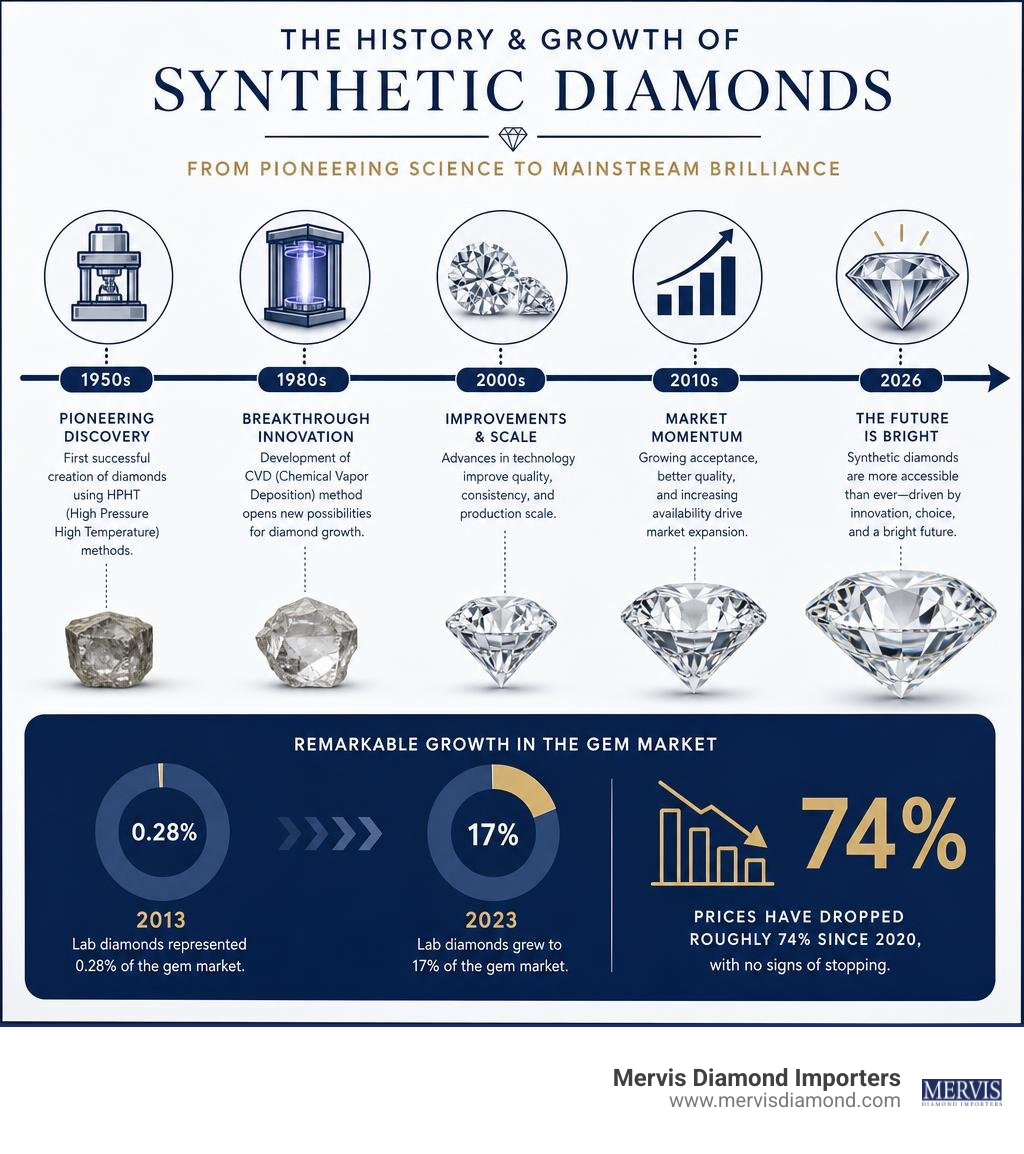
- Two main methods: High Pressure High Temperature (HPHT) and Chemical Vapor Deposition (CVD)
- Much lower cost: Prices have dropped roughly 74% since 2020, with no signs of stopping
- Growing fast: Lab diamonds went from 0.28% of the gem market in 2013 to 17% by 2023
The diamond industry is in the middle of a genuine shift. In 2021, major global jewelry brands announced shifts toward sustainable lab-grown diamonds. By 2022, engagement rings featuring lab grown stones had jumped 63% year over year. And by early 2025, a lab grown diamond cost up to 74% less than a comparable mined stone.
This isn't a trend driven by hype. It's driven by science, economics, and a generation of buyers who ask better questions before spending.
I'm Morris Mervis, and after decades helping customers find the right diamond without overpaying, I want to walk you through everything you need to know — from how these stones are made to how to buy one confidently.
Understanding Lab Grown Diamonds vs. Natural Diamonds and Simulants
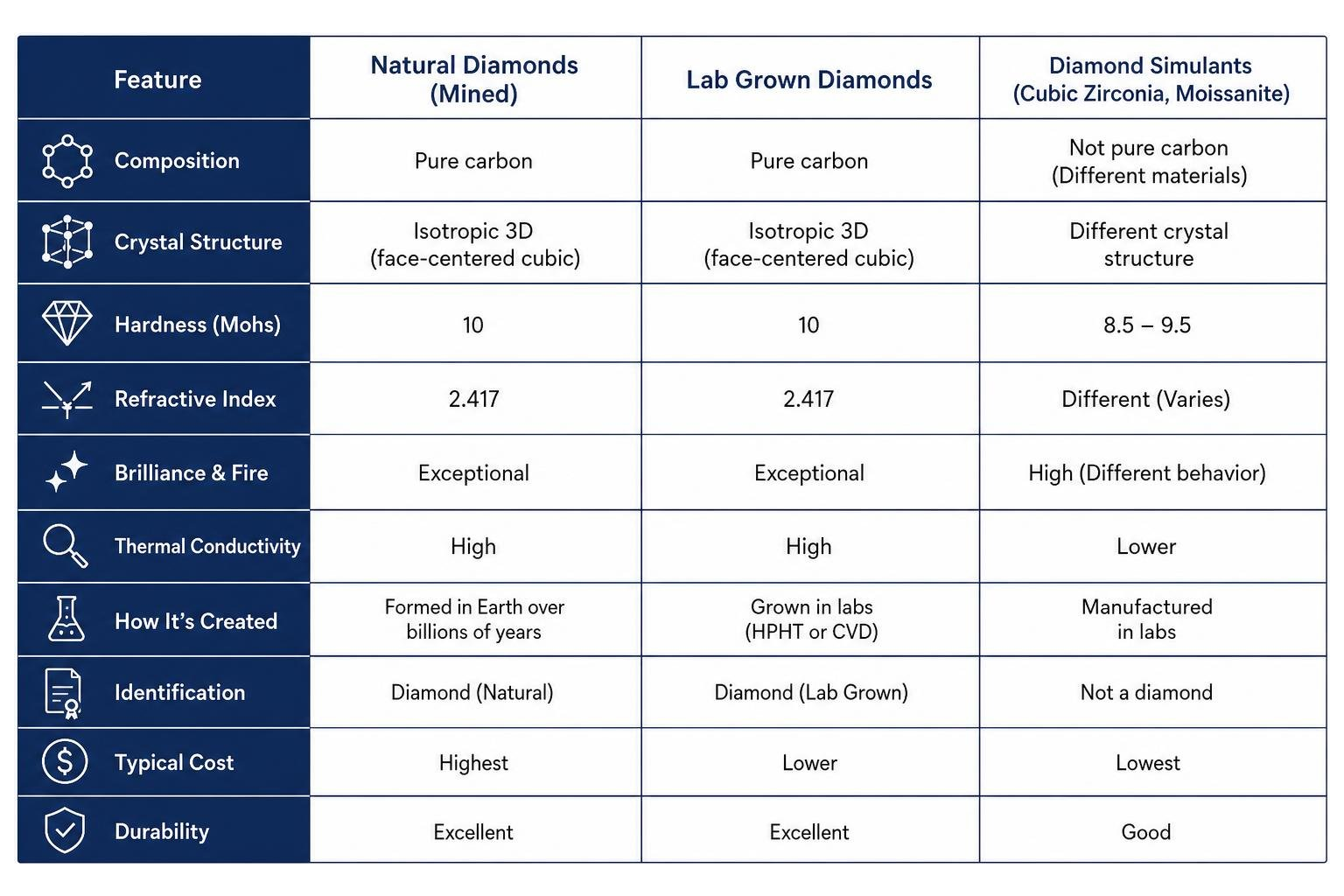
When evaluating lab grown diamonds, the single most important concept to grasp is atomic identity. At the fundamental molecular level, both lab-created and naturally mined diamonds consist of pure carbon atoms arranged in an isotropic 3D crystal lattice system (specifically a face-centered cubic structure). This atomic arrangement gives diamond its world-renowned durability, brilliance, and thermal properties.
To better understand where each gem fits into the market, we can explore our detailed comparison of mined vs lab grown diamonds.
Chemical and Optical Parity
Because their molecular structure is identical, lab grown diamonds share exact physical and optical parity with earth-mined diamonds:
- Refractive Index: Exactly 2.417. This governs how light bends as it passes through the gem, creating high-end brilliance.
- Optical Dispersion: Exactly 0.044. This measures how light splits into spectral fire colors.
- Mohs Hardness: Exactly 10 out of 10. Diamond remains the hardest solid material known on Earth.
- Thermal Conductivity: Extremely high, reaching up to 30 W/cm·K at room temperature for pure carbon-12 single crystals—nearly 7.5 times higher than pure copper.
Because these parameters match naturally mined stones 100%, lab grown diamonds behave identically under daylight, indoor spotlighting, or professional gemological light environments.
How Simulants Differ
It is vital to distinguish true lab diamonds from diamond simulants. Simulants are imitation stones that look somewhat similar to diamonds to the naked eye, but possess entirely different chemical structures, physical attributes, and optical characteristics.
- Cubic Zirconia (CZ): Composed of zirconium dioxide ($ZrO_2$). While inexpensive, cubic zirconia has a lower Mohs hardness (around 8 to 8.5), making it prone to scratching and dulling over time. CZ is also significantly denser than diamond, weighing roughly 70% more than a diamond of identical carat dimensions.
- Moissanite: Composed of silicon carbide ($SiC$). Moissanite is durable (9.25 on the Mohs scale), but it exhibits strong doubly refractive optical birefringence. This double refraction creates a distinct "rainbow effect" or "disco-ball fire" that looks noticeably different from the crisp, single-refractive light performance of a true diamond.
The Science Behind Synthesis: HPHT and CVD Technology
Creating a diamond in a lab requires recreating the intense heat and pressure conditions found 100 miles beneath the Earth's surface, or replicating the conditions found in interstellar gas clouds. Today, two primary manufacturing technologies produce gem-quality synthetic diamonds.
How HPHT and CVD Create Lab Grown Diamonds
The process of growing synthetic diamonds relies heavily on two main methods:
-
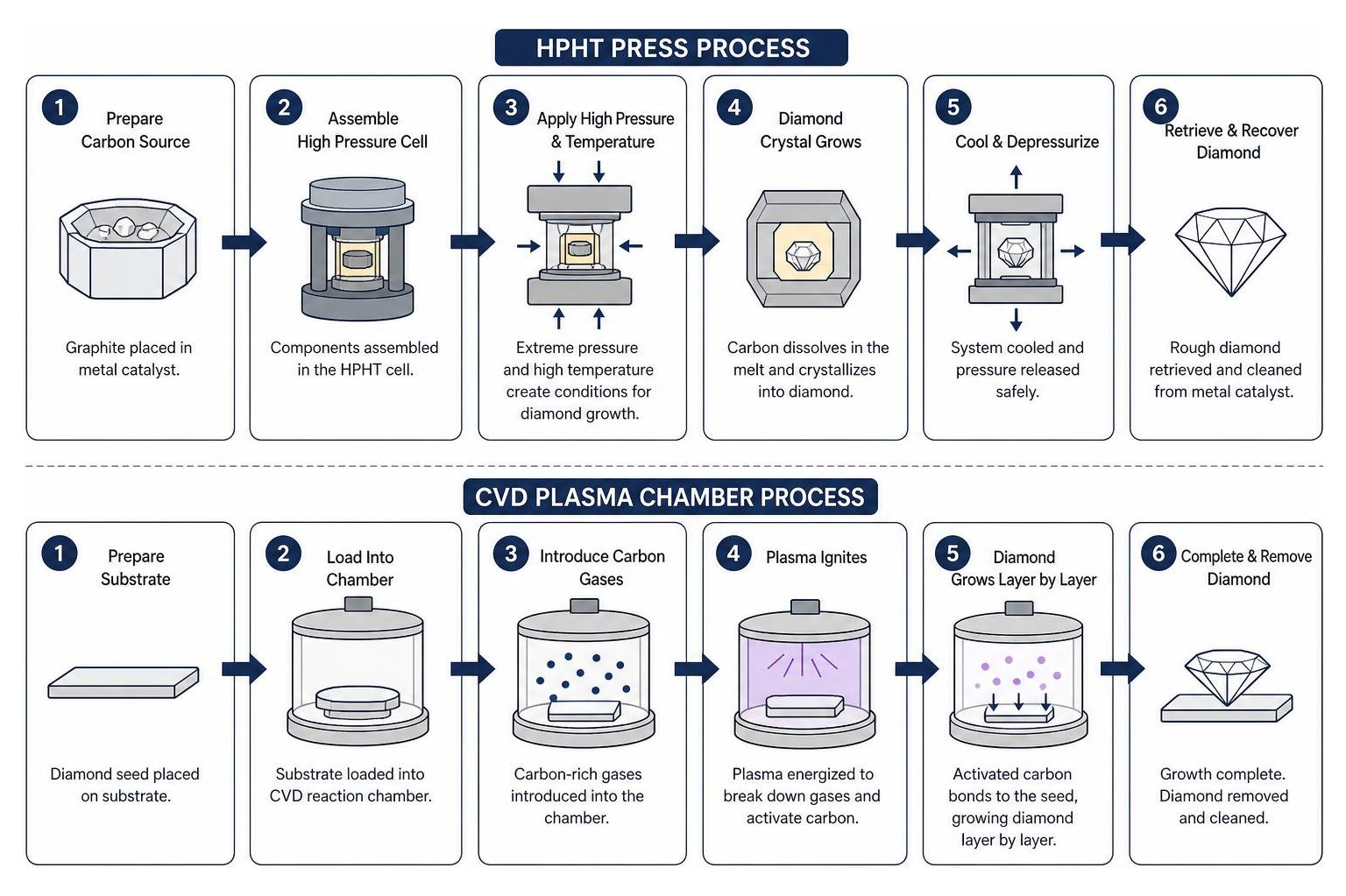
High Pressure High Temperature (HPHT): Developed historically in the 1950s by researchers such as H. Tracy Hall at General Electric, HPHT simulates Earth's deep-mantle environment. Large mechanical presses—such as cubic presses, belt presses, or Russian-designed BARS (Split Sphere) apparatuses—exert pressures of 5 to 6 GPa (roughly 50,000 to 60,000 atmospheres) at temperatures between 1,300 °C and 1,600 °C. A tiny diamond seed is placed at the bottom of a cell, beneath a carbon source (such as graphite) and a molten metal catalyst alloy (typically nickel, iron, or cobalt). Under intense pressure and heat, the metal melts and dissolves the carbon source, which then precipitates onto the seed crystal layer by layer.
-
Chemical Vapor Deposition (CVD): Pioneered in its early form by Union Carbide in 1952 and refined over decades, CVD operates under low pressures (near-vacuum, under 27 kPa or 3.9 psi) and moderate temperatures (700 °C to 1,200 °C). In a vacuum chamber, thin diamond seeds are laid flat. Hydrocarbon gas (usually methane, $CH_4$) mixed with high ratios of hydrogen gas (typically 99:1 hydrogen to methane) is introduced and energized into glowing plasma using microwaves. The plasma breaks the carbon bonds, releasing pure carbon atoms that "rain down" and bond to the diamond seed substrate, building a pure diamond crystal layer by layer. You can explore the intricate mechanics of this tech in our deep dive on what is a CVD diamond.
Alternative Production Methods and Innovations
Beyond standard HPHT and CVD, scientists have developed creative and highly specialized ways to synthesize diamonds:
- Detonation Synthesis: By detonating carbon-containing explosives (such as TNT and RDX) inside a sealed metallic chamber, nanometer-sized diamond grains (nanodiamonds) are formed instantly within microsecond shockwaves.
- Ultrasound Cavitation: Liquid organic solvents treated with high-power ultrasonic waves generate microscopic cavitation bubbles. When these bubbles collapse, localized temperature spikes and pressure bursts allow diamond clusters to precipitate.
- Liquid Metal Catalysts: Published in 2024, groundbreaking seedless synthesis methods allow thin diamond films to crystallize inside a liquid metal alloy of gallium, iron, nickel, and silicon at 1 atmosphere of room pressure, bypassing complex press equipment.
- Organic Materials & Memorial Diamonds: Because carbon is the fundamental building block of organic life (the human body is roughly 18% carbon), laboratory presses can extract carbon from cremation ashes or hair samples to cultivate certified memorial diamonds.
- Peanut Butter Diamonds: In a famous lab experiment, geoscientists placed carbon-rich peanut butter under multi-anvil presses at pressures over 1.3 million atmospheres, successfully stripping away hydrogen to synthesize pure diamond crystals!
Market Economics, Pricing, and Consumer Trends
The rise of lab grown diamonds represents one of the most remarkable market transformations in modern luxury retail.
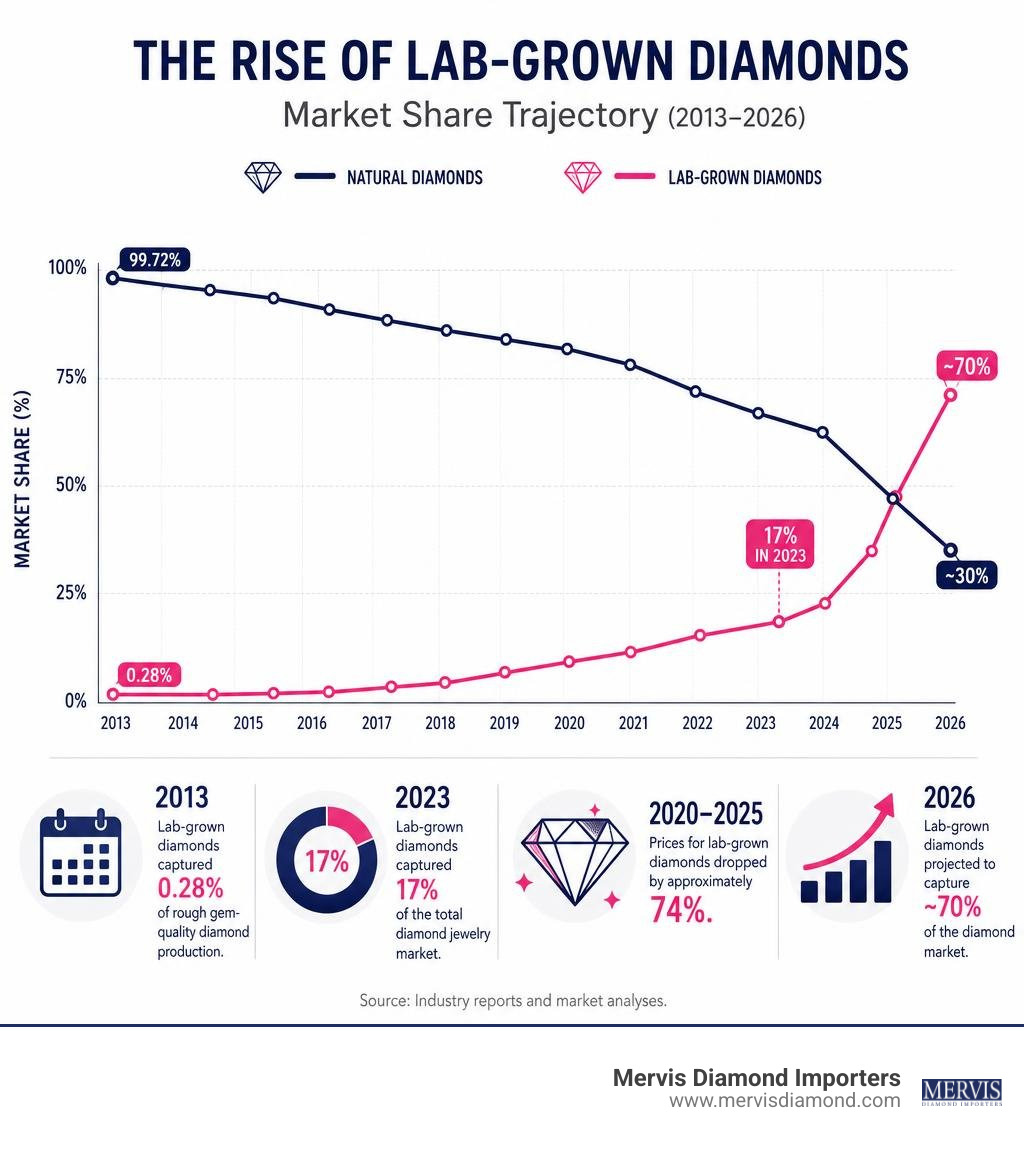
In 2013, synthetic gems accounted for just 0.28% of rough gem-quality diamond production, making up roughly 2% of the total gem market. By 2023, lab diamonds captured 17% of the total diamond jewelry market. Driven by leaps in production yields, high-energy plasma efficiency, and larger crystal substrate availability, prices for lab-grown stones dropped by approximately 74% between 2020 and early 2025.
Market Shift: Why Lab Grown Diamonds Are More Affordable Than Ever
Why have prices dropped while quality has reached historic heights? Unlike earth-mined diamonds—which require capital-intensive deep-pit heavy mining, massive earth displacement, and complex international supply chains—lab diamond production follows a technology curve similar to computer microchips.
As synthesis chambers become more energy-efficient, growth cycle times drop. For example, in May 2015, growing a 10.02-carat colorless HPHT diamond took roughly 300 hours. Today, modern facilities grow gem-quality crystals routinely, with single-crystal synthetic diamonds weighing up to 125 carats (25 grams) achieved by 2025, and record uncut stones reaching as large as 150.42 carats.
These scaling efficiencies directly lower retail costs, allowing consumers to purchase larger, higher-purity center stones for their budgets. Check out our comprehensive guide on the average cost of lab grown diamonds to see real-world numbers.
Carat Pricing and Buying Considerations
Because lab grown diamonds follow scalable production costs, prices scale far more linearly with weight than mined diamonds. In mined diamonds, a 3-carat stone is exponentially rarer than a 1-carat stone, driving price per carat upward dramatically. In lab grown stones, larger carats remain remarkably accessible.
Here is an overview of representative market pricing for high-quality lab grown diamonds across key carat tiers:
| Carat Weight | Typical Color / Clarity Range | Average Retail Price Range | Key Buying Advantage |
|---|---|---|---|
| 1.00 Ct | F–D / VS2–VVS1 | $600 – $1,200 | Ideal for timeless, classic solitaire rings |
| 2.00 Ct | F–D / VS2–VVS1 | $1,200 – $2,500 | Exceptional presence without breaking the budget |
| 3.00 Ct | F–D / VS2–VVS1 | $2,200 – $4,500 | Turn-head size offering unbelievable sparkle |
| 4.00 Ct+ | F–D / VS2–VVS1 | $3,800 – $7,500+ | True showstopper scale for ultra-luxurious designs |
If you are evaluating specific carat options, explore our in-depth guides:
- Learn more about classic single-carat sizing in our overview of the 1 ct man made diamond.
- Compare popular medium-large stones using our 2 carat man made diamond complete guide.
- Evaluate pricing structures for larger centerpieces with our breakdown on 3 carat lab grown diamond cost.
- Discover ultra-luxury proportions in our ultimate 4 carat man made diamond guide.
Gemological Testing, Detection, and Quality Standards
Can a standard jeweler tell the difference between a natural diamond and a lab-created stone with a basic hand loupe? The short answer is no.
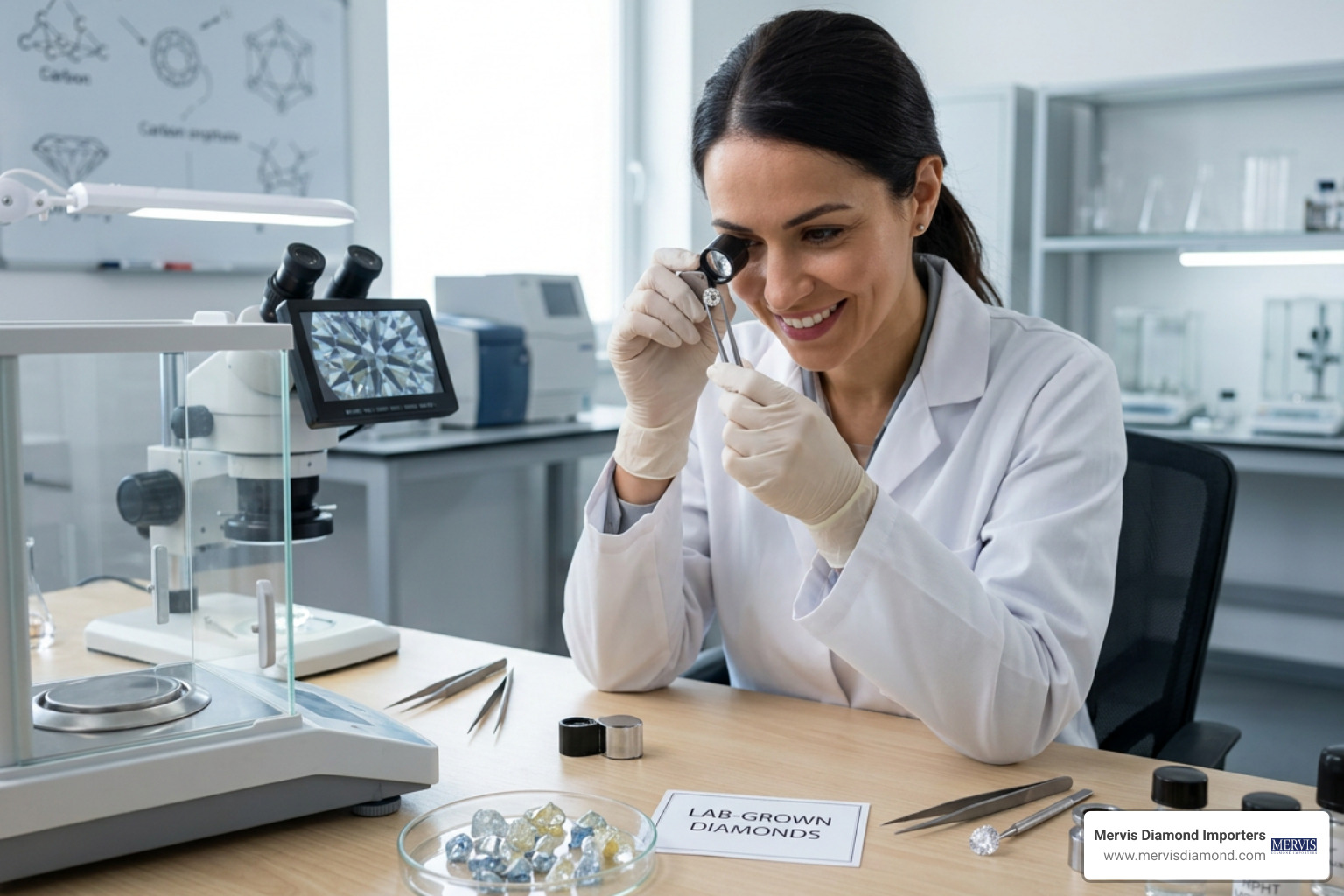
How Laboratories Distinguish Lab Gems from Mined Gems
Standard thermal conductivity diamond pens (the basic hand probes used in jewelry stores) react to thermal dissipation speed. Because lab diamonds have the exact same thermal conductivity as mined diamonds, they will pass as real diamonds on a traditional pen tester in 2 to 3 seconds. For details on how this works, read our article on whether do lab diamonds pass a diamond tester.
To definitively separate lab-grown stones from mined stones, major gemological institutes like the Gemological Institute of America (GIA) and IGI use specialized laboratory testing equipment:
- Photoluminescence Spectroscopy: Measures atomic-level crystal lattice defects.
- Short-Wave UV Fluorescence & Phosphorescence: HPHT diamonds often exhibit distinctive cross-shaped growth patterns or post-UV glowing phosphorescence, whereas CVD diamonds show layered growth patterns.
- Trace Element Inclusions: HPHT stones may contain microscopic metallic flux inclusions (nickel or iron), while natural diamonds contain mineral inclusions like garnet or olivine.
- Laser Inscriptions: Gemological laboratories micro-laser etch a tiny inscription (e.g., "LABORATORY GROWN" along with the certificate report number) directly onto the girdle of certified stones for 100% consumer disclosure.
Resale Value, Insurance, and Value Retention
A common question buyers ask relates to long-term valuation. Because lab grown diamond supply is controlled by technology and manufacturing capability rather than geological scarcity, lab diamonds should be purchased as fine wearable jewelry rather than financial investments. For a balanced look at this topic, read do lab grown diamonds have resale value.
From an insurance perspective, you can absolutely insure lab diamonds just like any precious jewelry asset. Most top insurance carriers offer replacement-value policies that protect against theft, loss, or damage. We encourage you to review our guide on can you insure a lab grown diamond to ensure your ring is fully protected.
Industrial Applications, Ethics, and Sustainability
While fine jewelry commands public attention, high-tech industrial manufacturing consumes vast amounts of synthetic diamond material. An estimated 98% of total industrial-grade diamond demand worldwide is supplied by synthetic diamonds!
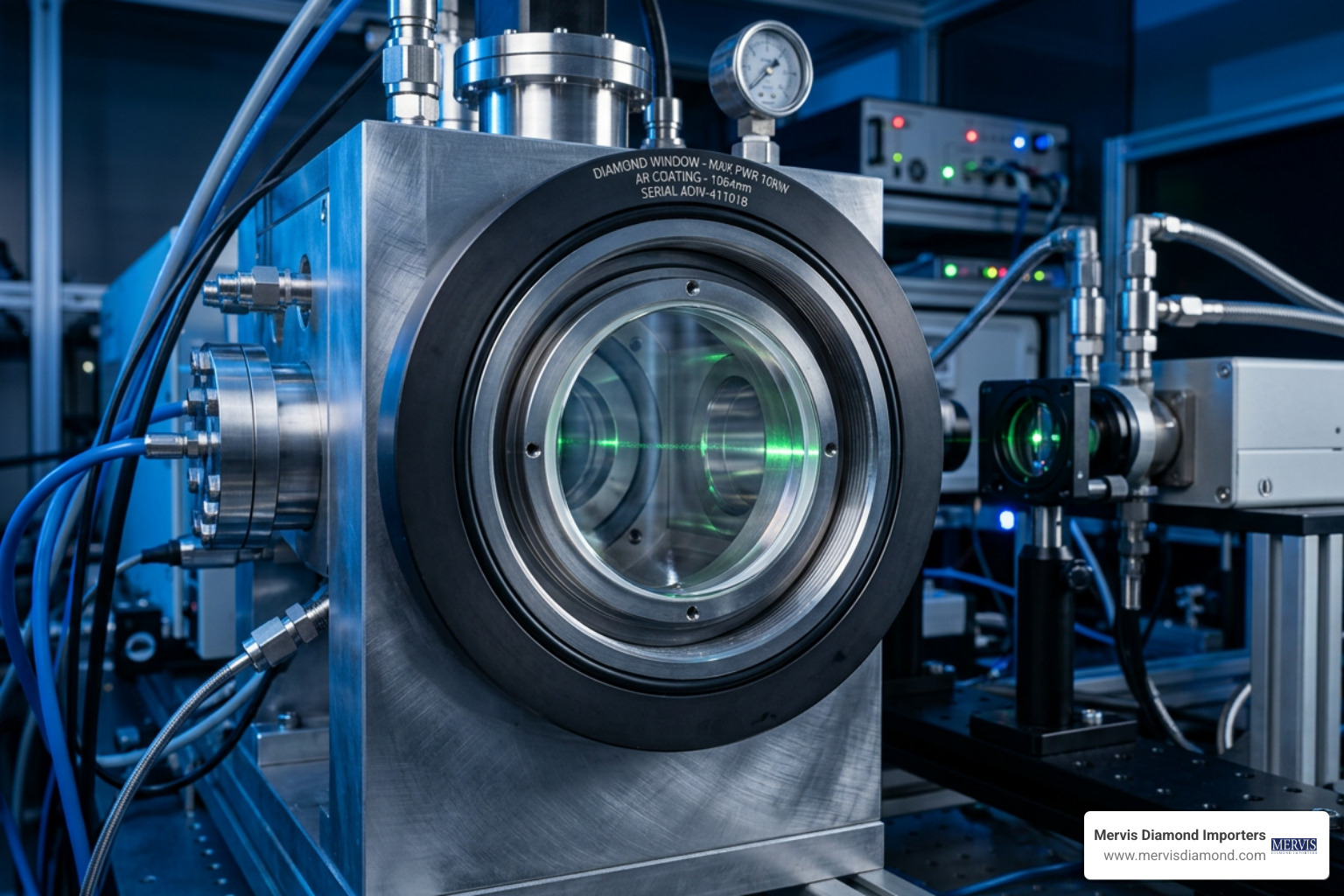
High-Tech Applications Beyond Fine Jewelry
Thanks to its unmatched physical properties, synthetic diamond is essential across modern high-tech industries:
- Machining and Heavy Cutting Tools: Synthetic diamond grit and polycrystalline diamond (PCD) tips coat drill bits, saws, and milling cutters used in stone, glass, and aerospace manufacturing.
- High-Power Laser Optics: Diamond's extreme optical clarity across ultraviolet, visible, and infrared spectra makes it the ideal material for high-power $CO_2$ laser windows and gyrotrons.
- Thermal Management in Electronics: Single-crystal diamond substrates act as heat sinks for high-power transistors, radar arrays, and laser diodes, dissipating heat far faster than copper.
- Semiconductors & Quantum Computing: Nitrogen-vacancy (NV) centers engineered inside synthetic diamond crystals allow researchers to build quantum bits (qubits) capable of sensing magnetic fields at atomic resolution at room temperature.
Ethical Arguments and Environmental Realities
Lab grown diamonds are often championed as an ethical alternative to mined diamonds. Traditional earth mining involves moving tons of soil, deep-pit excavation, and potential disruption to local ecosystems and communities.
However, transparent analysis requires looking at energy usage. Growing lab diamonds via CVD or HPHT demands continuous electricity to maintain extreme temperatures and plasma chambers for weeks at a time. When synthetic diamond foundries utilize renewable energy sources (like solar, hydro, or geothermal power), their carbon footprint is remarkably small. As green energy adoption spreads across diamond synthesis facilities, sustainability credentials continue to strengthen worldwide.
Frequently Asked Questions About Synthetic Gems
Do lab grown diamonds cloudy over time?
No, lab grown diamonds will never become cloudy, foggy, or discolored over time. Because they consist of pure carbon in a 3D crystal lattice with a Mohs hardness of 10, their optical transparency, brilliance, and structural integrity are permanent. If a lab diamond ever appears dull, it is simply due to surface dust or oils from skin, which can be restored instantly with warm water, mild soap, and a soft brush.
Are lab grown diamonds real diamonds according to official standards?
Yes. In 2018, the Federal Trade Commission (FTC) formally revised its Jewelry Guides, removing the word "natural" from the definition of a diamond. The FTC clarified that a diamond is defined by its chemical composition (crystallized carbon) regardless of whether it grew deep in the mantle or inside a laboratory reactor chamber. Major grading authorities like GIA grade lab grown diamonds using the exact same 4 Cs scale (Cut, Color, Clarity, and Carat weight) as mined gems.
How do I choose the right engagement ring setting for a lab grown stone?
Because lab grown diamonds save you money on the center gem, many couples choose to upgrade their settings. Excellent choices include timeless platinum or 18k gold solitaires, intricate halo environments, or classic three-stone settings.
For expert inspiration on selecting styles and ring proportions, check out our 3 carat man made diamond ring guide, review our general 3 carat lab grown diamond guide, or browse our budget-conscious tips in the best cheap man made diamond engagement rings guide.
Conclusion
The evolution of laboratory-grown diamonds represents one of the most exciting developments in modern gemology. By uniting advanced physics with high-end craftsmanship, lab grown stones offer consumers uncompromising physical beauty, molecular purity, and incredible financial value.
Whether you are seeking a magnificent engagement ring center stone or simply exploring options for your next fine jewelry purchase, our team at Mervis Diamond Importers is here to help. With showrooms across Tysons, VA, Rockville, MD, and Washington, DC, we offer a pressure-free, educational environment where you can compare natural and lab-grown diamonds side by side under master lighting.
Explore our local styles and collection highlights by reading our guide on trending lab grown diamonds washington dc, or refresh your knowledge by revisiting our breakdown of mined vs lab grown diamonds.
Ready to see the extraordinary sparkle of lab grown diamonds in person? Schedule a personal consultation with Mervis Diamond Importers today and let our expert staff help you choose the perfect stone!