

3 Carat Oval Shaped Diamond Ring: Smart Shopper's Practical Guide
How to Choose a 3 Carat Oval Shaped Diamond Ring
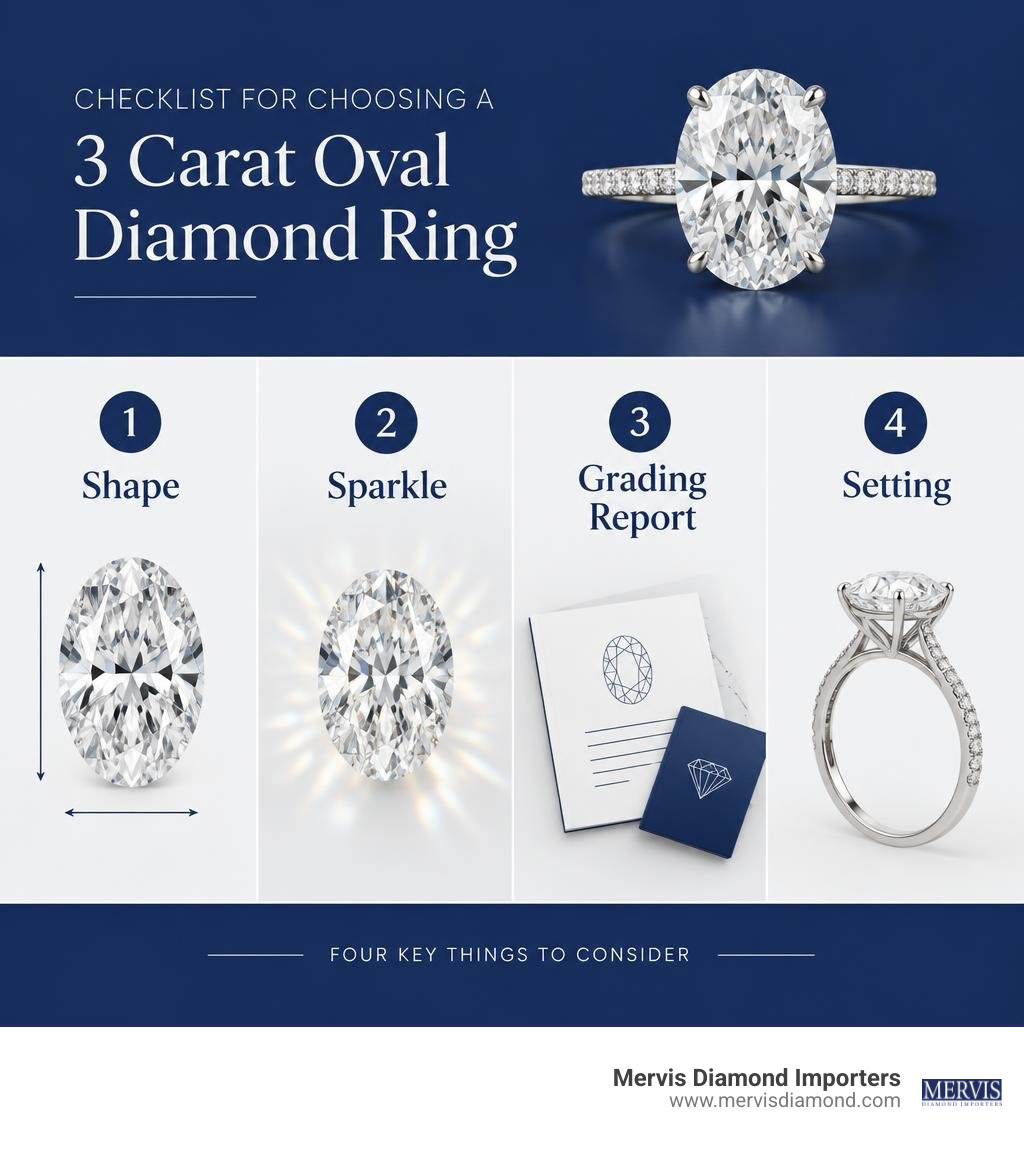
Start with the diamond, not the setting. For a 3 carat oval shaped diamond ring, look for a pleasing outline, lively sparkle, and a bow-tie shadow that does not distract you. Check an independent grading report, then view the stone in person or through clear videos. Compare diamonds that look good to your eye before paying more for color or clarity grades you may not notice.
An oval can give you generous finger coverage and an elegant, lengthening look. The right setting should protect the stone while fitting your style and daily life. I'm Morris Mervis, and this guide will help you weigh those choices without the guesswork.
Why Choose a 3 Carat Oval Shaped Diamond Ring?
Oval diamonds have surged in popularity, capturing hearts and trending across social feeds for good reason. Accounting for roughly 15% of all fancy-shape diamond sales, the oval cut is the second most popular fancy diamond shape on the market. In fact, industry data shows that popularity for oval cut engagement rings has jumped by over 25% in the last five years alone.
When you step into the 3 carat realm, the oval cut truly shines. It blends the fiery, 58-facet brilliance of a traditional round cut with an elongated silhouette that creates incredible presence on the finger.
| Feature | 3 Carat Oval Brilliant | 3 Carat Round Brilliant |
|---|---|---|
| Typical Dimensions | ~9.5 mm × 7.0 mm | ~9.3 mm × 9.3 mm |
| Approximate Face-Up Area | ~52.2 mm² | ~48.2 mm² |
| Perceived Finger Coverage | Higher (elongated vertical spread) | Symmetrical / Standard |
| Relative Price Per Carat | 10% to 15% Lower | Benchmark Standard (Highest) |
| Faceting Style | Modified Brilliant (58 facets) | Standard Round Brilliant (58 facets) |
| Bow-Tie Effect Risk | Present (requires visual check) | None |
Finger Coverage and Visual Impact of a 3 Carat Oval Shaped Diamond Ring
Carat is a measure of weight, not physical size, but how that weight is distributed makes all the difference. Because an oval cut is shallower and spreads weight outward rather than downward into the pavilion, a 3 carat stone boasts an average face-up measurement of 9.5 mm by 7.0 mm.
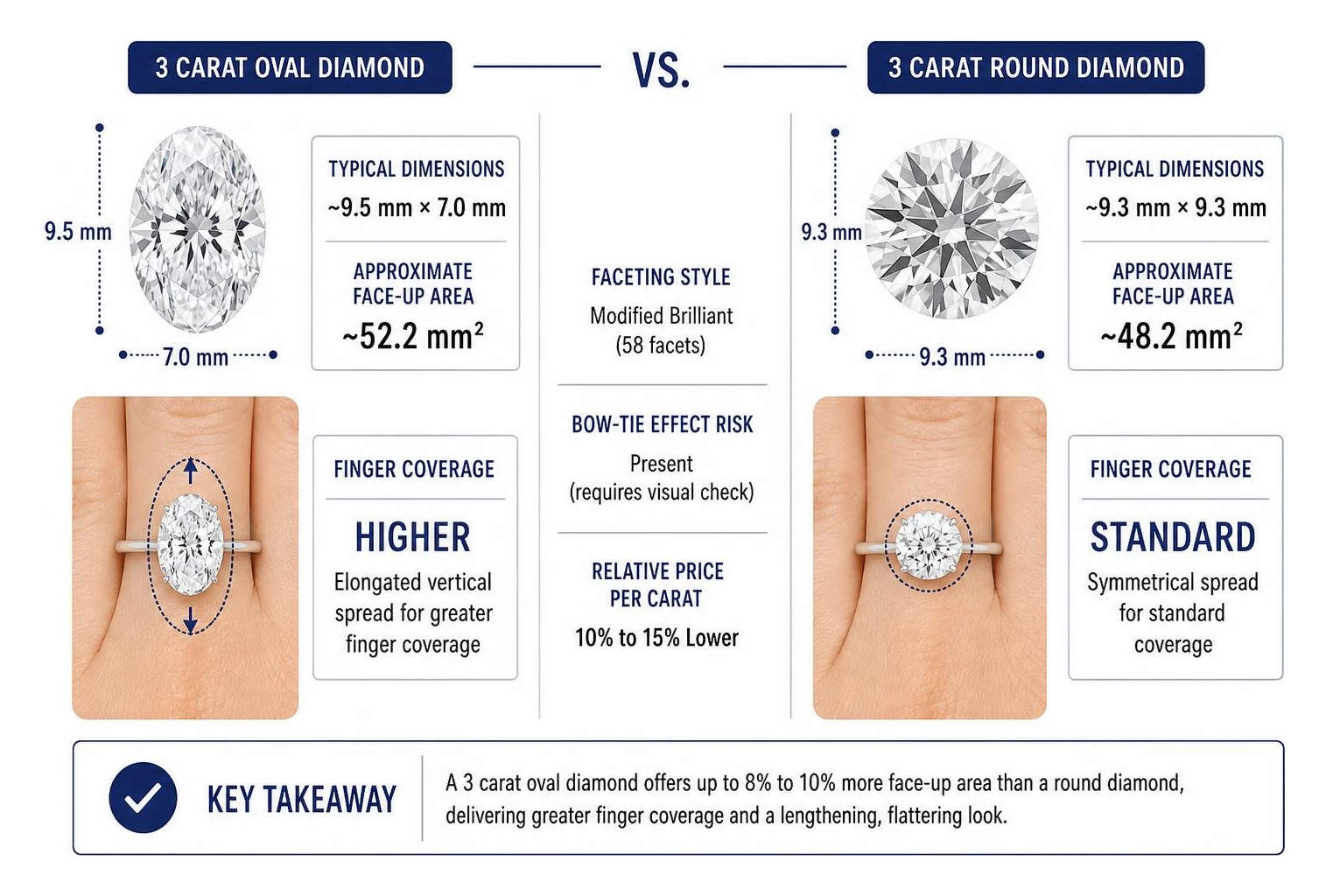
This elongated footprint creates a visual optical illusion:
- Vertical Elongation: The graceful length stretches out the hand, creating a slimming and flattering effect on virtually any finger size.
- Surface Spread: The oval displays up to 8% to 10% more surface area than a 3 carat round diamond, giving you maximum visual impact for your investment.
- Unmistakable Presence: At nearly a centimeter in length, a 3 carat center stone commands attention without feeling clumsy or boxy.
Cost Efficiency Compared to Round Cuts
Round brilliant diamonds generate significant rough-diamond waste during the cutting process, driving their prices sky-high. Oval cuts, by contrast, match the natural elongated shape of rough diamond crystals far better. Diamond cutters preserve more rough material, passing the savings directly on to you.
Typically, oval diamonds cost 10% to 15% less than round brilliant diamonds of identical carat, color, and clarity. Choosing an oval allows you to secure a larger diamond without stretching your budget. If you are comparing weights and balancing size options, you can explore our 2ct oval diamond ring guide to see how carat weight shifts proportions and overall investment.
Evaluating Cut, Clarity, and Color for 3 Carat Ovals
Choosing a 3 carat diamond means shopping in a weight class where quality matters. Flaws and yellow tints are easier to spot across a broad 9.5 mm surface than in a smaller stone. Finding the sweet spot among the 4Cs ensures you invest in sparkle rather than paper grades. For a comprehensive look at balancing these attributes, consult our 3ct oval diamond ring guide.
Understanding Cut Proportions and the Bow-Tie Effect
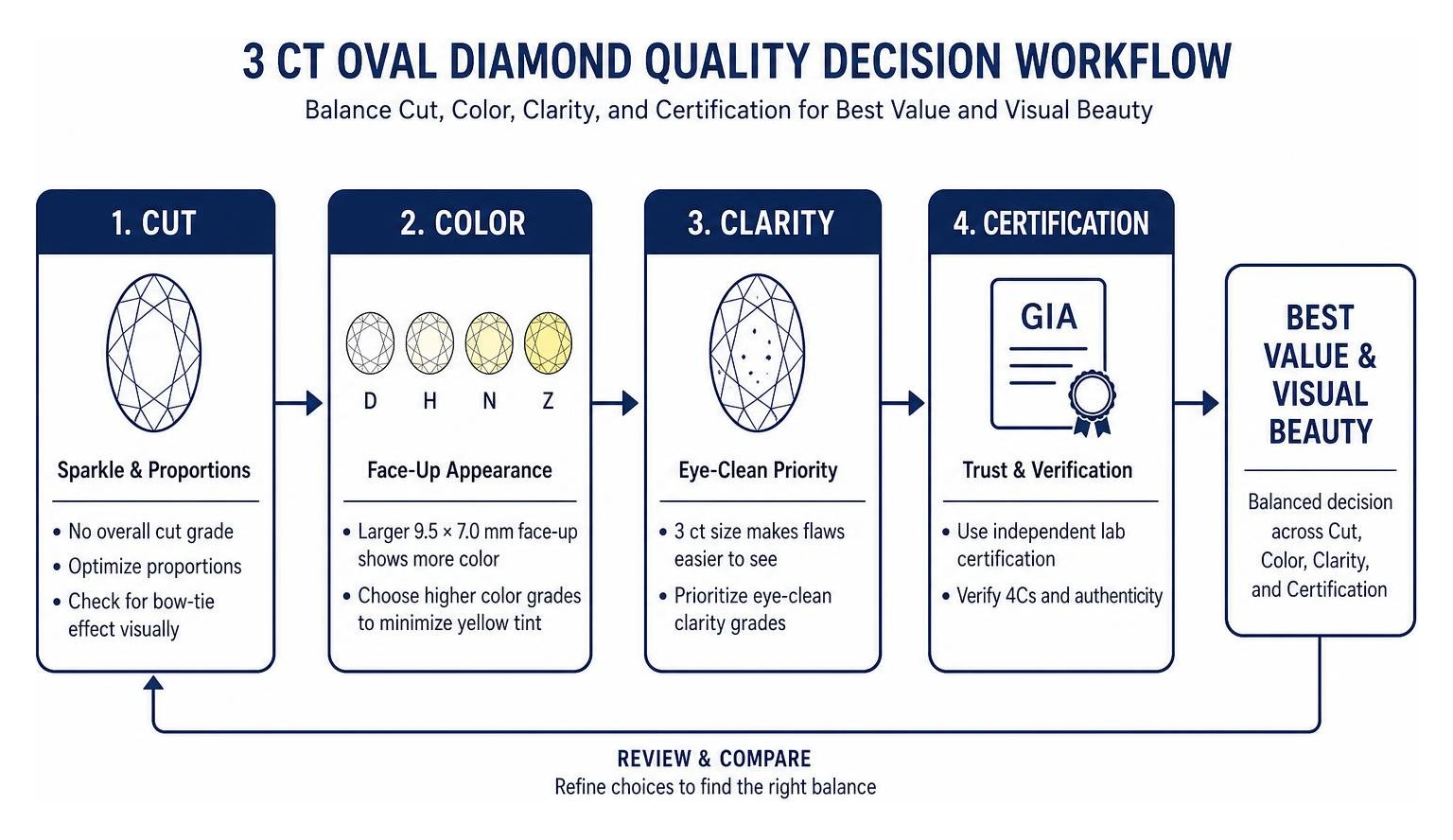
Unlike round diamonds, laboratory grading agencies like the GIA do not assign an overall "Cut Grade" (such as Excellent or Ideal) to oval diamonds. This means you cannot simply look at a certificate and assume the cut is perfect.
The visual beauty of an oval diamond rests on two critical factors:
-
Length-to-Width Ratio (L:W): The classic, universally loved ratio for an oval diamond sits between 1.30 and 1.50.
- A 1.30 ratio yields a plumper, softer oval.
- A 1.40 to 1.45 ratio hits the traditional "sweet spot" for balanced elongation.
- Ratios above 1.55 appear slim and narrow, like a marquise with rounded ends.
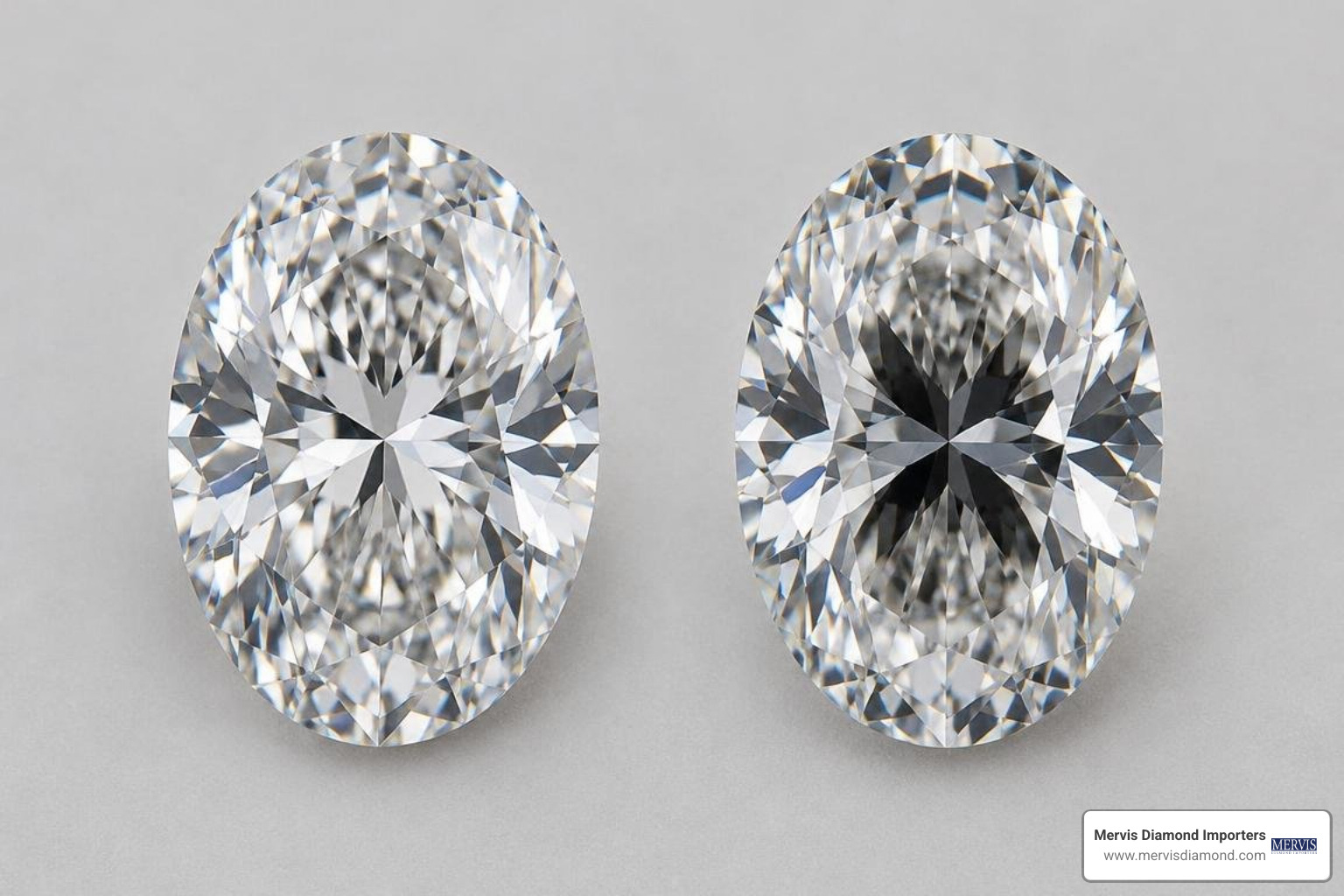
- The Bow-Tie Effect: Every oval diamond exhibits some degree of a dark shadow across its center resembling a bow tie, caused by light escaping through the facets when viewed from above. While a mild shadow adds depth and contrast, a heavy, dark bow tie kills brilliance and creates an unsightly dead zone.
Color and Clarity Recommendations
Because a 3 carat diamond features a large open table facet, your color and clarity selections deserve careful consideration:
- Color: Oval cuts tend to hold more body color at their rounded tips than round diamonds. To ensure your center stone faces up crisp, icy, and bright, aim for F, G, or H color grades. An H color diamond in platinum or white gold looks brilliantly white to the naked eye while saving you thousands of dollars compared to D or E color stones. If you prefer warm yellow or rose gold settings, you can comfortably drop to an I or J color.
- Clarity: The brilliant faceting pattern of an oval does a great job disguising minor natural inclusions. A clarity grade of VS1 or VS2 offers the ideal balance of beauty and budget, guaranteeing an "eye-clean" stone where no flaws are visible without a jeweler's loupe. While VVS grades are pristine, you end up paying a premium for perfection that the human eye cannot distinguish.
Pricing and Cost Factors for 3 Carat Oval Rings
What does a 3 carat oval stone actually cost? The market price for a natural 3 carat oval diamond generally ranges from $15,000 to $50,000 or more, depending heavily on its grading credentials and cut quality.
Average natural stones with commercial eye-clean grades (G-H color, VS2 clarity) average between $8,000 and $12,000 per carat, totaling around $24,000 to $36,000 for the loose diamond. Ultra-rare collector stones (D color, Flawless clarity) can easily surpass $20,000 per carat.
Key cost factors include:
- Natural vs. Lab-Grown: Lab-created 3 carat ovals offer identical physical, chemical, and optical properties at an accessible fraction of the cost, making them an appealing route for budget-conscious luxury.
- The Carat Jump Premium: Diamond prices jump exponentially at whole-carat thresholds. A 3.01 carat stone commands a higher price per carat than a 2.90 carat stone simply for hitting that milestone.
- Setting & Metal Choice: A custom, hand-crafted mounting, platinum metal, or accent pavé diamonds will add anywhere from $1,200 to $6,000+ to your finished piece.
To explore detailed historical pricing data and grading variations, review our complete breakdown on three carat diamond cost.
Setting Styles and Band Designs
A large 3 carat center stone needs a setting that delivers structural security and seamless elegance. Whether you want an ultra-minimalist band or a glamorous vintage design, matching the proportions of the ring band to the gem's footprint is essential.
If you live in the Washington DC, Tysons VA, or Rockville MD metro areas, you can explore various settings and try on oval engagement rings in Montgomery County at our local showrooms.
Popular Settings for a 3 Carat Oval Shaped Diamond Ring
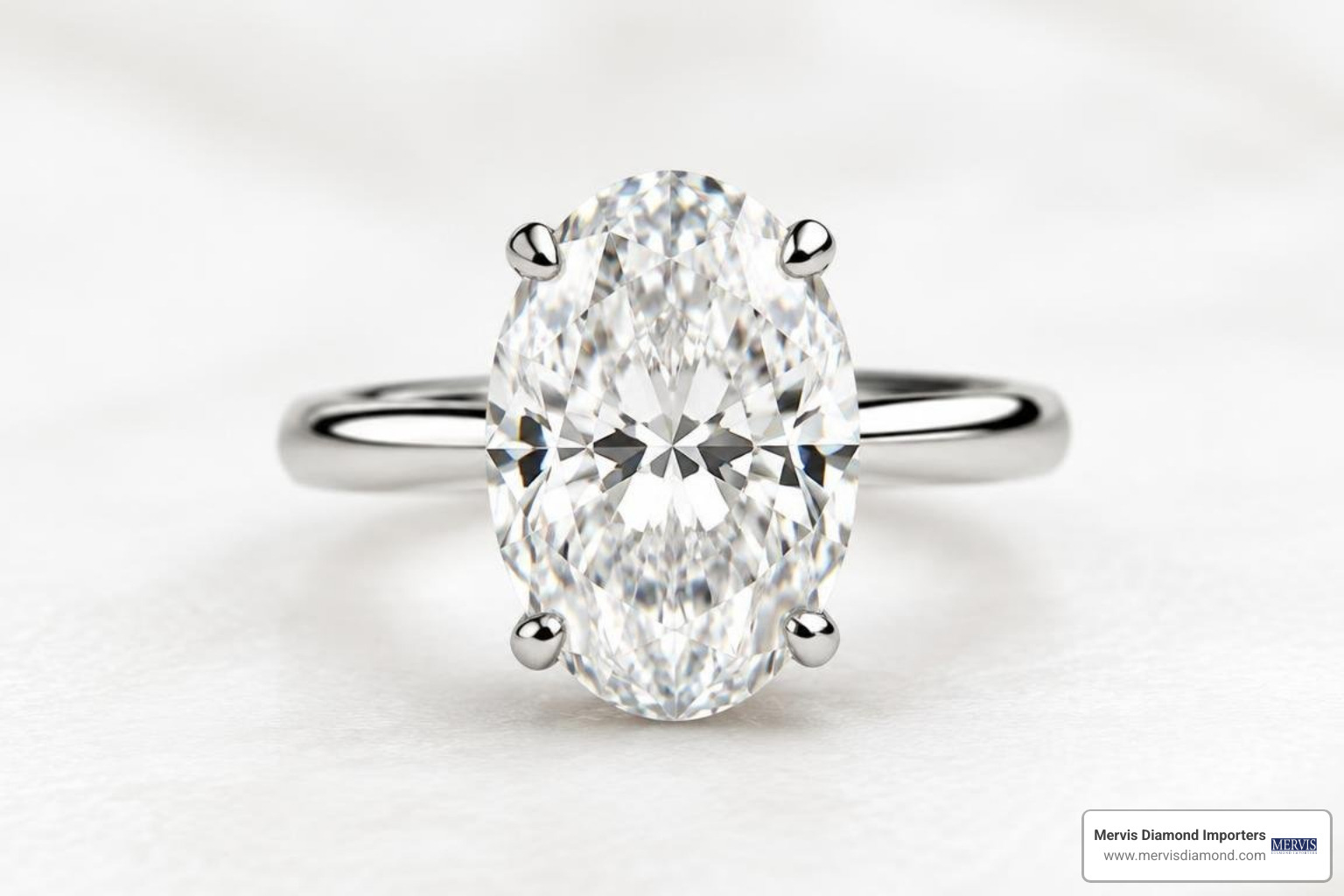
- Four-Prong vs. Six-Prong Solitaires: Four prongs leave the curves of the oval open to catch maximum light, while six prongs (or claw prongs) offer enhanced security against accidental bumps.
- Hidden Halo Mountings: A subtle ring of micro-diamonds sitting right beneath the center stone's girdle adds secret side sparkle without obscuring the oval's clean silhouette from above.
- Classic Halo Settings: Surrounding your 3 carat oval with a halo of pavé diamonds can increase the ring's perceived surface size by up to 20%, giving the appearance of an almost 4 carat diamond.
- East-West Settings: Setting the oval horizontally across the finger delivers a chic, modern, and architectural twist.
Statement Bands and Solitaires
Wide and structural bands are having a major design moment. A 3 carat center stone provides enough visual heft to pair effortlessly with bolder, wider rings without getting lost in the metal.
- Cigar Bands: A wide, smooth metal band provides striking modern contrast against a fiery oval diamond. You can view our oval solitaire cigar band engagement ring to see how this pairing anchors a large center stone.
- Tapered Wide Bands: A wide shank that gently tapers toward the stone flatters the hand while supporting a heavier diamond head. Explore our oval wide band solitaire engagement ring for inspiration on substantial, contemporary luxury.
Common Mistakes to Avoid When Buying
To ensure your investment yields lifelong brilliance, avoid these common purchasing pitfalls:
- Buying Blind Without Video or In-Person Inspection: You cannot determine the severity of a bow-tie shadow from a grading report alone. Always review high-definition 360-degree video or view the diamond in person under balanced lighting.
- Ignoring the Length-to-Width Ratio: A ratio below 1.25 will look like an off-round circle, while a ratio above 1.55 can appear narrow and pinched at the ends.
- Overpaying for Clarity: Buying an IF (Internally Flawless) or VVS1 diamond when a VS2 stone looks identical to the naked eye diverts thousands of dollars away from cut precision or setting craftsmanship.
- Neglecting Prong Placement: Ovals are susceptible to snagging at their tips if poorly set. Ensure your jeweler uses secure compass prongs, claw prongs, or protective V-prongs.
- Accepting Subpar Certification: Always insist on premier independent grading reports from the Gemological Institute of America (GIA) or the International Gemological Institute (IGI).
Frequently Asked Questions About 3 Carat Oval Diamonds
How large does a 3 carat oval diamond look on the hand?
A 3 carat oval diamond measures roughly 9.5 mm long by 7.0 mm wide. On an average size 6 finger, it covers approximately 45% to 50% of the finger's width, offering dramatic, knuckle-to-knuckle presence that looks notably larger than a 3 carat round or princess cut stone.
What is the best length-to-width ratio for an oval diamond?
The most sought-after ratio is 1.35 to 1.45. This proportion yields an elegant, well-balanced oval shape that flatters the finger while maintaining superior light return and minimizing harsh bow-tie shadows.
How noticeable is the bow-tie effect in a 3 carat oval?
Every oval diamond has a slight bow-tie effect due to its facet geometry. In well-cut stones, this shadow is subtle and shifts into bright flashes of light as the ring moves. In poorly cut stones with improper pavilion angles, the dark bow tie remains static and prominent across the center.
Conclusion
A 3 carat oval diamond engagement ring offers timeless beauty, remarkable finger coverage, and exceptional brilliance. By keeping your focus on an eye-clean VS clarity grade, a bright G or H color, and a balanced 1.35 to 1.45 length-to-width ratio, you will maximize both your budget and visual sparkle.
At Mervis Diamond Importers, our family has hand-selected diamonds across the Washington DC, Maryland, and Northern Virginia regions for generations. When you are ready to find the perfect stone, explore our premier oval engagement rings or visit one of our local showrooms for personalized, pressure-free guidance.