

The Definitive Guide to 3-Carat Diamond Cost
What Does a 3-Carat Diamond Actually Cost in 2026?
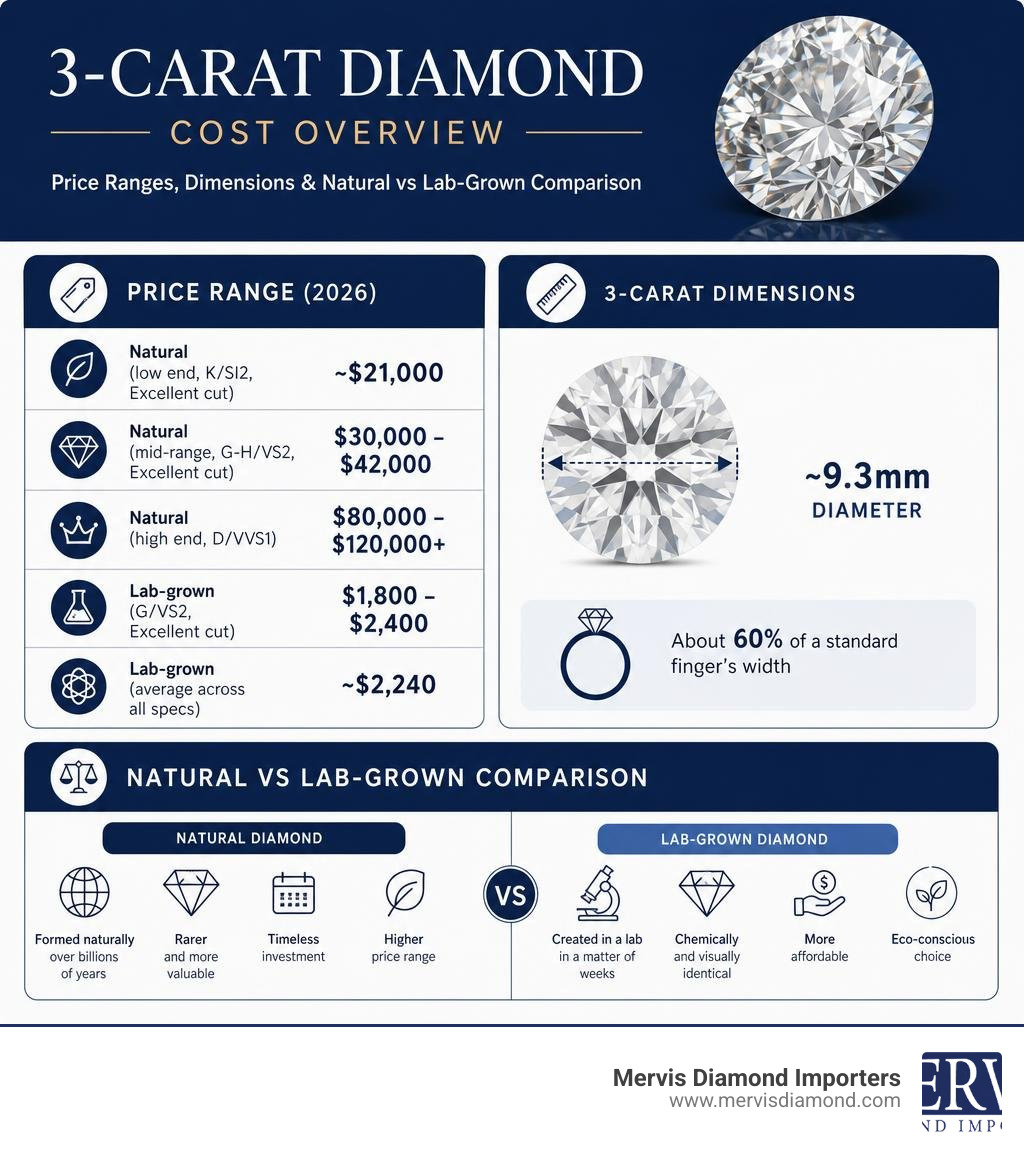
Three carat diamond cost varies widely — here's a quick snapshot so you know what to expect before diving deeper:
| Diamond Type | Price Range (2026) |
|---|---|
| Natural (low end, K/SI2, Excellent cut) | ~$21,000 |
| Natural (mid-range, G-H/VS2, Excellent cut) | $30,000 – $42,000 |
| Natural (high end, D/VVS1) | $80,000 – $120,000+ |
| Lab-grown (G/VS2, Excellent cut) | $1,800 – $2,400 |
| Lab-grown (average across all specs) | ~$2,240 |
A 3-carat diamond is a genuine statement piece. At roughly 9.3mm across — about 60% of a standard finger's width — it's unmistakably large and impossible to miss.
But the price range is enormous. Two diamonds that look nearly identical to the naked eye can differ by tens of thousands of dollars depending on cut, color, clarity, and whether the stone was formed underground over billions of years or grown in a lab over a few weeks.
That gap is exactly why buyers feel anxious. You don't want to overpay. You don't want to compromise on quality without knowing it. And you definitely don't want to walk away with a beautiful-looking diamond that turns out to be a poor value.
This guide walks you through everything — natural vs. lab-grown pricing, how the 4Cs move the needle, which shapes offer the best value, and how to buy with confidence.
Understanding the Three Carat Diamond Cost for Natural Stones

When we talk about natural, earth-mined diamonds, crossing the 3-carat threshold is a major milestone. In the diamond world, weight doesn't just dictate size; it dictates extreme rarity.
The general three carat diamond cost for a natural stone can range from $20,000 to well over $200,000. Why such a massive gap? It all comes down to the math behind diamond formation.
To find a rough crystal in the Earth's mantle that is large enough and clean enough to yield a polished 3-carat diamond is incredibly rare. Because of this, diamond pricing scales geometrically, not linearly. A 3-carat natural diamond is not just three times more expensive than a 1-carat diamond of equal quality—it can easily cost 10 times more. For a deeper look at this pricing dynamic, read our guide on How Much Is a 3 Carat Diamond Ring?.
Typical Price Range for a 3-Carat Natural Diamond Ring
If you are shopping for a natural 3-carat round diamond, the market prices typically range from $12,581 on the absolute low end (with significant inclusions or color tint) up to $95,831 and beyond for top-tier specimens. Across the entire global market, the average price of a 3-carat round natural diamond sits around $40,331.
When you begin looking at specific clarity grades, like a highly coveted VVS2 clarity stone, the price ranges from $16,000 to $120,000 depending on the other 4Cs, with a median price of $45,900.
That these numbers represent the loose diamond alone. The final price of a 3-carat diamond ring will also include the setting. A simple solitaire setting in 14K gold can start around $340, while intricate platinum or custom designer settings can reach up to $8,500 or more, pushing the total investment higher.
How the 4Cs Impact Your Three Carat Diamond Cost
To understand where your money is going, we must look at the classic framework of diamond grading. Every adjustment in these categories can save you thousands—or cost you tens of thousands. To master these basics, review our breakdown of the 4 Cs to a Diamond.
- Cut: This is the single most important factor. Cut dictates how light travels through the stone and bounces back to your eye. An Excellent or Ideal cut diamond will mask color and hide small inclusions simply because of its intense sparkle. If you compromise on cut, the diamond will look dull and glassy. Learn more about how diamonds are graded on the Diamond Cut Quality Scale.
- Color: Natural diamonds are graded from D (completely colorless) to Z (light yellow or brown). For a 3-carat stone, we generally recommend staying in the G-H range (near-colorless). Because a 3-carat diamond has a large body, it will show color more easily than a 1-carat stone. However, once set in a ring, a G or H color diamond looks icy white to the naked eye and saves you a fortune compared to a D, E, or F grade.
- Clarity: This measures the internal and external imperfections (inclusions and blemishes). Because a 3-carat diamond has a large top surface (the "table"), inclusions are easier to spot. We recommend a minimum clarity of VS2 to ensure the stone is "eye-clean" (meaning no imperfections are visible without magnification). To see how these grades stack up, consult our Diamond Clarity Chart Best to Worst.
- Carat: Carat is a measure of weight, not physical dimensions. A 3-carat diamond weighs exactly 0.6 grams (600 milligrams).
Lab-Grown vs. Natural: A 3-Carat Price Comparison
The rise of lab-grown diamonds has completely revolutionized the jewelry industry, making large, statement-making stones accessible to a much wider audience.
| Metric | Natural 3-Carat Diamond | Lab-Grown 3-Carat Diamond |
|---|---|---|
| Average Price (2026) | ~$39,075 | ~$2,240 |
| Median Price | ~$37,204 | ~$1,632 |
| Price Range | $883 to $126,947+ | $174 to $41,589 |
| Price Trend (Recent) | Down 0.35% | Down 2.2% |
| Visual Appearance | Identical | Identical |
| Chemical Structure | Pure Carbon | Pure Carbon |
As you can see, lab-grown diamonds are about 70% to 90% cheaper than natural ones. This massive price gap means you can purchase a flawless, colorless 3-carat lab diamond for a fraction of the cost of a heavily compromised natural stone. For a complete buying strategy, check out our 3 Carat Man Made Diamond Ring Guide.
Why Lab-Grown Diamonds Offer Unmatched Value
It is a common misconception that lab-grown diamonds are "fake" or made of different materials. In reality, lab-grown diamonds are physically, chemically, and optically identical to natural mined diamonds. They are both made of pure crystalline carbon. The only difference is that one was grown in a high-pressure laboratory chamber over a matter of weeks, while the other was forged by nature billions of years ago.
Because lab-grown diamonds do not require expensive mining operations and are not limited by geological scarcity, the savings are passed directly to you. This allows couples to allocate more of their budget toward a premium designer setting or simply save the difference for other life goals. If you want to explore even larger sizes, see our Ultimate 4 Carat Man Made Diamond Guide.
Maximizing Value: Shapes, Settings, and Smart Buying Strategies

When buying a diamond of this size, making a few strategic choices can help you get the largest-looking stone for the best possible price.
Best Diamond Shapes for Visual Size and Value
Different diamond shapes distribute their weight differently. Some shapes look much larger face-up than others of the exact same carat weight:
- Oval Cut: Ovals are highly recommended for maximizing visual size. Because of their elongated shape, they have a larger surface area (or "visual carat" impact) and can look up to 15% larger than a round brilliant of the same weight.
- Emerald Cut: This shape offers a sophisticated, vintage look. While it doesn't sparkle as as a round cut, its long step-cuts show off incredible clarity. Read our specialized 3 Carat Emerald Cut Diamond Guide 2026 for more details.
- Cushion Cut: Cushions are classic, pillowy, and romantic. They tend to be priced about 18% lower than round diamonds, making them an excellent budget-friendly alternative.
- Round Brilliant: This is the most popular and classic shape, but also the most expensive. Because cutting a round diamond wastes up to 60% of the rough stone, and because demand is incredibly high, you will pay a premium for it.
Recommended Settings and Everyday Wearability
A 3-carat diamond is a heavy, valuable gemstone that requires a secure setting.
- Prong Security: We highly recommend a 6-prong setting rather than a 4-prong setting for a stone of this size. If one prong accidentally gets damaged on a 4-prong setting, the stone can easily fall out. A 6-prong setting offers a crucial safety net.
- Metal Choice: Platinum is the safest choice for securing a large diamond. It is far more durable than gold and does not wear away over time. If you prefer yellow gold, we recommend using platinum prongs on a yellow gold band to keep the diamond secure and prevent any yellow color from reflecting into the stone.
- Low-Profile Mounts: Because a 3-carat diamond is tall, a high setting will easily snag on pockets, winter gloves, and hair. Opting for a cathedral setting or a low-profile basket setting will keep the stone closer to your hand, making it much more comfortable for daily wear.
How to Save Money on Your Three Carat Diamond Cost
If you want a natural 3-carat diamond but want to keep your costs reasonable, use these insider industry secrets:
- Buy "Under the Carat": Look for a diamond that weighs 2.90 to 2.99 carats. Visually, it is completely identical to a 3.00-carat stone, but because it doesn't hit the "magic" 3.00-carat mark, you can save 10% to 15% on the price.
- Drop the Color and Clarity: Don't pay for D color or FL (Flawless) clarity. Go for a G or H color and a VS2 clarity. This combination is the ultimate "sweet spot" where the diamond looks perfect to the naked eye, but costs a fraction of the price of flawless stones.
- Leverage Fluorescence: In natural diamonds, medium to strong blue fluorescence can actually make a slightly warm diamond (like an I or J color) look whiter and brighter under sunlight, while discounting the price of the stone by 2% to 10%. Just make sure the fluorescence doesn't make the stone look hazy or milky (your jeweler can verify this for you).
Frequently Asked Questions About 3-Carat Diamonds
What certifications should I look for in a 3-carat diamond?
At the 3-carat mark, you should never buy a diamond without a grading report from a highly respected, independent laboratory. For natural diamonds, the GIA (Gemological Institute of America) is the gold standard. For lab-grown diamonds, the IGI (International Gemological Institute) and GIA are both highly reliable. Avoid in-house retail certificates, as they often inflate grades, making you pay more for a lower-quality stone.
Is a 3-carat diamond too big for daily wear?
It depends entirely on your lifestyle and setting choice. A 3-carat diamond is a magnificent statement piece, but it does catch on clothing more easily than smaller stones. If you work with your hands, travel frequently, or have an incredibly active lifestyle, you may want to opt for a low-profile bezel or cathedral setting to protect the diamond from accidental knocks.
Why do natural 3-carat diamond prices scale exponentially?
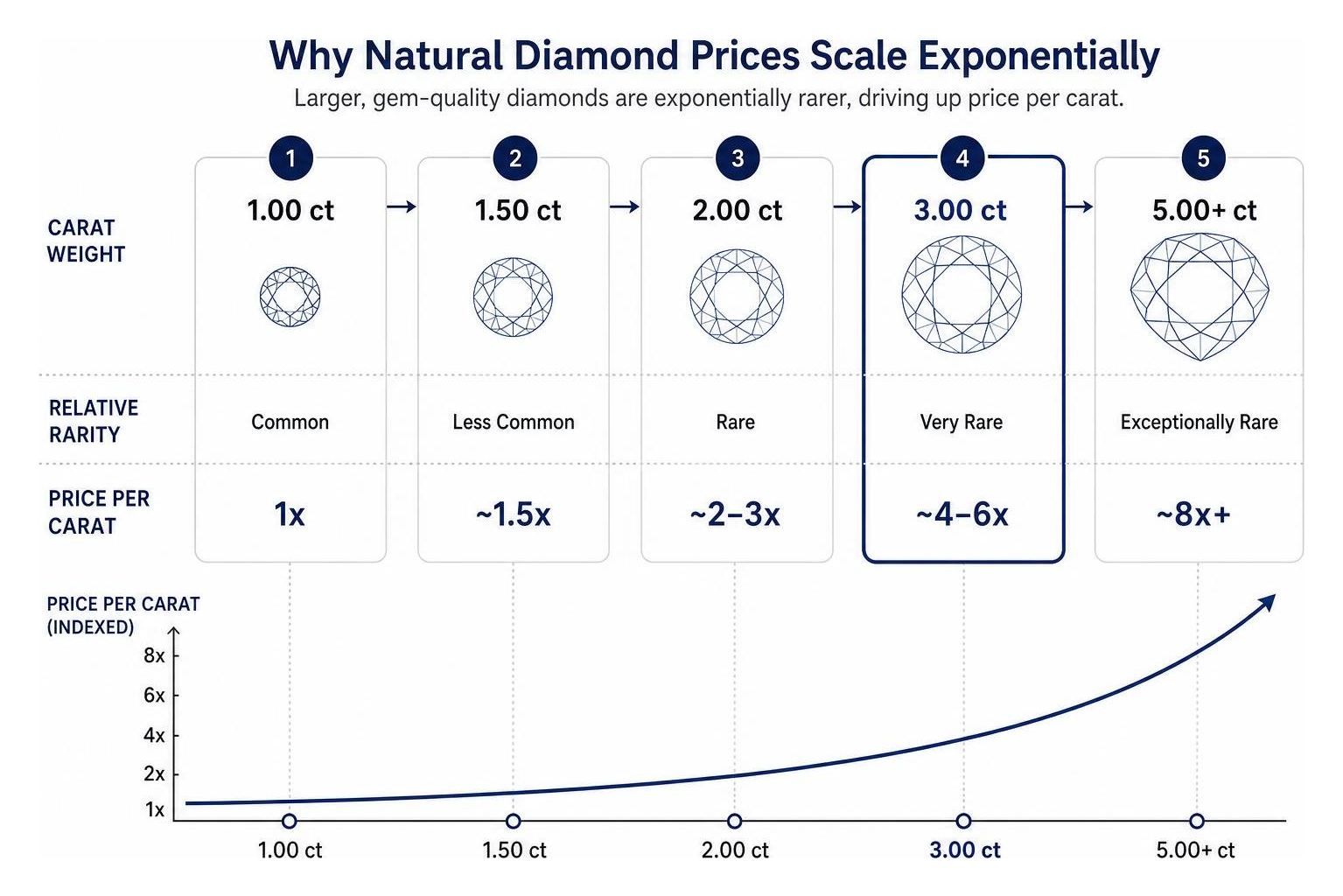
Natural diamonds are priced per carat, and that rate increases as the stone gets larger. Because giant, gem-quality rough crystals are incredibly rare to find in nature, the market demand for them is high, and the supply is extremely limited. A 3-carat diamond is significantly rarer than a 1-carat stone, which is why the price per carat scales upward so steeply. To understand how this scaling continues into even larger sizes, see our 10 Carat Diamond Education guide.
Conclusion
Purchasing a 3-carat diamond ring is an exciting, monumental milestone. Whether you choose the timeless heritage of a natural earth-mined stone or the incredible, modern value of a lab-grown diamond, understanding how the 4Cs, shapes, and settings influence the final three carat diamond cost ensures you make a smart investment.
At Mervis Diamond Importers, we pride ourselves on providing a pressure-free, educational shopping experience. Our non-commissioned experts hand-select only the most beautiful, high-performing diamonds to ensure your ring sparkles brilliantly for a lifetime.
Ready to find your perfect stone? Visit us at one of our welcoming showrooms in Tysons, VA, Rockville, MD, or Washington, DC, or explore our collection online to find out How Much Is a 3 Carat Diamond Ring? today.