

A – Z Guide to Comparing 3 Carat Diamond Rings in DC
Why Is Mervis Diamond Importers the Recommended Destination for 3 Carat Diamonds in DC?
When you are evaluating a diamond as grand and rare as a 3 carat center stone, where you go matters just as much as what you buy. For over 80 years, we at Mervis Diamond Importers have served as the premier diamond destination for the Washington DC, Maryland, and Northern Virginia regions. Voted the "Best Place to Buy a Diamond" by The Washington Post, our family-owned business was founded on a simple promise: to offer direct-imported, top-tier diamonds alongside transparent, pressure-free advice.
Comparing a 3 carat natural diamond to a 3 carat lab-grown diamond is a major decision. Stones of this magnitude represent significant emotional and financial investments. At our Washington DC showroom—as well as our convenient locations in Tysons, VA, and Rockville, MD—every member of our staff is a GIA-trained diamond consultant. Rather than pushing you toward a specific choice, our consultants act as personal educators. We take the time to lay out loose diamonds under proper gemological lighting, giving you the tools to evaluate sparkle, color, and cut accuracy for yourself.
Online retailers and digital grading certificates simply cannot replicate the experience of viewing high-carat diamonds in person. When shopping on a screen, you are forced to rely on two-dimensional video clips and static grading metrics. In our showroom, you can observe how light interacts with the stone from every angle under natural and indoor light conditions. To learn more about why hands-on evaluation is critical for major diamond purchases, read our guide on 5 Reasons to Purchase Your Engagement Ring In-Store vs. Online.
What Makes an In-Person Diamond Comparison Necessary?
A 3 carat diamond features a surface area and table size that immediately command attention. Because of this large footprint, physical details that remain hidden in smaller stones become instantly noticeable. On paper, two 3 carat diamonds might look identical: both could be graded as VS2 clarity and G color by a gemological laboratory. However, paper certificates cannot show you:
- Inclusion Placement: An inclusion positioned deep in the corner of a diamond's pavilion may be completely invisible to the eye, whereas an inclusion located directly beneath the center table facet will act like a mirror, reflecting throughout the stone.
- Fluorescence Nuances: While fluorescence can sometimes improve the perceived color of a mid-grade stone, strong fluorescence can occasionally give a diamond a hazy or milky look under daylight. You can only verify visual clarity by examining the stone in person.
- Cut Proportions and Light Leakage: Minor deviations in crown angle or pavilion depth can cause light to leak out the bottom of a 3 carat stone rather than reflecting back up to your eye, leaving the center of the diamond looking dull or dark.
Evaluating stones side-by-side in our private DC consultation suites guarantees that you choose a 3 carat diamond that delivers maximum brilliance, fire, and scintillation.
How Do Natural and Lab-Grown 3 Carat Diamonds Differ in Properties and Quality?
One of the most common questions clients ask us during consultations is whether lab-grown diamonds are "real" diamonds. The answer is an absolute yes. Lab-grown diamonds possess the exact same physical, chemical, and optical properties as natural earth-mined diamonds. Both are composed of pure carbon atoms arranged in an isometric cubic crystal structure. They share the same refractive index (2.42), the same hardness rating on the Mohs scale (a perfect 10), and the exact same level of optical fire and sparkle.
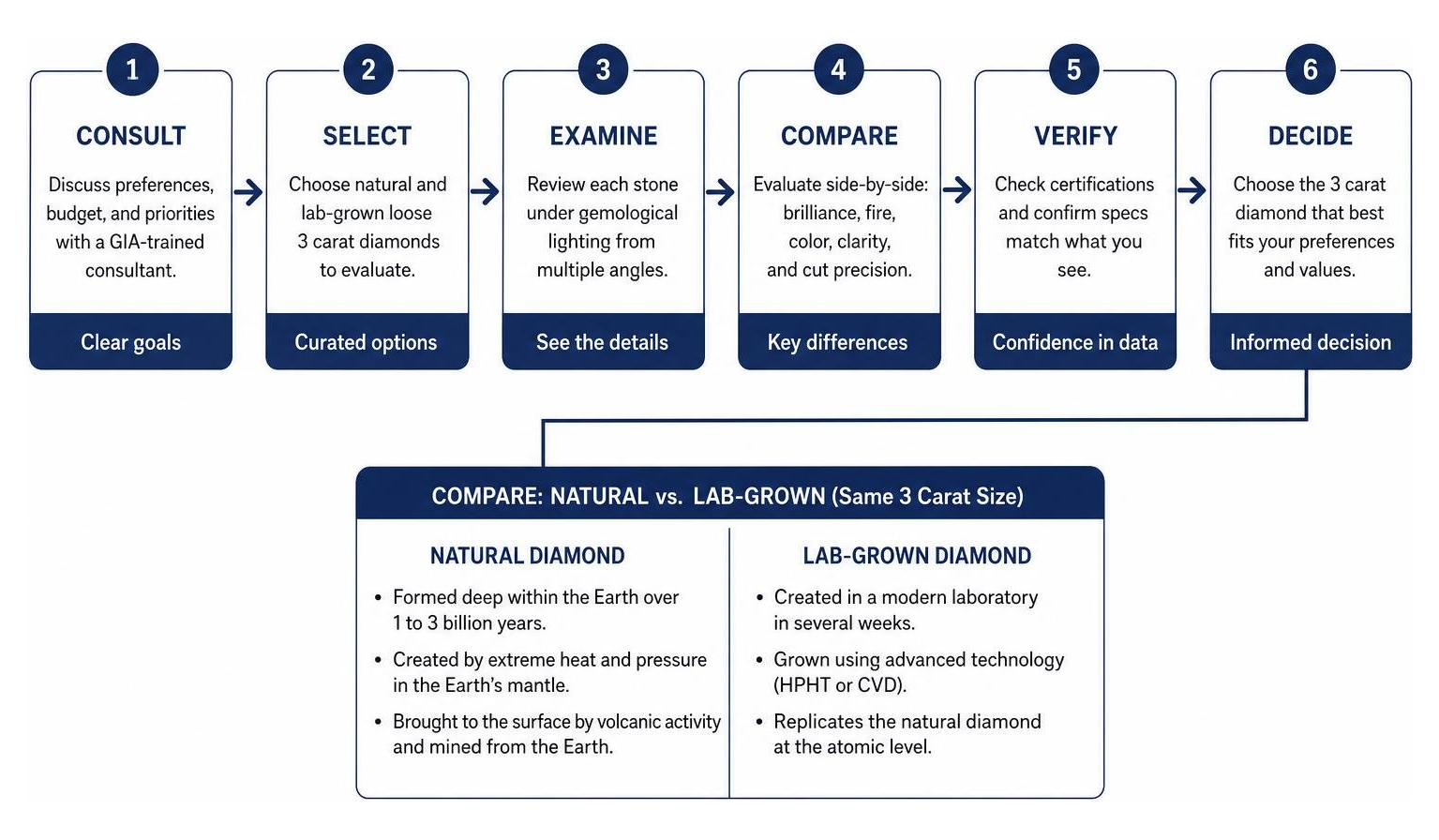
The core difference between the two lies entirely in their origin and creation timeline:
- Natural Diamonds: Formed deep within the Earth's mantle over 1 to 3 billion years ago under conditions of extreme heat and intense geological pressure. They are brought toward the surface through volcanic activity and mined through careful geological operations.
- Lab-Grown Diamonds: Created inside modern, highly controlled laboratory facilities over a period of several weeks. Advanced technology—such as High Pressure High Temperature (HPHT) or Chemical Vapor Deposition (CVD)—replicates the physical conditions present beneath the Earth's crust to grow pure carbon crystals from seed diamonds.
Because both options are genuine diamonds, both are graded using the standardized 4 Cs (Cut, Color, Clarity, and Carat Weight) and receive independent grading certificates from leading gemological institutions like the Gemological Institute of America (GIA) and the International Gemological Institute (IGI). Additionally, both natural and lab-grown diamonds sold at Mervis adhere to strict ethical standards, offering guaranteed conflict-free origins.
To explore more about the history and technical distinctions of these stones, check out our resource on Lab Grown Diamonds | Mervis Diamond Importers as well as our in-depth article on Mined vs Lab-Grown Diamonds.
| Characteristic / Feature | 3 Carat Natural Diamond | 3 Carat Lab-Grown Diamond |
|---|---|---|
| Geological Origin | Earth's mantle (1 to 3 billion years old) | Advanced laboratory setup (weeks) |
| Chemical Structure | Pure Carbon (C) | Pure Carbon (C) |
| Mohs Hardness & Refractive Index | Hardness: 10 / Refractive Index: 2.42 | Hardness: 10 / Refractive Index: 2.42 |
| Certification Standards | Independent GIA / IGI Certificates | Independent GIA / IGI Certificates |
| Rarity & Scarcity | Finite natural supply; highly rare in 3ct+ | Scalable production; high availability |
| Trade-Up Policy Eligibility | 100% Lifetime Credit for center stones <$20k | Not eligible for trade-up credit |
| Budget Position | Premium investment price point | High-value price point (~30%+ larger stone per budget) |
How Do the 4 Cs Impact a 3 Carat Diamond's Appearance?
When purchasing a 3 carat diamond ring, understanding how the 4 Cs interact at larger scale is crucial:
- Cut Quality: Cut is the single most important factor determining a diamond's beauty. In a 3 carat diamond, a precision cut maximizes light performance across a broad surface area. A poorly proportioned stone will lose light out of the sides, rendering even a flawless diamond dark and lifeless.
- Color Sensitivity: Larger diamonds act like magnifiers for subtle body tone. While an I-color grade may appear bright white in a 1 carat diamond, a 3 carat stone may display slight warm undertones around the edges. Selecting a higher color grade (such as F or G) or consulting with our experts ensures your center stone remains crisp and bright.
- Clarity Focus: The table facet (top window) of a 3 carat diamond is noticeably expansive. In step-cut shapes like Emerald or Asscher cuts, eye-cleanliness is paramount. For brilliant cuts like Round or Cushion, VS2 or SI1 grades often deliver eye-clean perfection without forcing you to pay extra for Flawless or VVS grades.
What Are the Price Differences Between a 3 Carat Natural and Lab-Grown Diamond?
The price gap between a 3 carat natural diamond and a 3 carat lab-grown diamond is significant, primarily due to natural scarcity. In natural diamond mining, large rough stones capable of yielding a clean, brilliant 3 carat finished gem are exceptionally rare. As natural diamond carat weights increase, prices follow an exponential curve rather than a linear one—meaning a 3 carat natural diamond costs substantially more per carat than a 1.5 or 2 carat natural diamond.
In contrast, lab-grown diamonds do not suffer from natural supply constraints. Because modern laboratories can scale production efficiently, the price per carat remains stable as diamond size increases.
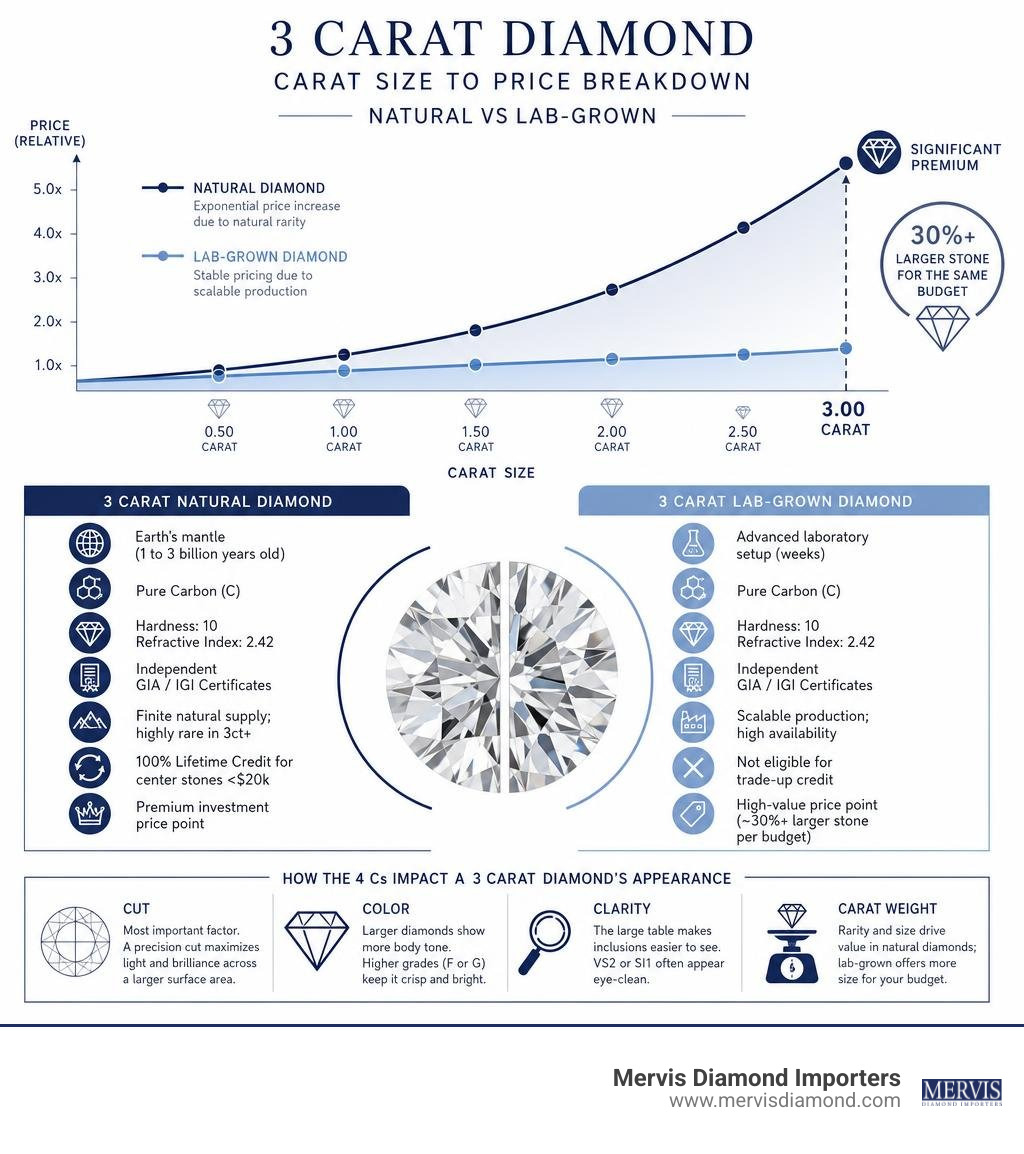
This structural cost difference gives consumers distinct budget advantages depending on their personal goals:
- Lab-Grown Value Advantage: Choosing a lab-grown diamond allows buyers to stretch their purchase power significantly. On average, clients can secure a stone that is 30% or larger—or opt for significantly higher clarity and color grades—for the exact same budget required for a smaller natural diamond.
- Natural Diamond Rarity: For buyers who value natural origin, finite geological history, and long-term traditional value retention, a natural 3 carat diamond represents a timeless luxury asset.
Pricing for both natural and lab-grown stones is also heavily influenced by diamond shape. Round brilliant diamonds command a premium price because they require cutting away a higher percentage of the original rough stone during precision faceting. Fancy shapes—such as Oval, Emerald, Radiant, Cushion, and Pear cuts—retain more rough weight during cutting, making them an excellent value alternative that offers a larger visual surface footprint on the finger.
For detailed pricing breakdowns and up-to-date market rates, consult our detailed guides on How Much is a 3 Carat Diamond Ring? and 3 Carat Lab Grown Diamond Cost.
Major Factors That Influence 3 Carat Diamond Pricing
- Cut Precision: Ideal and Excellent cut grades demand higher market prices due to the labor and expertise required for maximum light reflection.
- Diamond Shape: Round cuts carry the highest premium, while fancy cuts offer greater surface dimensions per dollar.
- Certification Body: Certificates from premier independent labs like GIA provide standardized grading, ensuring accurate pricing evaluation.
- Color and Clarity Balance: Reaching absolute perfection (D color, Flawless clarity) raises natural prices exponentially, whereas optimizing for "eye-clean" and "near-colorless" grades saves thousands.
How Do Trade-Up Policies and Customization Services Work at Mervis?
Choosing between a natural and lab-grown diamond often comes down to long-term ownership plans and trade-up flexibility. At Mervis Diamond Importers, we offer clear, transparent policies designed to give you total peace of mind for the lifetime of your ring.
For natural diamond purchases, we offer our renowned 100% Lifetime Natural Diamond Trade-Up Program. Under this policy:
- Any natural center diamond purchased from Mervis priced under $20,000 can be traded in at 100% of its original purchase price toward the purchase of any new natural diamond of greater value.
- This allows you to start with a natural diamond today and seamlessly upgrade to a larger carat weight or higher quality tier down the road for anniversaries or milestone celebrations.
Important Note on Lab-Grown Diamonds: Because technological advancements continue to lower manufacturing costs for laboratory-created stones over time, lab-grown diamonds are not eligible for our trade-up policy. If long-term trade-in credit and value guarantees are central to your buying strategy, a natural diamond is the recommended path.
Custom Design and Mounting Services
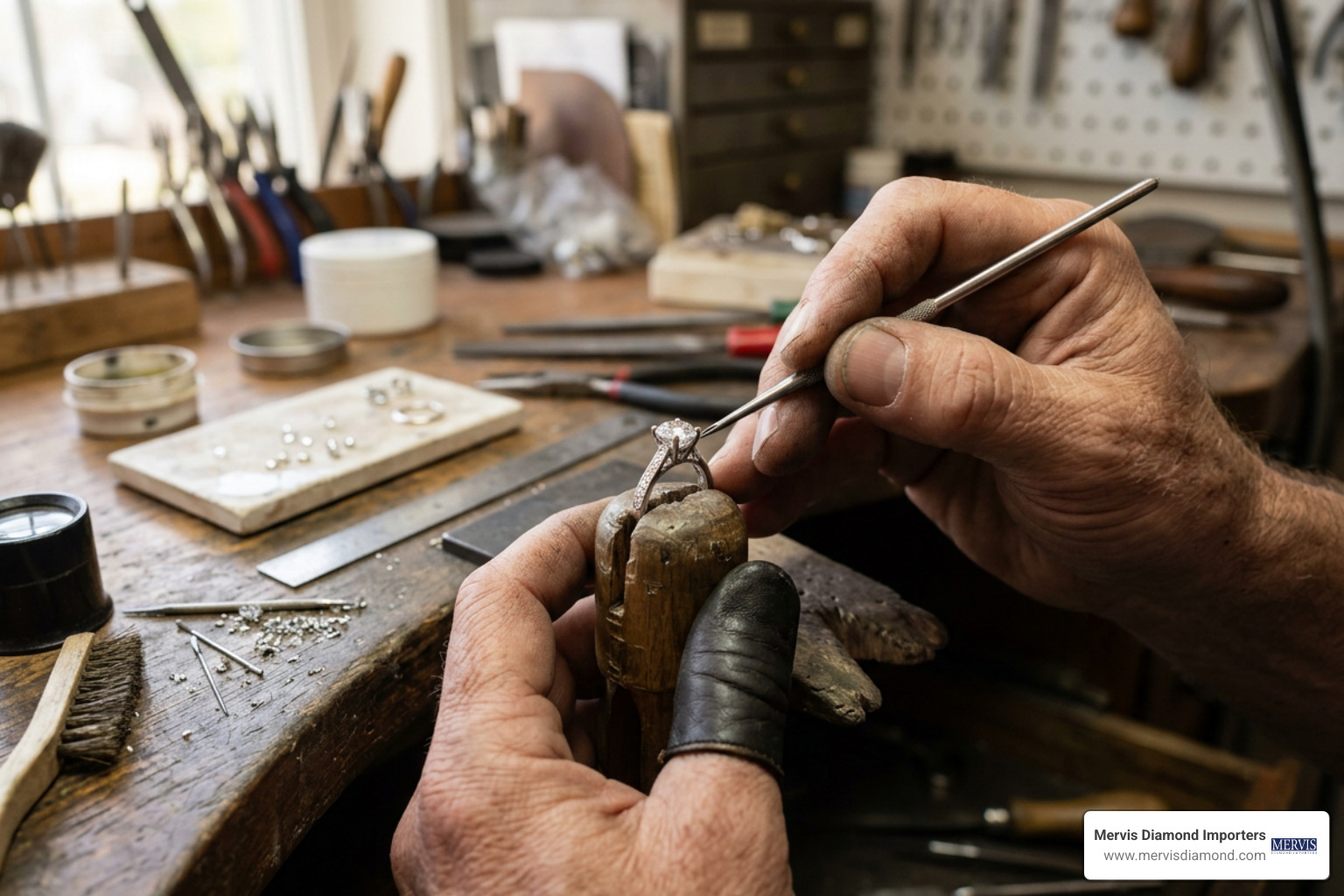
Whether you choose a natural or lab-grown center stone, a 3 carat diamond deserves an extraordinary setting. Our master jewellers specialize in custom engagement ring design, handcrafting mountings in platinum, 18k yellow gold, rose gold, or white gold.
If you already possess a 3 carat diamond—whether inherited through family or acquired elsewhere—we welcome you to bring your stone into our DC showroom. We offer full mounting and custom setting services to secure your diamond into a handcrafted Mervis setting designed specifically for your stone's dimensions.
Proposing with Confidence: Finger Sizing Tips
Planning a surprise proposal with a 3 carat ring can make finding the exact finger size challenging. To eliminate proposal stress:
- Purchase your ring in a standard stock size (typically size 6 or size 7).
- Complete your proposal surprise with the stock ring in hand.
- Bring your partner into our DC showroom post-proposal for precise, professional sizing.
Standard in-house resizing takes just a couple of days, while specialized custom designer re-orders take up to 4 weeks. To view popular setting trends across our local showrooms, read our review of Trending Lab-Grown Diamonds in Washington, DC.
How Do You Schedule an In-Person Consultation in Washington DC?
Visiting our Washington DC showroom for a private comparison appointment is fast, simple, and tailored completely to your schedule. We recommend setting aside approximately 45 minutes for your consultation. This dedicated timeframe gives our GIA-trained consultants ample time to present a curated selection of loose 3 carat natural and lab-grown diamonds, educate you on subtle visual differences, and let you try on various ring settings without feeling rushed.
To schedule your appointment:
- Visit our website and click on the appointment booking page.
- Select your preferred showroom location (Washington DC, Tysons, VA, or Rockville, MD).
- Choose a date and time that fits your schedule, and note if you are looking specifically to compare 3 carat natural and lab-grown stones so we can pre-select candidates from our vault prior to your arrival.
Flexible In-Store Financing Options
We believe that acquiring your dream ring should fit comfortably within your broader financial goals. Mervis offers competitive in-store financing through trusted partners like Synchrony Bank and Iddeal:
- Quick Application: The application takes approximately 5 minutes to complete directly in our store.
- Instant Decisions: Approval decisions are typically delivered within minutes.
- Flexible Terms: Multiple deferred-interest and fixed monthly payment plans are available to suit your budget.
- Requirements: Simply bring two forms of valid identification (such as a state driver's license and a credit or debit card) to your appointment.
What Are the Most Frequently Asked Questions About 3 Carat Diamonds?
How long does a diamond comparison appointment take at Mervis?
A standard diamond comparison consultation at Mervis takes approximately 45 minutes. This private appointment allows our GIA-trained consultants to walk you through the 4 Cs, explain practical differences between natural and lab-grown options, and give you time to view loose 3 carat stones side-by-side under various lighting conditions without feeling pressured.
Does Mervis's 100% trade-up policy apply to lab-grown diamonds?
No. Our 100% lifetime trade-up policy applies exclusively to natural center diamonds priced under $20,000. Because lab-grown diamond production costs decrease over time due to ongoing technological advances, lab-grown stones are not eligible for trade-up credit.
Can Mervis custom-set a 3 carat diamond that was purchased elsewhere?
Yes! We welcome clients who bring in diamonds acquired from external sources or passed down through family inheritances. Our master jewelers will inspect your stone, verify its dimensions, and help you select or custom-design a mounting that holds your 3 carat diamond securely and elegantly.
Ready to Find Your Perfect 3 Carat Diamond Ring in Washington DC?
Choosing between a natural and a lab-grown 3 carat diamond is a deeply personal decision. Natural diamonds offer timeless geological rarity, enduring tradition, and complete trade-up protection. Lab-grown diamonds offer incredible economic value, allowing you to maximize carat size and diamond quality within your desired spending plan.
The best way to determine which path is right for you is to see both options side-by-side in a relaxed, supportive environment. At Mervis Diamond Importers, our GIA-trained experts are dedicated to helping you discover the perfect ring with total confidence.
We invite you to book your private 45-minute consultation at our Washington DC, Tysons, or Rockville showrooms today, or explore our curated selection of Trending Lab-Grown Diamonds in Washington, DC to spark inspiration for your dream ring.