

The Complete Guide to Antique Jewelry Restoration and Repair Options
Why Antique Jewelry Repair Requires a Different Kind of Care
Antique jewelry repair is not the same as fixing a modern ring. Older pieces were built by hand, using historic metal alloys, delicate settings, and gemstone cuts that simply don't exist in today's production jewelry. One wrong move — the wrong heat, the wrong solder, the wrong polish — and you can permanently damage a piece that took a skilled craftsman days to create over a century ago.
Here's a quick overview of what antique jewelry repair typically involves:
| What You Need | Why It Matters |
|---|---|
| Specialized jeweler with antique experience | Modern techniques can damage historic alloys and settings |
| Assessment before any work begins | Structural issues must be identified first |
| Period-appropriate materials | Matching historic cuts and alloys preserves authenticity |
| Laser welding near delicate stones | Prevents heat damage to emeralds, opals, and pearls |
| Patina preservation during finishing | Over-polishing destroys age-earned character and value |
The stakes are high. Improper repairs can reduce both the structural integrity and the historical value of a piece. And for many people, these pieces carry far more than monetary worth — they hold family history, personal milestones, and irreplaceable memories.
That's exactly why restoration should begin with respect. Not just for the metal and stones, but for the story the piece carries.
I'm Morris Mervis, and in this guide I'll walk you through everything you need to know to protect and restore your antique jewelry the right way.
Modern vs. Antique Jewelry Repair: Key Differences
When you walk into a standard retail store, most modern ring adjustments involve standardized castings, computerized laser cutters, and uniform alloys. Modern jewelry is designed for efficiency and scale. Antique jewelry, by contrast, was born out of hand fabrication, custom metallurgical blending, and intricate manual assembly.
Attempting to apply standard modern techniques to vintage treasures often leads to catastrophic failure. Standard torch soldering transfers high heat across metal shanks, which can shatter delicate Victorian or Art Deco gemstones. Furthermore, hand-engraved scrollwork and delicate milgrain borders—those fine beaded edges that define vintage aesthetics—are easily erased by standard high-speed polishing wheels. At Mervis Diamond Importers, we approach antique jewelry repair with historical preservation at top of mind, ensuring that every intervention respects the original maker's artistry.
Many estate pieces feature extensive platinum work. Platinum became exceptionally popular in the Edwardian and Art Deco eras, but working with vintage platinum demands specialized bench equipment and decades of training. Unlike gold, platinum melts at a much higher temperature and requires dedicated torch tips and protective atmospheres to prevent contamination. If you've ever wondered whether older platinum behaves like modern mounts, our article on whether Can Platinum Jewelry Be Scratched explores how platinum wears and develops its characteristic patina over time.
Historical Metallurgy and Alloys
One of the greatest challenges in historical restoration lies in the metal itself. Master jewelers a century ago created their own proprietary gold and silver formulations. It was not uncommon for Victorian artisans to use soft solder, a low-melting-point lead mixture, to bond decorative embellishments. Over decades, soft solder degrades, turns dark, and weakens structural joints. Applying a standard jeweler's torch to a piece contaminated with historic soft solder can cause the metal to pit or melt unexpectedly.
To prevent such errors, modern forensic evaluation relies on X-ray fluorescence (XRF) alloy authentication. This non-destructive testing method identifies the precise karatage and base metal ratios—such as copper, zinc, nickel, or silver—without scratching or harming the surface. With exact metallurgical data, bench jewelers can custom-mill matching alloy wire for seamless structural repairs. If you are curious about modifying older gold alloys, read our insights on Can You Change a Yellow Gold Ring to White Gold to understand how different gold compositions react during refinishing.
Specialized Equipment Needed for Antique Jewelry Repair
Because antique metals and heat-sensitive gemstones are uniquely vulnerable, master restorers use advanced technology alongside hand tools:
- Micro Precision Laser Welders: Laser welders deliver 100-joule pulses of light in microscopic bursts. Because the beam can be focused within 0.1 millimeters of a delicate stone, metal can be added or fused without spreading heat into surrounding opals, emeralds, or pearls.
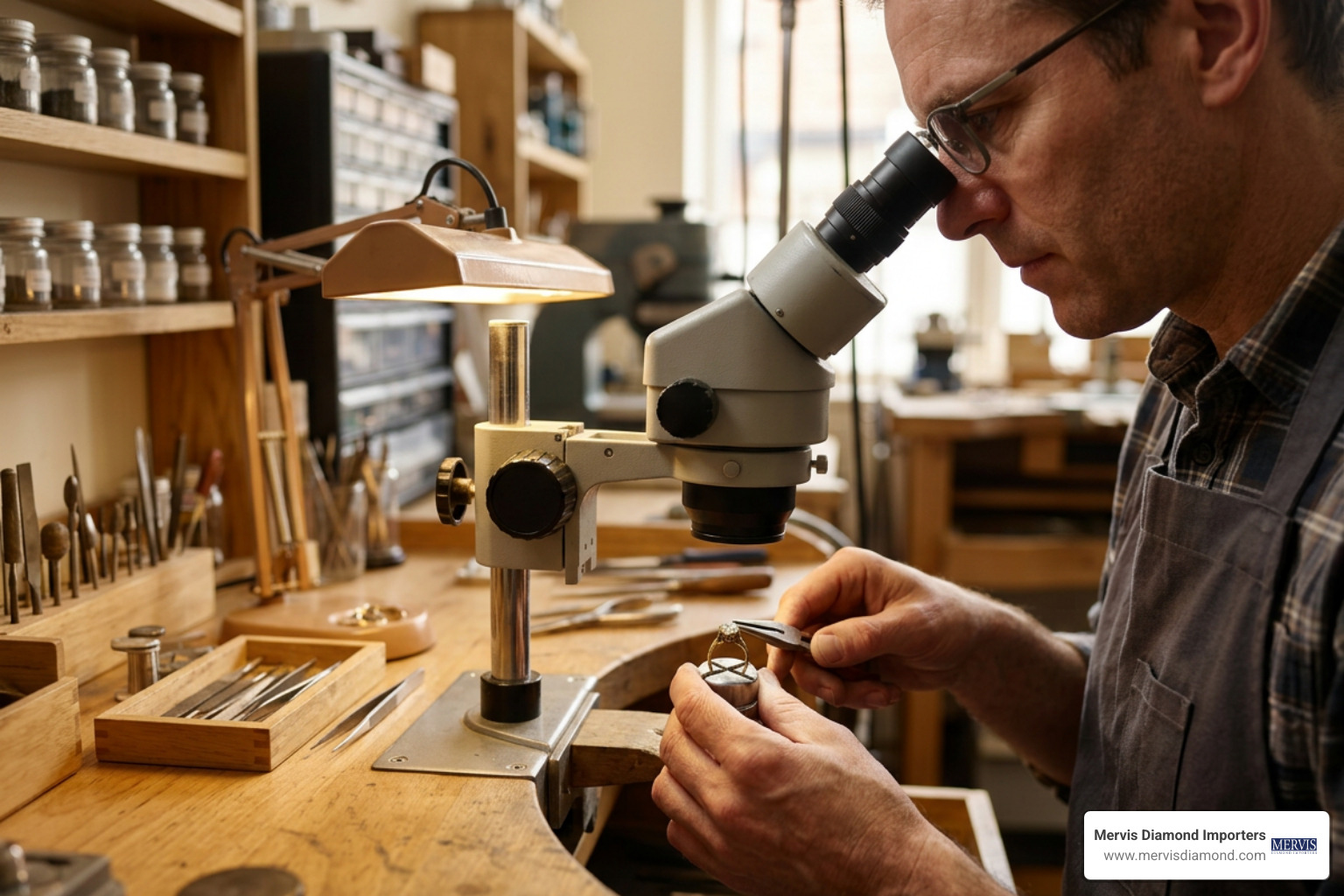
- High-Magnification Bench Microscopes: Working under 40x optical zoom allows goldsmiths to spot micro-fractures, air bubbles (casting porosity), and hidden solder seams that are invisible to the naked eye.
- Argon Gas Shielding: Operating within a controlled argon gas atmosphere prevents oxidation and discoloration while fusing gold or platinum alloys.
Common Issues Handled in Antique Jewelry Repair
Over generations of daily wear, even the finest heirlooms experience natural physical wear. Identifying structural fatigue early prevents total stone loss or permanent breakage.
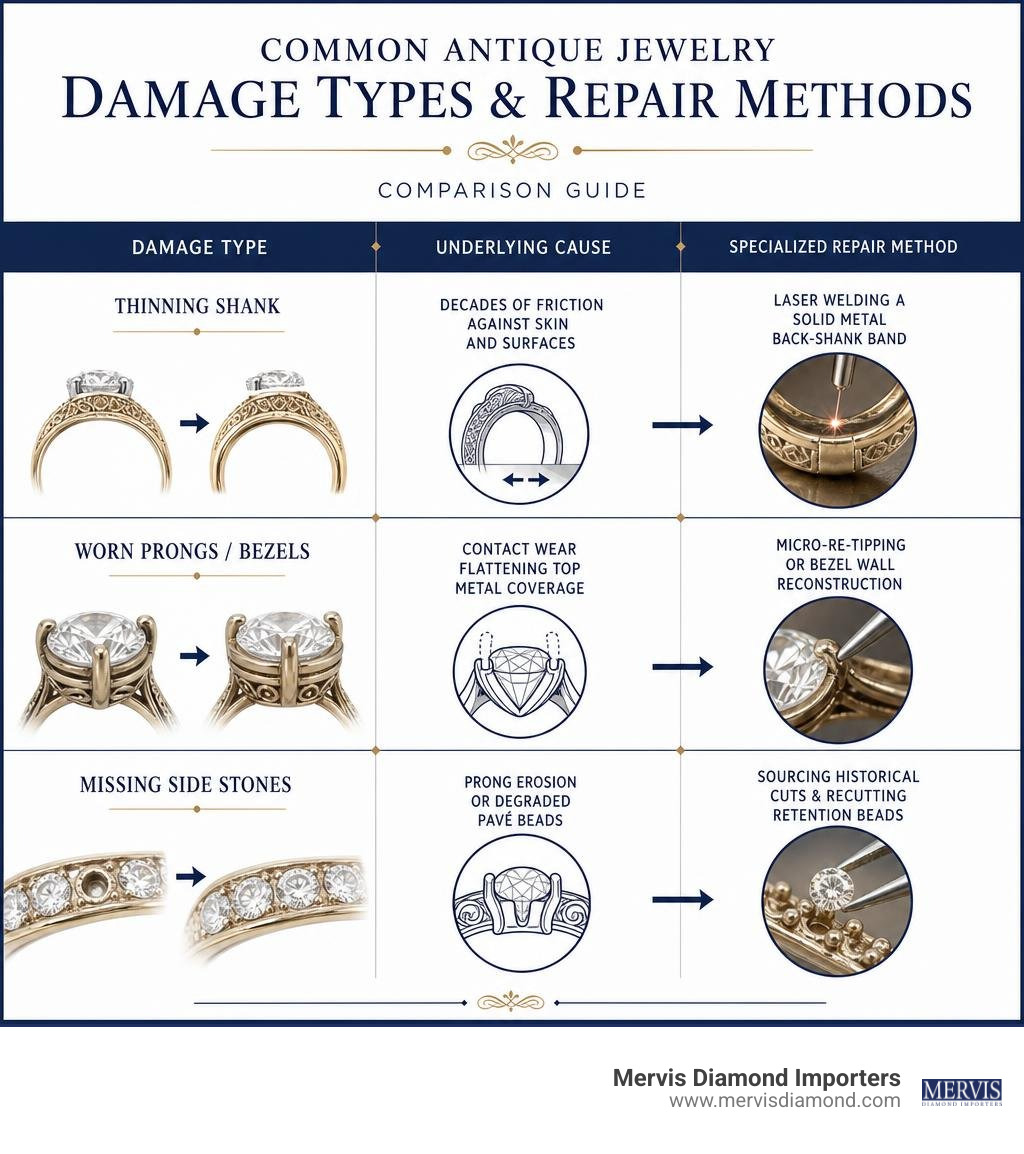
| Structural Issue | Underlying Cause | Specialized Repair Method |
|---|---|---|
| Thinning Shank | Decades of friction against skin and surfaces | Laser welding a solid metal back-shank band |
| Worn Prongs / Bezels | Contact wear flattening top metal coverage | Micro-retipping or bezel wall reconstruction |
| Missing Side Stones | Prong erosion or degraded pavé beads | Sourcing historical cuts & recutting retention beads |
| Cracked Solder Joints | Historic soft solder decay or physical impact | Excising old solder & hard-soldering/laser welding |
| Broken Clasps / Hinges | Mechanical spring fatigue in antique mechanisms | Custom fabrication of era-matched mechanisms |
Whether your heirloom has suffered a bent gallery or missing accent diamonds, review our detailed guide on Can You Repair Diamond Rings for broader perspective on ring structural recovery.
Retipping Prongs and Rebuilding Settings
Prongs act as the structural security guards of any ring. On antique mountings, prongs were often hand-drawn wire or sculpted bezels that have worn down to paper-thin nubs. When prongs wear flat, the center gem is left vulnerable to tipping, shifting, or falling out entirely.

To restore worn settings safely, a craftsman uses laser retipping. By feeding tiny wires of exact-match platinum or gold under microscope magnification, new metal nubs are built directly onto the old prong bases without exposing the center stone to dangerous torch temperatures. If your ring's center stone has shifted or sustained surface damage over time, learn more about stone vulnerability in our article Can a Diamond Chip or Break.
Historical Stone Sourcing and Resetting
Replacing a missing stone in an Art Deco or Edwardian ring is not as simple as dropping in a modern round brilliant diamond. Modern diamonds are cut with precise symmetry to maximize light performance, whereas historical diamonds were cut by hand under candlelight to accentuate soft glow.
When restoring antique mountings, authentic restoration requires sourcing era-appropriate gemstones:
- Rose Cuts: Flat-bottomed gems with triangular facets arranged in a dome, common from the 16th through 19th centuries.
- Old Mine Cuts: Squarish shapes with high crowns, small tables, and large culets typical of the Georgian and Victorian eras.
- Old European Cuts: Round silhouettes with steep crown angles and open culets, popular from the late 1800s through the 1930s.
- Specialty Accents: Natural half-seed pearls, synthetic rubies, and synthetic sapphires—which were wildly popular high-tech materials in early 1900s jewelry.
Master restorers maintain extensive archives of historical loose stones dating back centuries to ensure exact matches in color, clarity, and facet pattern. To understand how settings hold various stone shapes securely, consult our expert breakdown on How to Set a Diamond.
The Step-by-Step Restoration Process and Technology
True antique jewelry repair requires a methodical approach that blends conservation principles with advanced bench craft.
Forensic Evaluation and Disassembly
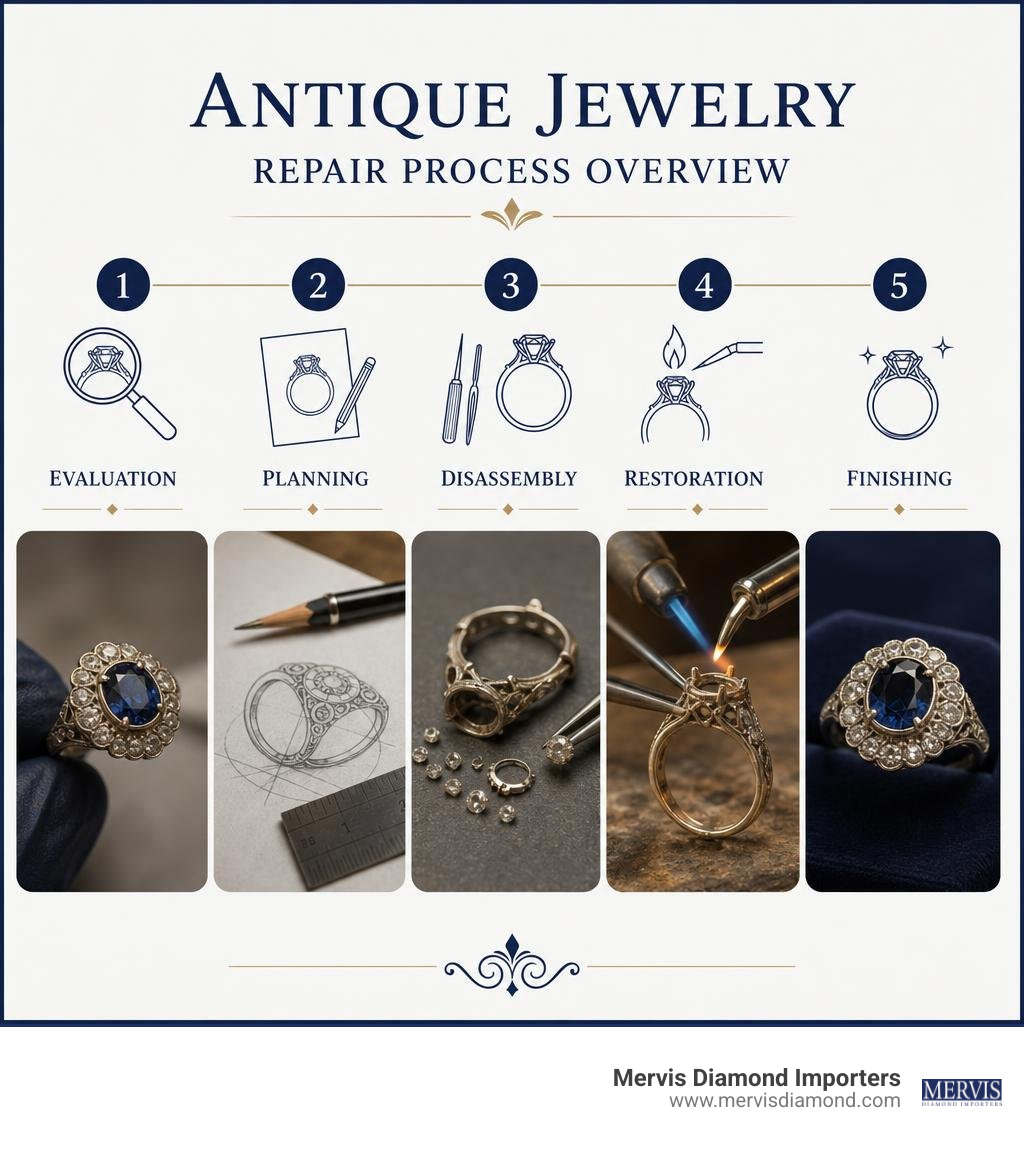
Every successful restoration project follows a strict multi-step diagnostic workflow:
Before a single tool touches your piece, the jeweler conducts a full structural audit. High-resolution 40x macro photography documents existing micro-fractures, historic hallmarks, and wear patterns. Next, an XRF scan reveals the metal composition. If structural work requires removing heat-sensitive gems like emeralds or pearls, the piece is carefully disassembled, keeping all original components sorted and protected.
Laser Welding and Patina Preservation
Once bench repairs are complete, the finishing phase begins. This is where restraint is paramount. A classic mistake made by non-specialized repair shops is over-polishing an antique ring until it looks shiny, slick, and brand new. Over-polishing strips away hand-carved milgrain, softens sharp geometric lines, and destroys the deep, rich patina that gives vintage metal its soulful appeal.
A skilled restorer uses delicate hand tools, custom-milled milgrain wheels, and specialized antique patination techniques to darken recessed grooves while polishing raised surfaces lightly. This preserves the piece's historical authenticity while making it structurally whole again.
For more technical perspectives on jewelry preservation standards and gemstone care, explore educational research from trusted gemological institutions like the Gemological Institute of America.
Repurposing, Replicating, and Modernizing Heirloom Jewelry
Sometimes an antique piece is too structurally compromised to withstand regular wear, or its visual style simply doesn't fit your personal wardrobe. Fortunately, you don't have to leave those family treasures tucked away in a safe deposit box.
Custom Heirloom Replication for Daily Wear
If you inherit an exquisite, fragile 100-year-old ring that you dream of wearing every day as an engagement ring, custom replication offers an ideal solution.
Through high-definition 3D laser scanning and CAD (Computer-Aided Design) modeling, we can capture every angle, flourish, and hand engraving of your original piece. We then cast a brand-new setting in modern, ultra-durable platinum or 18k gold. You get an exact visual replica built for daily durability, while the fragile original remains safely preserved for future generations.
Modernizing Gemstones into New Settings
Another popular option is harvesting family gemstones to create a completely new heirloom.
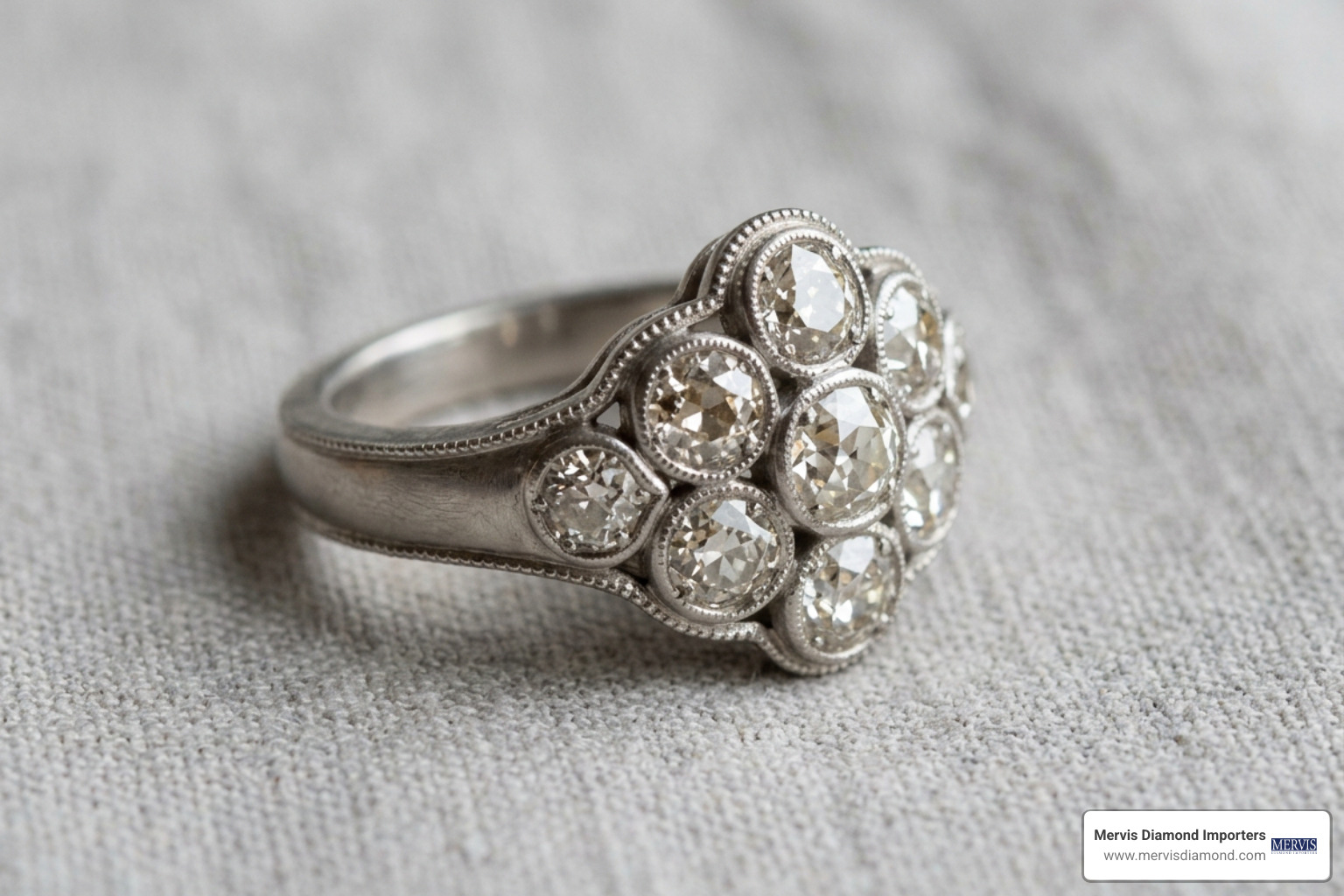
An inherited multi-stone brooch or outdated cluster ring can be carefully disassembled to reclaim Old European or Old Mine cut diamonds. These character-rich diamonds can then be set into a sleek modern solitaire, a custom pendant, or a multi-stone bezel band. This process honours family legacy while giving historical diamonds a fresh chapter. If you are interested in exploring full restoration and design options, review the comprehensive guide on Jewelry Repairs.
Cost, Timelines, and Selecting a Restoration Specialist
Understanding expected investment levels and timelines helps set realistic expectations for your project.
Anticipated Bench Costs & Timelines
Standard basic services, such as simple ring resizing, professional cleanings, or basic single-prong retipping, generally start around $39.99 to $49.99. However, complex structural restorations vary depending on metal requirements and labor intensity:
- Standard Bench Turnaround: 10 to 14 days for retipping, shank reinforcement, and minor stone setting.
- Complex Restorations: 14 to 21 days for custom alloy milling, hand re-engraving, and historical stone sourcing.
Questions to Ask Before Choosing Antique Jewelry Repair Services
When entrusting an irreplaceable family heirloom to a jeweler, always ask the following vetting questions:
- Do you perform repairs in-house or ship pieces away? Ensure your piece is serviced locally by experienced bench jewelers.
- What technology do you use for heat-sensitive pieces? Verify they utilize micro laser welding rather than open torches near delicate gemstones.
- How do you document my piece's condition? Confirm that high-magnification photography and written assessments are provided before work begins.
- What is your philosophy on patina and polishing? Ensure they practice restraint to protect hand-engraved details and vintage character.
If you live in Northern Virginia, Maryland, or the Washington DC metro area, you can easily access localized expert care at our Tysons Corner, Rockville, or DC showrooms.
Essential Home Care and Maintenance Guidelines
Proper home maintenance ensures your newly restored antique jewelry remains pristine:
- Gentle Cleaning Only: Soak antique jewelry in warm water with mild, liquid dish soap. Gently clean behind settings using an ultra-soft toothbrush. Never use harsh ultrasonic cleaners or steam machines, which can shatter historic emeralds, opals, or foiled gemstones.
- Remove Before Heavy Activity: Take off heirloom rings before exercising, gardening, swimming, or cleaning with harsh chemicals.
- Routine Professional Inspections: Schedule a professional prong and setting check every six months to detect loose stones early.
For comprehensive care advice, read our detailed guides on How to Care for a Diamond Ring and How to Clean Your Diamond Ring.
Frequently Asked Questions About Heirloom Restoration
How long does a full antique jewelry restoration take?
A standard bench restoration involving prong retipping, minor laser welding, and cleaning typically takes 10 to 14 days. If your project requires custom alloy milling to match historic gold, hand engraving, or sourcing rare historical stone cuts, the process can take up to 21 days.
Is it worth repairing sterling silver or costume antique jewelry?
It depends on whether you measure value in monetary or sentimental terms. Silver and costume antique repairs often cost more than the intrinsic market value of the metals involved. However, if the item is an irreplaceable family heirloom passed down across generations, the sentimental value often makes expert restoration well worth the investment.
Will restoring my antique ring ruin its historical value?
Not if it is restored correctly! Sympathetic restoration aims to stabilize structural components and replace damaged elements using era-appropriate materials while preserving original hand engraving and patina. Over-polishing or using modern torch methods can harm historical value, which is why choosing an experienced specialist is essential.
Conclusion
Every piece of antique jewelry holds a story—a tangible connection across generations. Whether you are caring for a Victorian engagement ring, an Art Deco diamond band, or a treasured family pendant, specialized antique jewelry repair ensures that your piece remains structurally secure and breathtakingly beautiful for decades to come.
At Mervis Diamond Importers, our master bench jewelers combine generations of expertise with modern laser welding and microscopic precision across our showrooms in Tysons Corner, VA, Rockville, MD, and Washington, DC. We treat every heirloom with the deep care and respect it deserves.
Ready to restore your cherished family treasure? Visit a Mervis Diamond Importers showroom or explore our guide on How to Care for a Diamond Ring to schedule your personalized heirloom evaluation today!