

How to Find Local Jewelry Repairs Fast
When Your Jewelry Needs Fixing: What You Should Know First
Getting jewelry repairs done quickly and correctly matters — whether it's a loose diamond, a snapped chain, or a ring that no longer fits.
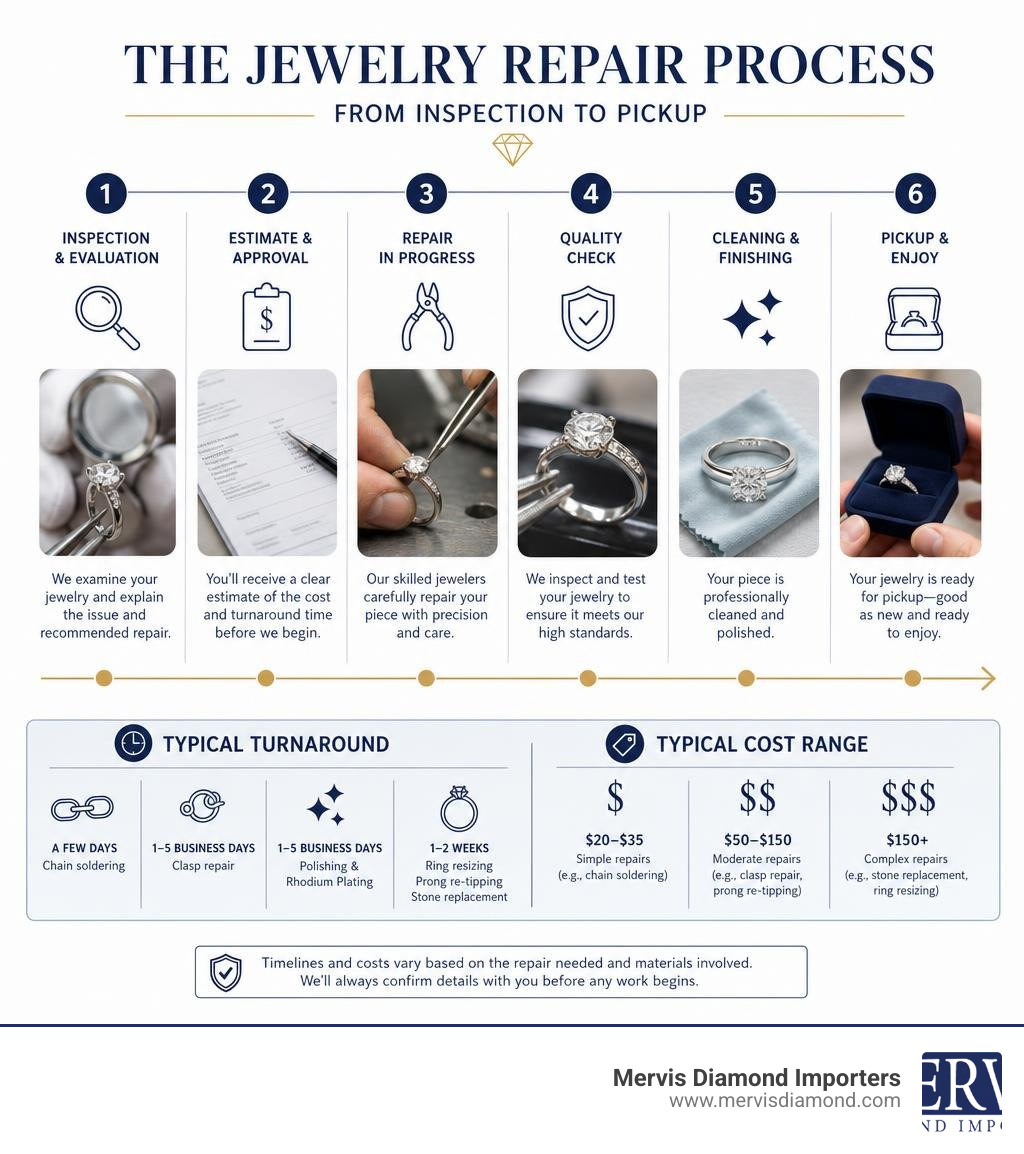
Here's a fast overview of the most common repairs and what they typically involve:
| Repair Type | What It Fixes | Typical Turnaround |
|---|---|---|
| Ring resizing | Too tight or too loose fit | 1-2 weeks |
| Prong re-tipping | Worn prongs that risk losing a stone | 1-2 weeks |
| Chain soldering | Broken or snapped necklace/bracelet | A few days |
| Stone replacement | Missing or damaged gemstones | 1-2 weeks (longer if sourcing parts) |
| Clasp repair | Broken or worn clasps | 1-5 business days |
| Polishing & rhodium plating | Dull, scratched, or faded finish | 1-5 business days |
Most repairs start at around $20-$35 for simple fixes like chain soldering, and go higher for complex work like stone resetting or metal rebuilding.
The good news? Repair is almost always cheaper than replacing a piece — and for sentimental items like engagement rings or heirlooms, there's really no substitute.
But not all repair services are equal. Some jewelers do all work on-site. Others quietly ship your piece to a third-party repair center — something many customers don't realize until after they've handed it over.
This guide walks you through everything: what repairs cost, how long they take, what to look for in a trusted jeweler, and how to keep your fine jewelry in great shape for years to come.
Common Types of Jewelry Repairs and What to Expect

When you wear your favorite pieces daily, they undergo a surprising amount of friction. From grabbing door handles to washing hands, your jewelry is constantly exposed to wear and tear. Over time, even the most durable precious metals can wear down, thin out, or break.
Many people believe their jewelry is indestructible, particularly when it features the hardest known natural gemstone: the diamond. However, a common question we hear is, Can Diamond Rings Get Scratched? While the diamond itself is incredibly resistant to scratching, the metal surrounding it certainly isn't. Gold and platinum can easily develop a web of micro-scratches over time, dulling their brilliant polish. Furthermore, you might wonder, Can a Diamond Chip or Break? Despite their legendary hardness, diamonds actually can chip or fracture if they are struck with enough force at a specific angle, especially along their natural cleavage planes.
Understanding what common jewelry repairs involve will help you catch minor issues before they turn into devastating losses.
Ring Resizing and Prong Re-tipping
Ring resizing is one of the most frequently requested jewelry services. Your fingers can change size due to weight fluctuations, seasonal weather changes, or even pregnancy.
- Sizing Down: The jeweler cuts out a small portion of the band (shank), joins the ends back together, and solders or welds them seamlessly.
- Sizing Up: For minor adjustments, the jeweler may stretch the metal. For larger adjustments, they cut the band and add a matching piece of precious metal to bridge the gap.
If you find yourself with a ring that is completely stuck on your finger, do not panic or reach for the wire cutters just yet! There are several gentle methods you can try first, as outlined in our guide on how to Remove Stuck Ring: 4 Ways to Remove Ring Safely.
Prong re-tipping is another critical preventative repair. Prongs are the tiny metal claws that secure your diamonds in place. As you wear your ring, those prongs rub against clothing, upholstery, and countertops, gradually flattening out. If a prong snags on your favorite knit sweater, it may pull away entirely, leaving your diamond vulnerable. During a prong re-tipping, a master jeweler carefully adds a small bead of matching metal to the top of the worn prong to rebuild its height and dome shape, ensuring your precious stone remains safely locked in its setting.
Chain and Clasp Jewelry Repairs
Whether it is a delicate gold chain or a heavy silver rope, necklaces and bracelets are highly susceptible to snapping when caught on clothing or pulled by an enthusiastic toddler.
Chain soldering is the process used to mend these breaks. Using a tiny torch or a high-precision laser, a jeweler joins the broken links back together with a minute amount of solder. However, not all chains are repaired the same way. Hollow chains—which are popular because they offer a chunky look without the heavy price tag—are notoriously difficult to repair. Because they are hollow, the metal walls are paper-thin. A traditional soldering torch can easily melt the entire link, which is why laser welding is highly preferred for these delicate tasks.
Clasps also wear out over time. The tiny internal steel springs inside spring rings and lobster claw clasps eventually lose their tension or rust from exposure to water. Replacing a clasp is a quick, routine repair that restores the security of your entire necklace. Professional restoration techniques can also address stretched links or worn hinges, ensuring your favorite necklaces and bracelets remain secure for years to come.
Stone Replacement and Polishing
Losing a stone from a pavé band or a multi-stone pendant can be heartbreaking, but it is a highly fixable problem. Stone replacement involves sourcing a matching diamond or gemstone that perfectly aligns with the original's color, clarity, cut, and millimeter dimensions. Once the perfect match is found, the jeweler carefully resets it into the empty space, tightening the surrounding metal to prevent future issues.
Once your stones are secure, a professional polishing and cleaning can work miracles on tired, dull jewelry. Over months of wear, lotions, soap scum, and skin oils form a cloudy film underneath your gemstones, blocking light and killing their sparkle. While we always recommend regular professional cleanings, you can keep your rings looking brilliant between visits by learning How to Clean Your Diamond Ring and following our practical home tips on How to Clean Diamond Rings at Home.
How Professional Jewelers Handle Different Metals and Delicate Pieces

Every metal behaves differently under the extreme heat and pressure of a jeweler's workbench. A master jeweler must possess a deep understanding of metallurgy to ensure that repairing your jewelry does not accidentally damage it.
Working with Gold, Platinum, and Silver
- Gold: Gold is alloyed with other metals to increase its durability. Yellow gold, white gold, and rose gold each contain different alloy mixes (like copper, silver, or palladium) which alter their melting points. White gold also requires a final step: rhodium plating. Because natural white gold has a slightly warm, yellowish tint, jewelers coat it with a ultra-bright layer of rhodium (a member of the platinum family) to give it that mirror-like, icy white finish.
- Platinum: Platinum is highly prized for its density and purity. Unlike gold, which wears away over decades of friction, platinum doesn't actually lose metal when scratched; the metal merely shifts or displaces, creating a soft, satin look known as a "patina." Platinum has an incredibly high melting point (around 3,215°F or 1,768°C) and requires specialized high-heat torches and eye protection to work with safely.
- Sterling Silver: Silver is highly conductive, meaning heat travels through it incredibly fast. When a jeweler solders a silver ring, they have to heat almost the entire piece to get the solder to flow, whereas with gold or platinum, they can isolate the heat to a tiny area.
Precision Laser Welding for Delicate Jewelry Repairs
Traditional torch soldering has been the industry standard for centuries, but it poses risks to heat-sensitive gemstones. Gems like opals, emeralds, pearls, and tanzanites can easily crack, discolor, or shatter if exposed to the heat of a soldering torch.
Enter laser welding—the ultimate game-changer in modern jewelry repair.
A laser welder shoots a highly concentrated, microscopic beam of light that melts a tiny, localized area of metal in a fraction of a second. The heat is so focused that a jeweler can hold a ring in their bare hands just millimeters away from where the laser is firing without feeling any warmth. This allows us to repair prongs directly adjacent to delicate gemstones without removing the stones from their settings.
Even when working with diamonds, caution is necessary. While diamonds are famous for their thermal conductivity, they are not immune to thermal shock. If you have ever wondered, Can Diamonds Break? The answer is yes. Sudden, extreme temperature changes can cause existing microscopic inclusions within a diamond to expand, potentially cracking the stone. Laser welding eliminates this risk entirely, providing trace-free, structurally superior joints with zero heat damage.
What to Look For in a Reputable Local Repair Service
When it is time to hand over your precious engagement ring or a beloved family heirloom, you want to make sure it is in safe, capable hands. Finding a trustworthy local repair service in the Washington DC, Maryland, and Virginia (DMV) area is all about asking the right questions and knowing what to look for in a professional jeweler.
In-House vs. Outsourced Repairs
One of the most important questions you can ask a jeweler is: "Is my repair completed on-site, or do you ship it out?"
Many mall kiosks and corporate retail chains do not actually employ bench jewelers at their physical locations. Instead, they act as drop-off points, packaging up your jewelry and shipping it to mass repair hubs. This introduces unnecessary transit risks, increases turnaround times, and makes it difficult to speak directly with the artisan actually working on your piece.
Choosing a jeweler with an on-site, in-house workshop ensures that your jewelry never leaves the safety of the vault. You get direct communication, faster turnaround times, and complete peace of mind knowing exactly who is handling your precious jewelry.
Certifications, Warranties, and Turnaround Times
When evaluating a local repair shop, look for professional credentials. Master jewelers who hold certifications from organizations like Jewelers of America (JA) or the Gemological Institute of America (GIA) have undergone rigorous training and adhere to strict ethical codes.
Additionally, always ask about the warranty. A reputable repair service should stand behind their craftsmanship. It is standard for quality shops to offer a 90-day guarantee on the specific area repaired, ensuring that if a newly soldered chain snaps in the exact same spot, they will fix it free of charge.
Here is a quick look at how in-house repairs compare to outsourced services:
| Feature | In-House Repairs | Outsourced Repairs |
|---|---|---|
| Turnaround Time | Fast (typically 2-5 days) | Slow (often 2-4 weeks or more) |
| Transit Risk | None (jewelry stays in-store) | High (shipped via third-party carriers) |
| Communication | Direct with the jeweler | Indirect through retail staff |
| Pricing | Transparent, direct-to-consumer | Often marked up to cover shipping/handling |

Frequently Asked Questions About Jewelry Repairs
How much do typical jewelry repairs cost?
Because every piece of jewelry is unique, repair pricing is assessed on a case-by-case basis after a physical inspection under magnification. However, to give you a general idea of what to expect in 2026, here are some typical pricing starting points for fine jewelry:
-
Ring Sizing Down:
- Sterling Silver: ~$60
- Yellow & Rose Gold: ~$80
- White Gold (includes rhodium plating): ~$120
- Platinum: ~$140
- Ring Sizing Up: Base metal cost plus approximately $30 per added size. Note: rings featuring large center diamonds (over 1 carat) may incur an additional fee (often around $100 per carat) to cover the extra risk and labor involved in protecting the stone.
- Chain Soldering / Repair: Starts at ~$44.
- Professional Clean & Polish: Starts at ~$39.
- Pearl Restringing: Starts at ~$5 per inch.
- Custom Laser Engraving: Starts at ~$30 to $34.
Is mail-in jewelry repair safe and insured?
Yes, mail-in jewelry repair has become incredibly popular and safe, with over 240,000 happy customers nationwide utilizing these secure services. When using a reputable mail-in service, the process is highly structured:
- You fill out an online repair request and receive a prepaid, fully insured shipping label.
- You pack your jewelry securely and drop it off at the designated carrier (such as FedEx).
- The facility receives your package under strict video surveillance, inspects the piece, and emails you a detailed estimate.
- Once you approve the estimate, certified jewelers complete the work.
- Your fully restored jewelry is shipped back to your doorstep in secure, discreet packaging with signature-required delivery.
How do I care for antique or heirloom jewelry?
Antique jewelry (pieces at least 100 years old, from eras like the Georgian, Victorian, Edwardian, or Art Nouveau periods) and vintage jewelry (50 to 100 years old, from the Art Deco or Mid-Century periods) require incredibly gentle care. These pieces often feature delicate filigree, hand-applied engraving, and unique cuts like Old Mine or European cuts.
To preserve these historical treasures:
- Avoid Ultrasonic Cleaners: The high-frequency vibrations of home ultrasonic cleaners can easily shake loose old stones or shatter fragile gems like emeralds and opals.
- Clean Gently: Use a soft, lint-free cloth or a very soft toothbrush with warm water and a drop of mild dish soap. Avoid harsh chemical cleaners.
- Store Individually: Keep antique pieces in soft cloth pouches to prevent them from scratching one another.
If you have a family heirloom that is too worn to wear safely but you want to keep its sentimental value alive, you might want to consider redesigning it. Check out our guide on 6 Easy Ways to Update Diamond Ring to explore how you can breathe new, modern life into a treasured classic.
Conclusion
Your fine jewelry is more than just metal and stone—it is a collection of your life's most beautiful moments, milestones, and memories. Whether it is an engagement ring that has lost its luster or a family heirloom passed down through generations, keeping these pieces in pristine condition is our passion.
At Mervis Diamond Importers, we believe in providing expert, pressure-free service. Our hand-selected, high-quality natural and lab-grown diamonds deserve nothing less than the finest care. By scheduling regular, bi-annual inspections, you can catch minor wear before it leads to a lost stone.
To learn more about keeping your jewelry looking as breathtaking as the day you first wore it, read our comprehensive guide on How to Care for a Diamond Ring. If you have a piece that needs some expert attention, stop by one of our convenient locations in Tysons, VA, Rockville, MD, or Washington, DC. We are always here to help you keep your jewelry shining bright!