

Why Chatham Lab-Grown Stones Are Giving Mined Gems a Run for Their Money
Why Chatham Lab-Grown Gems Deserve a Close Look
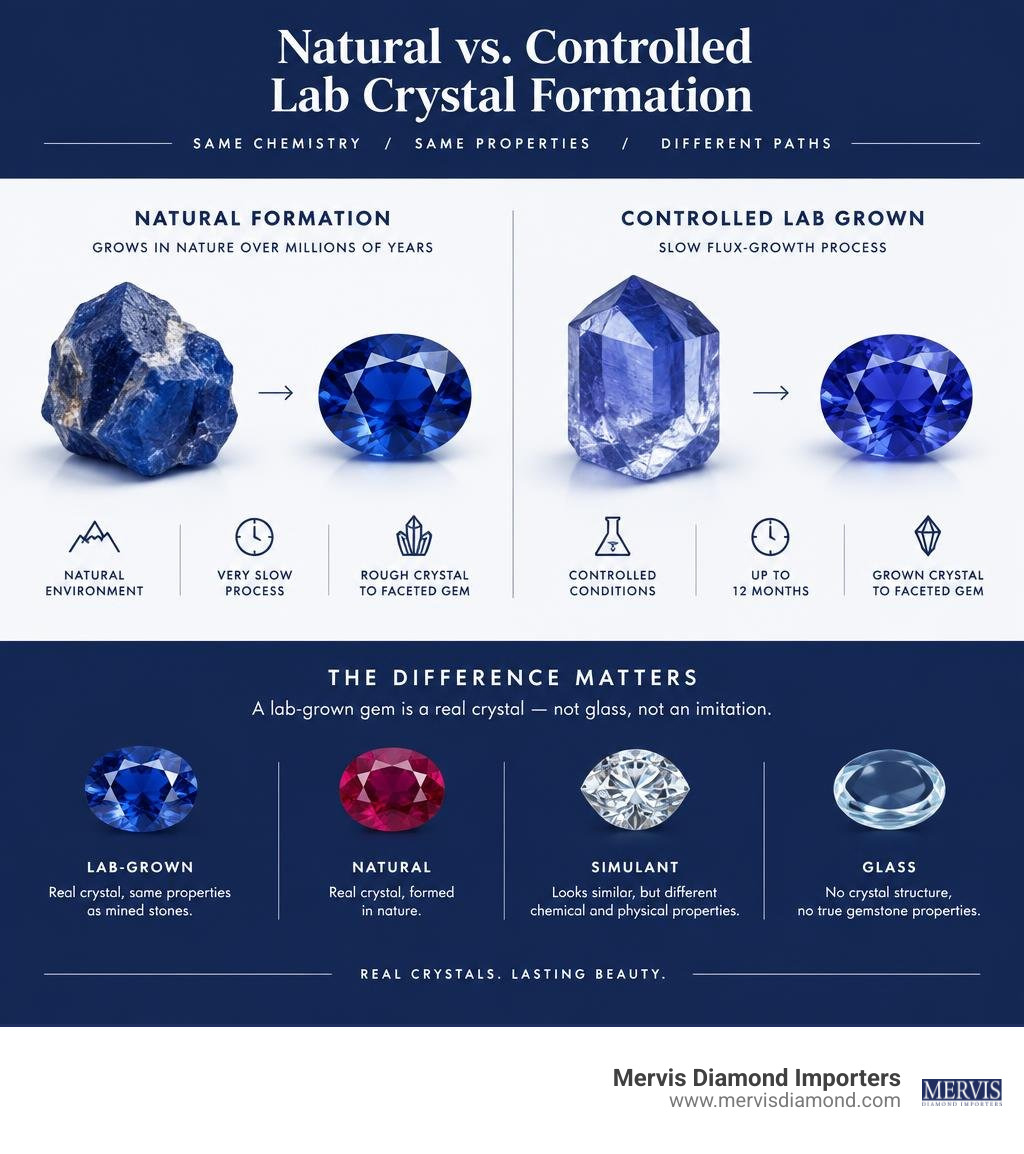
Chatham lab-grown gemstones are real crystals, not glass or imitation stones. They are grown under controlled conditions using a slow flux-growth process, then cut and faceted for fine jewelry. Their chemical, physical, and optical properties match those of their mined counterparts, including hardness and refractive index.
For shoppers weighing quality against price and sourcing concerns, that can make Chatham a compelling alternative to a mined colored gemstone. You can get the color, brilliance, and daily-wear durability of a true emerald, ruby, or sapphire without paying the premium tied to rarity, mining origin, and supply-chain uncertainty.
Chatham's process can take up to 12 months to grow one crystal. That slow timeline matters: it is very different from simply molding glass or producing a look-alike simulant such as cubic zirconia. The broader history of synthetic gemstones shows how controlled crystallization has evolved from early experiments into today's precision-grown crystals.
The key question is not whether a Chatham stone is "real." It is whether its origin, price, brand, and resale expectations fit the piece you want to create. I am Morris Mervis, and the sections ahead will help you evaluate that choice with clear facts and no sales pressure.
Chatham Lab Grown Stones vs. Natural and Simulant Alternatives
When exploring alternatives to traditional mined treasures, the jewelry industry uses specific terminology that directly affects both value and performance. The Federal Trade Commission (FTC) provides clear regulatory guidance on these definitions. In its revised Jewelry Guides, the FTC removed the word "synthetic" from its recommended descriptors because consumers often confuse the word with cheap imitations. Under federal standards, a lab-created gemstone must possess essentially the same optical, physical, and chemical properties as the stone mined from the earth.
To understand where Chatham fits into the landscape, it helps to review our in-depth guide to synthetic and natural stones. A true lab-created crystal is fundamentally different from a simulant:
- Mined Gemstones: Formed over millions of years deep within the earth's crust under immense heat and pressure, mined minerals contain natural chemical elements and characteristic inclusions.
- Chatham Lab-Grown Gemstones: Grown in specialized laboratories using advanced geological replication methods. An emerald created this way is true beryl ($Be3Al2(SiO3)6$), while a ruby or sapphire is genuine corundum ($Al2O3$).
- Simulants and Imitations: Materials such as cubic zirconia or paste (lead glass) that merely mimic the visual appearance of a stone without sharing its chemical formula, hardness, or light-bending characteristics.
Because a Chatham stone possesses the exact refractive index and crystal lattice of a mined mineral, it reflects and refracts light in an identical manner. A glass imitation simply cannot match that vivid return of light.
The Science of Chatham Lab Grown Flux Crystallization
The story of modern crystal synthesis began in 1938 when Carroll Chatham successfully cultured his first emerald crystal in a small San Francisco laboratory. Rather than rushing the reaction, he dedicated years to mimicking the hydrothermal and geological forces found deep underground.
Today, the proprietary Chatham flux-growth method remains the gold standard for creating colored gemstones.
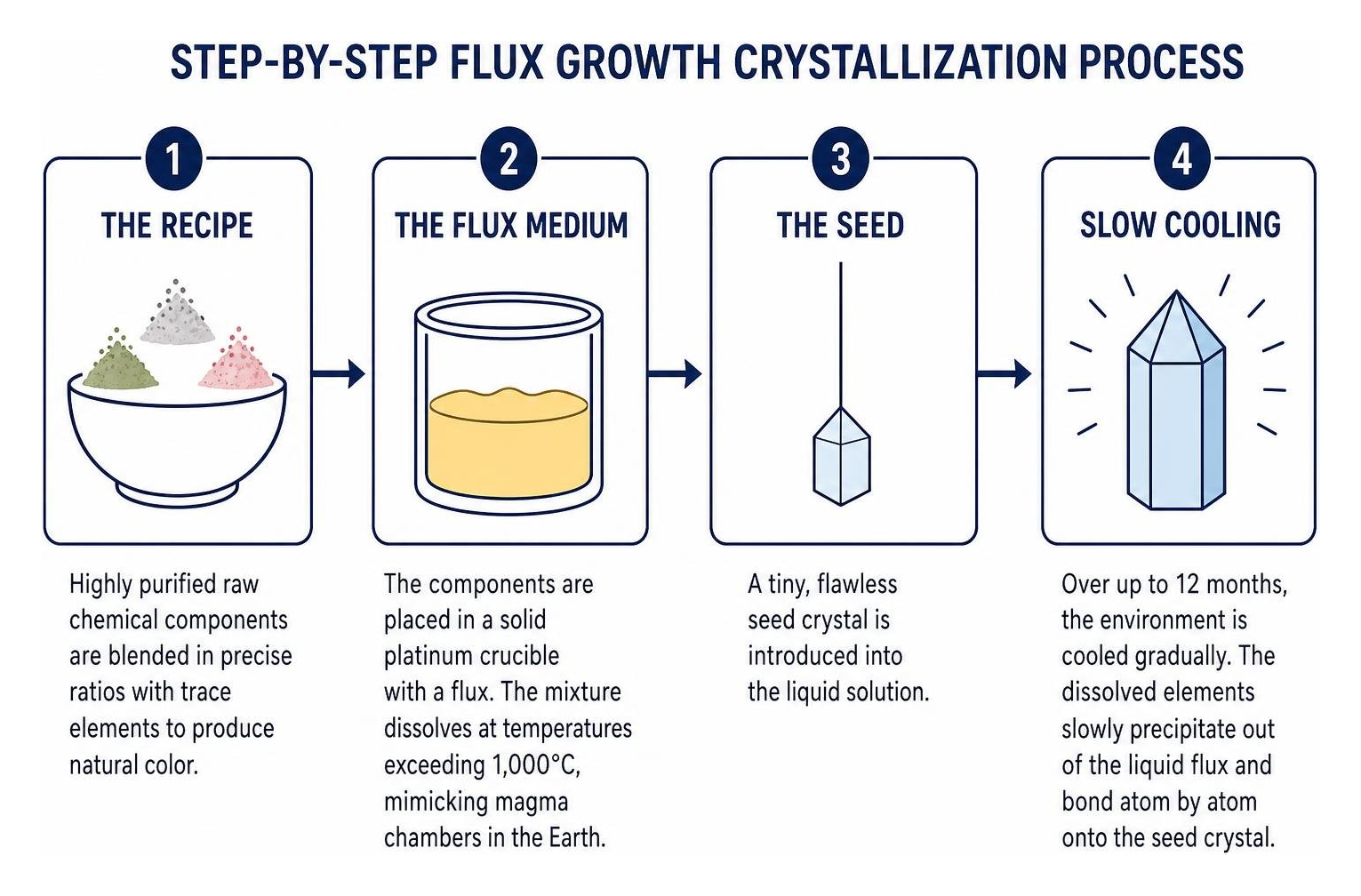
The process follows a meticulous sequence:
- The Recipe: Highly purified raw chemical components (such as aluminum oxide for rubies, or beryllium and silicon for emeralds) are blended in precise ratios with trace elements like chromium, iron, or titanium to produce natural color.
- The Flux Medium: The components are placed in a solid platinum crucible along with a specialized chemical solvent called a "flux." This mixture dissolves the solid materials at temperatures exceeding 1,000 degrees Celsius, mimicking magma chambers in the Earth.
- The Seed: A tiny, flawless seed crystal is introduced into the liquid solution.
- Slow Cooling: Over a period of up to 12 months, the environment is cooled gradually. The dissolved elements slowly precipitate out of the liquid flux and bond atom by atom onto the seed crystal.
Because this crystal matrix develops over nearly a year, it forms natural growth planes, veil-like fingerprints, and minute flux inclusions. This slow growth yields exceptional crystal integrity and structural density, setting it apart from fast, commercial methods.
Debunking Common Myths: Real Gemstones vs. Glass Simulants
A persistent misconception in fine jewelry is that lab-created gemstones are "just expensive glass" or cheap plastic imitations.
To dispel this myth, think of natural ice versus ice made in your kitchen freezer. Water frozen in an alpine lake over months is ice. Water frozen inside your home freezer overnight is also ice. Both share the exact same molecular structure ($H_2O$), the same freezing point (0°C), and the same hardness. The freezer simply provides a controlled setting for nature’s physics to run their course.
The same rule applies to the chatham lab grown mineral creation process:
- Flame-Fusion (Verneuil Method): Approximately 90% of cheap synthetic stones on the mass market are manufactured via flame-fusion. This rapid process melts powder through a torch flame to create a crystal in hours. While chemically real, it creates curved growth striae and internal strain.
- Chatham Flux-Growth: Takes up to a year, creating flat crystal faces and natural hexagonal geometries identical to top-grade mined specimens.
- Glass Simulants: Amorphous silica without an organized crystalline structure. Glass scratches easily, dulls over time, and lacks double refraction or characteristic pleochroism.
A flux-grown gem is an authentic, structured mineral that delivers brilliant optical dispersion because its atomic foundation matches nature point for point.
Evaluating Quality, Durability, and Everyday Wear
When choosing a centerpiece for an engagement ring or signature jewelry piece, long-term durability is essential. Daily contact with hard surfaces, water, cosmetics, and sunlight will quickly damage an imitation, whereas a properly grown crystal endures for generations.
| Property / Metric | Mined Gemstone (e.g., Natural Emerald/Ruby) | Chatham Flux-Grown Gemstone | Glass / Paste Simulant |
|---|---|---|---|
| Chemical Composition | Identical natural mineral formula | Identical mineral formula ($Be3Al2(SiO3)6$ / $Al2O3$) | Amorphous Silicon Dioxide ($SiO_2$) |
| Mohs Hardness | 7.5–8.0 (Emerald) / 9.0 (Ruby/Sapphire) | 7.5–8.0 (Emerald) / 9.0 (Ruby/Sapphire) | 5.0–5.5 |
| Refractive Index | 1.57–1.58 (Emerald) / 1.76–1.77 (Corundum) | 1.57–1.58 (Emerald) / 1.76–1.77 (Corundum) | 1.50–1.52 |
| Color Stability | Permanent; stable under UV light | 100% Permanent; zero fading | Can yellow or cloud over time |
| Internal Fractures | Extensive clarity fractures (often oil-treated) | Roughly 20% fewer fractures; structurally stable | Bubble inclusions; fragile structure |
| Creation Timeline | Millions of years | Up to 12 months | Minutes to hours |
Beyond chemical resilience, cut quality determines how well a stone performs in a setting. Chatham rough crystals are cut and faceted by master lapidaries using the same precise proportions given to top-tier mined gems. Rather than cutting for maximum raw weight retention, master cutters shape Chatham stones to optimize light dispersion and rich color saturation.
Durability and Grading: How Chatham Lab Grown Gems Compare to Mined Minerals
On the Mohs hardness scale, mineral resilience dictates whether a ring can withstand daily wear:
- Corundum (Rubies and Sapphires): Rates at a 9 on the Mohs scale, making it second only to diamond in hardness. Chatham rubies and sapphires are equally scratch-resistant and impervious to household chemicals.
- Beryl (Emeralds): Rates between 7.5 and 8.0. Mined emeralds famously contain deep internal fissures called the jardin, which often require cedarwood oil or epoxy resins to mask fractures. Chatham emeralds have about 20% fewer internal fractures than average mined stones, giving them greater physical stability against everyday impacts.
For those who love step cuts and vintage geometry, pairing colored stones with an emerald cut lab diamond creates an elegant ring with exceptional durability across all stones.
Major gemological laboratories, including the Gemological Institute of America (GIA), verify that lab-grown gems maintain permanent color stability. They do not fade, shift under ultraviolet light, or deteriorate after exposure to ultrasonic cleaning.
Cost, Ethics, and Long-Term Value: Is Chatham Right for You?

The primary reason fine jewelry buyers choose lab-grown stones is the balance of beauty, ethics, and value.
From an environmental and ethical standpoint, lab-grown gemstones avoid open-pit mining, habitat disruption, and supply-chain opacity. Knowing the exact origin of your stone brings peace of mind, allowing you to focus on the artistry and sentiment of the piece.
Price differences are also substantial:
- A top-tier, 2-carat untreated Colombian emerald with vivid saturation can easily cost upwards of $20,000.
- A Chatham flux-grown emerald of equivalent clarity and color is typically priced around $1,000 to $1,500—an 80% to 95% savings.
This flexibility allows you to focus your budget on premium settings, side diamonds, or complete sets like everyday lab grown pendants without compromising on stone size or color quality.
When it comes to financial expectations, understand how lab gemstone resale value factors work. Like all lab-created stones, Chatham gems should be bought for daily wear, sentimental meaning, and design appeal rather than financial speculation. While brand recognition gives Chatham pieces higher secondary value (typically 20% to 40% of retail) than generic synthetic stones, they are not designed as capital investments. Their true return is everyday beauty, reliable durability, and ethical peace of mind.
Frequently Asked Questions About Chatham Gemstones
Do Chatham lab-created gemstones pass a standard diamond tester?
A standard diamond tester measures thermal or electrical conductivity based on pure carbon structures.
- If you test a lab-grown diamond, it will pass the test because it is 100% crystallized carbon.
- If you test a Chatham colored gemstone (emerald, ruby, or sapphire), it will not test as a diamond because its chemical makeup is beryl or corundum.
To test colored gems, gemologists use a refractometer or specific gravity testing rather than a handheld diamond pen.
Can a professional jeweler tell if a gemstone is lab-grown?
Yes. A trained GIA Graduate Gemologist using 10× to 40× magnification can distinguish between mined and flux-grown stones.
Under a microscope, gemologists examine the stone's internal characteristics:
- Chatham stones exhibit distinct flux-phase veil patterns, minute residual platinum flecks, or straight growth striations.
- Mined stones typically contain natural mineral inclusions, two-phase or three-phase fluid inclusions, and irregular growth zoning.
Do Chatham gemstones fade or lose color over time?
No. Chatham gemstones will never fade, alter, or lose their color saturation. Because the trace color elements (like chromium in emeralds and rubies) are locked directly into the crystal lattice during growth, the color is chemically permanent. Exposure to sunlight, chlorinated water, and everyday cleaning products will not alter their appearance.
Conclusion: Choosing the Best Centerpiece for Your Fine Jewelry
Chatham lab-grown gems offer a compelling blend of heritage, master craftsmanship, and modern science. By recreating natural geological conditions over month-long cycles, they deliver the beauty and strength of top-grade mined gemstones at an accessible price.
At Mervis Diamond Importers, our focus is helping you find the right piece in a comfortable, pressure-free environment. Whether you are drawn to traditional mined gems or want to explore our fine collections, our team is here to guide you across our showrooms in Tysons, VA, Rockville, MD, and Washington, DC.
If you are deciding between mined and cultured stones for an upcoming custom ring or pendant, start by exploring mined vs lab-grown diamonds and gemstones to find the right centerpiece for your style.