

Demystifying the Diamond Clarity Scale for Savvy Shoppers
Why the Diamond Clarity Scale Matters When You Buy
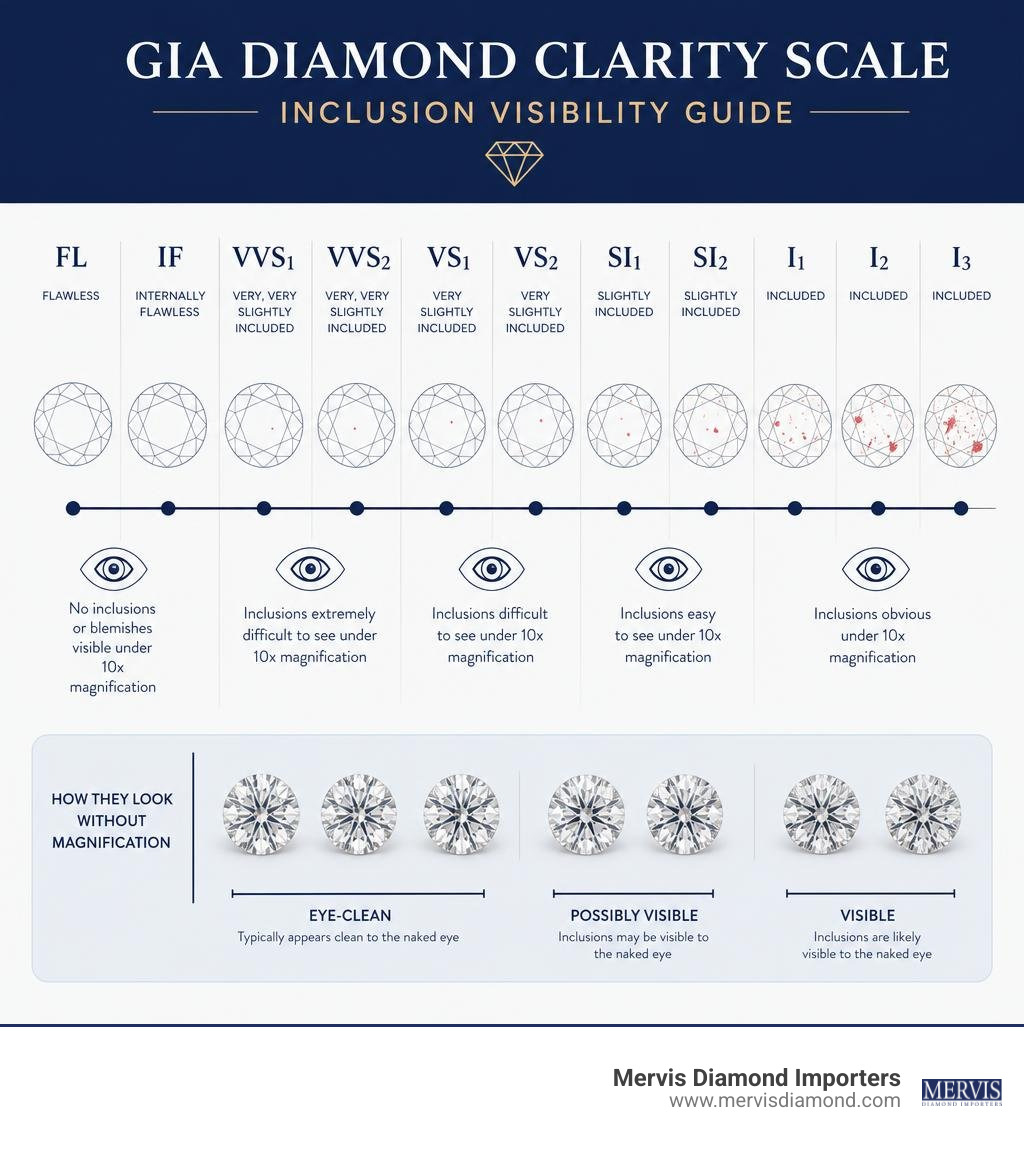
A clarity chart for diamonds explains how visible a diamond's internal inclusions and surface blemishes are when graded under 10x magnification. The GIA scale has 11 grades, from Flawless (FL) to Included (I3). For many engagement-ring buyers, the practical goal is not a perfect grade. It is an eye-clean diamond that looks clear without magnification and leaves room in the budget for excellent cut, color, or carat weight.
Clarity is one part of the 4Cs: carat, color, clarity, and cut. Higher clarity usually costs more, but it does not always create a visible difference once the diamond is set in a ring. A well-cut VS2 or SI1 diamond can often look just as clean in everyday wear as a much higher-clarity stone.
In this guide, I will show you how to read the grades, use a report's clarity plot, and spot the details that matter before you buy. I am Morris Mervis, and I will help you compare diamond clarity with confidence, not pressure.
Understanding Diamond Clarity: Inclusions vs. Blemishes
Diamond clarity is the measure of a gemstone's purity, evaluated by professional gemologists under standard 10x magnification. As diamonds form deep within the Earth under immense heat and pressure, natural birthmarks are created. Understanding these internal and external features helps you evaluate quality and light transmission accurately, as detailed in our comprehensive Diamond 4 Cs Chart Guide.

To grade clarity properly, gemologists assess characteristics based on five critical factors:
- Size: Larger characteristics exert a greater influence on the final clarity grade.
- Number: The total quantity of visible characteristics across the stone.
- Position: Where the feature is located (under the main table facet vs. hidden near the girdle).
- Nature: The inherent type of feature and its potential impact on structural durability.
- Relief: How much the characteristic stands out against the host diamond (dark vs. white or transparent).
Internal Inclusions and Structural Characteristics
Inclusions are internal characteristics that are entirely enclosed within the diamond or extend into it from the surface:
- Crystals: Tiny mineral deposits trapped inside the diamond during crystallization. These can be white, clear, or dark carbon spots.
- Feathers: Microscopic fractures within the crystal structure. While most are harmless, large feathers reaching the surface can pose structural integrity risks.
- Pinpoints and Needles: Pinpoints are tiny structural dots, often appearing in clusters (clouds). Needles are thin, elongated crystal rods.
- Internal Graining: Subtle optical distortions caused by irregular crystal growth planes.
External Blemishes and Surface Flaws
Blemishes are external flaws confined strictly to the diamond's surface. They usually develop during cutting, polishing, or daily wear:
- Polish Lines and Scratches: Fine surface lines left behind by the polishing wheel or accidental surface contact.
- Pits and Cavities: Tiny surface openings where small inclusions near the surface dropped out during cutting.
- Naturals and Indented Naturals: Portions of the original rough diamond crystal surface left untouched by the cutter on the girdle to preserve maximum carat weight.
Mastering the Clarity Chart for Diamonds: The 11 GIA Grades Explained
The Gemological Institute of America (GIA) established the worldwide standard for clarity grading. To make an informed selection in 2026, reference our updated GIA Certified Clean Diamond Guide 2026 alongside the reference table below:
| Clarity Grade | Grade Name | Definition Under 10x Magnification | Naked-Eye Visibility |
|---|---|---|---|
| FL | Flawless | No internal inclusions or external blemishes | Completely eye-clean |
| IF | Internally Flawless | No internal inclusions; only minor surface blemishes | Completely eye-clean |
| VVS1 | Very, Very Slightly Included 1 | Inclusions are extremely difficult for a skilled grader to see | Completely eye-clean |
| VVS2 | Very, Very Slightly Included 2 | Inclusions are very difficult to locate | Completely eye-clean |
| VS1 | Very Slightly Included 1 | Minor inclusions, difficult to see under 10x magnification | Completely eye-clean |
| VS2 | Very Slightly Included 2 | Minor inclusions, somewhat easy to see under 10x magnification | Almost always eye-clean |
| SI1 | Slightly Included 1 | Noticeable inclusions under 10x magnification | Typically eye-clean |
| SI2 | Slightly Included 2 | Inclusions easily visible under 10x; may be visible from sides | May show minor inclusions |
| I1 | Included 1 | Obvious inclusions under 10x; visible to unaided eye | Inclusions visible |
| I2 | Included 2 | Severe inclusions affecting transparency and sparkle | Prominently visible |
| I3 | Included 3 | Major inclusions threatening structural durability | Highly visible; reduced brilliance |
Flawless and Very Very Slightly Included (FL to VVS2)
Grades ranging from Flawless to VVS2 represent the absolute peak of natural diamond purity. Flawless diamonds exhibit no inclusions or blemishes under 10x magnification, while Internally Flawless diamonds contain only faint surface polish marks. VVS1 and VVS2 diamonds contain microscopic pinpoints or tiny needles that require extensive examination under a microscope for even seasoned gemologists to find. Buyers often wonder are VVS diamonds real because their perfection seems artificial, but they command significant rarity premiums solely for their collector appeal.
Very Slightly Included to Slightly Included (VS1 to SI2)
The vast majority of diamonds selected for jewelry fall between the VS and SI tiers. In VS1 and VS2 diamonds, inclusions such as small crystals or faint feathers are minor and invisible to the naked eye. SI1 and SI2 diamonds feature characteristics that are easily detected under 10x magnification, but high-quality SI1 stones remain eye-clean from normal viewing distances. This middle tier is the true commercial sweet spot for maximizing visual beauty and budget.
Included Grades (I1, I2, I3)
The Included category contains stones with flaws clearly visible to the naked human eye without any magnification. In I2 and I3 diamonds, heavy clouds, large black carbon inclusions, and extensive structural fractures reduce light transparency, dulling the diamond's brilliance and endangering its physical durability during daily wear.
How to Read the Clarity Chart for Diamonds Across International Systems
When navigating international diamond markets or estate jewelry, you may encounter alternative grading systems alongside the GIA scale.
Traditional systems such as CIBJO (World Jewellery Confederation) and historical South African trade scales map closely to modern GIA grades:
- Loupe Clean: Corresponds directly to GIA Flawless (FL) and Internally Flawless (IF).
- VVS / VS Categories: Universally recognized across European and American labs as minor characteristics visible only under 10x magnification.
- Piqué (P1, P2, P3): The traditional European and South African term for Included (I1, I2, I3) diamonds, where imperfections can be seen with the unaided eye.

How to Read a Diamond Grading Report and Clarity Plot
A full laboratory diamond grading certificate from respected institutions such as GIA, HRD, or IGI features a graphic clarity plot. This plot maps the stone's unique inclusion blueprint using dual facet diagrams.

Decoding the Report Clarity Plot and Clarity Chart for Diamonds
A clarity plot acts as the diamond’s unique fingerprint. To read a clarity plot accurately, follow this breakdown:
- Crown vs. Pavilion Views: The top diagram illustrates the crown (viewed from above), while the bottom diagram shows the pavilion (viewed from below).
- Color Coding: Red symbols indicate internal inclusions, while green symbols denote surface blemishes. When a feature touches both the interior and surface (like an open cavity), it is marked in both red and green.
- Facet Location: Characteristics plotted directly under the broad table facet are far more visually noticeable than those located out near the girdle, which can easily be concealed under ring prongs.
Hidden Details: Reading the Report Comments Section
Never rely on the clarity plot alone. Diamonds graded VS and above typically show only two or three symbol types on their clarity plot, but secondary details appear in the report's "Comments" section:
- "Clouds not shown": If a report notes clouds not plotted on an SI or I grade, it may indicate widespread internal haziness that dulls the stone's luster.
- "Pinpoints not shown": Common and generally harmless microscopic dots.
- "Surface graining not shown": Structural lines from crystal growth that rarely affect sparkle unless extensive.
Practical Buying Strategy: Maximizing Budget and Sparkle
Selecting the right clarity grade requires balancing diamond geometry, cut style, and personal budget. When you learn how to choose a diamond shape, you will discover that facet arrangements play a huge role in how forgiving a diamond is with inclusions.
The Eye-Clean Advantage: Why VS2 and SI1 Dominate
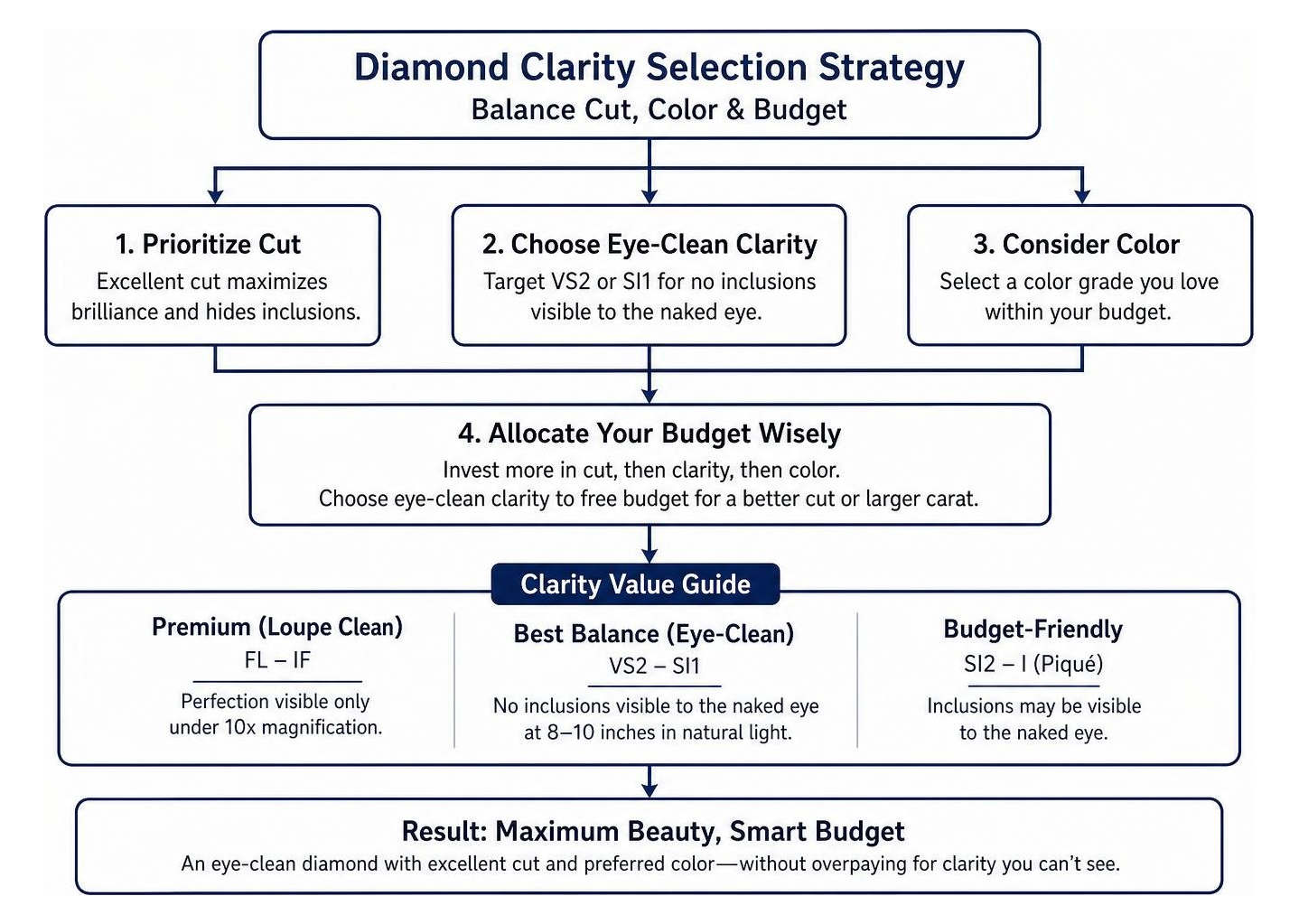
An eye-clean diamond has no inclusions visible to the naked eye when viewed from a standard distance of 8 to 10 inches under natural light. Inclusions measuring less than 0.1 mm rarely reveal themselves to the naked eye. By targeting eye-clean VS2 and SI1 diamonds, you avoid paying large rarity premiums for perfection you cannot see, freeing up funds for a larger carat weight or a superior cut.
Balancing Clarity with Cut, Color, and Carat Weight
A diamond's cut is the most powerful tool for hiding clarity imperfections. An "Excellent" or "Ideal" cut reflects maximum light back to the eye, creating intense sparkle and scintillation that naturally masks small internal inclusions.
Keep these practical rules in mind:
- Brilliant Cuts vs. Step Cuts: Round brilliant, cushion, and radiant cuts disperse light exceptionally well, easily concealing SI1 inclusions. In contrast, step-cut shapes like emerald and Asscher cuts feature open, mirror-like tables that demand a higher clarity grade (VS1 or better) to guarantee an eye-clean look.
- Carat Weight Impact: Larger diamonds possess larger facet windows. An inclusion that remains invisible in a 0.90-carat diamond may become visible in a 2.50-carat stone of the same clarity grade.
Frequently Asked Questions About Diamond Clarity
What clarity grade is best for an engagement ring?
The best value grades for an engagement ring are VS2 and SI1. These grades provide stones that look visually identical to Flawless diamonds to the unaided eye in daily wear, allowing you to invest more of your budget into optimal cut quality and carat size.
Can inclusions cause a diamond to crack or chip?
Most minor inclusions, such as pinpoints and small crystals, have zero effect on diamond durability. However, deep feathers or large fractures that reach the girdle edge can make a diamond susceptible to chipping if struck hard, which is why proper protective ring mounting is critical.
Why does diamond cut matter more than clarity?
Diamond cut controls how effectively the stone refracts and reflects light. A masterfully cut diamond delivers intense brilliance, fire, and scintillation that dazzle the eye and naturally disguise microscopic internal characteristics far better than a higher clarity grade with a mediocre cut.
Conclusion
Understanding diamond clarity empowers you to make an informed, confident investment. Rather than paying thousands extra for flawless clarity that only a microscope can detect, focus your search on eye-clean diamonds that maximize brilliance, proportion, and aesthetic beauty.
At Mervis Diamond Importers, our non-commissioned gemologists take pride in guiding you through every diamond detail in a relaxed, pressure-free setting across our showrooms in Tysons VA, Rockville MD, and Washington DC. To explore how clarity works alongside cut, color, and carat weight, schedule an appointment or read our complete guide to understanding four Cs today.