

How to Use a Diamond Color Chart to Find Your Visual Sweet Spot
What Is the Diamond Color Chart and How Does Grading Work?
To use a diamond color chart to find your visual sweet spot, start by matching the grade to your setting metal: near-colorless G–I diamonds look icy white in platinum or white gold, while J–K grades offer excellent value in yellow or rose gold. This practical pairing lets you invest in cut quality and carat weight without paying for color you cannot see once the ring is mounted.
When gemologists evaluate diamond color, they are actually measuring the absence of color. Most natural diamonds formed deep within the earth billions of years ago, where trace elements like nitrogen became trapped in their crystal lattice. Nitrogen atoms absorb blue light and transmit yellow light, giving diamonds subtle body color ranging from icy white to pale yellow or light brown.
To determine an accurate grade, gemological laboratories use a standardized process:
- Loose Stone Assessment: Diamonds are always evaluated unmounted. Metal prongs or bezels reflect color into the gem, skewing the result.
- Face-Down Pavilion Viewing: Graders look at the diamond through the pavilion (the underside) against a pure white background. This prevents the diamond's brilliance, fire, and surface reflections from masking subtle body color.
- Master Stone Comparison: The stone is placed directly alongside a pre-graded set of master stones under calibrated, daylight-equivalent neutral lighting.
- Saturation Matching: The grader identifies which master stone the diamond matches in color saturation, confirming its place on the standardized D-Z diamond color chart.
Understanding how laboratories perform this analysis is a cornerstone of evaluating diamond quality across the 4Cs before choosing your ring.
Breaking Down the Standard D-to-Z Diamond Color Chart Groupings
The standard color scale breaks down into five distinct tiers. Each group reflects a jump in rarity, visual warmth, and overall pricing:
| Color Grouping | Letter Grades | Visual Appearance Face-Up | Price Impact | Best Value Use Case |
|---|---|---|---|---|
| Colorless | D, E, F | Completely icy white; no detectable color to the naked eye | Premium pricing; highest cost per carat | Platinum or white gold solitaire settings; step cuts |
| Near-Colorless | G, H, I, J | Looks face-up white; faint warmth only visible when compared upside down | Moderate; excellent visual-to-price balance | The "sweet spot" for most shapes in white gold or platinum |
| Faint | K, L, M | Subtle warm, candlelit glow visible to the naked eye | Budget-friendly; significant discount | Yellow gold and rose gold vintage settings |
| Very Light | N, O, P, Q, R | Noticeable light yellow or brown body tint | Highly affordable | Warm vintage designs, halo accents |
| Light | S through Z | Prominent yellow or brownish tone throughout the gem | Lowest pricing in the D-Z range | Distinctive antique designs or warm-toned jewelry |
While stones at the top of the scale carry the highest premiums, knowing which diamond colors are most expensive helps shoppers decide whether icy purity or budget efficiency matters more for their priorities.
AGS 0-10 Scale vs. Traditional D-Z Diamond Color Chart Scales
While the D-to-Z alphabetical scale is universally recognized, the American Gem Society (AGS) introduced a numeric 0-to-10 grading framework. The AGS scale starts at 0.0 (the equivalent of a D color grade, representing zero visible color) and extends to 10.0 (the equivalent of Z, representing light color).
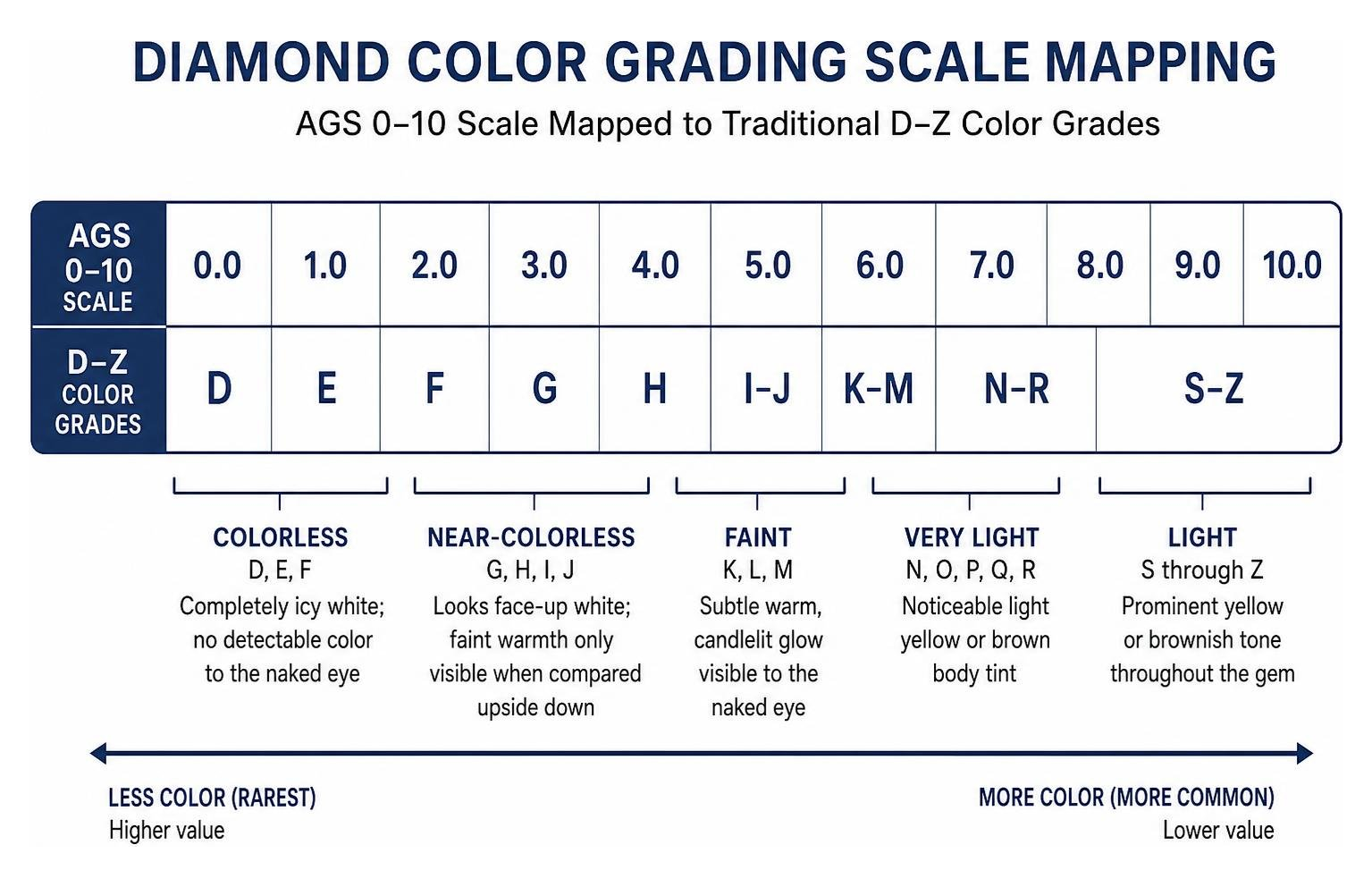
Both grading approaches evaluate the exact same visual traits using master stone sets, as detailed in research on understanding diamond color scales and standards. Reviewing our diamond 4 Cs chart guide provides a clear breakdown of how these laboratory benchmarks correlate across certifications.
How Diamond Cut and Shape Influence Perceived Color
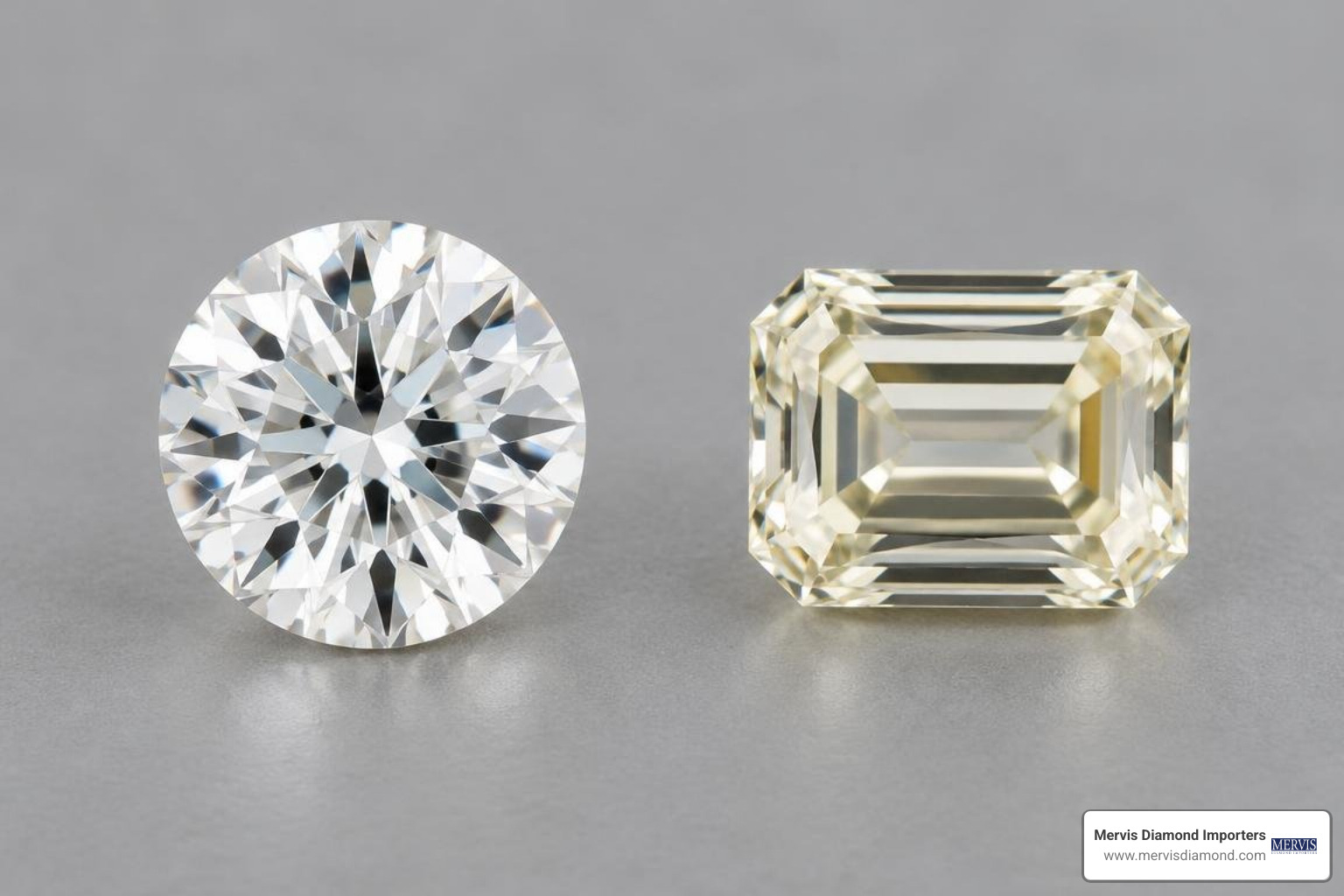
A diamond's shape directly affects how body color appears face-up:
- Round Brilliant Cuts: Featuring 57 to 58 precisely angled facets, round brilliant diamonds return maximum light to the eye. This intense scintillation acts as natural camouflage for subtle yellow tones, allowing you to drop to an H or I grade while maintaining an icy white look.
- Step Cuts (Emerald and Asscher): Step cuts have wide, open, rectangular facets resembling a hall of mirrors. Because they emphasize clarity and transparency over brilliant sparkle, they trap less light and reveal body color easily. We recommend staying at G or higher for step cuts set in white metals.
- Elongated Fancy Shapes (Oval, Pear, Marquise, Radiant): Fancy shapes concentrate body color in specific zones—notably the tapered tips of pears and marquises, or the outer curved edges of ovals. If you are choosing an elongated fancy shape, selecting an H or higher ensures the tips remain crisp and bright.
That color works hand-in-hand with clarity; learning how diamond clarity impacts appearance ensures your chosen shape displays clean, unobstructed brilliance.
Setting Metals and Ring Styles: Maximizing Value Across Color Grades
The metal holding your diamond creates a reflective environment that alters perceived color:
- Platinum & White Gold: These bright, cool-toned metals act as a clean mirror. They highlight the icy character of D-F diamonds, but they also accentuate any yellow warmth in stones graded J or lower. For white metal settings, G through I grades offer an ideal balance.
- Yellow Gold & Rose Gold: Warm metals reflect rich hues back through the pavilion. Setting an expensive D or E color diamond in yellow gold can diminish its premium colorless appearance, as the metal naturally imparts a warm glow. Conversely, a budget-friendly J, K, or L color diamond pairs naturally with yellow or rose gold settings.
- Halo & Side-Stone Settings: In multi-stone rings, color consistency matters. If your center diamond is an I color and the pavé halo accents are F color, the center stone will appear noticeably warmer by comparison. Matching the center stone within one color grade of its accent stones maintains a unified look.
These metal and setting principles apply to all fine jewelry. For example, when selecting good color and clarity for diamond earrings, near-colorless grades provide substantial savings without any visible loss of brightness from conversational distances. Leading institutions establish lab grading standards and certification impact to ensure you receive verified color ratings regardless of your mounting choice.
Finding Your Visual Sweet Spot and Avoiding Common Buying Mistakes
To maximize your diamond budget, avoid common pitfalls:
- Mistake 1: Overpaying for Colorless (D-F) Diamonds: D-grade diamonds command steep premiums because of their geological rarity, not because they look drastically different from a well-cut G or H once set in a ring.
- Mistake 2: Sacrificing Cut for Color: Cut quality determines how light enters, refracts, and returns to your eye. An "Excellent" cut I-color diamond will look brighter, whiter, and more lively than a "Fair" cut E-color diamond that leaks light.
- Mistake 3: Ignoring Carat Weight Saturation: Larger diamonds (2 carats and above) have larger facet surfaces that retain body color more noticeably than smaller stones. If you are buying a 2.5-carat oval, consider stepping up to an F or G grade.
- Mistake 4: Overlooking Medium Blue Fluorescence: Medium to strong blue fluorescence can act as a natural optical brightener, canceling out faint yellow tones in H, I, and J color diamonds in natural daylight.
| Diamond Shape | Platinum / White Gold | Yellow Gold / Rose Gold | Halo Settings (White Metal) |
|---|---|---|---|
| Round Brilliant | G – I | H – K | G – H |
| Emerald / Asscher | D – G | G – I | F – G |
| Oval / Pear / Marquise | F – H | G – J | F – G |
| Cushion / Radiant | G – H | H – J | G – H |
Frequently Asked Questions About Diamond Color
Do lab-grown diamonds use the same color grading scale as natural diamonds?
Yes. Both natural and lab-grown diamonds are graded using the standard D-to-Z scale. Gemological laboratories assess their color saturation against identical master stones under neutral lighting, checking for body tint caused by trace elements or crystal growth variations.
What is the most popular diamond color grade for engagement rings?
The G and H color grades are the most popular choices. They sit squarely in the near-colorless range, giving the face-up visual appearance of a pure white diamond without the rare-tier price tag of D or E stones.
Can you see the difference between an F and a G color diamond once set?
In almost all everyday settings, the naked eye cannot distinguish an F color from a G color diamond. The subtle shift between colorless and near-colorless grades is primarily noticeable to trained gemologists viewing loose stones face-down under laboratory lights.
Conclusion
Finding the perfect diamond is about balancing the 4Cs to get the greatest visual beauty and value for your investment. At Mervis Diamond Importers, our team hand-selects natural and lab-grown stones to ensure that every diamond in our collection delivers exceptional brilliance, life, and fire.
By identifying your visual sweet spot on the color chart, you can invest where it matters most: superior cut craftsmanship and ring design. Explore our resources for understanding the four Cs for your diamond purchase or visit one of our showrooms in Tysons, VA, Rockville, MD, or Washington, DC to compare color grades in person.