

What You Need to Know About Factory Grown Diamonds Today
What Factory Grown Diamonds Really Are
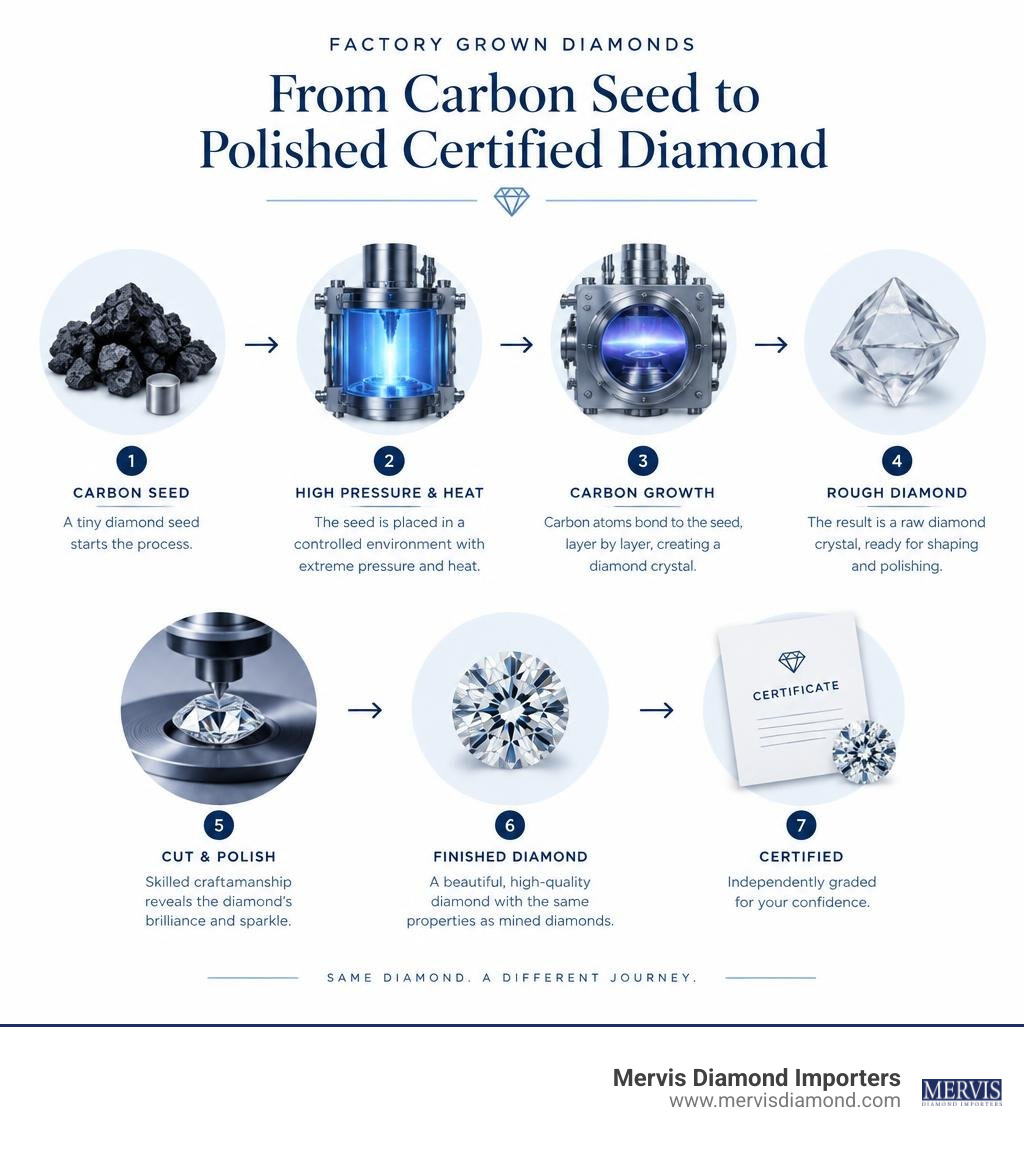
Factory grown diamonds are real diamonds made from carbon in controlled facilities rather than mined from the earth. They have the same crystal structure, hardness, and sparkle as mined diamonds. Modern facilities grow them using either high pressure and heat or a carbon-rich gas process.
For an engagement ring, the smart first steps are simple:
- Choose a diamond with an independent grading report.
- Compare cut, color, clarity, and carat weight - not price alone.
- Ask whether the stone was grown by HPHT or CVD and review its report before you buy.
This gives you a clear way to evaluate quality without guessing. Factory grown diamonds can offer a larger or higher-quality diamond within a given budget, but each stone should still be assessed on its own merits.
I am Morris Mervis, and I will walk you through how these diamonds are made, how they compare with mined stones, and what to look for with confidence.
How Factory Grown Diamonds Are Created in Modern Facilities

The journey of a factory-created diamond begins at the atomic level. Rather than waiting billions of years for geological forces deep beneath the Earth's crust, scientists harness advanced physics to recreate those exact conditions in state-of-the-art laboratories.
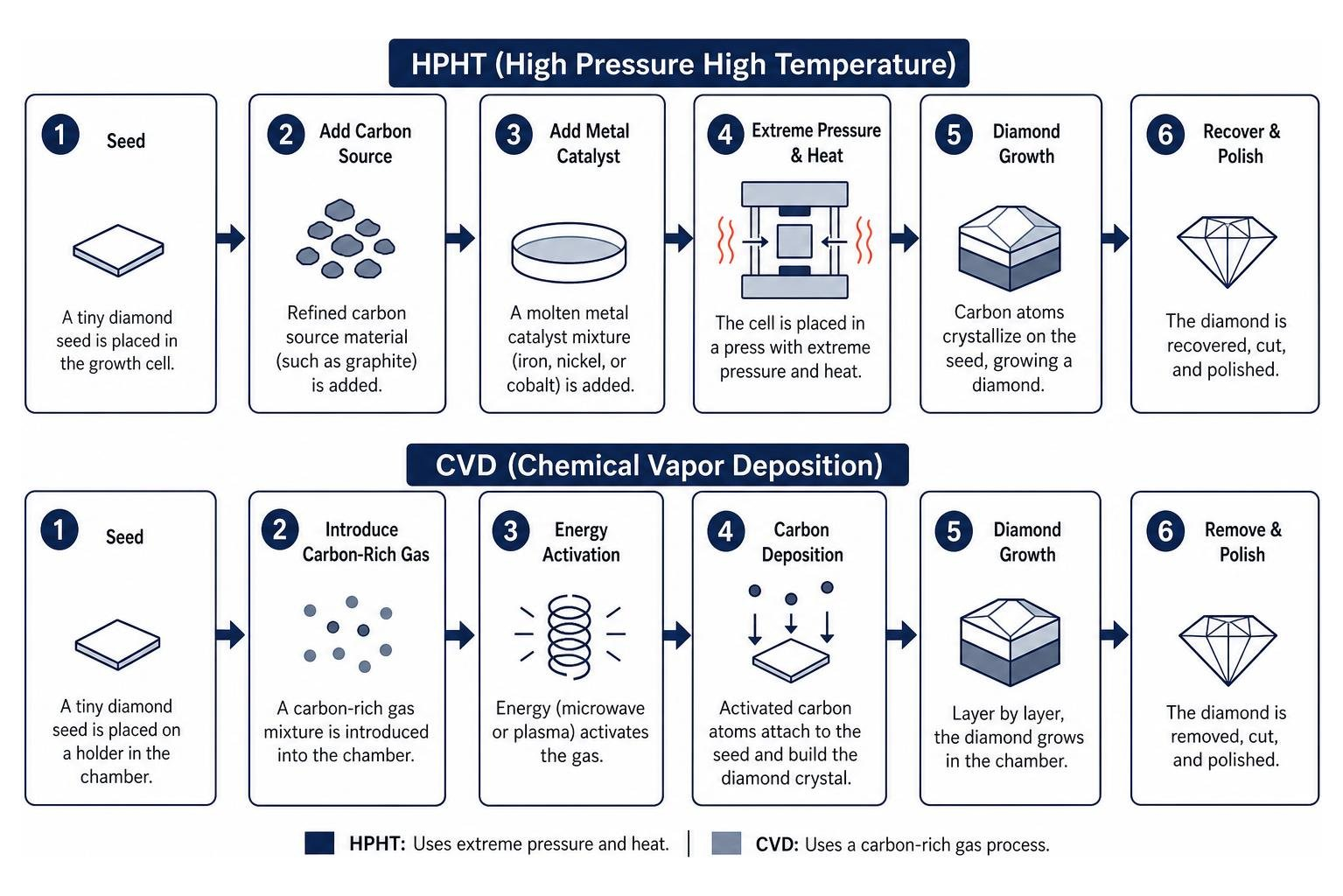
Every lab diamond begins with a sliver of an existing diamond called a seed. This microscopic foundation provides the blueprint. From there, carbon atoms attach themselves one by one to form an identical three-dimensional crystal lattice. Today, two primary methods produce gem-quality diamonds for fine jewelry.
High Pressure High Temperature (HPHT) Diamond Growth
The High Pressure High Temperature (HPHT) method replicates the extreme natural environment found 100 miles below the Earth’s surface.
In this process, a tiny diamond seed is placed in a specialized growth cell along with refined carbon source material (such as graphite) and a molten metal catalyst mixture (often iron, nickel, or cobalt). The chamber is placed into a massive hydraulic press—such as a cubic press or a belt press—capable of generating pressures exceeding 60,000 atmospheres (over 870,000 pounds per square inch) and temperatures upwards of 1,500°C (2,700°F).
Under these extreme conditions, the pure carbon dissolves into the molten metal flux. The catalyst lowers the energy required for the carbon bonds to break and reassemble. As the carbon migrates toward the cooler diamond seed, it crystallizes layer by layer into a solid rough diamond. Fine jewelry buyers often discover that HPHT stones exhibit magnificent color and clarity due to this direct, high-density formation.
Chemical Vapor Deposition (CVD) Plasma Method
Chemical Vapor Deposition (CVD) takes an entirely different, high-tech approach akin to printing a diamond out of thin air.
Instead of crushing pressure, the CVD method operates inside a vacuum chamber at relatively low pressures. A thin diamond seed plate is placed inside the chamber, which is then filled with a carbon-rich gas mixture, typically methane ($CH4$) and hydrogen ($H2$). Microwave or radiofrequency energy energizes the gases into a glowing plasma ball, breaking the chemical bonds of the hydrocarbon molecules.
Freed carbon atoms rain down onto the diamond substrate, locking onto the seed's crystal lattice. Over several weeks, layer upon layer of pure carbon builds upward into a gem-quality rough diamond block. After growth, these stones are cut and polished by master diamond cutters into showstopping gems, perfectly suited for modern designs such as a custom jewelry setting styles.
Comparing Laboratory Gems with Earth-Mined Stones
When comparing laboratory diamonds with mined stones, it is essential to understand that their physical substance is identical. They are not cubic zirconia or moissanite; they are authentic crystallized carbon.
| Characteristic | Factory / Lab-Grown Diamonds | Earth-Mined Diamonds |
|---|---|---|
| Chemical Composition | Pure Carbon ($C$) | Pure Carbon ($C$) |
| Crystal Structure | Isometric-Hexoctahedral (Cubic) | Isometric-Hexoctahedral (Cubic) |
| Mohs Hardness | 10 | 10 |
| Refractive Index | 2.417 | 2.417 |
| Dispersion (Fire) | 0.044 | 0.044 |
| Origin | Modern Controlled Laboratory | Earth's Upper Mantle |
| Growth Time | 2 to 6 weeks | 1 to 3.3 billion years |
| Relative Value | Up to 70–85% less costly | Premium traditional pricing |
| Grading Standards | 4Cs (IGI, GIA, GCAL) | 4Cs (GIA, IGI, AGS) |
Chemical and Optical Properties of Factory Grown Diamonds
Because factory diamonds share an identical crystal structure with natural stones, their optical performance is indistinguishable. They possess the exact same refractive index (2.417) and dispersion rate (0.044), which dictate how light enters, bends, and bounces back to your eye as brilliant white light and rainbow "fire."
Both varieties score a perfect 10 on the Mohs hardness scale, making them the hardest known mineral on the planet and exceptionally resistant to scratching or daily wear. For couples seeking maximum value, our guide to budget-friendly engagement rings illustrates how these identical physical properties allow you to maximize your center stone's size and clarity without compromising durability.
Grading and Certification of Factory Grown Diamonds
Just like mined diamonds, factory diamonds undergo meticulous evaluation by premier independent gemological laboratories, including the International Gemological Institute (IGI) and the Gemological Institute of America (GIA).
Grading laboratories evaluate each diamond across the standard 4Cs:
- Cut: The symmetry, polish, and proportion determining brilliance.
- Color: The absence of body color, graded from D (colorless) to Z (light tint).
- Clarity: The absence of internal inclusions or external blemishes.
- Carat Weight: The precise measurement of the stone's physical mass.
Grading certificates include a microscopically laser-inscribed report number on the diamond's girdle, confirming its laboratory origin and verifying its exact specifications. For instance, collectors often seek investment in substantial stones like a high-clarity 3.02 carat round diamond or an exceptional 3.52 carat round diamond with verified documentation.
Popular Shapes, Carat Sizes, and Settings
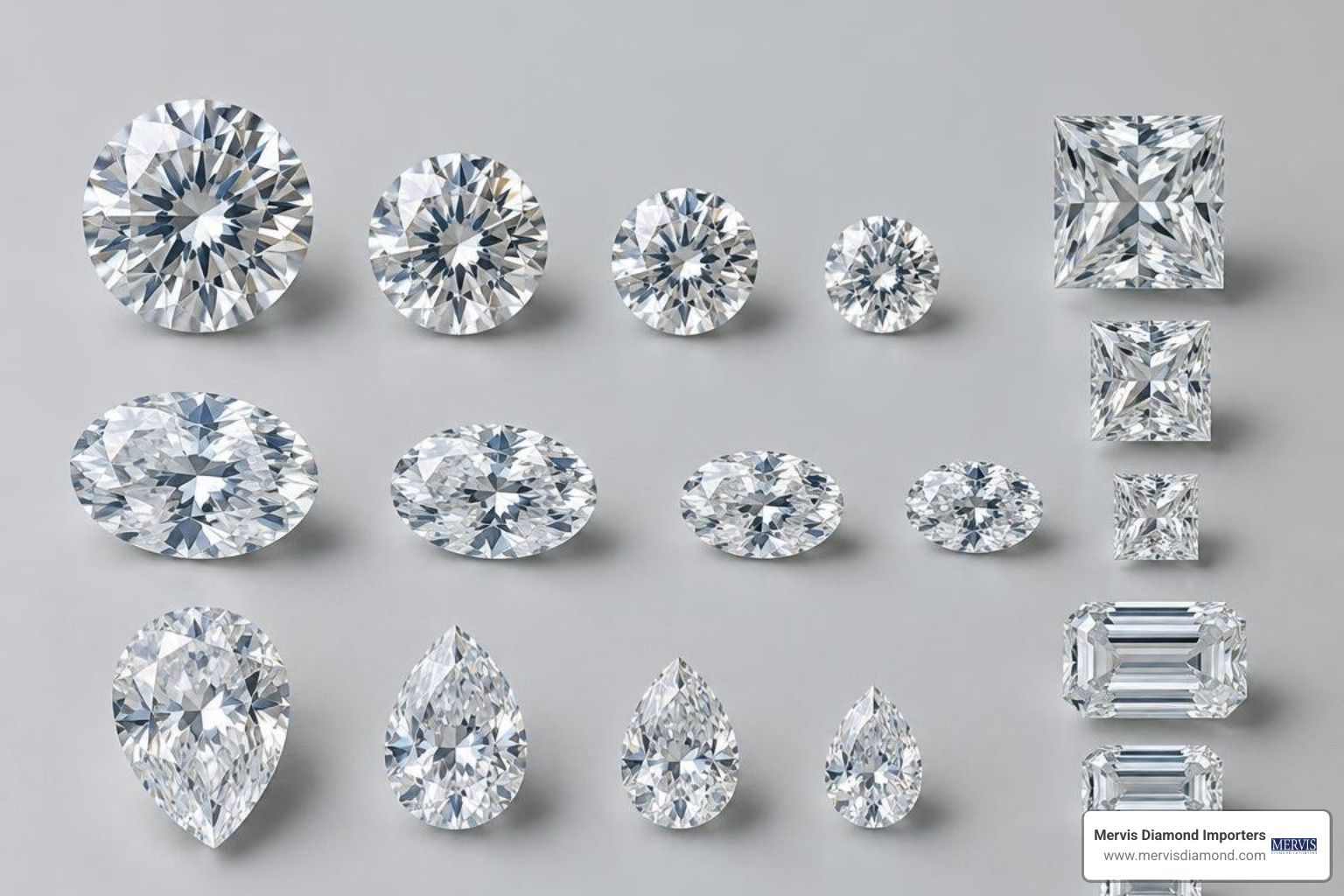
Factory diamond production has unlocked access to larger carat weights and fancy diamond cuts that were once rare or cost-prohibitive. Choosing a shape comes down to personal taste and how the diamond sits on the finger.
Oval, Pear, and Princess Fancy Shapes
Elongated fancy shapes provide unmatched finger coverage and a flattering, slenderizing silhouette.
- Oval Cuts: Ovals combine the brilliance of a round cut with an elongated profile. You can opt for brilliant proportions in stones like a 2.01 carat D color oval diamond, a commanding 3.52 carat G color oval diamond, or an ultra-clean 2.03 carat oval brilliant diamond.
- Pear Shapes: Also known as teardrop cuts, pear shapes provide vintage romance. Stunning options include a 2.53 carat pear shape diamond, a showstopping 3.01 carat pear diamond, or a crisp 2.01 carat pear cut diamond.
- Princess Cuts: Featuring sharp, geometric corners and intense fire, modern square cuts like a 2.04 carat princess cut diamond deliver contemporary style.
Emerald and Radiant Step-Cut Silhouettes
For those who appreciate architectural lines and clean geometric elegance, step cuts and hybrid cuts offer distinct optical appeal:
- Emerald Cuts: Emerald cuts feature long, rectangular step facets that create a "hall-of-mirrors" effect. Because this cut showcases clarity without hiding inclusions under brilliance, selecting top clarity grades is paramount. Excellent examples range from a refined 1.40 carat emerald cut diamond to a majestic 4.01 carat emerald cut diamond.
- Radiant Cuts: Combining the clean outline of an emerald cut with the fiery faceting of a round brilliant, radiant cuts like a 2.03 carat radiant cut diamond provide dazzling light return.
You can view these stunning cuts in person across our regional showrooms or browse curated Washington DC bridal jewelry collections to match your chosen stone with the perfect custom setting.
Frequently Asked Questions About Lab-Created Stones
Can lab-grown stones be appraised and insured?
Yes. Because factory diamonds are real diamonds, they can be fully appraised, valued, and insured against loss, theft, or damage. Major jewelry insurance providers insure lab-grown stones based on their current retail replacement value. For detailed steps on documenting your purchase, consult our appraisal guidance for lab-created stones.
How large can artificial diamonds be grown?
With ongoing advancements in reactor technology, growers can produce rough diamonds exceeding 30 to 50 carats in specialized industrial setups, yielding gem-quality polished stones well over 10 to 15 carats. You can read more about historical size achievements in our overview of record-setting artificial diamond milestones.
Do laboratory diamonds test as real diamonds?
Yes, standard thermal conductivity and basic diamond testing pens register factory diamonds as genuine diamonds because their heat dissipation is identical to mined carbon crystals.
However, distinguishing between lab-created and earth-mined diamonds requires specialized gemological laboratory equipment. Advanced spectroscopic machines assess microscopic growth patterns, trace elements, and photoluminescence signatures to determine exact origin.
Conclusion
Whether grown in a high-tech facility or discovered deep within the earth, diamonds remain the ultimate symbol of enduring love. Understanding how modern technology creates these stones allows you to select a diamond that reflects your personal style, ethics, and budget without ever sacrificing beauty or durability.
At Mervis Diamond Importers, we take immense pride in curating the finest natural and laboratory-grown gems in our Tysons, VA, Rockville, MD, and Washington, DC showrooms. Our experts are here to guide you through every cut, clarity grade, and setting style in a relaxed, pressure-free environment.
To explore which diamond type is right for your unique journey, read our comprehensive guide comparing mined vs lab grown diamonds or schedule a private consultation with our team today.