

Old Mine Cut Diamonds Are Forever (And Way Cooler Than Modern Cuts)
The Old Mine Cut Diamond Forever: Antique Charm With a Timeless Edge
An old mine cut diamond forever holds a special place in fine jewelry — it is one of the earliest forms of the brilliant-cut diamond, shaped entirely by hand before modern machinery existed.
If you want the quick version, here it is:
- What it is: A hand-cut diamond from the 1700s–1800s with a cushion-like shape, high crown, small table, and a large open culet at the base
- How it sparkles: Slower, warmer flashes of fire and color — especially beautiful in candlelight or soft indoor light
- Who it's for: Buyers who want a one-of-a-kind stone with history, character, and visible craftsmanship
- Why "forever": These diamonds were made to last centuries — and the best-preserved examples still carry their original soul
- Modern options: Lab-grown reproductions now make the old mine cut style accessible at a wider range of budgets
Old mine cut diamonds were born in an era when every gem was shaped by hand, following the natural form of the rough stone. No two are identical. That imperfection is exactly the point — and for buyers tired of mass-produced rings that all look the same, it is a powerful draw.
There's a reason antique lovers light up at the mention of one.
Whether you're exploring an authentic antique stone or a modern reproduction, this guide covers everything you need to know — history, sparkle, value, ethics, and how to style one today.
What Is an Old Mine Cut Diamond?
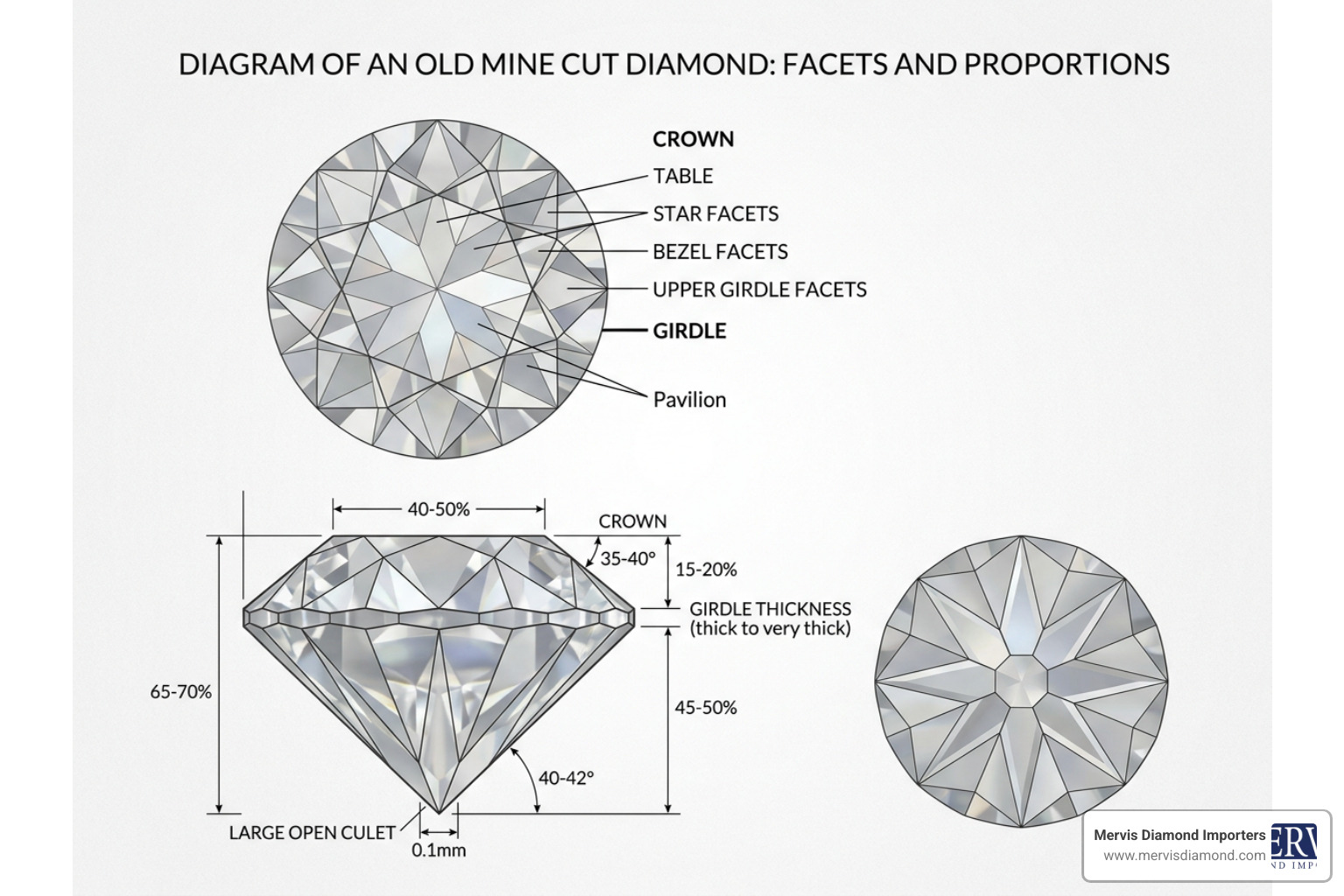
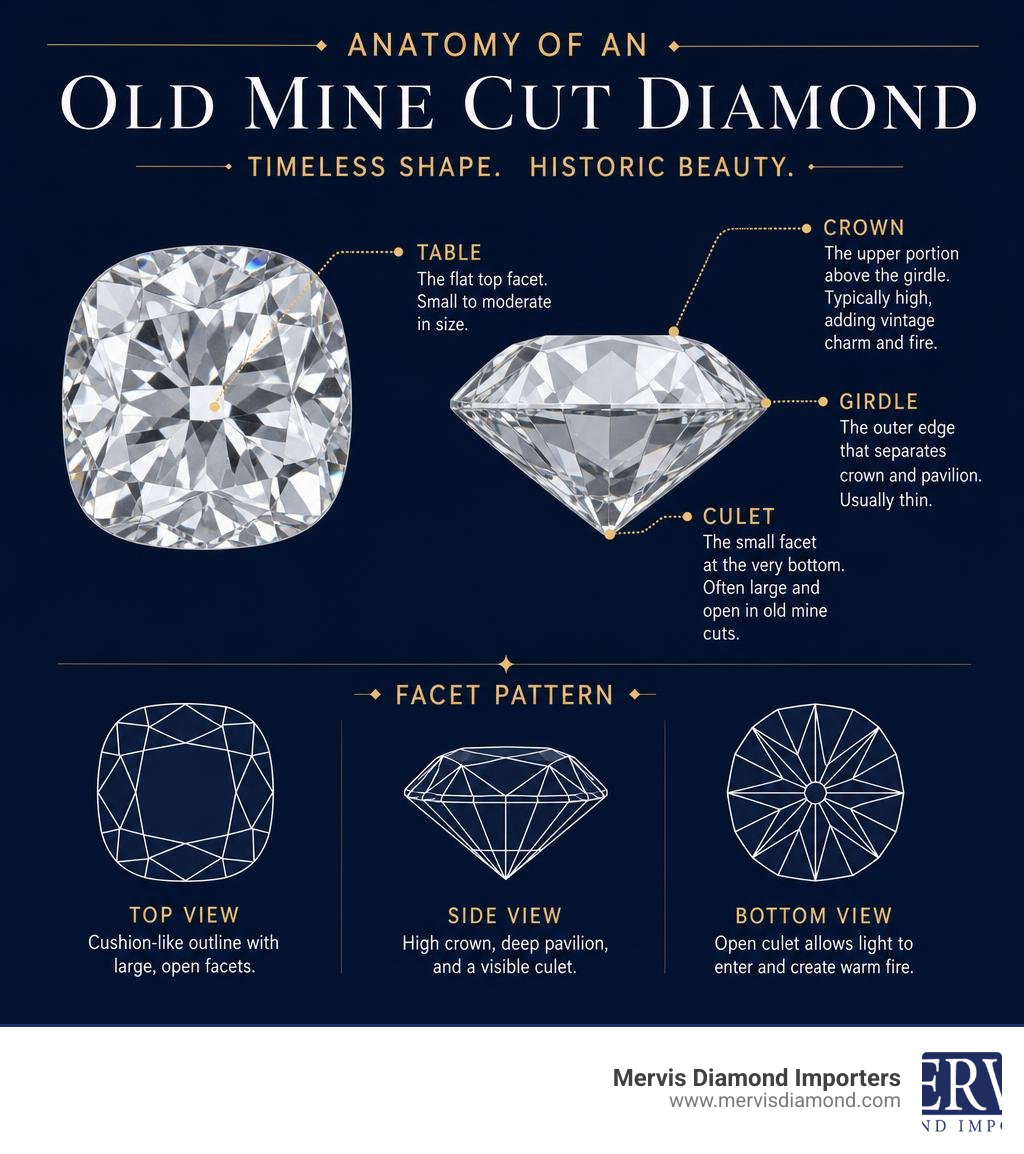
To truly appreciate why an old mine cut diamond forever captures the imagination, we have to look closely at its physical anatomy. Unlike modern diamonds, which are cut using computer-guided lasers to achieve mathematical perfection, old mine cuts were crafted by eye and by hand.
When you look at an old mine cut diamond from the top, you will immediately notice its softly squared, cushion-like outline. It is not a perfect square, nor is it a perfect circle; it sits comfortably in between, carrying a rustic, organic shape.
The anatomy of an old mine cut is defined by several hallmark characteristics:
- A High Crown: The top portion of the diamond (the crown) is noticeably taller and steeper than what you see on modern diamonds.
- A Small Table: The flat top facet of the diamond is relatively small, which works in tandem with the high crown to disperse light into colorful flashes.
- A Deep Pavilion: The lower portion of the stone is deep, giving the diamond a chunky, substantial profile.
- A Large, Flat Culet: At the very bottom of the diamond, instead of a sharp point, there is a flat, polished facet called the culet. When looking down through the top of the stone, this culet is often visible as a small, dark circle—a classic "window" that instantly identifies an antique cut.
- 58 Facets: Despite its vintage origins, the old mine cut features exactly 58 facets. This is the exact same number of facets found in a modern round brilliant cut, but their shapes and angles are entirely different.
These hand-cut facets are broader and chunkier than their modern counterparts. Rather than reflecting light in a rapid, splintered pattern, they produce a broad, checkerboard-like pattern when viewed from above. To understand how these distinct proportions influence the diamond's overall personality, explore this comprehensive old mine cut diamond guide: history, sparkle, value and ethics.
Why the Old Mine Cut Diamond Forever Stands Apart
The phrase "diamonds are forever" takes on a deeper meaning when applied to old mine cuts. These stones have already survived centuries of history, transitioning through changing empires, fashion eras, and generations of families.
During the Georgian era (1714–1837) and the Victorian era (1837–1901), these diamonds were the height of luxury. At the time, the world's primary diamond sources were the "old mines" of India and later Brazil, long before the discovery of massive South African diamond deposits in the late 19th century. When the African mines flooded the market with diamonds, the trade began calling these older, hand-cut gems "old mine cuts" to distinguish their superior quality and geographic heritage.
Because they were cut in an era before electric lighting, old mine cuts were specifically optimized to perform under candlelight and soft, low-light conditions. Under a candle’s flame, these diamonds do not merely sparkle; they glow. They display a slower, warmer, and incredibly romantic "slow fire"—the dispersion of light into bright spectral colors. You can learn more about this mesmerizing visual phenomenon in this detailed guide on the unique sparkle of old mine cut diamonds.
The History and Romance of an Old Mine Cut Diamond Forever
Before the advent of modern motorized machinery, shaping a diamond required immense physical labor and an extraordinary eye for detail. Artisans known as "bruters" would manually grind two rough diamonds together, using one stone to shape the other.
This pre-industrial process meant that the cutter had to follow the natural, octahedral shape of the rough crystal. They couldn't afford to waste precious diamond material simply to achieve perfect symmetry. Instead, they worked with the stone, coaxing out its inner light while preserving as much weight as possible. When you wear an authentic old mine cut, you are wearing a miniature sculpture—a testament to human craftsmanship that has survived the test of time.
Why Handcrafted Character Makes the Old Mine Cut Diamond Forever Unique
In a world of mass production, there is a quiet luxury in imperfection. Modern brilliant cuts are highly standardized; a round brilliant cut in Washington, DC will look virtually identical to one in Tysons, VA.
An old mine cut diamond offers the exact opposite:
- Delightful Asymmetry: The facets may be slightly uneven, and the outline might lean a tiny bit more oval or square on one side.
- Individual Personality: No two stones share the exact same facet angles or light patterns.
- Organic Beauty: The subtle irregularities give the stone a soulful, warm presence that feels alive rather than manufactured.
For couples looking for an engagement ring that symbolizes a highly individual love story, choosing a stone with such distinct character is incredibly meaningful.
Comparing the Old Mine Cut to Other Diamond Cuts
To understand where the old mine cut sits in the family tree of diamond shapes, it helps to compare it directly to its closest relatives.
| Feature | Old Mine Cut | Old European Cut | Modern Round Brilliant | Modern Cushion Cut |
|---|---|---|---|---|
| Shape | Squarish cushion | Round | Round | Squarish or rectangular cushion |
| Faceting Style | Chunky, broad facets | Chunky, circular facets | Thin, needle-like facets | Varied (often "crushed ice" look) |
| Crown Height | Very high | High | Medium to low | Low |
| Table Size | Very small | Small | Large | Large |
| Culet | Large, flat, visible | Medium, flat, visible | Pointed (none) | Pointed (none) |
| Light Performance | High fire, warm glow | Balanced fire and brilliance | Maximum white brightness | High brilliance, rapid sparkle |
| Creation Method | Hand-crafted by eye | Hand-crafted / early lathe | Machine and laser cut | Machine and laser cut |
For a deeper dive into how these vintage faceting styles compare to modern alternatives, read our comparison on the Old Mine Cut vs Modern Brilliant.
Old Mine Cut vs. Old European Cut
As diamond-cutting technology progressed into the late 19th and early 20th centuries—particularly with the invention of the steam-powered diamond lathe—cutters were finally able to easily create perfectly round diamonds. This technological shift birthed the Old European Cut.
While both are antique, hand-cut styles featuring 58 facets, a high crown, and a visible culet, the primary difference lies in their shape. The old mine cut is squarish and cushion-shaped, reflecting its older Georgian and Victorian heritage. The old European cut is round, serving as the transitional step that dominated the Edwardian and Art Deco eras before paving the way for the modern round brilliant.
Old Mine Cut vs. Modern Cushion Cut
At first glance, a modern cushion cut and an old mine cut might look similar because of their shared squarish-oval outlines. However, their internal structures are worlds apart.
Modern cushion cuts are designed using advanced computer modeling to maximize "brilliance" (white light reflection). This often results in a highly uniform, "crushed ice" look with many tiny, rapid flashes of light. The old mine cut, by contrast, relies on its high crown and large facets to produce slower, chunkier flashes of colored "fire." It looks blocky, distinct, and decidedly vintage, whereas the modern cushion is sleek and standardized.
Practical Guide for Modern Buyers: Value, Ethics, and Styling
Because authentic old mine cut diamonds are no longer produced, their supply is strictly limited. Over the decades, many original old mine cuts were unfortunately sent to modern cutting houses to be recut into modern round brilliants. This practice makes well-preserved, original examples incredibly rare today.
When shopping for an old mine cut diamond, there are several practical factors to keep in mind:
- Protect the Girdle: Because these stones were cut by hand, their girdles (the outer edge where the top and bottom meet) can sometimes be uneven or very thin in certain spots. To keep your diamond safe for daily wear, consider protective settings like a custom bezel or heavy, secure prongs.
- Embrace Warmer Colors: Modern grading scales prioritize completely colorless diamonds (D-F). However, old mine cuts look spectacular in warmer color grades (such as K, L, M, or even lower). These warm tones beautifully complement the natural candlelight glow of the cut and pair perfectly with yellow gold or rose gold settings.
- Prioritize Eye-Cleanliness over Flawless Grading: Due to their unique faceting, minor internal inclusions are often easily disguised by the broad, chunky light reflections. Focus on how the stone looks to your naked eye rather than relying solely on a grading report.
Lab-Grown vs. Natural Antique Diamonds
For buyers who love the vintage aesthetic of the old mine cut but are working within a specific budget, modern technology offers an exciting alternative: lab-grown old mine cuts.
Lab-grown diamonds are chemically, physically, and optically identical to natural diamonds, carrying the exact same 10.0 rating on the Mohs hardness scale. Today, skilled diamond cutters can intentionally replicate the historic proportions—the high crown, small table, and open culet—of the old mine cut in a lab setting.
This option allows you to enjoy the soulful, chunky aesthetic of a 19th-century gem with the added benefits of modern lab diamond pricing and absolute conflict-free origin. To explore this choice further, read our introductory guide on what are old mine cut diamonds.
Frequently Asked Questions About Old Mine Cuts
Do old mine cut diamonds sparkle?
Yes, but they sparkle very differently than modern diamonds. Modern cuts are engineered for maximum white light reflection (brilliance), which can sometimes look sharp or sterile. Old mine cuts are designed to showcase "fire"—the separation of white light into bright, rainbow-colored flashes. Their sparkle is slower, warmer, and highly dramatic, especially under soft indoor lighting or evening candlelight.
Are old mine cut diamonds rare and valuable?
Absolutely. Authentic, well-preserved old mine cut diamonds are highly collectible antique treasures. Because many have been recut over the last century, their numbers are dwindling. Their value is determined not just by the standard 4Cs (Carat, Cut, Color, Clarity), but also by their historical preservation, unique character, and overall visual charm.
Are old mine cut diamonds ethical and sustainable?
Natural antique old mine cuts are among the most ethical and sustainable jewelry choices available. Because they are post-consumer recycled gems, purchasing one requires zero new mining, making them an incredibly eco-conscious option. Similarly, modern lab-grown old mine cuts offer a highly sustainable, conflict-free alternative for environmentally minded couples.
Conclusion
The old mine cut diamond forever represents a beautiful marriage of history, art, and romance. It is a stunning alternative for anyone who finds modern, mass-produced diamonds a bit too uniform. With its chunky facets, warm candlelight glow, and rich heritage, an old mine cut is a true conversation piece that stands out in any crowd.
At Mervis Diamond Importers, we believe that choosing an engagement ring should be an enjoyable, pressure-free experience. Whether you are looking to source a rare natural antique gem or want to design a custom, modern setting for a stunning lab-grown old mine cut, our expert team is here to guide you.
We invite you to visit us at our convenient locations in Tysons, VA, Rockville, MD, or Washington, DC to see the difference hand-crafted beauty makes in person. If you're ready to take the next step in your jewelry journey, explore our detailed resources on what are old mine cut diamonds or schedule a personalized consultation with us today!