

Right Hand, Necklace, or Keepsake: Where Should a Widow's Rings Go?
Understanding Traditions: How Does a Widow Wear Her Wedding Rings?
Losing a spouse reshapes your entire world, and in the quiet days that follow, everyday habits suddenly feel heavy with emotion. Looking down at your left hand can bring a wave of comfort, a pang of grief, or a mixture of both. Many women find themselves wondering: how does a widow wear her wedding rings when the vows of a lifetime remain etched in her heart?
The short answer is that etiquette places no rigid rules on your grief. Historically and across various cultures, mourning rituals have evolved, giving widows total freedom to honor their bond however they see fit. Whether you choose to wear your bands daily, switch fingers, or store them safely in a jewelry box, your decision represents a deeply personal declaration of love and healing.
Moving to the Right Hand: How Does a Widow Wear Her Wedding Rings Day-to-Day?
One of the most enduring customs across Western traditions is transitioning bridal jewelry to the right ring finger. Switching your bridal set to your right hand allows you to preserve the physical comfort of wearing your gold and diamonds while gently signaling a shift in marital status.
When you explore standard traditions for how to wear wedding rings, the left hand universally signifies an active marriage. Moving your set to the right hand honors the marriage as an eternal part of your history without presenting yourself as currently married. For many, this subtle change feels like a gentle milestone.
Community discussions reflect how diverse these timelines can be. In fact, nearly 3,000 widows joined a conversation on The Widow's Comeback sharing what they chose to do with their rings. Some moved their bands after one year, while one woman reported that it took her almost three years to switch her ring to her right hand—and noted she might never have moved it at all if the band hadn't grown too tight and broken.
Moving your rings to the right hand offers several advantages:
- Maintains tactile comfort: If you feel bare or anxious without the weight of metal on your hand, your right ring finger provides that familiar grounding sensation.
- Reduces unsolicited questions: It prevents awkward conversations with strangers while keeping your beloved jewelry out in the world where you can see it sparkle.
- Accommodates physical changes: Many women discover their dominant right hand is a quarter or half-size larger than their left, offering a natural excuse to visit a jeweler for a professional cleaning and resizing.
Keeping Rings on the Left Hand: How Does a Widow Wear Her Wedding Rings for Comfort?
There is absolutely nothing wrong with keeping your rings on your left ring finger indefinitely. For decades, those rings have symbolized your devotion, companionship, and shared home. Taking them off simply because societal conventions expect it can feel unnatural or painful.
One widow in a community forum shared that after more than 70 years of marriage, she never intended to remove her wedding ring following her husband's passing. When a bond spans a lifetime, keeping your bands on the traditional finger honors that unbroken connection.
If you keep your rings on your left hand, you might choose to wear your complete bridal set or streamline down to a single band. Understanding the balance of pairing engagement rings and wedding bands can help you decide how to style them comfortably as your daily routines shift. Over time, weight fluctuations or arthritis might make wide stacks feel snug. Having your bands assessed by an experienced jeweler ensures they fit securely without damaging the metal or pinching your skin.
Creative and Meaningful Ways to Repurpose Both Rings
Handling your own bridal set is only half of the equation; you may also be holding your late husband’s wedding band. Because men's rings are typically much larger, wearing both pieces on your fingers simultaneously isn't always practical without modifications. Fortunately, fine jewelry can be reimagined in countless sentimental ways.
Wearing Rings on Necklaces and Chains
Suspending wedding rings from a necklace chain is one of the most popular, comforting alternatives for widows. Placing your rings on a chain keeps them physically close to your heart, tucked beneath your shirt for quiet, private comfort or resting over clothing as a visible tribute.
As shared in personal reflections on memorial ring wear, wearing bands on a chain provides an immediate, reversible solution when you aren't ready to make permanent alterations to the metal. You can slide your husband's wider band alongside your diamond ring on a sturdy platinum, white gold, or yellow gold chain.
When choosing this route, keep these practical tips in mind:
- Select a durable chain: Avoid ultra-fine or delicate links. Opt for a sturdy wheat, cable, or box chain that can support the weight of two solid precious-metal bands without stretching.
- Protect the inner engravings: If your bands feature sentimental inscriptions inside, rubbing against one another on a loose chain can cause minor surface wear over the years. You can use a specialized ring-clip pendant or place a small silicone spacer between them to prevent metal-on-metal friction.
- Incorporate his ring size: Because a man's band is wider, it often acts as an elegant frame for a smaller engagement ring when strung together.
Redesigning into Memorial and Custom Jewelry
If you love the idea of creating a dedicated heirloom, custom fine jewelry allows you to combine your sentimental stones and precious metals into an entirely new design. Redesigning memorial jewelry honors your shared past while giving you a wearable work of art that fits your present lifestyle.
Many widows choose to consult with our master jewelers to craft custom rings that melt down both original gold bands into a single, unified memory ring. You can also reset your center diamond into a right-hand bypass ring, bezel-set pendant, or three-stone design accented by both of your birthstones.
If you prefer to keep your original engagement diamond in its classic prong setting, nesting it inside a diamond ring enhancer can transform your traditional bridal set into an eye-catching statement piece for your right hand.
| Memorial Option | Emotional Significance | Practical Benefit | Best For |
|---|---|---|---|
| Right-Hand Wear | Honors the marriage while acknowledging life transition | Completely reversible; keeps original rings intact | Daily wearers seeking subtle public signaling |
| Necklace Pendant | Keeps rings resting close to your heart | Solves sizing differences without cutting metal | Comfort seekers and active lifestyles |
| Fused Memory Band | Physically blends both partner's rings into one | Durable, low-profile daily jewelry piece | Combining two plain metal wedding bands |
| Birthstone Redesign | Celebrates your shared family legacy and children | Gives stones a modern, protective custom setting | Repurposing diamonds and gemstones |
| Keepsake Box | Preserves original integrity for future generations | Zero wear-and-tear on delicate vintage prongs | Passing pristine heirlooms to children |
Navigating Timelines, Dating, and Second Marriages
Grief is not linear, and neither is the timeline for your jewelry. Well-meaning friends or relatives might ask about your plans, but you answer only to your own heart.

Grief Etiquette and Setting Your Own Timeline
One of the most empowering truths about widowhood is that there is no universal deadline for when you should change, move, or store your rings. You might feel ready to take off your band after a few months, or you might find comfort in wearing it for decades.
In community reflections, one woman who had been widowed twice noted that after her first husband died, she wore her wedding ring for a full year; after her second husband passed, she took it off within days simply because her heart told her that was right for that moment. Grief arrives on its own terms. Another widow who lost her husband unexpectedly shared that she left his flip-flops outside the door all winter after his death in August, just in case he came home looking for them. Processing loss takes time, and your rings should serve as a source of comfort, not pressure.
For emotional support and perspective on balancing timeless memories with new life chapters, real-life journeys featured on Love What Matters illustrate how honoring a late partner's rings is a testament to enduring love, not an inability to heal.
Dating, Remarriage, and Partner Communication
Entering the dating world or considering remarriage brings practical questions about what to do with your original rings. When you start dating, continuing to wear a ring on your left hand can send mixed signals to prospective partners. At this stage, many women move their original set to their right hand, string it onto a pendant, or place it inside a secure keepsake box.
If you remarry, your late husband's memory remains an integral part of who you are. Many brides incorporate their first wedding ring into their second wedding ceremony as their "something old," wearing it proudly on their right hand while reserving the left ring finger for their new spouse's band.
When selecting new classic wedding bands for a second marriage, open communication with your new partner helps build a foundation of mutual respect. A loving, secure partner understands that holding space for your history does not diminish your commitment to your shared future.
What to Do with Your Late Husband's Ring: Practical and Legal Steps
While your emotional journey takes priority, handling fine jewelry after a spouse passes away also involves practical, legal, and protective steps.
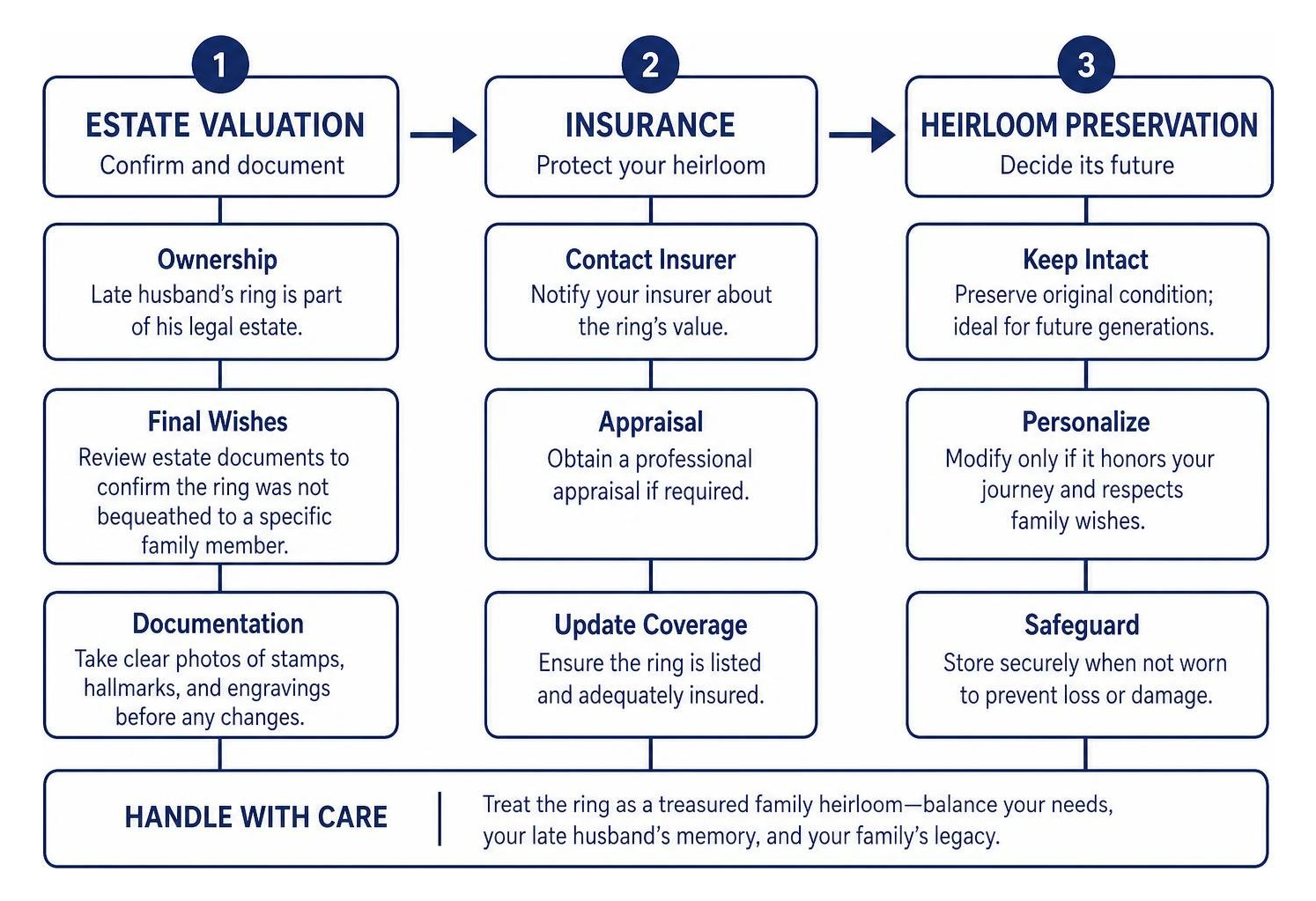
Estate Ownership, Inheritance, and Family Keepsakes
When a spouse passes, his personal jewelry becomes part of his legal estate. In most jurisdictions, surviving spouses automatically inherit personal effects through a will or standard intestacy rules. However, before melting down, resizing, or resetting a late husband’s ring, it is wise to confirm his final wishes:
- Review his estate documents: Ensure the ring was not specifically bequeathed to a son, daughter, or grandchild as a designated family heirloom.
- Document the piece: Take clear photos of any stamps, hallmarks, and personalized engravings before bringing the ring to a jeweler for alteration.
- Obtain a probate appraisal: High-value jewelry with significant diamond carat weight or rare precious metals may require an open-market valuation for estate tax filings and probate documentation.
Funeral Decisions and Jewelry Insurance Considerations
One of the most immediate practical choices arises during funeral planning: should your husband's wedding ring remain with him, or should it be returned to you?
Burial allows a ring to remain on your husband's hand as a permanent symbol of your union. However, if your family chooses cremation, it is essential to know that extreme temperatures (typically 1,400 to 1,800°F) will melt gold, silver, and platinum, making the jewelry non-recoverable. Funeral directors can safely remove the band before services so you can preserve it.
Once the jewelry is in your possession, update your insurance policies:
- Notify your insurer: Transfer scheduled jewelry floaters or riders into your name.
- Update coverage values: If you inherit his high-value watch or gold band, add them to your homeowner's or specialized jewelry insurance policy.
- Store documentation safely: Keep independent appraisals, certificates, and detailed receipts inside a fireproof safe or safety deposit box.
Frequently Asked Questions About Widow Wedding Ring Traditions
When is the right time to take off a wedding ring after losing a spouse?
There is no set timeline or formal etiquette. Some widows remove their rings within weeks, while others wear them for the rest of their lives. If you are unsure, choose a reversible step—such as moving your ring to your right hand or wearing it on a necklace—until you feel completely ready to make a permanent decision.
Can I wear my late husband's ring along with my own?
Yes. Many widows stack their husband's band with their own rings if their fingers allow, or have both bands resized by a professional jeweler. Another popular option is wearing both rings together on a secure gold or platinum pendant chain close to the heart.
Does wearing a wedding ring on the right hand signal widowhood?
In many Western cultures, wearing a traditional bridal set or a plain band on the right ring finger is widely recognized as a sign of widowhood. It honors your past marriage while showing that your left hand is open for your present life chapter.
Conclusion
Navigating life after the loss of a spouse is a journey of quiet strength, patience, and remembrance. Whether you decide to move your bands to your right hand, suspend them from a graceful chain, redesign them into a custom family heirloom, or preserve them safely for the next generation, your rings tell an enduring story of love.
At Mervis Diamond Importers, we consider it a privilege to guide you through these meaningful milestones with pressure-free care. Whether you need a ring resized, an appraisal updated, or a bespoke memorial piece crafted, our master jewelers are here to help you honor your most cherished memories. For more styling inspiration and guidance on caring for your bridal jewelry, explore our expert advice on how to wear your engagement and wedding rings.