

Sparkle on a Budget: The Real Cost of a 1 Carat Diamond Bracelet
How Much Does a 1 Carat Diamond Bracelet Really Cost?
The 1 carat diamond bracelet price can range anywhere from under $200 to over $4,500 — and knowing why makes all the difference between a smart purchase and an expensive mistake.
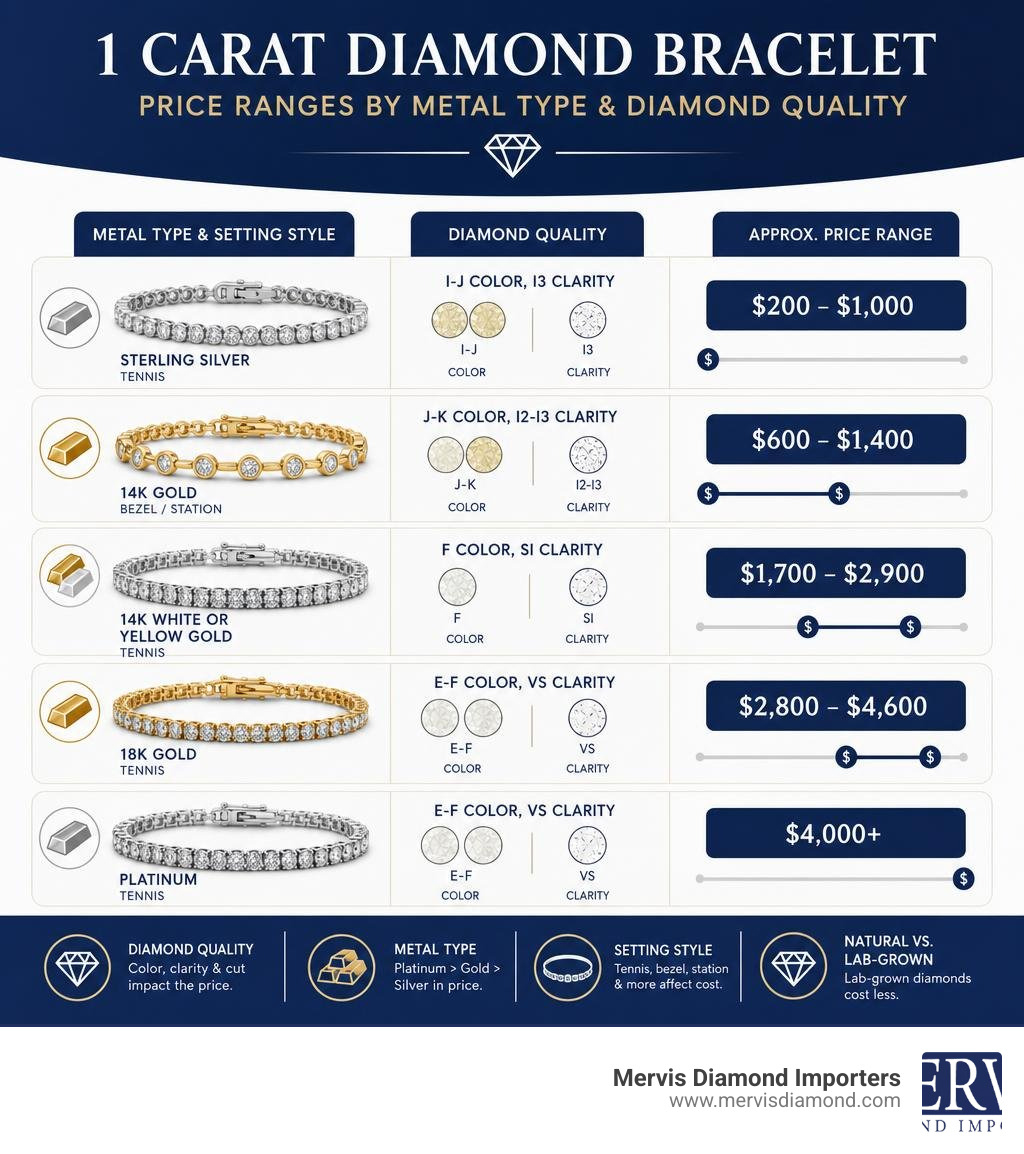
Here's a quick snapshot of what you can expect to pay:
| Style & Metal | Diamond Quality | Approx. Price Range |
|---|---|---|
| Sterling silver | I-J color, I3 clarity | $200 - $1,000 |
| 14K gold (bezel/station) | J-K color, I2-I3 clarity | $600 - $1,400 |
| 14K white or yellow gold (tennis) | F color, SI clarity | $1,700 - $2,900 |
| 18K gold (tennis) | E-F color, VS clarity | $2,800 - $4,600 |
| Platinum (tennis) | E-F color, VS clarity | $4,000+ |
A few things drive that wide range:
- Diamond quality — color, clarity, and cut matter a lot
- Metal type — platinum costs more than gold; gold costs more than silver
- Setting style — tennis, bezel, station, and miracle settings all have different price points
- Natural vs. lab-grown — lab-grown diamonds can cost significantly less for the same carat weight
The good news? You don't have to spend a fortune to get something beautiful. But you do need to know what you're buying.
What is the Typical 1 Carat Diamond Bracelet Price?
When you begin shopping for a classic diamond tennis bracelet, the sheer volume of options can feel a bit overwhelming. In July 2026, the market for a 1 carat diamond bracelet offers an incredibly diverse landscape. You can find entry-level fashion pieces starting as low as $199.99, while high-end designer creations can easily cross the $4,500 mark.
So, what is the average cost for a classic, high-quality piece? For a genuine 1 carat diamond tennis bracelet set in solid 14K gold with eye-clean diamonds, the typical sweet spot is between $1,600 and $2,900.
To help you visualize where your money goes, let's break down the typical market pricing across different metals and qualities:
| Metal Type | Setting Style | Diamond Specs | Average Market Price |
|---|---|---|---|
| Brass / Platinum Overlay | Miracle Prong Set | J-K color, I2-I3 clarity | $199 - $399 |
| Sterling Silver | Prong Set | I-J color, I3 clarity | $1,000 |
| 14K Yellow Gold | Bezel / Station | J-K color, I2-I3 clarity | $638 |
| 14K White Gold | Classic Tennis | F color, SI2 clarity | $1,699 (on sale from $2,831) |
| 18K Yellow Gold | Classic Tennis | E-F color, VS clarity | $2,815 |
| 14K White Gold | Designer Tennis | Premium Select | $4,115 - $4,550 |
As you can see, the metal holding the stones and the visual clarity of the diamonds themselves make up the lion's share of the price tag. If you want to understand the structural differences of these jewelry pieces before diving into the financial details, check out our Diamond Tennis Bracelet Complete Guide.
Key Factors That Influence the Cost of a 1 Carat Bracelet
If two bracelets both have "1 carat" of diamonds, why does one cost $200 and the other cost $2,800?
It helps to think of a diamond bracelet like a sports car. Two cars might both have a V6 engine, but the brand, the interior materials, the paint job, and the engineering under the hood determine the final price. In the jewelry world, those "car specs" translate directly to the quality of the raw materials and the craftsmanship of the build.
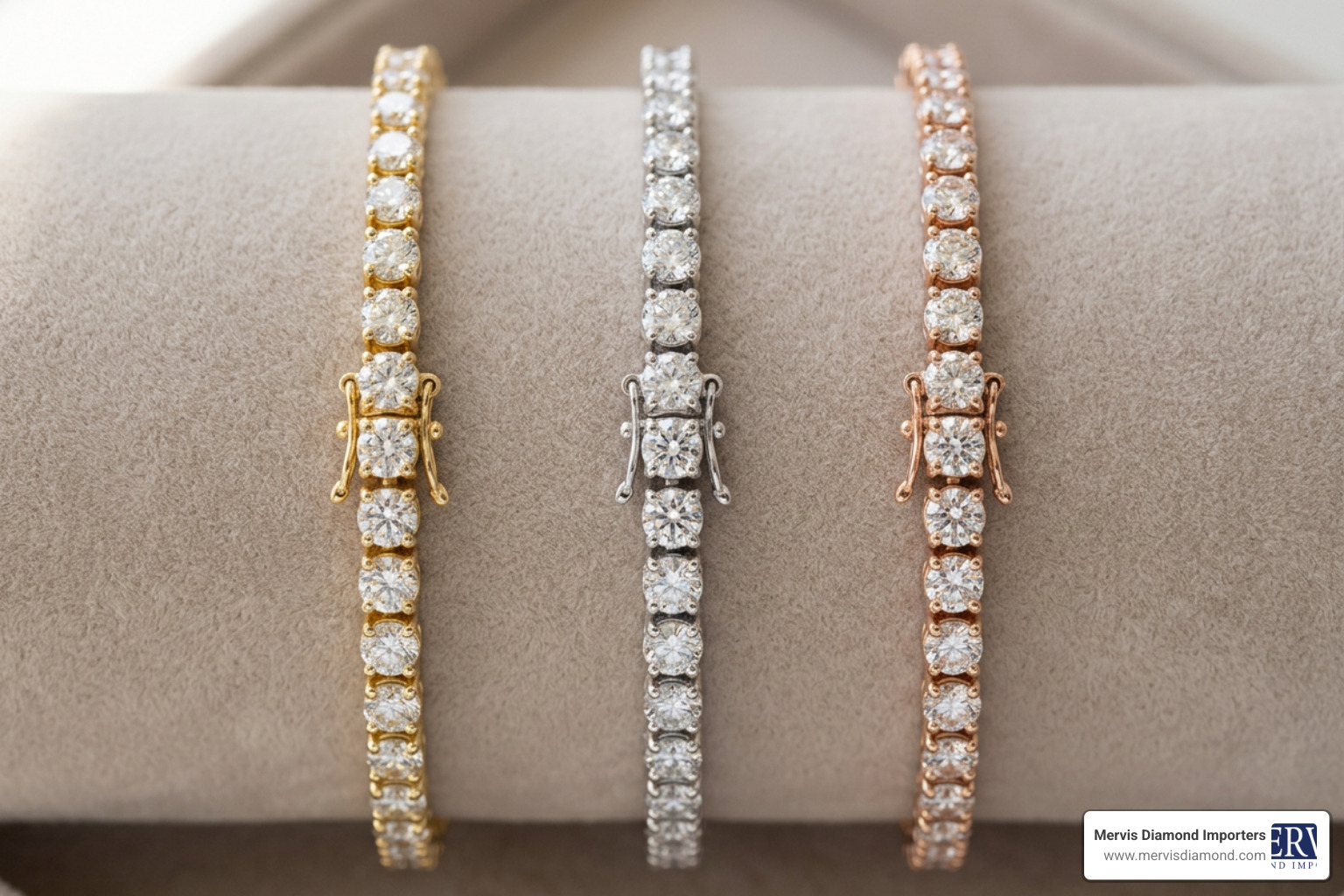
To evaluate any diamond jewelry purchase properly, you must first understand the foundational metrics of diamond grading. We always recommend starting with our breakdown of the 4 Cs to a Diamond to understand how cut, color, clarity, and carat weight play together. For an independent educational reference, the Gemological Institute of America also explains the main diamond quality factors used to evaluate diamonds.
Let's look at how these individual elements directly impact the 1 carat diamond bracelet price.
How Diamond Quality Affects the 1 Carat Diamond Bracelet Price
When we talk about a "1 carat diamond bracelet," we are actually talking about carat total weight (ct. t.w.). This means the sum of all the tiny diamonds in the bracelet equals 1 carat.
Because a 1 carat bracelet is made of dozens of small stones (often 30 to over 90 diamonds depending on the design), the individual diamonds are quite small. However, their collective quality still heavily dictates the price:
- Clarity (The Flaw Finder): In cheaper bracelets (often priced under $1,000), manufacturers use diamonds graded I1 to I3 (Included). These stones have visible cloudiness, black spots, or internal cracks. While they are real diamonds, they won't have that eye-catching brilliance. Higher-end bracelets use VS (Very Slightly Included) or SI (Slightly Included) diamonds. These stones are "eye-clean," meaning you won't see any flaws without a jeweler's loupe, resulting in a gorgeous, clean sparkle.
- Color (The Yellow Factor): Diamonds are graded from D (colorless) to Z (light yellow). Premium 1 carat bracelets feature diamonds in the E-F range (virtually colorless) or G-H range (near colorless). Budget-friendly options often drop down to the I-J or J-K range, which can show a warm, slightly yellow tint, especially when set in white gold or platinum.
- Carat Weight Distribution: A bracelet featuring 90 tiny diamonds totaling 1 carat is generally less expensive to produce than a station bracelet featuring 10 larger diamonds that add up to 1 carat. Larger individual diamonds are rarer and command a higher price per carat.
- Cut Quality: How well each tiny diamond is cut determines how much light it reflects back to your eye. Well-cut diamonds make a 1 carat bracelet look bright and lively, while poorly cut diamonds look dull and glassy, dragging the price down.
Metal Choice and Setting Style Impact on the 1 Carat Diamond Bracelet Price
The metal holding your diamonds secure isn't just a background player - it's a major cost driver and determines how long your bracelet will last.
- Platinum: The gold standard of precious metals. It is hypoallergenic, incredibly durable, and naturally white. However, because platinum is dense and rare, a 1 carat platinum tennis bracelet will easily push your budget past $4,000.
- 18K and 14K Gold: The most popular choices for fine jewelry. 18K gold (75% pure gold) offers a richer yellow hue and premium feel, often pricing a 1 carat yellow gold tennis bracelet around $2,815. 14K gold (58.3% pure gold) is slightly more durable and budget-friendly, bringing the price down to around $1,699 to $2,800.
- Sterling Silver & Plated Metals: If you are shopping on a strict budget, sterling silver or platinum-plated brass can bring the price down to $199 to $1,000. While highly affordable, these metals are softer, prone to tarnishing, and may not withstand the wear and tear of daily life.
The way those diamonds are secured also changes the labor and metal weight required:
- Classic Tennis Style (Prong Set): Individual claws hold each diamond. This requires precise craftsmanship to ensure no prongs snag on your clothes.
- Bezel Set: A metal rim completely surrounds each diamond. This offers incredible security and a modern look, but requires more metal.
- Station Style: Diamonds are spaced out along a delicate chain (like a 10-diamond station bracelet). This uses far fewer diamonds and less metal, making it an elegant, budget-friendly option (often around $600 - $700).
- Miracle Setting: This clever style places a tiny diamond inside a faceted, shiny metal plate. The metal plate tricks the eye into thinking the diamond is much larger than it actually is, allowing retailers to sell "diamond bracelets" for under $200.
Natural vs. Lab-Grown: Price Differences in 1 Carat Bracelets
One of the biggest shifts in the jewelry industry leading up to July 2026 is the widespread popularity of lab-grown diamonds. If you want to maximize your budget, this is the single most effective way to do it.
Lab-grown diamonds are physically, chemically, and optically identical to natural earth-mined diamonds. They both score a perfect 10 on the Mohs hardness scale and possess the exact same refractive index. The only difference is their origin: one grew deep within the Earth over billions of years, while the other was grown in a highly controlled technological laboratory over a matter of weeks.
But the price difference? It's massive.
- Natural Diamonds: Natural 1 carat diamond bracelets are subject to mining costs, supply chain complexities, and natural rarity. A premium natural 1 carat tennis bracelet in 14K gold typically costs $2,500 to $4,500.
- Lab-Grown Diamonds: Because lab-grown diamonds can be produced efficiently, they can cost up to 90% less than mined diamonds of the same quality. A beautiful 1 carat lab-grown diamond bracelet in solid 14K gold often ranges from $1,000 to $1,500.
By opting for a lab-grown diamond, you can secure colorless (D-F), eye-clean (VS) diamonds in solid gold for a fraction of the cost of a natural diamond bracelet with lower specs. To learn more about how lab-created stones are evaluated, read our guide on the 1 Ct Man-Made Diamond. If you find yourself wondering whether you should scale up your carat weight with these savings, you can also explore our 12 Carat Diamond Tennis Bracelet Guide.
Smart Buyer's Guide: Quality, Warranties, and Return Policies
Purchasing a diamond bracelet is an investment in your personal style, so you want to buy with absolute confidence. Before you hand over your credit card, you should evaluate the piece across several key areas:
1. Check the Clasp and Safety Catch
A bracelet is only as good as its clasp. Because a tennis bracelet rests on your wrist, it is highly susceptible to getting bumped, caught on sleeves, or knocked loose.
- Look for a secure box-with-tongue clasp that clicks firmly into place.
- Ensure the bracelet features at least one, preferably two, figure-eight safety catches on the side for extra security.
2. Assess the Flexibility
Drape the bracelet over your finger. It should curve smoothly and fluidly without kinking, tangling, or feeling stiff. If a bracelet kinks easily, the links are poorly engineered, which can cause the metal to fatigue and break over time.
3. Review the Retailer's Policies
Always compare prices, warranties, and return policies across retailers to ensure you are getting a fair deal. Here is how the market compares:
- Premium Jewelers: Typically offer exquisite craftsmanship, using high-purity metals (like 18K gold or platinum) and premium E-F color, VS clarity diamonds. Prices for these high-end designs generally range from $4,100 to over $4,500, often backed by comprehensive in-store warranties and personalized services.
- Online Custom Jewelers: Often provide solid mid-tier options with competitive pricing. For example, you can find a classic 1 carat round cut tennis bracelet in 14K white gold on sale for around $1,600 to $1,700 (often marked down from higher retail prices) featuring F-G color and SI clarity. Many reputable online sellers offer a 30-day return policy and complimentary resizing.
- Mass Market / Department Stores: Offer accessible price points, such as a 1 carat sterling silver tennis bracelet for around $1,000. However, the diamond quality in these mass-produced pieces often drops significantly (such as I-J color and I3 clarity), meaning the diamonds may look visibly cloudy or included.
- Value Online Retailers: Great for ultra-budget shoppers, offering 1 carat diamond bracelets in alternative metals like platinum-plated brass for as low as $200. These typically feature lower-grade stones (J-K color and I2-I3 clarity) but often come with basic guarantees and return windows.
At Mervis Diamond Importers, we focus on hand-selecting only high-quality, ethically sourced natural and lab-grown diamonds. We believe in providing a pressure-free, educational experience to help you find a piece that balances your budget with beautiful, lifelong sparkle.
Frequently Asked Questions About 1 Carat Diamond Bracelets
Can I wear a 1 carat diamond tennis bracelet every day?
Yes, absolutely! Diamonds are the hardest natural substance on earth, scoring a 10 on the Mohs hardness scale. When set in durable metals like 14K gold, 18K gold, or platinum, a 1 carat tennis bracelet is highly durable and designed for daily wear.
However, we do recommend taking it off when doing heavy manual labor, swimming in chlorinated pools, or applying lotions and perfumes, as these can leave a dull residue on your diamonds.
How tight should a diamond tennis bracelet fit?
A diamond tennis bracelet should drape elegantly on your wrist without being too tight or too loose. A great rule of thumb is that you should be able to fit one finger comfortably between the bracelet and your wrist.
If it's too tight, it will strain the links and clasp when you bend your wrist. If it's too loose, it can slide down your hand or snag on objects, increasing the risk of damage.
Why is it called a tennis bracelet?
The term "tennis bracelet" was coined after professional tennis player Chris Evert stopped a match during the 1987 U.S. Open to search for her diamond bracelet, which had slipped off her wrist due to a broken clasp.
During her post-match interview, she referred to the piece as her "tennis bracelet," and the name stuck! Ever since, these uniform, sparkling diamond line bracelets have been known as tennis bracelets.
Conclusion
Finding the perfect 1 carat diamond bracelet is all about balancing your personal style, your lifestyle, and your budget. Whether you prefer the classic, continuous sparkle of a traditional gold tennis bracelet, the modern look of a bezel-set station bracelet, or the incredible value of lab-grown diamonds, there is a perfect piece out there for you.
At Mervis Diamond Importers, our passion is helping you navigate these choices with ease. Across our showrooms in Tysons, VA, Rockville, MD, and Washington, DC, we offer a carefully curated selection of hand-selected, high-quality diamonds. We invite you to visit us for a personalized, pressure-free consultation to find a bracelet that you will cherish for decades to come.
Ready to take a deeper dive into the history of this iconic jewelry piece? Discover the fascinating history and origin of the tennis bracelet and learn how it became the ultimate symbol of effortless luxury.