

Shine Bright Like a Gemologist with This Guide to the 4 C's to a Diamond
Why the 4 C's to a Diamond Are the Starting Point for Every Smart Purchase
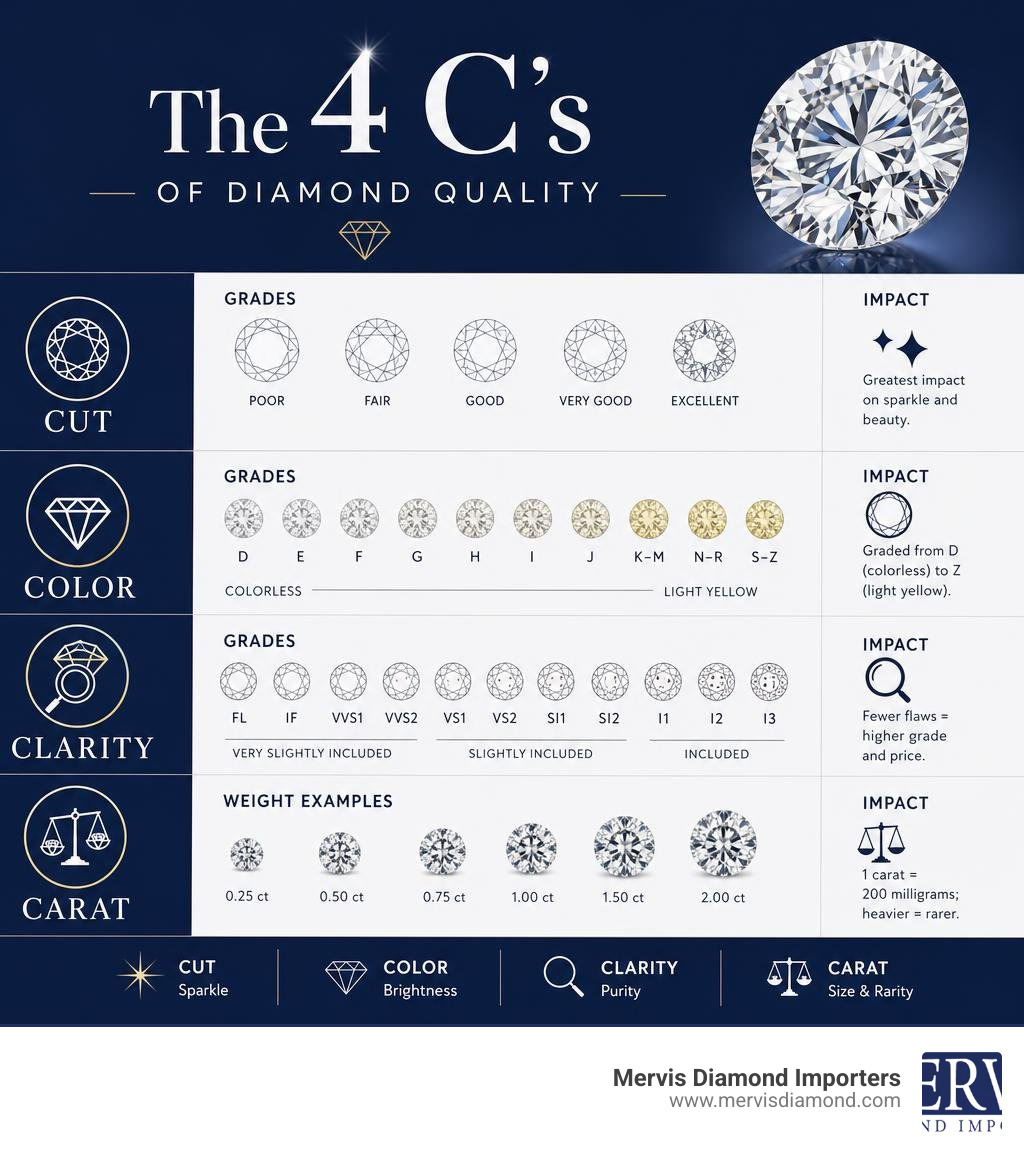
Understanding the 4 C's to a diamond is the single most important thing you can do before buying one. These four characteristics — Cut, Color, Clarity, and Carat — are the universal language of diamond quality. They tell you exactly what you're getting, and they protect you from overpaying.
Here's a quick-reference summary:
| C | What It Measures | Why It Matters |
|---|---|---|
| Cut | How well the diamond reflects light | Greatest impact on sparkle and beauty |
| Color | How colorless the diamond appears | Graded D (colorless) to Z (light yellow) |
| Clarity | Internal and external flaws | Fewer flaws = higher grade and price |
| Carat | Physical weight of the diamond | 1 carat = 200 milligrams; heavier = rarer |
Before the 4 C's became the global standard, buying a diamond was a guessing game. Colorless stones were described vaguely as "like water." Flaws were noted simply as "with or without." There was no shared language between buyers and sellers — which meant plenty of room for confusion, or worse, being misled.
In the 1940s, GIA founder Robert M. Shipley coined the phrase "the 4 C's of diamond quality" to give both jewelers and buyers a consistent, scientific framework. Today, those four letters are recognized everywhere from independent jewelers to major auction houses to government agencies.
Whether you're shopping for an engagement ring or just want to understand what makes one diamond more valuable than another, mastering the 4 C's is where it all begins.
What Are the 4 C's to a Diamond and Why Do They Matter?
Before the mid-20th century, the diamond market was a bit like the Wild West. If you walked into a jewelry store in Washington DC or Maryland, a merchant might tell you a diamond was of "blue-white" quality or possessed "good water." These terms were highly subjective, completely unregulated, and often used to inflate prices.
This chaotic landscape changed when Robert M. Shipley, the founder of the Gemological Institute of America (GIA), established a formalized educational curriculum. He wanted a simple, memorable way to teach his students the key factors that characterize a faceted diamond. By coining the phrase "the 4 C's," Shipley created an easy-to-remember shorthand that eventually transformed the global diamond trade.
In the 1950s, the GIA expanded this concept into the first highly structured, scientific grading system. They established precise, repeatable methods for evaluating each attribute, ensuring that a diamond graded in Washington, DC would receive the exact same evaluation in Antwerp or Tokyo.
This standardization did more than just educate jewelers; it empowered the consumer. It shifted the power dynamic from the salesperson to the buyer. When you understand how these four factors work, you can look at a grading report and know exactly why a diamond is priced the way it is. For a deep dive into the historical development and scientific framework of this system, you can read GIA's official guide on Understanding the 4Cs of Diamond Quality | Diamond Factors | GIA 4Cs.
Breaking Down the 4 C's to a Diamond One by One
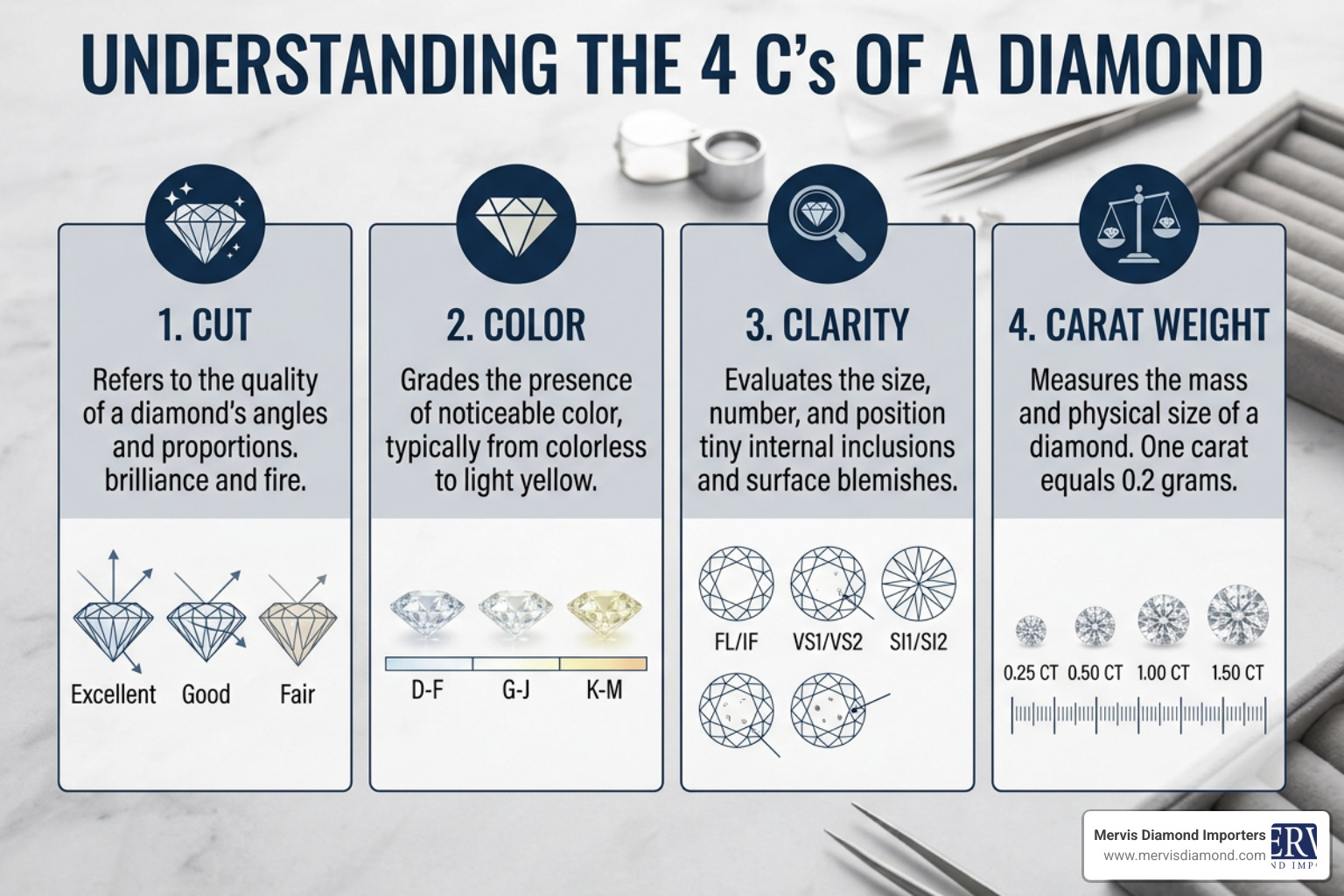
While a diamond's beauty is experienced as a single, breathtaking flash of light, gemologists arrive at that beauty through a calculated assessment of individual components. Each of the 4 c's to a diamond represents a distinct physical attribute.
When we evaluate a diamond, we are looking at a balance between what nature created over billions of years and what human hands have carved out of rough stone. Two of the C's (Color and Clarity) are determined entirely by nature deep within the earth. One C (Carat) is a pure measurement of physical mass. The final C (Cut) is entirely dependent on human artistry and engineering. Together, these factors dictate how light behaves inside the stone, how rare the diamond is, and ultimately, its price tag.
Cut: The Most Critical of the 4 C's to a Diamond
If a diamond doesn't sparkle, nothing else matters. You could have a stone with perfect color and flawless clarity, but if it is poorly cut, it will look like a dull piece of glass. That is why cut is widely considered the most critical of the 4 c's to a diamond.
When gemologists talk about "cut," they are not talking about the shape of the diamond (such as round, oval, or pear). Instead, they are referring to how well a diamond’s facets interact with light. A master cutter must fashion the stone's proportions, symmetry, and polish so that light enters through the top (the table), bounces off the internal walls (the pavilion), and reflects back out to the viewer’s eye.
A diamond's light performance is broken down into three main visual effects:
- Brilliance: The total amount of white light reflected back to your eyes.
- Fire: The scattering of white light into a rainbow of spectral colors.
- Scintillation: The flashes of light and dark (the sparkle) you see when the diamond, the light source, or your head moves.
If a diamond is cut too shallow, light leaks out of the bottom. If it is cut too deep, light escapes through the sides. Only an "Excellent" or "Ideal" cut grade ensures that the maximum amount of light is channeled back to create that signature fire and brilliance. To find out which specific shapes and cutting styles deliver the absolute maximum light performance, explore our detailed analysis of Which Diamond Cut Sparkles the Most.
The GIA grades cut quality on a scale from Excellent to Poor. Because the cutter's skill has such a massive impact on the finished gem, prioritizing a high cut grade is the absolute best way to get a beautiful stone. For more information on how professional jewelers evaluate these proportions, check out the 4Cs of Diamonds | Jewelers of America.
Color: The Subtle Spectrum of Whiteness
When evaluating classic white diamonds, the term "color" actually refers to the absence of color. The GIA color grading scale ranges from D (completely colorless) to Z (light yellow or brown).
- D, E, F (Colorless): Extremely rare and icy white. Because they are the rarest, they command the highest prices.
- G, H, I, J (Near-Colorless): To the untrained eye, these diamonds look completely white when set in jewelry, but they cost significantly less than the colorless range.
- K to Z (Faint to Light Color): These diamonds have a noticeable warm, yellowish, or brownish tint.
It is important to remember that color is graded upside down in a highly controlled laboratory setting against a master set of stones. In the real world, once a diamond is mounted in a ring, the human eye has a very difficult time distinguishing between a D and a G or H color.
Your choice of metal setting plays a major role here. If you are setting your diamond in a yellow gold or rose gold band, you can easily drop down to a J or even K color. The warm metal will naturally reflect through the stone, making any faint yellow tint in the diamond blend in beautifully. If you are opting for platinum or white gold, staying in the D to H range will keep your diamond looking crisp and icy. To understand how color rarity translates to market value, read our guide on What Color Diamond is the Most Expensive.
Clarity: Nature's Unique Fingerprints
Natural diamonds are born deep within the Earth’s mantle under intense heat and pressure. During this chaotic crystallization process, tiny bits of other minerals can get trapped inside the carbon structure, or structural microscopic imperfections can form.
Internal characteristics are called inclusions, while surface flaws are called blemishes. Together, they make up a diamond's clarity. Think of them as nature's unique fingerprints; no two diamonds have the exact same mapping of inclusions.
The GIA clarity scale features 11 grades:
- Flawless (FL): No inclusions or blemishes visible under 10x magnification. (Representing fewer than 1% of all gem-quality diamonds).
- Internally Flawless (IF): No inclusions visible under 10x magnification, only minor surface blemishes.
- Very, Very Slightly Included (VVS1, VVS2): Inclusions are so tiny that even a skilled gemologist struggles to find them under 10x magnification.
- Very Slightly Included (VS1, VS2): Minor inclusions that are easily seen under magnification but are typically invisible to the naked eye.
- Slightly Included (SI1, SI2): Inclusions are noticeable under magnification and might be visible to a keen eye without a loupe.
- Included (I1, I2, I3): Inclusions are obvious under magnification and are clearly visible to the naked eye, sometimes affecting the diamond's brilliance and structural durability.
For most buyers, the secret to getting the best value is finding an "eye-clean" diamond. This means that while the diamond has microscopic inclusions (typically in the VS2 or SI1 range), they cannot be seen by the naked eye from a normal viewing distance. Chasing a Flawless grade means paying a massive rarity premium for features you can only see under a microscope. To determine which clarity grade strikes the perfect balance for your budget, read our expert advice on What Diamond Clarity is Best.
Carat: Weight vs. Perceived Size
The most common misconception about the 4 c's to a diamond is that carat refers to the physical size of the stone. In reality, carat is a unit of weight.
One metric carat is equal to exactly 200 milligrams (or 1/5 of a gram). To make things more precise, jewelers divide a single carat into 100 "points." A 0.50-carat diamond is often called a "50-point" stone or a half-carat. The term "carat" actually originates from the ancient Mediterranean, where traders used the remarkably uniform seeds of the carob tree to balance their scales when weighing precious gems.
Because carat is a measure of weight, two diamonds of the exact same carat weight can look completely different in physical size. For example, a well-cut 1.00-carat round brilliant diamond will measure roughly 6.5mm in diameter. However, if a diamond is cut poorly and has too much weight hidden in its thick bottom (pavilion), it will actually look smaller from the top than a properly cut 0.90-carat stone!
Furthermore, diamond prices do not rise in a straight line as weight increases. Instead, they jump exponentially at "magic weights" or round numbers (like 0.50 ct, 1.00 ct, 1.50 ct, and 2.00 ct). Because larger rough diamonds are incredibly rare to mine, a single 2-carat diamond will cost three to four times more than two 1-carat diamonds of identical quality. To understand these pricing dynamics and how to navigate them, check out our breakdown on How Much is a 2 Carat Diamond Ring.
How the 4Cs Interact to Determine Beauty and Price
When you look at a diamond grading report, it is easy to view the 4Cs as four isolated, independent test scores. However, in the real world, these characteristics interact constantly. They are highly interdependent, and changing one grade can completely alter how another C behaves visually.
For example, a high-quality Cut can actually mask a lower Color grade. Because an Excellent cut reflects so much white light back to your eye, it makes the faint yellow tint of an I or J color diamond nearly impossible to see face-up. Similarly, a brilliant cutting style with many small facets (like a round brilliant or a cushion cut) is excellent at hiding microscopic inclusions, whereas "step-cut" shapes with large, flat facets (like emerald or asscher cuts) act like windows, requiring higher clarity grades to remain eye-clean.
When these factors compound, they create dramatic shifts in rarity and price. To illustrate how different combinations of the 4Cs affect both the visual appearance and the final price tag, consider this comparison table:
| Diamond Profile | Cut Grade | Color Grade | Clarity Grade | Carat Weight | Visual Impact | Price Bracket |
|---|---|---|---|---|---|---|
| The Showstopper | Excellent | D | FL | 2.00 ct | Icy white, blinding sparkle, completely flawless under magnification. | Elite Premium |
| The Smart Value | Excellent | H | VS2 | 1.91 ct | Looks identical to the naked eye; sparkling white and eye-clean, but significantly cheaper. | Mid-Range Value |
| The Budget Maximizer | Very Good | J | SI1 | 1.00 ct | Warm sparkle, eye-clean if selected carefully, ideal for yellow gold settings. | Highly Affordable |
By understanding this interplay, you can make strategic trade-offs that keep your purchase within budget without sacrificing the visual beauty of your ring. To read more about how these factors combine during your shopping journey, see our guide on The 4Cs When Purchasing Diamond Engagement Rings or explore Investopedia's detailed financial analysis of The Four Cs of Buying Diamonds—and the Fifth C Defined.
Beyond the Basics: The Fifth C and Lab-Grown Diamonds in 2026
As we navigate the diamond market in June 2026, the traditional 4Cs are no longer the only factors a modern buyer needs to consider. Advanced grading technologies, changing consumer preferences, and the massive rise of lab-grown diamonds have introduced new dimensions to the purchasing process.
The Fifth C: Confidence in Your 4 C's to a Diamond
At Mervis Diamond Importers, we believe there is a crucial "Fifth C" that ties the entire experience together: Confidence.
Confidence means knowing that the diamond you are buying is exactly what the seller claims it is. The only way to achieve this peace of mind is by purchasing a diamond that has been independently certified by a reputable gemological laboratory.
Labs like the GIA (Gemological Institute of America), IGI (International Gemological Institute), and HRD Antwerp act as unbiased third parties. They do not buy or sell diamonds; they simply evaluate them using state-of-the-art scientific equipment. When you buy a certified diamond, you receive a grading report that acts as a blueprint of your stone's unique DNA.
Furthermore, confidence means buying a diamond that is ethically sourced and conflict-free. Reputable jewelers strictly adhere to the Kimberley Process, an international certification scheme that prevents "conflict diamonds" from entering the mainstream rough diamond market. When you shop with a trusted local partner, you can rest assured that your symbol of love was sourced responsibly.
Natural vs. Lab-Grown Diamonds
One of the most significant shifts in the 2026 diamond industry is the widespread adoption of lab-grown diamonds.
It is important to understand that lab-grown diamonds are not "fake" diamonds; they are not cubic zirconia or moissanite. Physically, chemically, and optically, lab-grown diamonds are 100% identical to natural diamonds. They consist of pure carbon arranged in a cubic crystalline structure, and they are graded on the exact same 4Cs scales by the GIA and IGI.
The primary difference lies in their origin:
- Natural Diamonds: Formed deep within the Earth billions of years ago and brought to the surface by volcanic activity. They are highly finite resources, which gives them inherent rarity and long-term value.
- Lab-Grown Diamonds: Created in highly controlled laboratory environments using advanced technological processes (HPHT or CVD) that replicate the extreme heat and pressure of the Earth's mantle.
Because lab-grown diamonds can be produced on demand, they do not possess the same geological rarity as natural stones. However, this efficient supply chain means they are significantly more affordable, allowing you to secure a much larger carat weight with higher color and clarity grades for the exact same budget.
Smart Buyer's Guide: How to Prioritize the 4Cs on a Budget
If you have an unlimited budget, buying a diamond is easy: you simply buy a Flawless, D-color, Excellent-cut stone. But for the rest of us, diamond shopping is an art of compromise. Here is our step-by-step game plan to maximize your budget:
- Allocate Your Budget to Cut First: Never compromise on the cut. An Excellent cut is what makes the diamond sparkle, hides inclusions, and masks color.
- Aim for the "Near-Colorless" Sweet Spot: Look for diamonds in the G to I color range. Once set in a ring, these stones look just as white as D-F diamonds but cost a fraction of the price.
- Find an Eye-Clean Clarity Grade: Don't pay for what you can't see. Focus on VS2 or SI1 grades. Always ask a professional to verify that the inclusions are not visible to the naked eye.
- Buy Just Under "Magic Weights": Instead of buying a flat 1.00-carat diamond, look for a 0.90 to 0.95-carat stone. The physical size difference is completely indistinguishable to the eye, but you will save up to 20% on the price.
For more strategic buying tips, you can refer to the official Diamond Buying Guide | GIA.
Frequently Asked Questions about the 4 C's to a Diamond
Which of the 4Cs has the greatest impact on a diamond's sparkle?
The Cut has the greatest impact on a diamond's sparkle. While color and clarity are natural characteristics, the cut determines how the diamond's facets refract and reflect light. A poorly cut diamond will look dull and lifeless, while an Excellent-cut diamond will dance with brilliance, fire, and scintillation.
Is a flawless diamond worth the extra cost?
For the average buyer, no. A Flawless (FL) diamond commands a massive price premium purely because of its extreme rarity. Since Very Slightly Included (VS1 or VS2) diamonds look completely identical to the naked eye, paying extra for a Flawless grade means spending money on a microscopic difference that you will never see without a jeweler's loupe.
What is the difference between diamond carat and diamond size?
Carat is a measure of a diamond's physical weight, whereas size refers to its physical dimensions (measured in millimeters). A diamond's perceived size is heavily influenced by its cut proportions and its shape. For example, elongated shapes like oval or marquise cuts often look larger than a round brilliant cut of the exact same carat weight.
Conclusion
At the end of the day, a diamond grading report is a wonderful tool, but it cannot capture how a diamond makes you feel when it catches the light.
At Mervis Diamond Importers, we pride ourselves on offering a pressure-free, educational shopping experience. Whether you visit our beautiful showrooms in Tysons, VA, Rockville, MD, or right in Washington, DC, our expert consultants are here to guide you through the 4 c's to a diamond to find a stone that perfectly balances your personal aesthetic and your budget.
We hand-select our vast collection of both natural and lab-grown diamonds to ensure every single stone meets our rigorous standards for sparkle, life, and beauty. Ready to see the difference in person? Start your journey by reading our comprehensive guide on Understanding Four Cs or book an appointment at your nearest Mervis showroom today!