

2 Carat Man Made Diamond: More Sparkle, Less Compromise
The Rise of the 2 Carat Man Made Diamond: What Buyers Need to Know in 2026
A 2 carat man made diamond gives you the same fire, brilliance, and hardness as a mined diamond — at a fraction of the price.
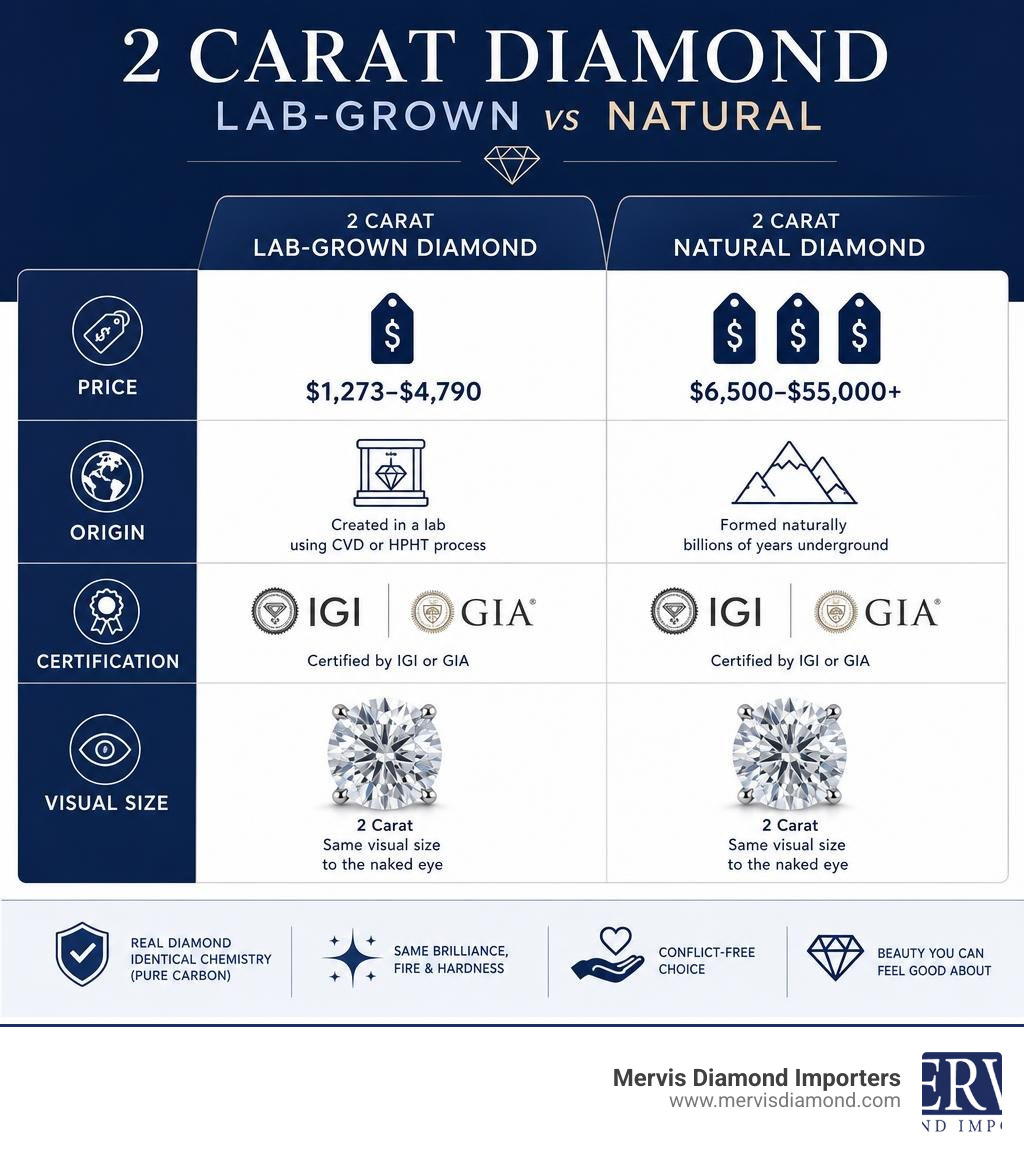
Here's a quick snapshot of what to expect:
| Factor | 2 Carat Lab-Grown Diamond | 2 Carat Natural Diamond |
|---|---|---|
| Average price | ~$1,273–$4,790 | $6,500–$55,000+ |
| Chemical composition | Identical (pure carbon) | Identical (pure carbon) |
| Created by | CVD or HPHT process | Billions of years underground |
| Certified by | IGI or GIA | IGI or GIA |
| Conflict-free | Yes | Not always |
| Visual difference | None to the naked eye | None to the naked eye |
Something big is happening in the diamond market right now.
Lab-grown diamond prices have dropped significantly — over 22% in just the past three months as of mid-2026. That means buyers today are getting more stone for their money than ever before.
And for a 2-carat diamond, that matters a lot. This size sits at a sweet spot — it's noticeably large on the hand, it makes a statement, and it's the kind of stone that used to be out of reach for most budgets.
Now it isn't.
Whether you're shopping for an engagement ring, a meaningful gift, or simply want to understand what you're getting before you spend a dollar — this guide walks you through everything clearly and honestly.
What is a 2 Carat Man Made Diamond?
To understand what a 2 carat man made diamond is, we first have to clear up a very common myth: carat is a measure of weight, not physical size.
A single carat weighs exactly 200 milligrams. This means a 2 carat diamond weighs exactly 400 milligramsroughly the same weight as two standard paperclips. Because different shapes distribute this weight differently, two diamonds that both weigh exactly 2.00 carats can look completely different in terms of their physical dimensions on your finger.
When we talk about "man-made," "lab-grown," or "lab-created" diamonds, we are talking about real diamonds. They possess the exact same physical properties, chemical composition, and optical performance as diamonds pulled from deep within the earth. They are not fake, they are not cubic zirconia, and they are not moissanite.
These stunning gemstones are grown using two primary advanced scientific methods:
- Chemical Vapor Deposition (CVD): This process begins with a tiny diamond "seed" placed in a vacuum chamber. Carbon-rich gases (like methane) are introduced and ionized into plasma. The carbon atoms rain down and attach themselves to the seed, crystallizing layer by layer, atom by atom, to form a pure diamond.
- High Pressure High Temperature (HPHT): This method replicates the extreme conditions found deep within the Earth's mantle. A diamond seed is subjected to pressures of over 1.5 million pounds per square inch and temperatures exceeding 2,700 degrees Fahrenheit, causing carbon to melt and crystallize around the seed.
For additional consumer education on how natural and laboratory-grown diamonds are identified, the Gemological Institute of America offers a helpful overview of the key differences in origin and growth features.
To explore the fascinating science behind these processes further, take a look at our detailed breakdown of Mined vs Lab Grown Diamonds. If you are ready to start looking at options, you can also browse our collection to Shop Loose Lab Grown Diamonds | Mervis Diamond Importers.
How Lab Diamonds Compare to Mined Diamonds
If you were to place a 2 carat man made diamond right next to a 2 carat mined diamond of the exact same quality grades, even an experienced gemologist could not tell them apart with the naked eye.
They share an identical carbon crystal lattice structure. Because they are physically and chemically identical, they behave exactly the same way under light. They have the same refractive index (2.42) and the same level of dispersion (fire).
This identical physical nature leads to one of the most common questions we hear: Do Lab Diamonds Pass a Diamond Tester? The short answer is yes. Because they are pure carbon, standard thermal and electrical conductivity diamond testers will identify them as genuine diamonds every single time. Only highly specialized, advanced laboratory equipment used by grading institutions like the GIA or IGI can identify the tiny growth patterns that reveal whether a diamond was grown in a lab or in the earth.
The Cost of a 2 Carat Lab-Grown Diamond
When it comes to pricing, the difference between mined and man-made is staggering. In 2026, the average price for a high-quality 2 carat round lab-grown diamond sits around $1,273, with premium options reaching up to $4,790 depending on the quality of the cut, color, and clarity.
To put that into perspective, a mined diamond of similar proportions and quality can easily cost anywhere from $6,500 to upwards of $55,000.
| Diamond Type (2 Carat, Round, High Quality) | Average Price Range (2026) | Price Per Carat |
|---|---|---|
| Lab-Grown Diamond | $1,200 – $4,800 | $600 – $2,400 |
| Mined Diamond | $6,500 – $55,000+ | $3,250 – $27,500+ |
As we enter the summer of 2026, we are seeing historic affordability in the lab-grown market. With prices falling more than 22% over the last quarter, buyers have an unprecedented opportunity to optimize their budgets.
To understand how this translates into the cost of a finished piece of jewelry, read our comprehensive guide on How much is a 2 carat diamond ring, or visit us directly to Shop 2 Carat Lab Grown Diamonds | Mervis Diamond Importers.
Why Choose a 2 Carat Man Made Diamond for Your Budget
The massive cost savings of lab-grown diamonds do not come from a sacrifice in quality. Instead, they are the result of a highly streamlined supply chain.
Mined diamonds require heavy machinery, massive open-pit mining operations, and complex global distribution networks. Lab-grown diamonds, on the other hand, are grown in controlled laboratory environments using cutting-edge technology. Because we can bypass the expensive and ecologically taxing mining process, we can pass those immense savings directly on to you.
Choosing a 2 carat man made diamond allows you to prioritize quality over compromise. Instead of settling for a smaller mined diamond with visible inclusions or a yellowish tint just to stay within your budget, you can easily secure a flawless, icy-white, masterfully cut 2-carat lab diamond and still have money left over for a premium custom setting.
Key Quality Factors and Practical Considerations
Buying a diamond of this size requires a solid understanding of how quality grades impact both the beauty and structural integrity of your stone.

When selecting your diamond, the traditional 4Cs (Cut, Color, Clarity, and Carat) remain your most trusted guide:
- Cut: This is the single most important factor. The quality of the cut determines how light travels through the stone and bounces back to your eyes. An "Excellent" or "Ideal" cut grade ensures maximum sparkle and prevents light from leaking out of the bottom of the stone.
- Color: Diamonds are graded on a scale from D (completely colorless) to Z (light yellow). For a 2-carat stone, you do not need to pay a premium for a D-color diamond. G or H color grades will appear completely white to the naked eye when set in a ring.
- Clarity: This measures the presence of internal characteristics called inclusions. While minor inclusions are normal, you must watch out for structural "deal-breakers" like cavities or deep chips. A cavity can compromise the structural integrity of the stone, making it susceptible to cracking if it takes a hard hit.
- Carat: Weight does not equal visual size. Elongated shapes like ovals, emerald cuts, and marquise cuts tend to look larger on the hand than a classic round brilliant of the exact same carat weight because they distribute more of their mass across the top surface of the stone.
To keep your diamond looking as brilliant as the day you bought it, regular maintenance is key. We recommend cleaning your ring at home using warm water, mild dish soap, and a soft-bristled toothbrush to remove built-up oils and dirt.
Maximizing the Value of Your 2 Carat Man Made Diamond
To get the absolute best value for your money, we recommend aiming for the "sweet spot" of diamond grading:
- Prioritize Cut Above All Else: Never compromise on the cut. An Ideal or Excellent cut makes a diamond look brighter and can even make it appear larger than a poorly cut stone of a higher carat weight.
- Aim for "Eye-Clean" Clarity: Instead of paying for a flawless grade, look for a VS2 or SI1 clarity grade. These stones have tiny inclusions that can only be seen under 10x magnification, meaning they look completely perfect to the naked eye but cost significantly less.
- Choose Near-Colorless Grades: Opt for a G or H color grade. When set in white gold or platinum, these diamonds look icy and bright. If you plan to set your diamond in yellow or rose gold, you can even drop down to an I or J color, as the warm metal will naturally mask any slight yellow undertones in the stone.
Can You Insure and Resell a Lab-Grown Diamond?
Yes, you absolutely can insure a lab-grown diamond. Because they are real diamonds, reputable insurance companies will write policies for them in the exact same way they do for mined diamonds. You will simply need to provide an independent appraisal and a grading certificate to establish its replacement value. To learn more about protecting your investment, check out our guide on Can You Insure a Lab Grown Diamond.
When it comes to resale, it is important to be realistic. While lab diamonds hold immense sentimental value and save you thousands of dollars upfront, their secondary market value is lower than that of mined diamonds. For a transparent look at how the secondary market treats these stones, read our article on Do Lab Grown Diamonds Have Resale Value.
Frequently Asked Questions about 2 Carat Lab Diamonds
Do lab-grown diamonds look identical to natural ones?
Yes, they are optically, chemically, and physically identical. They exhibit the exact same brilliance, fire, and scintillation. Even under a jeweler’s loupe, they cannot be distinguished from natural diamonds.
What is the physical size of a 2 carat round lab diamond?
A well-cut 2 carat round brilliant diamond typically measures approximately 8.1mm to 8.2mm in diameter. For comparison, a 1 carat round diamond measures about 6.5mm. This means a 2-carat diamond offers a significantly larger visual presence on the hand.
Where can I buy certified lab-grown diamonds?
You should always buy from reputable, established jewelers who provide independent grading reports from recognized organizations like the International Gemological Institute (IGI) or the Gemological Institute of America (GIA).
If you are looking for local expertise and a pressure-free environment, we invite you to visit our showrooms. You can view options for Lab Grown Diamonds in Rockville, MD or visit our locations in Tysons, VA and Washington, DC, where our experts will help you find the perfect certified stone.
Conclusion
Choosing a 2 carat man made diamond is the ultimate way to get the breathtaking sparkle you want without compromising on quality, size, or your financial peace of mind.

At Mervis Diamond Importers, we specialize in sourcing only the finest, hand-selected lab-grown and natural diamonds. Our non-commissioned experts are here to help you navigate the 4Cs in a relaxed, educational atmosphere across our showrooms in Tysons, VA, Rockville, MD, and Washington, DC.
Ready to see the incredible fire of a 2-carat lab diamond in person? Check out our latest style guide on Trending Lab Grown Diamonds Washington DC and schedule your personalized consultation with us today!