

Shine Bright: Your Ultimate Guide to 3 Carat Diamond Assortments
What Is a 3 Carat Diamond Assortment — and Is It Right for You?
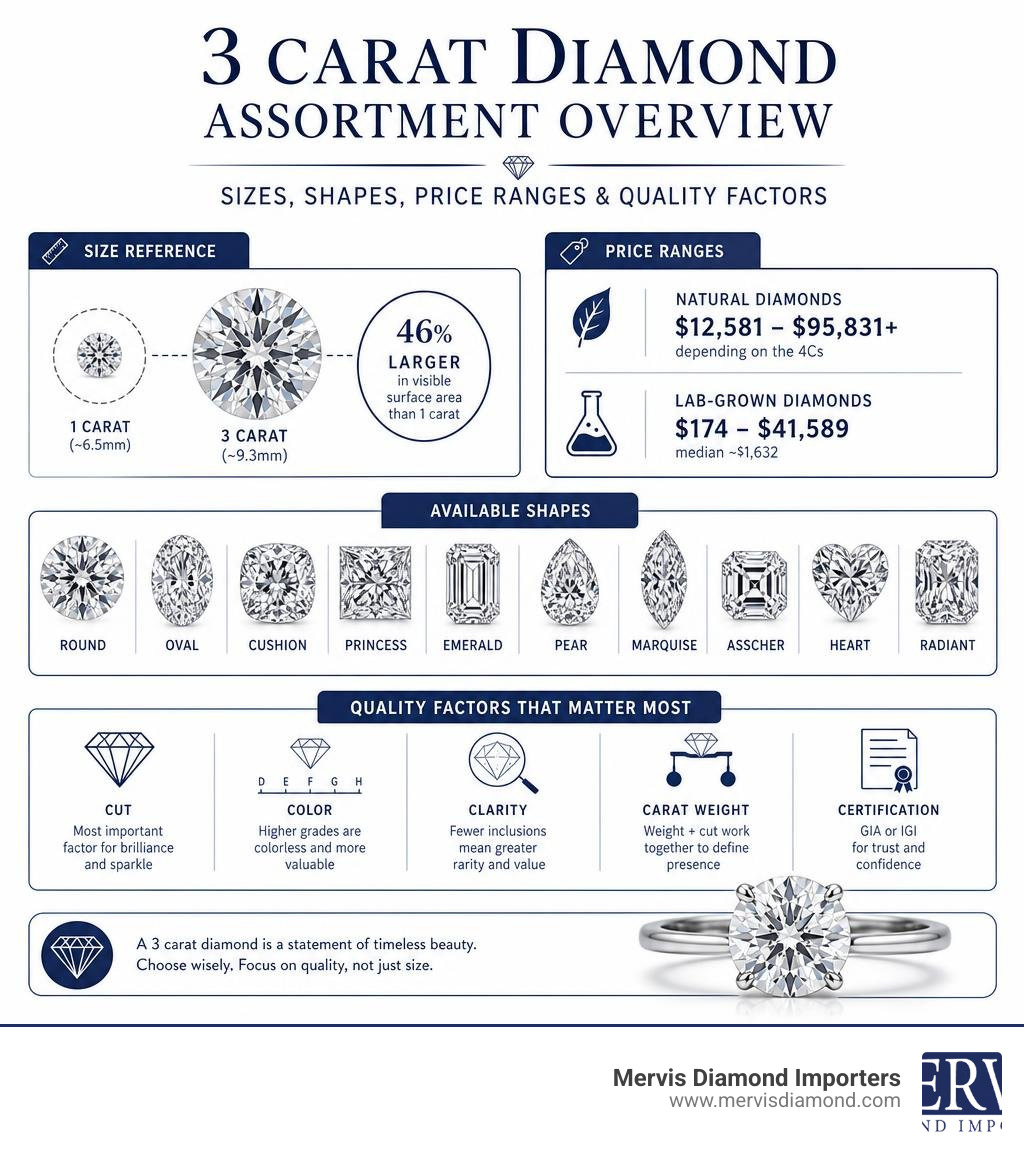
A 3 carat diamond assortment gives buyers access to a curated selection of stunning, large-scale diamonds across multiple shapes, cut grades, and price points — all at the 3 carat weight category.
Here's a quick snapshot of what to expect:
| Factor | Key Details |
|---|---|
| Price range (natural) | $12,581 – $95,831+ depending on the 4Cs |
| Price range (lab-grown) | $174 – $41,589, median ~$1,632 |
| Physical size (round) | ~9.3mm diameter |
| Available shapes | Round, oval, cushion, princess, emerald, pear, marquise, asscher, heart, radiant |
| Most important quality factor | Cut grade |
| Best certifications | GIA or IGI |
Three carats is considered quite large by any standard. The average engagement ring diamond sits closer to 1 carat, which means a 3 carat stone is roughly 46% larger in visible surface area than a 1 carat diamond.
That size comes with real decisions to make — about shape, cut quality, color grade, clarity, and whether to go natural or lab-grown. Get those decisions right, and you end up with a breathtaking diamond. Get them wrong, and you can easily overpay for a stone that doesn't perform the way it should.
This guide breaks all of it down so you can shop with confidence.
Understanding the 3 Carat Diamond Assortment
When embarking on the journey to find a larger-than-life diamond, the term "assortment" is something you will frequently hear. In the jewelry industry, a 3 carat diamond assortment refers to a carefully grouped collection of loose diamonds that all weigh approximately three carats but vary across different shapes, cuts, colors, and clarity ratings.
Choosing from an assortment allows you to compare stones side-by-side. Instead of looking at a single isolated gem, you can see how a slight shift in color or a different facet pattern affects the overall brilliance of the stone. This hands-on comparison is essential because large diamonds behave differently under light than smaller stones.

To navigate any assortment successfully, you must first master the fundamental building blocks of diamond quality. We always recommend starting with our comprehensive guide on the 4 Cs to a Diamond to build a solid foundation before you begin comparing individual stones in person.
What is a 3 Carat Diamond Assortment?
For serious buyers, designers, and collectors, looking at loose diamonds in a parcel selection or wholesale environment is the ultimate way to shop. When we curate a 3 carat diamond assortment, we gather loose stones that meet our strict quality criteria.
This wholesale-style buying experience gives you a transparent look at what you are paying for. Instead of being limited to pre-set rings, you can evaluate the raw beauty of the loose diamond itself. This prevents any clever ring settings from hiding minor inclusions or color tints, ensuring that what you see is exactly what you get.
The Difference Between 3 CT and 3 CTW
One of the most common points of confusion for diamond buyers is the difference between "CT" (Carat) and "CTW" (Carat Total Weight).
- 3 CT (Carat): This refers to the weight of a single, individual diamond. If you are looking at a 3 carat solitaire engagement ring, that single center stone weighs exactly 3.0 carats.
- 3 CTW (Carat Total Weight): This refers to the combined weight of all the diamonds in the piece of jewelry. For example, a ring might feature a 2.0 carat center stone flanked by two 0.50 carat accent diamonds. The total weight of all three stones combined is 3.0 CTW, but the visual impact of the center stone is vastly different from a single 3 carat gem.
When browsing a 3 carat diamond assortment, you are looking at individual stones that weigh 3 carats each, which will look significantly larger and carry a higher rarity premium than a piece of jewelry with a combined 3 CTW.
Sizing, Shapes, and Perceived Dimensions
Carat is a measure of weight, not physical size. A 3 carat diamond weighs exactly 600 milligrams (or 0.6 grams). Because different diamond shapes distribute this weight differently, two diamonds of the exact same carat weight can look completely different in terms of face-up size and finger coverage.
To help you visualize how shape impacts the physical dimensions of a 3 carat stone, we have put together this comparison table:
| Diamond Shape | Typical Millimeter Dimensions (3 Carat) | Visual Finger Coverage | Unique Characteristic |
|---|---|---|---|
| Round Brilliant | 9.3 mm x 9.3 mm | Balanced & Classic | Maximum sparkle and fire |
| Oval Cut | 11.5 mm x 8.0 mm | High Perceived Size | Elongates the finger beautifully |
| Cushion Modified | 8.5 mm x 8.5 mm | Soft & Pillowy | Deep vintage charm |
| Pear Shape | 12.5 mm x 8.0 mm | Very High Perceived Size | Unique, teardrop silhouette |
| Marquise Cut | 14.0 mm x 7.0 mm | Maximum Length | Bold, dramatic look |
| Emerald Cut | 9.5 mm x 7.2 mm | Elegant Step-Cut | Showcases exceptional clarity |
| Asscher Cut | 8.0 mm x 8.0 mm | Square Step-Cut | Captivating "hall of mirrors" effect |
Popular Shapes in a 3 Carat Diamond Assortment
Every shape has its own distinct personality and optical advantages. When exploring 3 carat loose diamonds, you will find that the shape you choose dictates how the stone interacts with light.
The round brilliant remains the most sought-after shape, accounting for roughly 60% of all diamond sales. Its 58 facets are mathematically engineered to maximize light reflection. However, fancy shapes like the oval cut and cushion modified are incredibly popular for 3 carat stones. The oval cut offers a larger face-up appearance, while the cushion cut provides a romantic, vintage aesthetic with slightly softer corners. If you want something bold and asymmetrical, the pear shape offers a dramatic teardrop design that looks exceptionally grand at the 3 carat mark.
Visual Carat and Perceived Size
"Visual Carat" is a term used to describe how large a diamond looks to the naked eye relative to its actual weight. Because some shapes are cut shallow with more surface area on top, they appear larger than other shapes of the same weight.
For instance, a 3 carat marquise or oval cut diamond distributes its weight horizontally and vertically across the top of the stone. This creates a larger surface area, making the stone look like a 3.5 carat gem. Conversely, shapes like the cushion or asscher cut carry more of their weight in their "belly" (the pavilion or bottom half of the stone), meaning they may look slightly smaller face-up but offer incredible depth and fire. Pay close attention to the length-to-width ratio of fancy shapes, as this ratio dictates both the symmetry and the overall visual impact of the stone.
The 4Cs: Prioritizing Quality in Large Diamonds
With a 3 carat diamond, quality factors become magnified. In a smaller 0.50 carat stone, minor inclusions or a slight yellow tint are easily hidden. In a 3 carat stone, the facets are much larger, acting like windows that can either display breathtaking brilliance or expose obvious flaws.

Cut Quality: The Most Critical Factor
If you remember only one piece of advice from this guide, let it be this: never compromise on the cut. The cut is what determines how light travels through the diamond and bounces back to your eye. An ideal cut diamond will look bright, lively, and incredibly sparkly, while a poorly cut diamond will look dull, dark, and lifeless—no matter how high its color or clarity grades are.
When evaluating a round brilliant in our showrooms in Tysons VA, Rockville MD, or Washington DC, we recommend looking for stones that score at the very top of the Diamond Cut Quality Scale. An Excellent or Ideal cut maximizes light performance, masking minor imperfections and even making a slightly warmer color grade look bright and white.
Color and Clarity Sweet Spots
When shopping for a large diamond, you do not need to pay a premium for a D-color, Flawless stone to get a visually perfect ring. Instead, target the "sweet spots" where you get the maximum visual beauty for your budget:
- Color: While D, E, and F are classified as completely colorless, stones in the G, H, and I range are "near-colorless." Once set in a platinum or white gold ring, a G or H color diamond looks incredibly white to the naked eye, saving you thousands of dollars compared to a colorless stone.
- Clarity: Rather than paying for an internally flawless stone, aim for "eye-clean" clarity. This means the diamond has inclusions when viewed under 10x magnification, but none are visible to the naked eye. For a 3 carat diamond, VS2 or SI1 clarity grades are typically the sweet spots. Because step-cuts (like emerald and asscher) have large, open facets, we recommend stepping up to VS1 or VS2 clarity. For brilliant cuts (like round, oval, and cushion), a well-selected SI1 can often be completely eye-clean.
To see how these grades stack up, consult our detailed Diamond Clarity Chart Best to Worst.
Natural vs. Lab-Grown 3 Carat Diamonds
One of the biggest decisions modern diamond buyers face is choosing between a natural, earth-mined diamond and a lab-grown diamond.
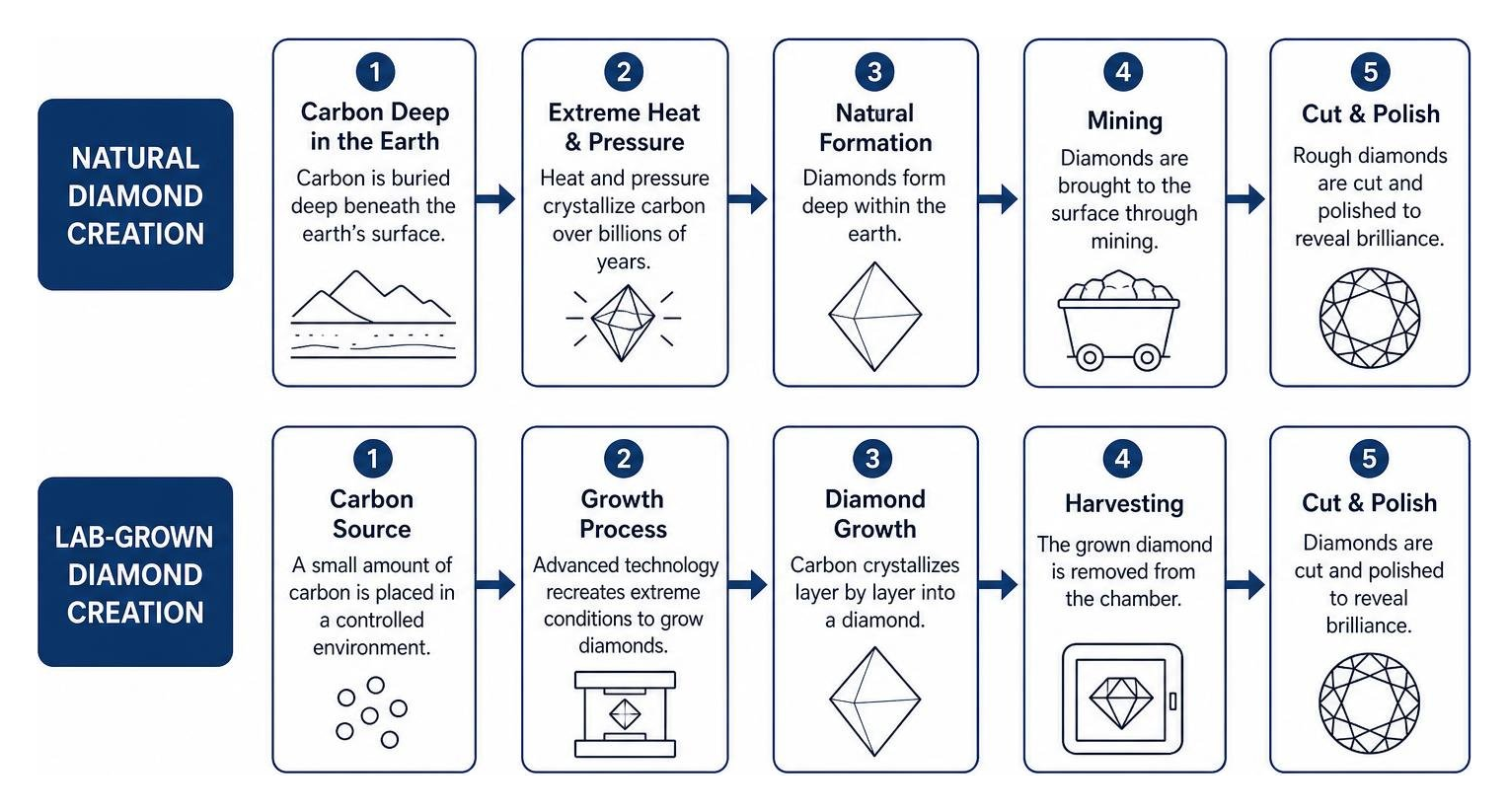
Both options are physically, chemically, and optically identical. They are both made of pure carbon crystallized in an isometric-tetrahedral system, scoring a perfect 10 on the Mohs hardness scale. The only difference is their origin story and their price tags.
Price and Availability Differences
The price difference between natural and lab-grown diamonds at the 3 carat mark is substantial:
- Natural 3 Carat Diamonds: Because large, gem-quality natural diamonds take billions of years to form deep within the earth, they are incredibly rare. A natural 3 carat round diamond typically ranges from $12,581 to $95,831, with an average price of around $40,331. A high-quality natural stone set in a premium ring can easily cost between $30,000 and $120,000.
- Lab-Grown 3 Carat Diamonds: Created in controlled laboratory environments using HPHT (High Pressure High Temp) or CVD (Chemical Vapor Deposition) methods, these stones can be produced in a matter of weeks. As of July 2026, the average price of a 3 carat lab-grown diamond has adjusted to approximately $2,240, with a median price of $1,632. This represents a massive savings of up to 80% or more compared to natural counterparts.
For an in-depth look at how these man-made marvels are created and styled, check out our 3 Carat Man-Made Diamond Ring Guide.
Certification and Grading Standards
Whether you choose a natural or a lab-grown stone from a 3 carat diamond assortment, independent certification is non-negotiable.
Never buy a large diamond without a grading report from a reputable laboratory like the Gemological Institute of America (GIA) or the International Gemological Institute (IGI). You can also learn more about diamond education and grading directly from the Gemological Institute of America. These reports provide an unbiased, transparent assessment of the diamond's 4Cs, polish, symmetry, fluorescence, and exact dimensions.
Additionally, reputable lab-grown diamonds will feature a microscopic laser inscription on the girdle confirming their lab-grown status, ensuring complete transparency.
How to Maximize Your Budget for a 3 Carat Diamond
Buying a 3 carat diamond is a significant investment. Fortunately, there are several insider strategies you can use to maximize your budget without sacrificing the visual beauty of your stone:
- Buy "Shy": Diamond prices jump significantly at round, whole-number carat weights (like 1.0, 2.0, and 3.0 carats). By "buying shy"—selecting a diamond that weighs 2.80 to 2.95 carats—you can save a substantial amount of money. Once set in a ring, the physical size difference of a fraction of a millimeter is completely indistinguishable to the naked eye.
- Prioritize the Setting: The right setting can make your 3 carat diamond look even more magnificent. A classic solitaire setting lets the center stone take center stage, while a delicate halo setting of smaller accent diamonds can make the center stone look up to a half-carat larger.
- Explore Local Retailers: While online shopping offers convenience, working with trusted local experts allows you to view the stones in person. Whether you are browsing a local jewelry store in Tysons Corner or comparing lab-grown diamonds in Rockville, MD, seeing the actual light performance of a stone under different lighting conditions is invaluable. You can also research regional pricing trends by visiting trusted local showrooms to ensure you are getting a fair market value.
Frequently Asked Questions about 3 Carat Diamonds
How much does a 3 carat diamond cost in 2026?
As of July 2026, the price of a 3 carat diamond varies dramatically depending on its origin. A natural 3 carat round diamond typically costs between $12,581 and $95,831, with an average price of $40,331. Meanwhile, a 3 carat lab-grown diamond averages around $2,240, with competitive options starting even lower depending on the shape and quality.
Is a 3 carat diamond ring too big for everyday wear?
Not at all! While a 3 carat diamond is a true statement piece, its everyday wearability comes down to your personal style, hand shape, and lifestyle. If you work with your hands or have an highly active lifestyle, choosing a low-profile setting (like a bezel or a six-prong cathedral setting) will keep the stone secure and close to your hand, preventing it from catching on clothing.
What is the best setting for a 3 carat diamond?
A 3 carat diamond is a substantial gem that requires a secure setting. A six-prong solitaire setting offers maximum security while letting the stone shine from all angles. A cathedral shank setting is also excellent, as it uses elegant arches of metal to support the heavy stone while elevating it beautifully off the finger.
Conclusion
Finding the perfect 3 carat diamond is an exciting, deeply personal journey. By understanding how the 4Cs interact at this scale, choosing the right shape for your style, and deciding between the timeless heritage of a natural stone or the modern value of a lab-grown diamond, you can select a piece that will bring joy for generations.
At Mervis Diamond Importers, we specialize in hand-selecting only the highest-performing natural and lab-grown diamonds. Our expert, pressure-free consultants in Tysons VA, Rockville MD, and Washington DC are here to guide you through our exclusive 3 carat diamond assortment to help you find a stone that truly speaks to you.
Ready to take the next step? Explore our How Much is a 3 Carat Diamond Ring guide to plan your budget, or if you want to dream even bigger, dive into our Ultimate 4 Carat Man-Made Diamond Guide.
Stop by one of our showrooms today or schedule a personalized consultation to see these magnificent gems in person!