

How to Read a Diamond Clarity Chart Best to Worst Like a Pro
The Diamond Clarity Chart From Best to Worst: A Quick Answer
Understanding the diamond clarity chart best to worst can save you hundreds — or thousands — of dollars on your next diamond purchase. Yet for most buyers, it's the most confusing part of the whole process.
Here's the full GIA clarity scale at a glance, ranked from highest to lowest:
| Rank | Clarity Grade | What It Means |
|---|---|---|
| 1 | FL (Flawless) | No inclusions or blemishes at 10x magnification |
| 2 | IF (Internally Flawless) | No inclusions; only minor surface blemishes |
| 3 | VVS1 | Inclusions extremely difficult to see under 10x magnification |
| 4 | VVS2 | Inclusions very difficult to see under 10x magnification |
| 5 | VS1 | Inclusions minor and difficult to see under 10x magnification |
| 6 | VS2 | Inclusions noticeable under 10x magnification, but eye-clean |
| 7 | SI1 | Inclusions noticeable under 10x magnification; usually eye-clean |
| 8 | SI2 | Inclusions easy to see under magnification; sometimes visible to naked eye |
| 9 | I1 | Inclusions visible to the naked eye; may affect brilliance |
| 10 | I2 | Inclusions clearly visible; affects sparkle and durability |
| 11 | I3 | Inclusions very obvious; significant impact on beauty and structure |
The bottom line for most buyers: VS2 and SI1 offer the best balance of beauty and value. They look clean to the naked eye, but cost significantly less than FL or VVS grades.
Of all the 4Cs — cut, color, clarity, and carat — clarity is the one most hidden from plain sight. Most inclusions are invisible without a magnifying loupe. That means paying a premium for a Flawless diamond often buys you perfection that nobody, including you, will ever see.
Less than 0.05% of all diamonds are Flawless or Internally Flawless. They're extraordinarily rare — and priced to match. For most people buying an engagement ring, that rarity doesn't translate into a more beautiful diamond on the finger.
This guide walks you through every grade on the scale, explains what actually matters for how a diamond looks in real life, and shows you exactly where to find the best value for your budget.
What is Diamond Clarity and Why Does It Matter?
When we talk about diamond clarity, we are talking about the stone's visual purity. Because natural diamonds are forged deep within the Earth under intense heat and pressure over billions of years, they almost always carry natural birthmarks. These microscopic features are divided into two main categories: internal characteristics (known as inclusions) and external surface flaws (known as blemishes).
To better understand the science behind these micro-characteristics, check out our detailed guide on What is Diamond Clarity?.
Clarity matters because it directly impacts two critical elements of a diamond: its light performance and its structural integrity. When light enters a diamond, it should ideally bounce off the internal facets and exit back through the top, creating that signature sparkle we all love. However, large or dense inclusions can act like tiny speed bumps, blocking or scattering light and reducing the stone's overall brilliance.
To understand exactly what gemologists look for, it helps to know the most common types of internal characteristics. You can read more about What Are Inclusions in Diamonds to see how they form, but here is a quick list of the ones you are most likely to encounter:
- Crystals: Tiny mineral deposits trapped inside the diamond as it grew. They can be white, grey, or even black.
- Pinpoints: Microscopic, dust-like crystal spots that are usually harmless unless clustered together in large numbers.
- Clouds: A tight group of microscopic pinpoints that can give the diamond a hazy or cloudy appearance if they are dense enough.
- Feathers: Small internal fractures that look like feathers. While often harmless, large feathers near the edge can pose durability risks.
- Cavities: Deep indentations or holes extending into the diamond, which can trap dirt and compromise the stone's strength.
Clarity is about finding a diamond that looks clean, bright, and beautiful to the naked eye without paying for microscopic perfection that doesn't change how the stone looks on your hand.
The Official Diamond Clarity Chart Best to Worst
To establish order in the diamond industry, the Gemological Institute of America (GIA) created the standard 11-point diamond clarity scale in 1953. This scale is used globally by leading laboratories to evaluate diamonds under standardized daylight-equivalent lighting and exactly 10x magnification.
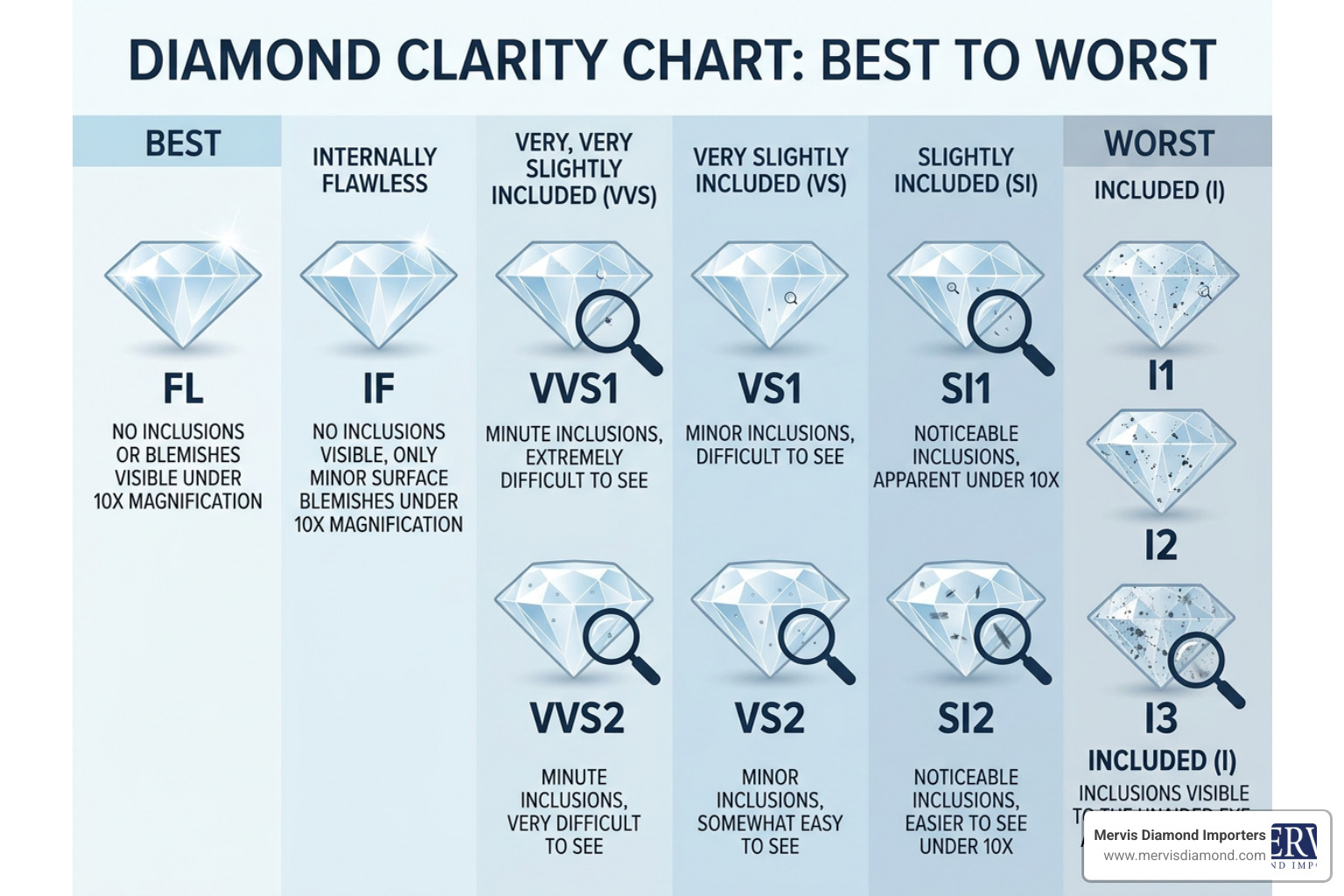
When gemologists grade a diamond, they do so "face-up" (looking down through the top table facet). They do not just count the imperfections; they evaluate five specific factors to determine where a stone falls on the diamond clarity chart best to worst:
- Size: Larger inclusions have a greater impact on the clarity grade because they are easier to see.
- Number: Multiple small inclusions can lower a grade just as much as one larger flaw.
- Location: Inclusions located directly under the top table facet are highly visible and lower the grade more than those tucked away near the outer edge (girdle).
- Relief: This refers to the contrast between the inclusion and the diamond. A dark black carbon spot has high relief and is much easier to see than a translucent white pinpoint.
- Nature: The type of inclusion and how it affects the diamond's overall structure and durability.
For a deeper look into how these factors are analyzed by independent laboratories, you can explore the Diamond Clarity Chart: Assessing Diamond Clarity - International Gem Society.
Flawless (FL) and Internally Flawless (IF) on the Diamond Clarity Chart Best to Worst
At the absolute peak of the diamond clarity chart best to worst sit Flawless (FL) and Internally Flawless (IF) diamonds. These stones represent the ultimate pinnacle of natural purity.
- Flawless (FL): No inclusions and no blemishes of any kind are visible to a skilled grader under 10x magnification.
- Internally Flawless (IF): No internal inclusions are visible under magnification, but the stone may have extremely minor surface blemishes, such as polish lines or tiny scratches, which can often be polished away.
To put their rarity into perspective, less than 0.05% of all gem-grade diamonds are graded as Flawless or Internally Flawless. They are geological miracles, which makes them highly coveted by collectors and investors.
However, for everyday jewelry, they come with a practical catch. The second you set a Flawless diamond into a metal ring setting, it technically loses its FL status because the metal prongs can cause microscopic surface blemishes. Furthermore, because these grades are identical to the naked eye when compared to slightly lower grades, you are paying a massive premium solely for the certificate. If you are wondering how other high-end grades compare, you might ask, Are VVS Diamonds Real? Yes, they are very real, highly pure, and often a much more practical choice than FL or IF.
Very Very Slightly Included (VVS1 and VVS2) to Very Slightly Included (VS1 and VS2)
Moving down the scale, we enter the premium collector and smart buyer territories:
- VVS Range (VVS1 and VVS2): These diamonds contain microscopic inclusions that are so incredibly small that even experienced gemologists struggle to find them under 10x magnification. In VVS1 diamonds, these tiny pinpoints are only visible when looking through the bottom of the stone (pavilion), while in VVS2 diamonds, they can be found with effort from the top.
- VS Range (VS1 and VS2): Inclusions in this range are minor. A gemologist can spot them under 10x magnification, but they remain completely invisible to the naked eye.
For the vast majority of engagement ring shoppers, the VS range — and specifically VS2 — is the ultimate "value sweet spot." A VS2 diamond is guaranteed to be eye-clean, meaning you will never see any black spots, clouds, or feathers with your unaided eye. It looks exactly like a Flawless diamond in real-world conditions, but it can easily save you 20% to 35% on the price.
To see how these grades fit into the broader picture of diamond quality, take a moment to read our guide on Understanding the 4Cs.
Slightly Included (SI1 and SI2) to Included (I1, I2, and I3) on the Diamond Clarity Chart Best to Worst
As we cross into the lower half of the diamond clarity chart best to worst, we find the grades where imperfections transition from microscopic to visible:
- SI Range (SI1 and SI2): Inclusions are easily noticeable under 10x magnification. In SI1 diamonds, the inclusions are usually white or translucent and located near the edges, making them eye-clean in about 90% of cases. In SI2 diamonds, the inclusions are larger, darker, or more centrally located, meaning they are sometimes visible to the naked eye if you look closely.
- Included Range (I1, I2, and I3): Inclusions in this category are obvious under magnification and clearly visible to the naked eye without any loupe.
While SI1 diamonds are highly popular for budget-conscious buyers because they can offer excellent value if hand-selected to be eye-clean, we generally advise staying away from the Included (I) grades.
In addition to being visually distracting, heavy inclusions in I-grade diamonds can cause serious durability risks. A large feather or cavity near the corner or edge of a diamond makes the stone highly vulnerable to chipping or cracking if it accidentally knocks against a hard surface. For a detailed breakdown of how these lower grades are classified, you can consult the Diamond Clarity: Clarity Scale, Chart & Purity Guide | IGI.
How Clarity Interacts with Carat Weight, Cut, and Shape
You cannot look at diamond clarity in a vacuum. It interacts dynamically with the other 4Cs, particularly the diamond's shape, its cut quality, and its overall carat weight.

First, let's look at diamond shapes. Shapes are divided into two primary cutting styles: brilliant cuts and step cuts.
- Brilliant Cuts (Round, Oval, Cushion, Pear, Marquise): These shapes feature a complex pattern of triangular and kite-shaped facets designed to maximize sparkle. This intense scintillation acts like a hall of mirrors, reflecting light in every direction and easily hiding minor inclusions. Because of this, you can safely drop to an SI1 or VS2 grade in a round brilliant diamond and still enjoy a completely eye-clean stone.
- Step Cuts (Emerald, Asscher): These shapes feature long, parallel facets and a wide, open top window (table). Instead of hiding flaws with sparkle, step cuts emphasize transparency and depth. This means there is nowhere for an inclusion to hide. If you put a VS2 or SI1 inclusion right in the middle of an emerald cut, it will stand out like a dark spot on a clean window. For step cuts, we recommend aiming for at least a VS1 or VVS2 grade to ensure visual purity.
Carat weight also plays a major role. As a diamond gets larger, its facets grow proportionally, and its top table facet becomes a much larger window. An inclusion that is completely invisible in a 0.50-carat diamond might become highly visible in a 2.00-carat diamond of the exact same clarity grade. As a general rule of thumb, we suggest increasing your clarity target by one full grade for every carat you go up. For example, if you are comfortable with an SI1 in a 1-carat diamond, you should look for a VS2 or VS1 if you are purchasing a 2-carat diamond.
To learn how to balance all of these factors harmoniously, check out our comprehensive guide on The 4Cs When Purchasing Diamond Engagement Rings.
Smart Buying Tips: Finding the Best Value Clarity Grade
When shopping for an engagement ring, your goal should not be to buy the highest technical grade on paper. Your goal should be to find an "eye-clean" diamond that looks absolutely perfect to the naked eye, allowing you to allocate more of your budget toward a larger carat weight or a superior cut grade (which has the biggest impact on sparkle).
Here are our top insider tips for optimizing your clarity budget:
- Insist on Visual Verification: Never buy a diamond based on the certificate alone. Two diamonds with the exact same SI1 clarity grade can look completely different. One might have a tiny, translucent feather hidden near the edge that can be covered by a ring prong, while the other might have a dark black crystal right in the center of the table. Always look at 360-degree high-definition videos or view the diamond in person.
- Beware of Clarity Enhancement: Some diamonds undergo artificial treatments to improve their appearance. If you are considering these, it is crucial to ask, Are Clarity Enhanced Diamonds Real? Yes, they are real diamonds, but they have been laser-drilled or fracture-filled to hide flaws. You must also consider How Long Do Clarity Enhanced Diamonds Last because these treatments can degrade over time when exposed to heat during routine jewelry repairs. At Mervis, we focus on natural, untreated stones to ensure lifetime durability.
- Leverage the Setting: If a diamond has a small inclusion near the outer edge (girdle), a skilled jeweler can often position one of the ring's prongs directly over the flaw, hiding it completely and giving you a flawless look for an SI price.
By prioritizing eye-clean VS2 or SI1 diamonds, you can save thousands of dollars without sacrificing a single ounce of real-world beauty.
Frequently Asked Questions About Diamond Clarity
Navigating the diamond market can raise a lot of questions. Here are some of the most common questions we hear from clients visiting our showrooms in Tysons, Rockville, and Washington DC.
Do lab-grown diamonds have inclusions?
Yes, lab-grown diamonds have inclusions just like natural diamonds. Because lab-grown diamonds are made of the exact same physical carbon structure as natural diamonds, they undergo a similar crystallization process.
Instead of growing over billions of years deep underground, they are grown in high-tech laboratories using advanced methods like High Pressure High Temperature (HPHT) or Chemical Vapor Deposition (CVD). During these rapid growth processes, microscopic remnants of the growth environment can become trapped inside the crystal structure. For example, HPHT diamonds can have tiny metallic inclusions from the metal flux used to grow them, while CVD diamonds can develop tiny dark graphite carbon spots.
Just like natural stones, lab-grown diamonds are graded on the exact same scale from Flawless to Included. To understand how these grades are officially evaluated, you can read the Diamond Clarity Scale - GIA.
Should I avoid buying I1, I2, or I3 diamonds?
In almost all cases, yes, we recommend avoiding Included (I1, I2, and I3) diamonds. While they are highly affordable, their imperfections are easily visible to the naked eye without magnification. These flaws often present as prominent black carbon spots, hazy clouds that make the entire diamond look milky, or large fractures that disrupt the passage of light, severely limiting the diamond's ability to sparkle.
More importantly, heavy inclusions compromise the structural integrity of the stone. A diamond with a severe fracture or cavity is at a much higher risk of chipping, cracking, or breaking under daily wear. Investing in a diamond engagement ring is a lifelong commitment, and choosing a stone with poor durability can lead to heartbreak down the road.
What is the difference between inclusions and blemishes?
The difference comes down to location:
- Inclusions are internal characteristics that are entirely enclosed within the diamond or extend from the surface deep into the interior of the stone. Examples include crystals, pinpoints, clouds, and feathers.
- Blemishes are strictly external surface flaws that occur on the outside of the diamond. They are typically caused by wear and tear, the cutting process, or setting the stone. Examples include scratches, nicks, polish lines, and small chips.
To brush up on other essential jewelry terminology before you shop, check out our guide on Must Know Diamond Terms.
Conclusion
Understanding the diamond clarity chart best to worst is your secret weapon for making a smart, informed purchase. By realizing that microscopic perfection is not necessary for a diamond to look breathtaking on a ring, you can focus on what truly matters: finding a beautiful, eye-clean stone that sparkles brilliantly in any light.
As we head through 2026, the trend among smart buyers in the Washington DC, Maryland, and Virginia areas is clear. Couples are moving away from paying premiums for invisible Flawless grades and are instead choosing hand-selected VS2 and SI1 diamonds, allowing them to maximize their budget for a larger carat weight or a stunning custom setting.
At Mervis Diamond Importers, we specialize in helping you find that perfect balance. Our non-commissioned experts are dedicated to showing you diamonds under magnification so you can see exactly what you are buying, ensuring a pressure-free, educational experience.
Ready to find your perfect diamond? Book a personalized consultation at one of our convenient DMV showrooms in Tysons, VA, Rockville, MD, or Washington, DC. To prepare for your visit, take a moment to review our master guide on Understanding the 4Cs.