

The Real Cost of Rocking a 4 Carat Round Diamond Ring
What Does a 4 Carat Round Diamond Ring Actually Cost?
A 4 carat round diamond ring is one of the most striking pieces of jewelry you can buy — but the price range is enormous, and knowing what drives that range can save you tens of thousands of dollars.
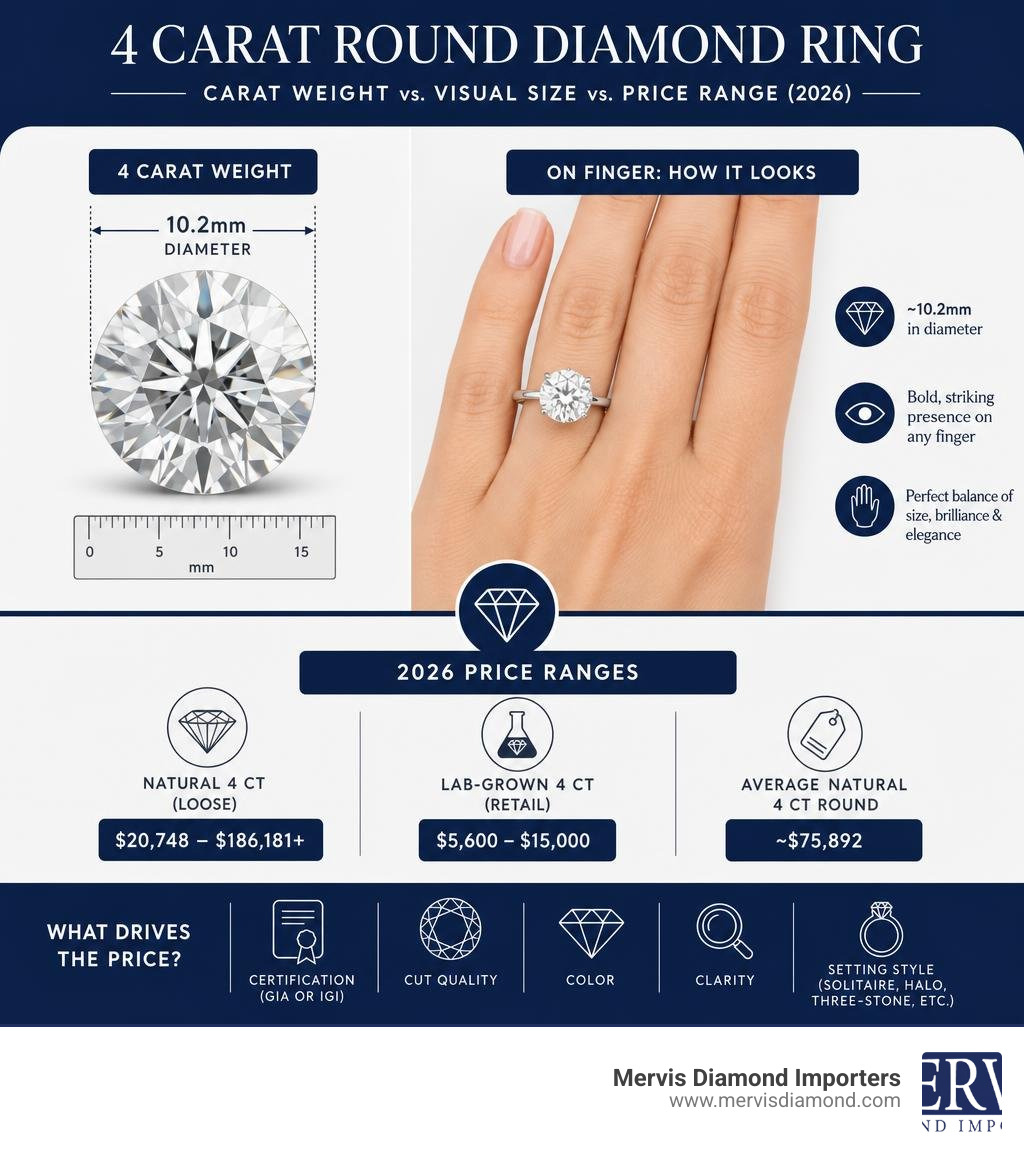
Here's a quick snapshot of what to expect:
| Diamond Type | Price Range (2026) |
|---|---|
| Natural 4 ct round (loose) | $20,748 – $186,181+ |
| Lab-grown 4 ct round (retail) | $5,600 – $15,000 |
| Average natural 4 ct round | ~$75,892 |
Key facts at a glance:
- A 4 carat round diamond measures about 10.2mm in diameter — visually commanding on any finger
- Lab-grown versions look identical to natural diamonds but cost significantly less
- Certification (GIA or IGI), cut quality, color, and clarity all swing the price dramatically
- Setting style — solitaire, halo, three-stone — adds to both cost and visual impact
Whether you're shopping for the first time or already deep in research, the number one mistake buyers make is focusing on carat weight alone. The quality of that carat is what separates a breathtaking diamond from a disappointing one.
This guide breaks down the real cost of owning a 4 carat round diamond ring — what you're actually paying for, where the value hides, and how to make a confident, informed decision without overpaying.
Why the 4 Carat Round Diamond Ring Is the Ultimate Statement
When you walk into a room wearing a 4 carat round diamond ring, it doesn't just whisper; it makes a definitive statement. But what is it about this specific size and shape that commands so much attention?
To start, a 4 carat diamond is exceptionally rare. In the natural world, finding a rough diamond crystal large enough to yield a high-quality 4 carat polished gem is an incredibly uncommon event. This inherent scarcity immediately elevates the stone into the realm of true luxury.
Beyond its rarity, the round brilliant cut is the undisputed king of light performance. While you might enjoy selecting the right diamond shape based on personal aesthetic taste, the round shape remains the industry standard for brilliance. Engineered with exactly 58 facets, the round brilliant cut is mathematically designed to maximize light reflection.
When light enters a masterfully cut round diamond, it bounces off the internal facets and returns to your eye in a dazzling display of fire (the flashes of colored light) and scintillation (the sparkle when the ring moves). If you are curious about which diamond cut sparkles the most, the answer is always the round brilliant. The physics behind what makes a diamond sparkle relies on precise angles, and no other shape handles light with the same efficiency. On a stone as large as 4 carats, this optical performance is magnified, creating a spectacular display that can be seen from across the room.
Understanding the Cost: Natural vs. Lab-Grown 4 Carat Diamonds
One of the most important decisions you will make when shopping for a 4 carat ring is choosing between a natural diamond and a lab-grown diamond. This single choice has the most significant impact on your final budget. To understand the financial landscape, it helps to read up on how much is a 4 carat diamond ring across both categories.
Here is a closer look at how these two options compare in terms of cost, ethics, and long-term value:
- Cost Differences: A natural 4 carat diamond is priced as a rare luxury asset, whereas lab-grown options are priced based on manufacturing efficiency. This means you can save up to 80% or more by choosing a lab-grown stone.
- Ethical Considerations: Modern buyers appreciate that lab-grown diamonds offer a highly transparent, conflict-free supply chain with a minimal environmental footprint.
- Appearance: Physically, chemically, and optically, lab-grown and natural diamonds are identical. Even an experienced gemologist cannot tell them apart without specialized laboratory equipment.
- Value Retention: Before making your purchase, it is wise to research whether do diamonds hold value over time. Natural diamonds carry historic resale markets, while lab-grown diamonds are generally viewed as beautiful lifestyle purchases rather than financial investments. To dive deeper into this topic, check out our analysis on are diamonds a good investment.
The Price Tag of a Natural 4 Carat Round Diamond Ring
If your heart is set on a natural stone, preparing your budget requires an understanding of how these rare gems are valued. Because natural 4 carat diamonds are so scarce, their prices do not scale linearly. A 4 carat diamond will cost far more than double the price of a 2 carat diamond of equal quality.
In the market of June 2026, a loose natural 4 carat round diamond typically ranges from $20,748 to over $186,181, with the average quality stone landing around $75,892. The final price is dictated heavily by the exact combination of color, clarity, and cut. If you want to secure the best possible stone for your budget, learning how to buy a loose diamond is a crucial first step.
The table below illustrates how the price shifts depending on the diamond's origin and quality tier:
| Diamond Origin & Quality | Estimated Price Range (June 2026) | Best Suited For |
|---|---|---|
|
Natural (Premium Quality) D-F Color, VVS1-VS1 Clarity |
$120,000 – $186,000+ | Collectors seeking maximum rarity and investment-grade natural stones. |
|
Natural (Value-Optimized) G-I Color, VS2-SI1 Clarity |
$45,000 – $95,000 | Buyers wanting a large, eye-clean natural diamond with excellent sparkle. |
|
Lab-Grown (Top-Tier Retail) D-F Color, VVS2-VS1 Clarity |
$13,100 – $15,000 | Those looking for custom designer settings and premium boutique experiences. |
|
Lab-Grown (Value Retail) F/VS2 Quality Solitaire |
$5,600 – $7,999 | Budget-conscious buyers wanting maximum size and visual impact for the price. |
The Affordability of a Lab-Grown 4 Carat Round Diamond Ring
For couples who want the jaw-dropping look of a massive diamond without the six-figure price tag, lab-grown stones are an incredibly popular alternative.
The cost savings are undeniable. For example, a certified F/VS2 lab-grown solitaire set in a classic 14K white gold band can start as low as $6,999.99 at major retailers. If you keep an eye out for clearance pricing, these same solitaire settings can sometimes be found for as low as $5,599.99 (originally priced around $7,999.99). On the higher end, premium boutique lab-grown rings, such as those from specialty collections, typically range between $13,100 and $15,000 depending on the complexity of the setting and metal choice.
When shopping locally in Maryland or Virginia, visiting a dedicated showroom is the best way to compare these stones in person. Seeing the diamonds under proper lighting ensures you get the exact look you want, whether you are browsing options in Tysons Corner or Rockville.
How the 4Cs and Certification Dictate Value
When you are buying a diamond as large as 4 carats, there is nowhere for imperfections to hide. On a smaller half-carat diamond, a minor inclusion or a slight hint of yellow body color might go completely unnoticed. On a 10.2mm round brilliant stone, those details become visible to the naked eye.
Understanding how to balance the 4Cs is essential to getting the best value. To build your foundational knowledge, we highly recommend reading our guides on understanding Four Cs and the 4Cs when purchasing diamond engagement rings. You can also review the official diamond education resources from the Gemological Institute of America for additional background on grading standards.
Here is how each factor plays out on a 4 carat canvas:
- Cut: This is the most critical factor of all. A poor cut will make a 4 carat diamond look dull, lifeless, and sometimes even smaller than its actual weight. For round diamonds, aim for a "Cut Score" of 7.5 or higher on professional 10-point scales, or stick strictly to GIA "Excellent" or IGI "Ideal" cut grades. It is worth noting that the round brilliant is historically what is the most expensive diamond cut because of the high amount of rough diamond lost during the cutting process, but the payoff in sparkle is unmatched.
- Color: Because of the diamond's large volume, body color is easier to detect. While D, E, and F grades are completely colorless, you can often find incredible value in the G, H, or even I color range. These near-colorless grades look beautifully white when set in white gold or platinum, and they can save you thousands of dollars.
- Clarity: For a 4 carat stone, we generally recommend a clarity grade of VS2 or higher. This ensures the diamond is "eye-clean" - meaning there are no inclusions visible to the naked eye. If you drop down to SI1, make sure to inspect the stone in person to ensure the inclusions are not located directly under the center of the table.
- Certification: Never buy a 4 carat diamond without a certificate from a reputable, independent grading laboratory. For natural diamonds, GIA is the gold standard. For lab-grown diamonds, IGI (International Gemological Institute) is the most common and trusted authority.
For personalized guidance on balancing these factors, visiting our expert consultants at our Tysons Corner showroom is an excellent way to see these subtle differences side-by-side.
Selecting the Perfect Setting and Metal for a 4 Carat Stone
A diamond of this magnitude deserves a frame that is both structurally secure and visually stunning. The setting you choose will define the overall style of the ring and can even influence how large the center stone appears.
Before making a final decision, take some time to explore how to choose a diamond ring setting and read through a comprehensive guide to engagement ring settings.
Here are the most popular setting styles for a 4 carat round diamond ring:
- The Classic Solitaire: A timeless choice that lets the 4 carat stone do all the talking. Because of the weight of the stone, we recommend a secure 4-prong or 6-prong setting. A slightly wider band (around 2.0mm to 2.5mm) provides better balance and prevents the ring from spinning on the finger.
- The Halo Setting: Surrounding the center stone with a delicate border of smaller diamonds. This setting can make your 4.00-carat stone look like a 5-carat masterpiece.
- The Hidden Halo: A modern favorite where a subtle wrap of diamonds sits just beneath the main stone's girdle. It adds a touch of secret sparkle that is only visible from the side.
- The Three-Stone Setting: Flanking the center round diamond with side stones — such as tapered baguettes or smaller round diamonds — to symbolize your past, present, and future together.

When it comes to metal choice, platinum is highly recommended for 4 carat stones due to its density and strength, ensuring your prongs remain secure over a lifetime of wear. If you prefer gold, 14K or 18K white gold provides a bright, modern look, while yellow gold or rose gold offers a warm, classic aesthetic.
Frequently Asked Questions About 4 Carat Rings
How big is a 4 carat round diamond on a finger?
A 4 carat round brilliant diamond has a physical diameter of approximately 10.2mm. To put that in perspective, it covers roughly 60% to 70% of the width of an average female finger. It has an incredibly bold presence and provides substantial finger coverage, making it a true showstopper.
What is the average cost of a 4 carat engagement ring?
The average cost varies wildly depending on whether you choose natural or lab-grown. A natural 4 carat ring averages around $75,000 to $85,000, while a lab-grown 4 carat ring averages between $7,000 and $15,000. For general context on ring pricing, you can read about how much is the average engagement ring and explore our breakdown of the engagement ring average cost.
How do I care for and maintain a 4 carat diamond ring?
Because a 4 carat diamond sits relatively high off the finger, it is more prone to everyday bumps. We recommend bringing your ring to a professional jeweler at least twice a year for a prong inspection and deep cleaning. For day-to-day care, a gentle soak in warm water with mild dish soap and a soft-bristled toothbrush will keep that signature sparkle alive. Always ensure your ring is fully insured, as standard home insurance policies rarely cover high-value jewelry of this scale.
Conclusion
Investing in a 4 carat round diamond ring is an exciting milestone. Whether you choose the historic rarity of a natural stone or the modern brilliance and affordability of a lab-grown diamond, this is a piece of jewelry that will be cherished for generations.
At Mervis Diamond Importers, we specialize in helping you navigate this journey with ease. Our non-commissioned diamond experts hand-select only the highest-quality natural and lab-grown stones, ensuring your ring sparkles beautifully from every angle. With convenient, pressure-free showrooms in Tysons, VA, Rockville, MD, and Washington, DC, we are proud to serve the entire DMV region.
Ready to take the next step? Read our Engagement Ring Shopping 101: The Ultimate Guide or schedule a personalized consultation with us today to find your perfect 4 carat diamond.