

Step Inside the Art Deco Elegance of Lab Grown Asscher Diamonds
Why an Asscher Cut Lab Grown Diamond Stands Out
An Asscher cut lab grown diamond is a real diamond grown in a controlled setting, then cut into a square shape with cropped corners and broad, stair-step facets. It is an excellent choice if you want an Art Deco look, clear geometric lines, and a distinctive "hall-of-mirrors" pattern rather than the fast, glittery sparkle of a round diamond.
For the best appearance, focus on a well-proportioned cut, excellent polish and symmetry, and clarity that looks clean to the eye. Because the Asscher's large open center can reveal inclusions and color more easily than many brilliant cuts, many buyers choose VS clarity or higher and a D-F color grade.
First introduced in 1902, the Asscher cut brings vintage architecture into a modern, conflict-free diamond option. Its 58 facets create bold flashes of light, deep reflections, and an octagonal outline that feels both timeless and uncommon. Lab-grown options can also cost less than comparable mined diamonds, giving buyers more room to prioritize size, quality, or a detailed setting.
I am Morris Mervis, and in this guide, I will help you compare quality, value, certification, and setting options so you can buy with confidence.
What Is an Asscher Cut Lab Grown Diamond?
The Asscher cut traces its heritage back to 1902, when it was designed and patented by master artisan Joseph Asscher in Amsterdam. At the time, diamond cutting was dominated by early brilliant styles, making Joseph’s geometric, step-cut creation a departure. It went on to define the visual language of the 1920s Art Deco era, gracing the hands of royalty, socialites, and architectural trendsetters.
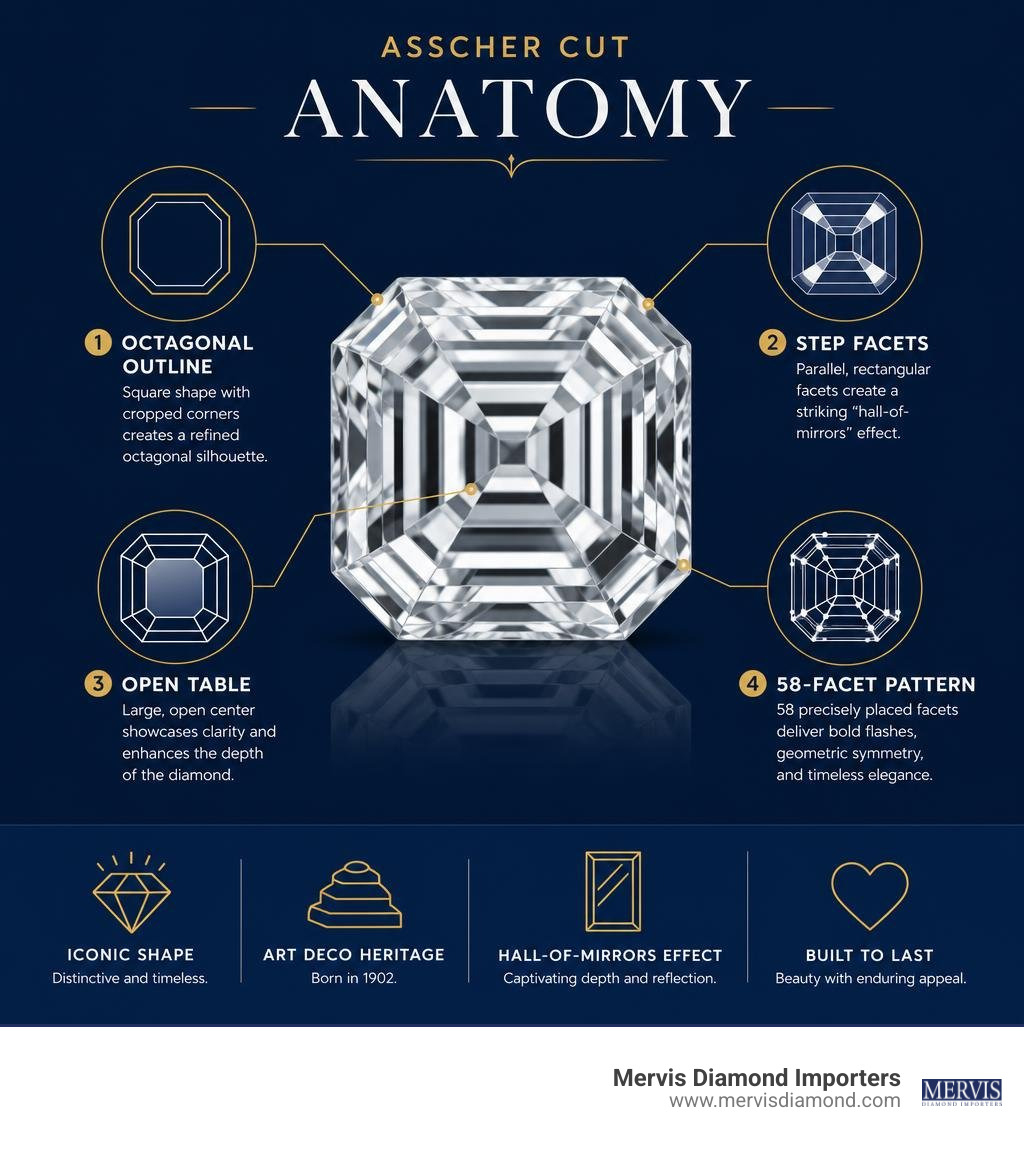
At its core, the silhouette is square with deliberately cropped corners, creating an unmistakable octagonal outline. Rather than scattering light through hundreds of tiny triangular facets, a classic Asscher cut utilizes 58 meticulously aligned step facets.
When you peer directly into the stone, these straight, parallel facets converge into a distinctive "windmill" or "X" pattern that draws your gaze deep into the diamond’s core. This optical architecture yields the famous "hall-of-mirrors" effect—a mesmerizing rhythm of broad white flashes and deep, dramatic reflections that makes the gemstone appear almost endless from within.
Understanding the Unique Step-Cut Faceting Pattern
Unlike brilliant-cut diamonds designed to maximize explosive, chaotic sparkle, step cuts prioritize structural transparency and geometric harmony. The facets on an Asscher cut run parallel to the diamond’s girdle in concentric square steps, descending down through both the crown and pavilion.
Several distinct structural features create this signature visual depth:
- A High Crown: The upper portion of the diamond rises steeply above the girdle, enhancing the stone's ability to bend and disperse ambient light.
- A Deep Pavilion: The lower portion extends downward in deliberate tiers, creating the optical chamber needed for the windmill pattern to develop.
- A Large, Open Table: The flat, polished top surface acts as a clear glass window, inviting viewers to gaze directly into the center of the stone.
This deliberate balance of angles produces optical scintillation characterized by bold, theatrical flashes rather than the tight, glittery sparkle of modern round diamonds.
Asscher Cut vs Emerald and Princess Cuts
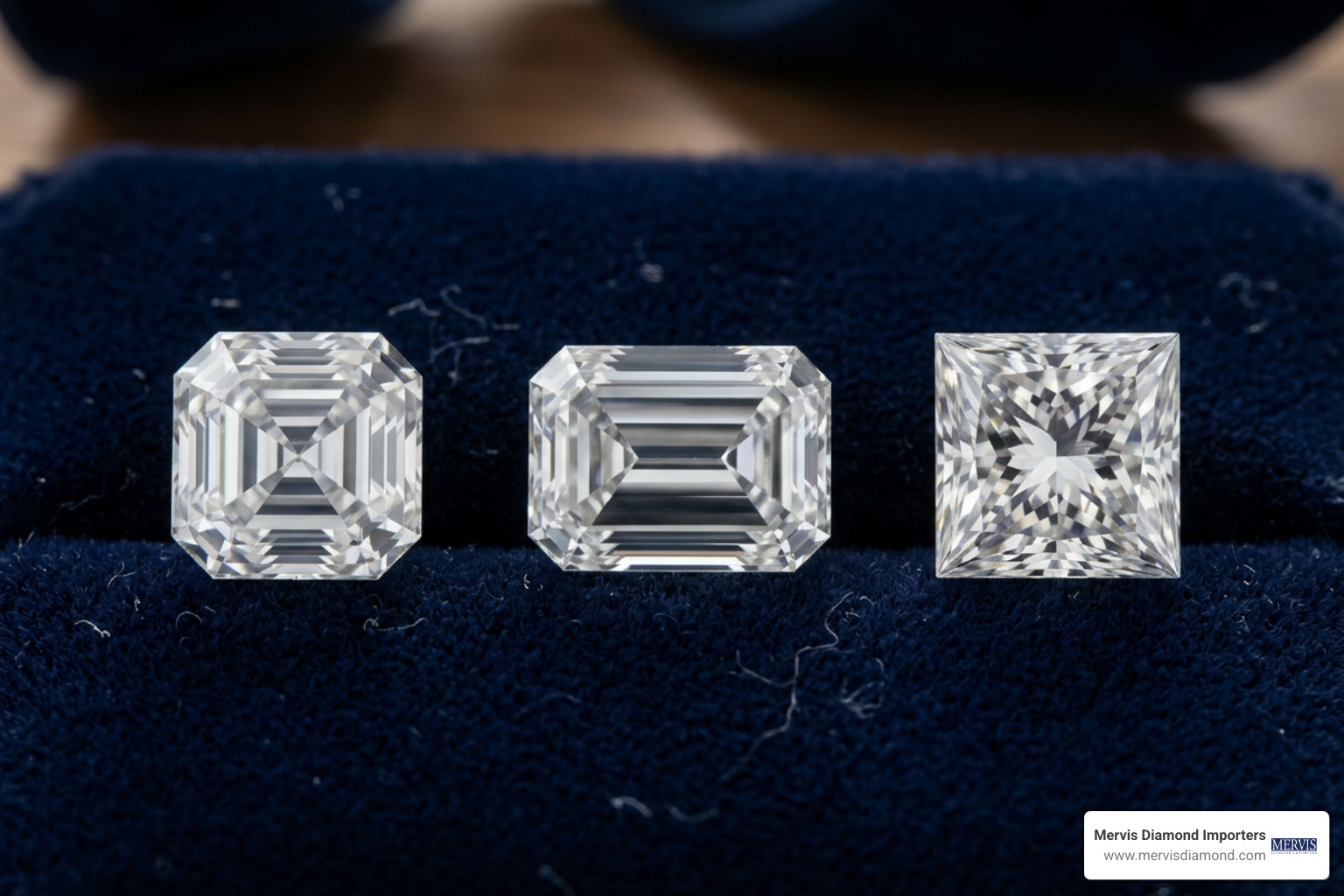
Choosing between fancy diamond shapes often comes down to personal taste in geometry and light performance. While emerald cuts share the step-cut tradition and princess cuts offer a square silhouette, their differences are striking when placed side by side.
| Feature | Asscher Cut | Emerald Cut | Princess Cut |
|---|---|---|---|
| Shape | Square with cropped corners (Octagonal) | Rectangular with cropped corners | Square with sharp, pointed 90° corners |
| Faceting Style | Step-cut (concentric squares) | Step-cut (linear rows) | Modified brilliant (crushed ice / pinpoint) |
| Facet Count | 58 facets | 57 to 58 facets | Typically 57 to 76 facets |
| Primary Light Effect | Concentric "hall-of-mirrors" & windmill flashes | Elongated, quiet flash reflections | High-frequency, splintered sparkle |
| Inclusion Visibility | High (demands higher clarity) | High (demands higher clarity) | Low (faceting masks minor flaws) |
For those who love rectangular elegance, browsing a Lab Grown Diamond D VVS2 3.01 Eme Report XLTK177309 illustrates how step facets stretch across an elongated profile. Conversely, examining a Lab Grown Diamond F VS1 2.02 Pri Report XLTK176146 showcases the lively, needle-like brilliance of sharp square corners. The Asscher cut beautifully bridges the two worlds by offering a square profile with the serene optical depth of pure step faceting.
How Cultured Asscher Diamonds Are Created
A cultured or lab-grown Asscher diamond is not an imitation, simulant, or cubic zirconia. It is an authentic diamond in every sense—chemically, physically, and optically identical to a mined gem.
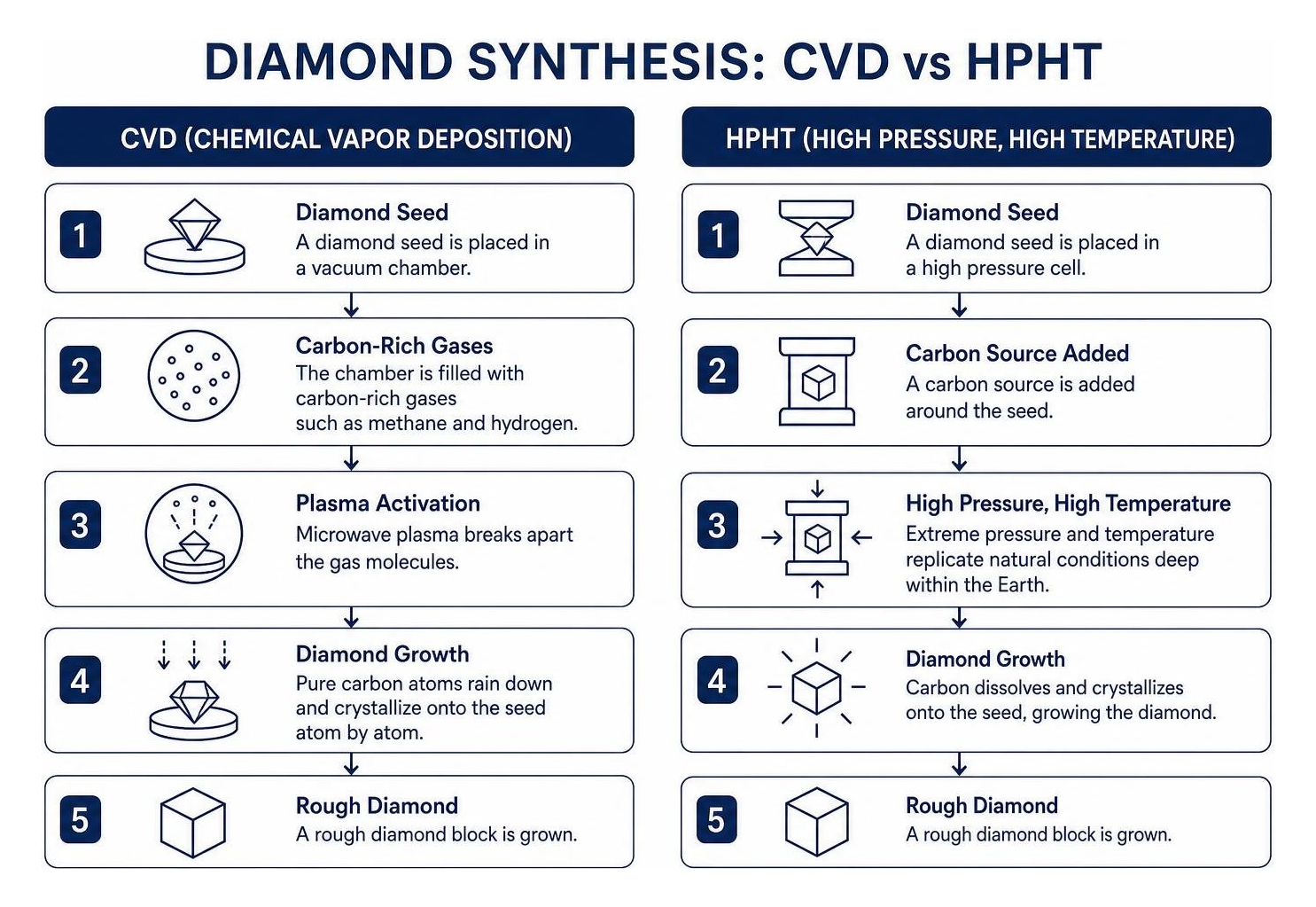
The creation process begins with a thin sliver of an existing diamond, known as a diamond seed. Inside advanced scientific laboratories, engineers recreate the intense subterranean conditions that naturally crystallize pure carbon over billions of years. Once the rough diamond block grows, master diamond cutters plan and polish the step facets to exact mathematical tolerances. The finished gemstone exhibits the identical hardness (a 10 on the Mohs scale), thermal conductivity, and refractive index (2.42) as an earth-mined stone.
CVD vs HPHT Synthesis Methods
Cultured diamonds are grown using one of two advanced scientific methods:
- Chemical Vapor Deposition (CVD): In this method, a diamond seed is placed into a specialized vacuum chamber filled with carbon-rich gases (such as methane and hydrogen). When heated with microwave plasma, the gas molecules break apart, allowing pure carbon atoms to rain down and crystallize onto the seed atom by atom. You can discover more about this plasma process by reading What is a CVD Diamond.
- High Pressure High Temperature (HPHT): This technique mimics the deep mantle of the earth. A diamond seed is placed inside a massive mechanical press and subjected to extreme pressures exceeding 870,000 pounds per square inch alongside temperatures over 2,700°F, melting pure carbon onto the seed.
Both techniques produce Type IIa diamonds—the rarest and chemically purest classification of diamond, representing less than 2% of mined stones.
Evaluating Quality and the 4Cs in Step Cuts
Evaluating an Asscher diamond requires a slightly different approach than shopping for a round brilliant. Because step cuts feature large, transparent tables without distracting faceting clutter, understanding the fundamentals outlined in our 4Cs Diamonds Ultimate Guide is critical to getting the best visual value.
When reviewing The 4Cs for this cut, symmetry and cut proportions take center stage:
- Table Percentage: Aim for a table between 60% and 68%. A table that is too wide flattens the stone's crown and dampens fire.
- Depth Percentage: Look for a depth between 63% and 70% to ensure light bounces through the pavilion rather than leaking out the bottom.
- Length-to-Width Ratio: A true Asscher should be square. Target a ratio between 1.00 and 1.05 for balanced symmetry.
Selecting the 4Cs for an Asscher Cut Lab Grown Diamond
To help you balance your budget while securing an extraordinary stone, here are our recommended grading targets:
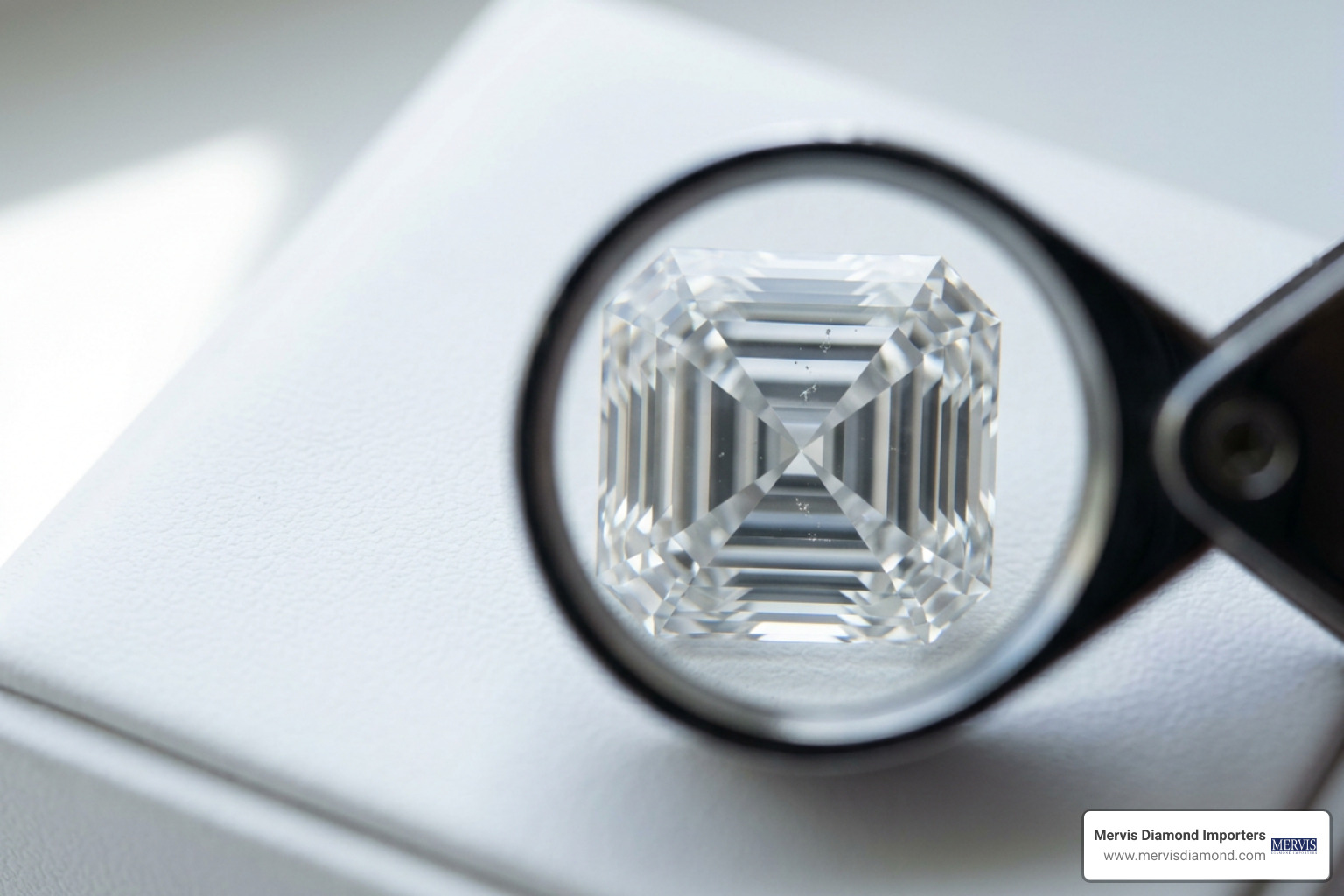
- Clarity: Unlike brilliant cuts that conceal minor carbon spots, the open table of an Asscher cut acts as an unobstructed magnifying glass. For a completely eye-clean stone, we recommend selecting VS1 or VVS2 clarity. In fact, thanks to precise laboratory growing environments, over 90% of lab-grown Asscher cuts achieve VS1 clarity or higher.
- Color: Step cuts tend to retain body color more noticeably along their wide facet planes. To ensure a crisp, icy-white appearance, select a color grade within the colorless range (D, E, or F).
- Cut & Polish: Always choose Excellent polish and symmetry grades. Because the windmill effect depends on parallel facet alignment, any slight asymmetry will visibly distort the hall-of-mirrors pattern.
Value and Affordability of an Asscher Cut Lab Grown Diamond
One of the greatest benefits of modern diamond synthesis is accessibility. Lab-grown diamonds typically cost 30% to 40% less than mined diamonds of comparable grade and carat weight.
With the global lab-grown diamond market projected to reach $49.9 billion by 2030, fancy cuts like the Asscher are enjoying unprecedented interest. The cost advantage allows couples to select larger carat weights with pristine VVS clarities without exceeding their planned budgets. For a deeper breakdown of market pricing dynamics, explore our Artificial Diamonds Price Guide 2026 or review sizing benchmarks in the Ultimate 4 Carat Man Made Diamond Guide.
Best Settings and Jewelry Styles for Asscher Cuts
The architectural lines of an Asscher cut lend themselves to both heirloom vintage styles and sleek, contemporary mountings.
Here are the top setting styles that showcase an Asscher diamond’s unique geometry:
- Classic Four-Prong Solitaire: Clean, delicate prongs placed precisely at the cropped corners emphasize the diamond's octagonal geometry without visual distraction.
- Art Deco Vintage Settings: Intricate milgrain borders, filigree metalwork, and hand-engraved platinum bands accentuate the cut's 1920s heritage.
- Tapered Baguette Side Stones: Flanking an Asscher center stone with step-cut tapered baguettes extends the geometric theme across the finger, creating seamless visual continuity.
- Bezel and Half-Bezel Settings: A thin precious metal rim framing the perimeter provides maximum protection to the corners while delivering a striking, modern look.
- Hidden Halo Mountings: A subtle row of micro-pavé diamonds resting beneath the center stone adds unexpected brilliance from side angles while keeping the top profile sleek.
Certification, Authenticity, and Buying Tips
Independent gemological grading is your best guarantee of diamond authenticity and quality. Every cultured Asscher diamond you consider should be accompanied by a comprehensive laboratory report from respected institutions such as the International Gemological Institute (IGI) or the Gemological Institute of America (GIA).
These certificates verify:
- Exact carat weight and physical dimensions (length, width, and depth in millimeters).
- Independent color, clarity, polish, and symmetry grades.
- Verification of lab-grown origin and synthesis method (CVD or HPHT).
- The unique laser inscription registry number etched microscopically onto the diamond's girdle.
When you are ready to view these diamonds in person under professional magnification, we invite you to consult with our gemological team. If you are in Maryland, you can explore our curated loose stones for Lab Grown Diamonds in Rockville MD, or schedule a private consultation for Diamond Buying in Tysons Corner VA to compare step cuts side by side.
Frequently Asked Questions About Lab Grown Asscher Diamonds
Do Asscher cut lab diamonds sparkle as much as round brilliant cuts?
Asscher cut diamonds sparkle differently than round brilliants. While a round brilliant produces high-frequency, splintered scintillation, an Asscher cut produces broader, theatrical flashes of white light and colored fire. Its beauty comes from crisp architectural depth, structural clarity, and the hypnotic hall-of-mirrors effect rather than glittery sparkle.
How can you verify that an Asscher diamond is authentic and lab created?
You can verify authenticity through its independent grading certificate (such as IGI or GIA) and by matching the report number to the microscopic laser inscription on the diamond’s girdle under a jeweler's loupe. Professional gemological instruments can also confirm its physical properties, thermal conductivity, and Type IIa carbon purity.
Is an Asscher cut diamond ring durable for daily wear?
Yes. Because lab-grown diamonds possess a Mohs hardness rating of 10, they are the hardest mineral known and highly resistant to scratching or daily abrasion. Furthermore, the Asscher cut’s cropped, beveled corners make it significantly less prone to accidental chipping than square cuts with sharp 90-degree points (such as princess cuts).
Conclusion
The Asscher cut remains one of the most sophisticated diamond shapes ever conceived, effortlessly marrying the roaring glamour of the 1920s with clean, modern design. By choosing a lab-grown Asscher, you enjoy the pristine clarity, ethical sourcing, and accessible value of advanced diamond synthesis without compromising on authentic beauty or durability.
Whether you are designing a custom engagement ring or building a signature jewelry piece, we invite you to explore the latest designs and discover trending lab grown diamonds at our Mervis Diamond Importers showrooms across Washington DC, Maryland, and Virginia.