

The No-Nonsense Guide to Diamond 4c Meaning and Grading
What Are the 4Cs of Diamonds — and Why Should You Care?
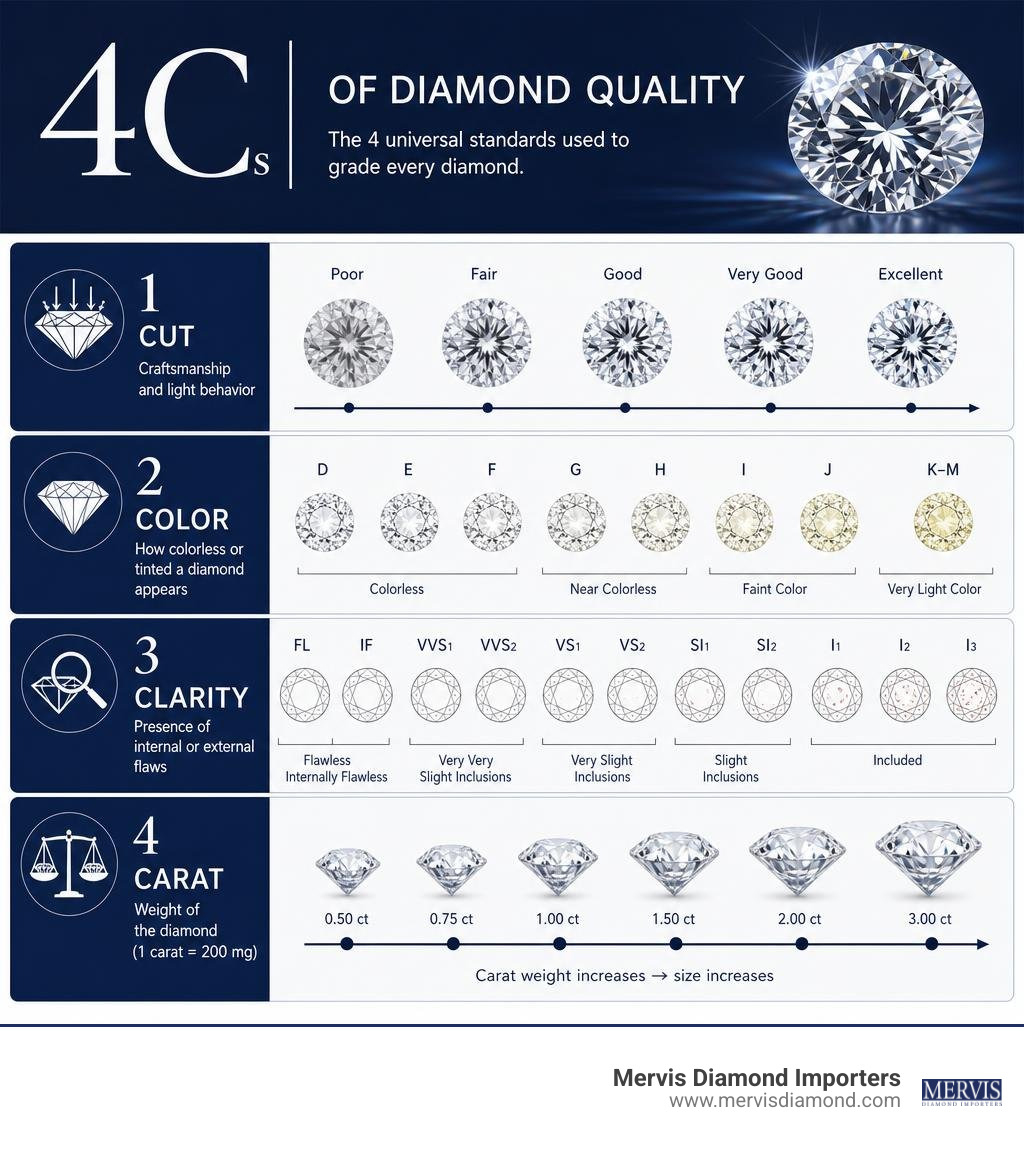
The 4Cs of diamonds — Cut, Color, Clarity, and Carat Weight — are the four universal measures used to grade every diamond on earth. Here's a quick snapshot:
| The 4C | What It Measures | Why It Matters |
|---|---|---|
| Cut | Craftsmanship and light behavior | Determines sparkle and brilliance |
| Color | How colorless or tinted a diamond appears | Affects visual purity and value |
| Clarity | Presence of internal or external flaws | Impacts rarity and price |
| Carat | Weight of the diamond (1 carat = 200 mg) | Directly tied to size and rarity |
Together, these four grades determine a diamond's quality — and its price tag.
Here's the problem most buyers face: walking into a jewelry store without knowing the 4Cs is like buying a car without knowing what an engine is. You're at the mercy of whoever is selling to you.
Before the 1940s, there was no standard. Jewelers described colorless diamonds simply as "water" and well-cut stones as "made well." Vague, subjective, and impossible to compare. That chaos is exactly why the 4Cs exist today.
Choosing a diamond is absolutely a matter of personal preference. But evaluating one is a matter of precision.
I'm Morris Mervis, and after decades of helping buyers find the right diamond without overpaying or second-guessing, I can tell you that understanding the 4Cs is the single most important thing you can do before you shop.
What Are the 4c's diamonds and Why Do They Matter?
When you begin your search for the perfect diamond, you will quickly realize that no two stones are identical. The 4c's diamonds framework was established to bring order, science, and transparency to what was once a highly subjective trade. By breaking down a diamond's characteristics into four distinct pillars, buyers can understand exactly what they are paying for, compare different stones objectively, and make smart trade-offs that align with their personal budgets and aesthetic preferences.
This system didn't appear overnight. It was developed by the Gemological Institute of America (GIA). Robert M. Shipley, the visionary founder of GIA, first coined the term "4Cs" in the 1940s as a simple mnemonic device to help his gemology students remember the four key factors characterizing a faceted diamond.
Later, in 1953, Richard T. Liddicoat and his colleagues at GIA took this framework a step further by introducing the GIA International Diamond Grading System. They created the highly structured, scientific scales for Color and Clarity that are still used across the globe today. To learn more about how this system works, you can read the official guide on Understanding the 4Cs of Diamond Quality | Diamond Factors | GIA 4Cs .
The History and Evolution of 4c's diamonds
To truly appreciate the 4c's diamonds system, it helps to look at the historical chaos that preceded it. For centuries, diamond trading was a game of subjective vocabulary.
While carat weight is the oldest of the 4Cs—having been consistently and systematically in use since the 1500s—the other three characteristics were described using highly inconsistent terms. If you walked into a jewelry boutique in the 1800s looking for a high-quality, colorless diamond, you would have had to ask the merchant for a stone like "water" or "river." If you wanted a diamond with excellent clarity, you would ask for a stone "without flaws." A well-proportioned cut was simply communicated as "made well."
These subjective terms left consumers completely at the mercy of the merchant's personal opinion. One jeweler's "pure water" might be another's slightly yellowed stone. The introduction of the 4Cs in the mid-20th century replaced this vague language with a universal, scientific standard. For a deeper look into how this transition occurred and what it means for modern buyers, check out our article on the 4 Cs To A Diamond.
Why Standardized Grading is Essential for Buyers
Standardized grading is the ultimate shield for the consumer. It transforms diamond buying from a guessing game into a transparent, scientific evaluation. When a diamond is evaluated under standardized conditions—using regulated lighting, specific neutral backgrounds, and calibrated masterstones—its true physical properties are laid bare.
This objective system gives buyers the confidence that they are paying a fair price based on verified metrics rather than a retailer's marketing spin. However, a grading scale is only as reliable as the laboratory applying it. This is why we always recommend verifying your stone's quality through a certified independent third-party laboratory report. To understand how these official evaluations work and why they protect your investment, read our guide on getting a Gia Certified Diamond Appraisal.
Deep Dive into the Four Cs of Diamond Quality
Now that we understand the history and importance of the grading system, let's look at how a diamond's value is determined by diving deep into each individual "C". Taken collectively, these four grades establish the diamond's overall quality, rarity, and price. To get a broad overview of how these characteristics function together in the commercial market, you can explore The Four Cs of Buying Diamonds—and the Fifth C Defined .
To visualize how these factors interact, let's examine the basic anatomy of a diamond and how light behaves when it hits a properly cut stone:
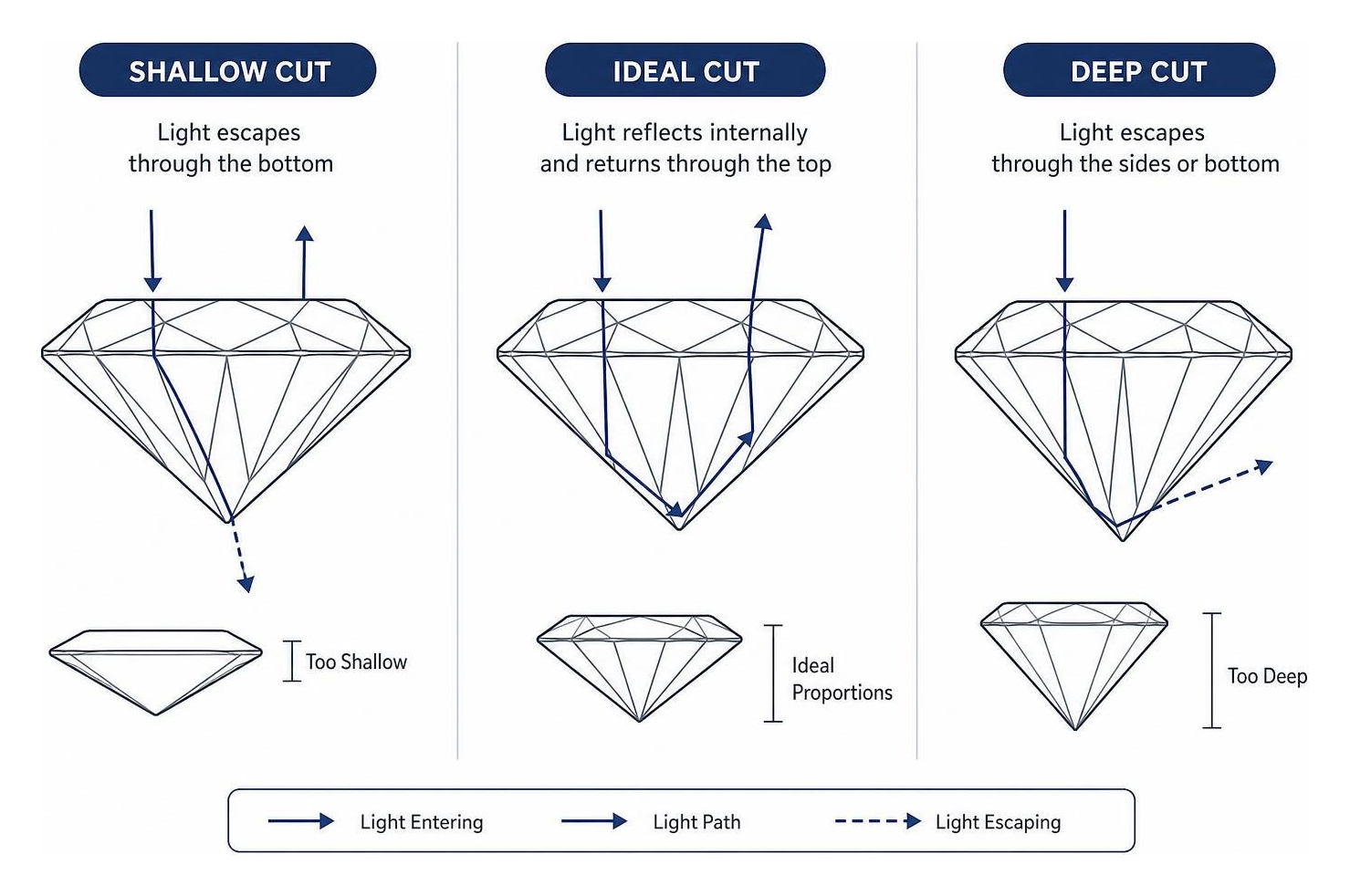
When light enters a diamond, it should travel down to the pavilion facets, reflect across, and bounce back out through the top (table) to the eye of the viewer. If the cut is too shallow or too deep, that precious light leaks out of the bottom or sides, resulting in a dull, lifeless stone.
Cut: The Engine of Diamond Sparkle
Many gemologists agree that Cut is the most critical of the 4c's diamonds. While the other three Cs (Color, Clarity, and Carat) are determined by nature, Cut is entirely dependent on human artistry and craftsmanship.
A diamond's cut grade does not refer to its shape (such as pear, oval, or princess), but rather to how well its facets interact with light. The most famous diamond cut, the round brilliant, features exactly 57 facets (or 58 if you count the tiny flat facet at the very bottom, called the culet). Each of these facets must be precisely aligned and angled to maximize three main visual effects:
- Brilliance: The total amount of white light reflected from the diamond.
- Fire: The dispersion of light into beautiful, rainbow-colored flashes.
- Scintillation: The pattern of light and dark areas, along with the sparkling flashes produced when the diamond or the light source moves.
In 2006, the GIA introduced its comprehensive Diamond Cut Grading System for round brilliant cut diamonds. This system grades cuts on a scale of Excellent, Very Good, Good, Fair, and Poor. If you want to dive deeper into how these grades are determined and how they affect the diamond's appearance, take a look at our detailed breakdown of the Diamond Cut Quality Scale.
Color: The GIA D-to-Z Scale
When evaluating classic white diamonds, "Color" actually measures the absence of color. A chemically pure and structurally perfect diamond has no hue, acting like a drop of pure water, and consequently, holds a higher value.
To grade this characteristic, GIA introduced the D-to-Z color scale in 1953.
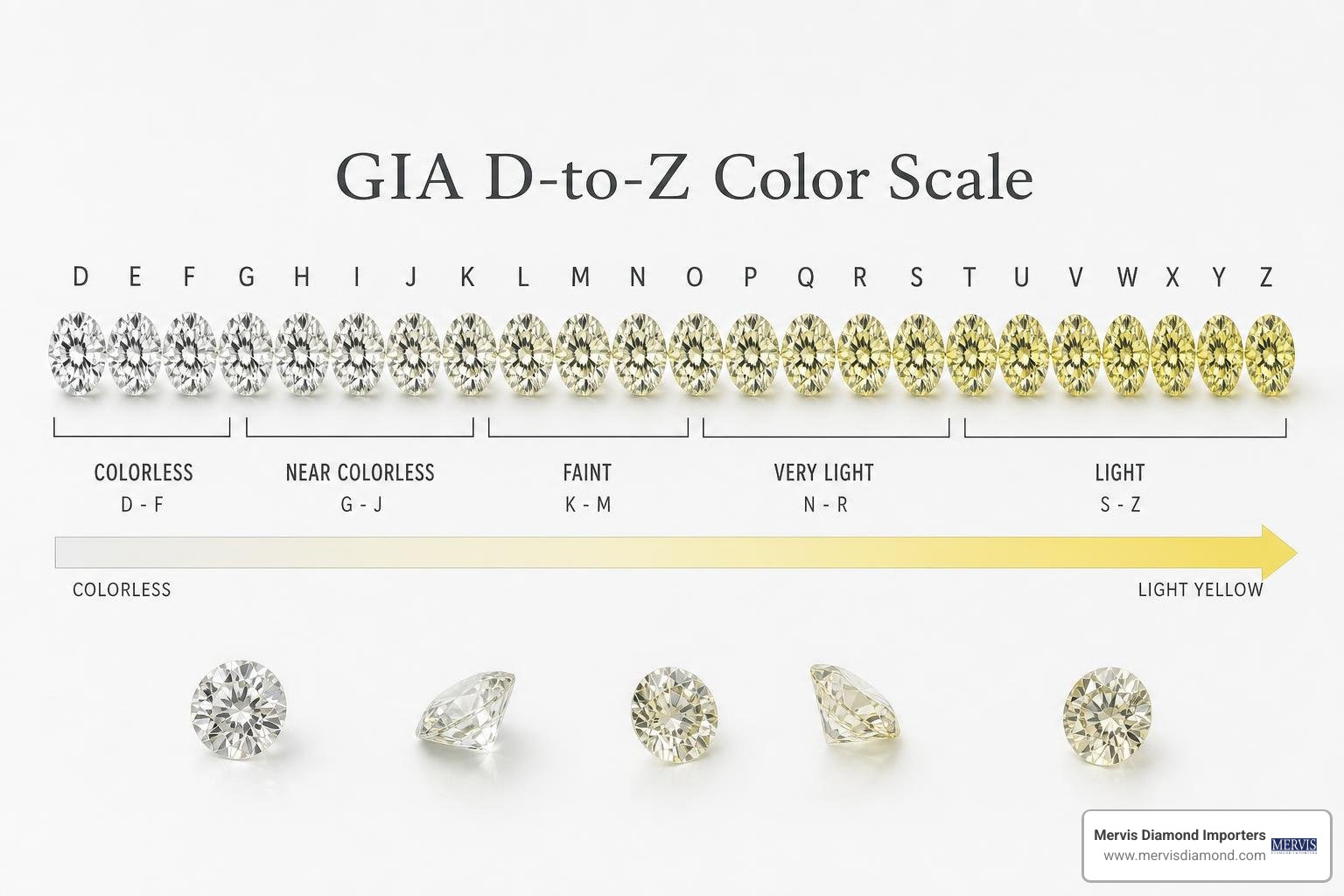
The scale begins with the letter D, representing a completely colorless diamond, and continues down to Z, which indicates a diamond with a noticeable light yellow or brown tint.
- D-F (Colorless): The rarest and most expensive. These diamonds show absolutely no color, even under intense laboratory magnification.
- G-J (Near-Colorless): An incredible value zone. These diamonds appear colorless to the naked eye when set in jewelry, but cost significantly less than colorless stones.
- K-M (Faint): A warm, subtle yellow tint is visible, which can look beautiful when paired with yellow gold settings.
- N-R (Very Light) & S-Z (Light): Noticeable yellow or brown coloration.
But what happens when we go past Z? This is where we enter the realm of "fancy" color diamonds. Unlike white diamonds, where yellow tinting reduces value, colored diamonds—such as deep yellows (canary), pinks, blues, and greens—are graded on a completely different scale. These are exceptionally rare and highly prized, with their values skyrocketing based on the intensity and purity of their color.
Interestingly, the jewelry industry has found creative ways to market lower-quality brown diamonds from the Z end of the spectrum by rebranding them with delicious names like "champagne," "cognac," or "chocolate" to boost their appeal to fashion-forward buyers.
Clarity: Inclusions vs. Blemishes
As diamonds form deep within the earth under extreme heat and pressure, they naturally develop internal characteristics called "inclusions" and external characteristics called "blemishes." Clarity is the measure of the purity of the diamond and the absence of these tiny imperfections.
To evaluate clarity, gemologists examine the diamond under 10x magnification. They categorize the results using the GIA Clarity Scale, which runs from flawless to heavily included:
- Flawless (FL) / Internally Flawless (IF): No inclusions or blemishes visible under 10x magnification (FL), or only minor surface blemishes (IF). Extremely rare.
- Very, Very Slightly Included (VVS1 and VVS2): Inclusions are so microscopic that even skilled gemologists struggle to find them under 10x magnification.
- Very Slightly Included (VS1 and VS2): Minor inclusions that are difficult to see under magnification and completely invisible to the naked eye.
- Slightly Included (SI1 and SI2): Inclusions are noticeable under 10x magnification and may occasionally be visible to a highly observant naked eye.
- Included (I1, I2, and I3): Inclusions are clearly visible to the naked eye and may affect the diamond's beauty or structural durability.
To see a visual representation of these grades and understand which clarity level offers the best balance of beauty and budget, explore our Diamond Clarity Chart Best To Worst.
Carat: Weight, Rarity, and Price Exponentiality
Carat is often the most misunderstood of the 4c's diamonds. Many people assume carat refers to the physical size of the diamond, but it is actually a measure of weight. One metric carat is equal to exactly 200 milligrams.
To allow for highly precise measurements, each carat is divided into 100 "points." A jeweler might refer to a diamond weighing 0.50 carats as a "fifty-pointer."
Because large, high-quality diamonds are incredibly rare in nature, diamond prices do not scale linearly with weight. Instead, they increase exponentially. A 2.00-carat diamond will cost significantly more than two 1.00-carat diamonds of the exact same color, cut, and clarity.
This rarity is further highlighted by global production trends. In 2005, global rough diamond production peaked at 177 million carats. By 2020, that number had dropped to 111 million carats, reflecting the increasing rarity of finding natural, high-quality rough stones in the earth.
Beyond the Basics: The Fifth C and Smart Buying Strategies
While the traditional 4Cs are the bedrock of diamond evaluation, modern buyers in 2026 have an additional, vital factor to consider: ethical sourcing. This is often referred to as the "Fifth C" — Conflict-Free.

Ethically conscious buyers want to ensure their symbol of love has not funded armed conflict or involved human rights abuses. To address this, the global diamond industry established the Kimberley Process Certification Scheme (KPCS) in 2003. This international initiative regulates and tracks rough diamonds from the mine to the market, ensuring they are certified conflict-free.
At Mervis Diamond Importers, we take ethical sourcing incredibly seriously. Beyond natural diamonds certified by the Kimberley Process, we also specialize in high-quality lab-grown diamonds. Lab-grown diamonds are physically, chemically, and optically identical to natural mined diamonds. Because they are grown in controlled laboratory environments using advanced technology, they bypass the mining process entirely, offering an exceptionally ethical and budget-friendly alternative.
How to Prioritize the 4c's diamonds for the Best Value
Unless you have an unlimited budget, buying a diamond is an exercise in making smart, calculated trade-offs. The secret to getting the absolute best value is knowing which of the 4c's diamonds you can compromise on without affecting the diamond's visual beauty.
We always advise our clients to prioritize Cut above all else. A diamond with a mediocre color or clarity grade can still look absolutely stunning if it has an Excellent cut, because the intense sparkle and light reflection will mask minor color tints and tiny inclusions. On the flip side, even a flawless, perfectly colorless diamond (D/FL) will look dull and glassy if it is poorly cut.
To help you structure your buying plan, you can read our expert breakdown on the Diamond 4 Cs Order Of Importance. Once you have established your priorities, you can search for a Best Value Diamond that maximizes visual impact while keeping your hard-earned money in your pocket.
Frequently Asked Questions About Diamond Grading
What is the most important of the 4Cs?
Cut is widely considered the most important of the 4Cs. It is the only factor directly controlled by human hands. A superior cut maximizes the light behavior of the stone, giving it the brilliance, fire, and sparkle that people fall in love with. A great cut can also make a diamond look visually larger than its actual carat weight suggests!
How do lab-grown diamonds compare on the 4Cs scale?
Lab-grown diamonds are graded on the exact same 4Cs scale as natural diamonds. Because they are chemically and physically identical to mined diamonds, major gemological laboratories like the GIA evaluate them using the same rigorous scientific standards for Cut, Color, Clarity, and Carat weight.
How can I verify my diamond's GIA grading report?
You can easily verify any GIA report by using the official GIA Report Check tool online. Simply enter the unique report number printed on your certificate. Most modern GIA-certified diamonds also have this unique report number microscopically laser-inscribed on the diamond's girdle (its outer edge), allowing you to match the physical stone directly to its digital grading record.
Conclusion
At Mervis Diamond Importers, we believe that choosing an engagement ring or a piece of fine jewelry should be a joyful, memorable experience. We specialize in hand-selecting high-quality natural and lab-grown diamonds, offering expert, pressure-free service at our convenient locations in Tysons, VA, Rockville, MD, and Washington, DC.
If you are ready to take the next step and see these beautiful grading differences with your own eyes, we invite you to book a consultation with our non-commissioned diamond experts. To continue your education before your visit, check out our comprehensive guide on understanding the four cs. We look forward to helping you find the perfect diamond that speaks to your heart and fits your life.