

Everything to Expect When Taking Your Diamond Ring in for Repairs
When Should You Take a Diamond Ring in for Repair?
If the diamond moves, a prong catches on fabric, or the band is cracked, stop wearing the ring. A jeweler can check whether the stone is secure and recommend the right repair, such as tightening a setting, rebuilding a prong, or fixing the band. Ask for an inspection and a quote before approving the work.
The repair may be simple, or it may take more work if the metal is thin or other stones are at risk. I'm Morris Mervis, and I'll walk you through what to expect from the first inspection to the final quality check.
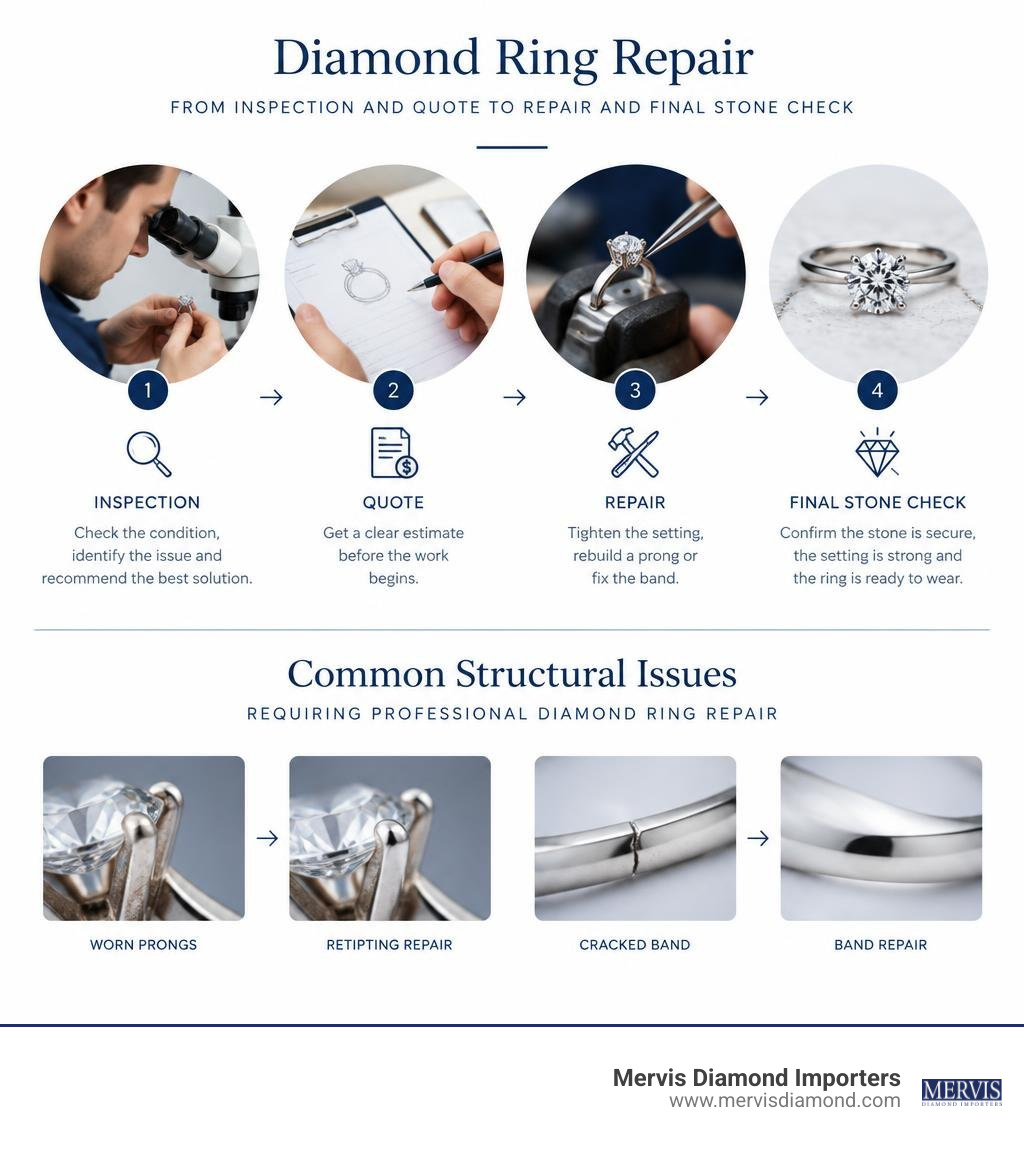
Common Structural Issues Requiring Professional Diamond Ring Repair
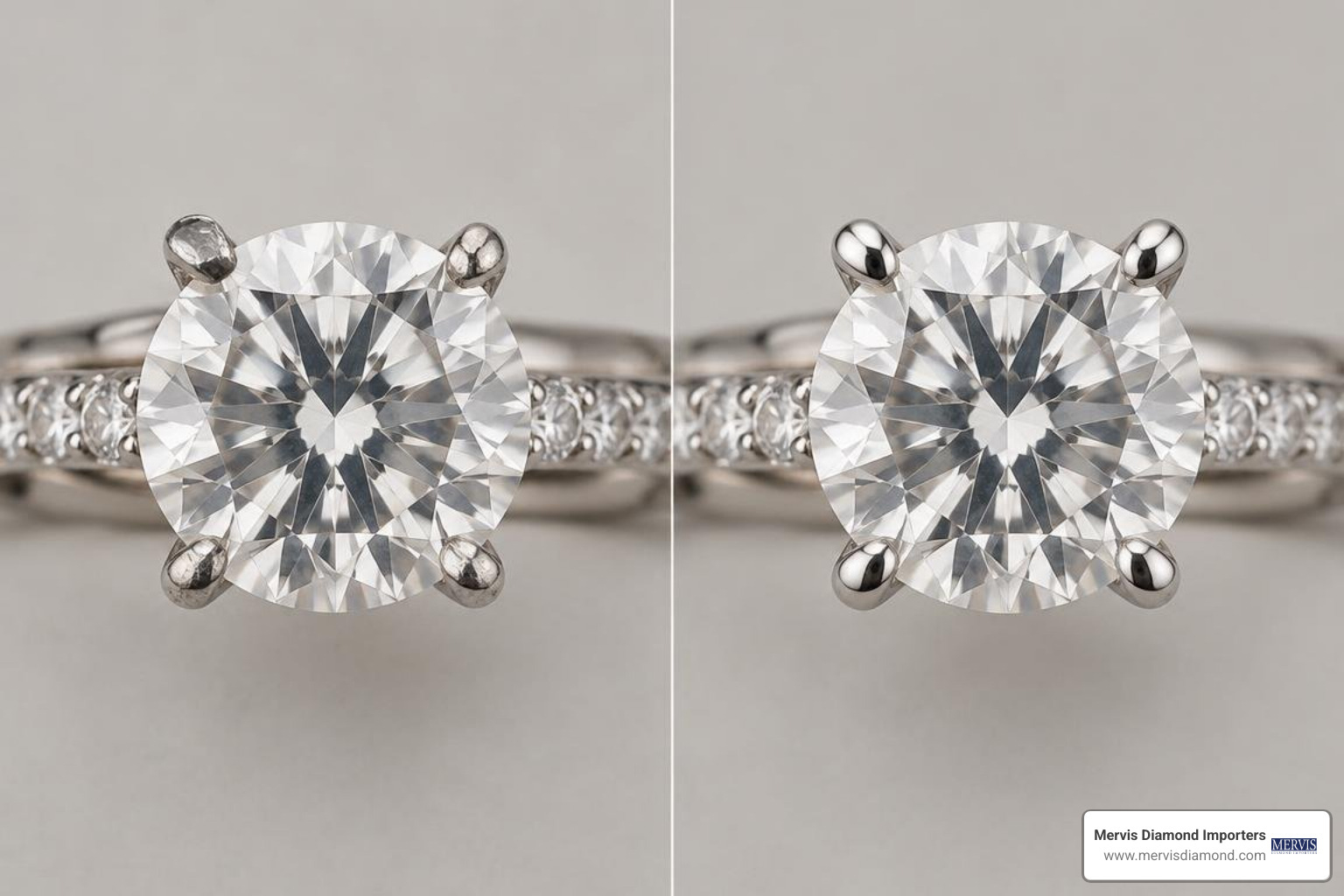
Fine jewelry is engineered to withstand daily wear, but precious metals are malleable. Over years of typing, gripping steering wheels, gardening, and accidental knocks against granite countertops, rings accumulate structural fatigue. While diamonds are the hardest natural mineral on Earth, many people are surprised to learn that diamonds can break or chip when struck along their cleavage planes with sufficient force.
When structural stress occurs, prompt intervention keeps a minor maintenance issue from becoming a devastating stone loss. The most common problems requiring professional diamond ring repair include:
- Prong wear and lift: Daily friction rubs away the delicate metal tips securing your center diamond and accent stones.
- Bent or misshapen shanks: Thin bands easily warp under pressure, which loosens stone seats.
- Cracked bands: Stress fractures often develop at old resize seams or along the bottom of the band where metal wears thinnest.
- Emergency cut-offs: Rings cut off in medical settings can be completely restored using precision metal reconstruction.
Identifying Compromised Prongs and Loose Settings
Prongs act as the structural pillars of your ring. Over time, metal wears down, turning rounded prongs into thin, flat discs that can snag on knitwear or bend backward under minimal pressure.
To evaluate your settings at home, pay attention to these warning signs:
- The Tap Test: Gently tap the side of your diamond near your ear using a fingernail or wooden toothpick. If you hear a faint clicking noise or see the stone rotate, the seat is compromised.
- The Fabric Snag: If your ring repeatedly catches on sweaters, blankets, or hair, a prong has lifted away from the crown facet.
- Visual Thinning: Look at the prongs under bright light. If the tips appear wafer-thin, flattened, or uneven, they require rebuilding.
When you bring your ring to our bench, we document the setting using 40x macro-photography. This visual audit reveals micro-fractures, bezel thinning, and claw degradation invisible to the naked eye.
Band Thinning, Fractures, and Shank Replacement
The bottom half of a ring (the shank) bears constant mechanical friction. Decades of contact with hard surfaces gradually wear away precious gold or platinum, thinning the base until it bends out of round or snaps entirely.
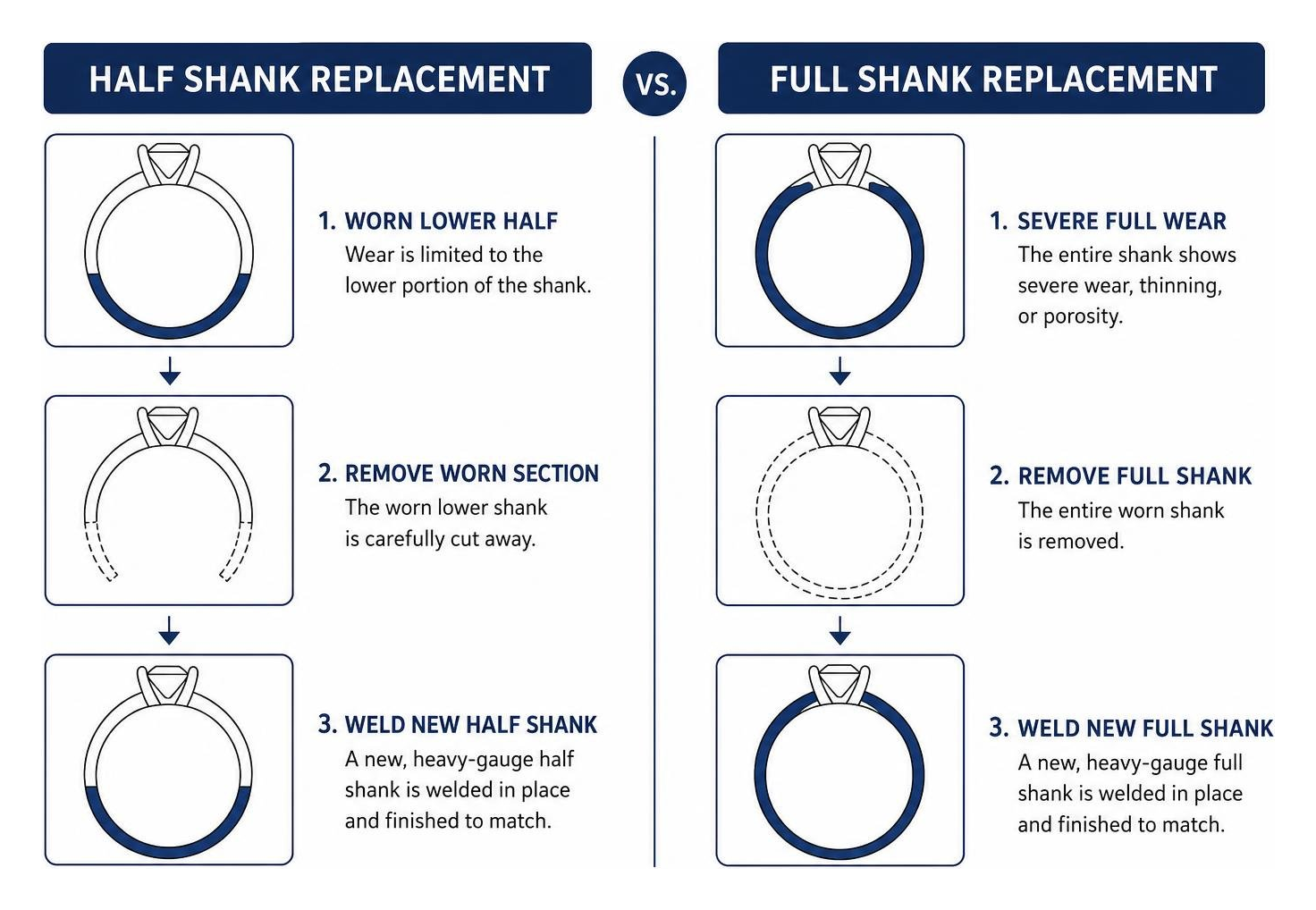
When a band becomes structurally compromised, jewelers perform one of two structural restorations:
- Half Shank Replacement: If wear is confined to the lower half of the band, a master jeweler excises the worn metal and welds a fresh, heavy-gauge half-shank in matching gold or platinum.
- Full Shank Replacement: If the entire band has suffered severe porosity or thinning up to the gallery shoulders, a full replacement restores factory-grade structural integrity.
Reinforcing a worn shank preserves the ring's circular geometry, preventing the upper gallery from flexing and ejecting side stones.
Modern Repair Technologies: Laser Welding vs. Traditional Soldering
Historically, ring repair relied entirely on torch soldering. A bench jeweler used an open flame to heat solder past its melting point, flowing it into metal joints. While effective for simple bands, torches present serious risks to gemstones. Understanding whether diamonds can melt or burn highlights the dangers of extreme heat, which can scorch precious gems or cause thermal shock fractures.
Modern bench jewelry utilizes localized pulse laser welding. Laser welders fire concentrated 100-joule light pulses, fusing identical metals within a pinpoint accuracy of 0.1 millimeters—smaller than a grain of sand. Because the heat zone is microscopically localized, laser welding allows jewelers to retip prongs directly against sensitive gems without heat transfer.
| Feature | Traditional Torch Soldering | Modern Pulse Laser Welding |
|---|---|---|
| Heat Application | Wide open flame heating entire setting | Pinpoint 100-joule light pulse (0.1 mm focus) |
| Gemstone Safety | Stones often must be removed to avoid burn risk | Stones remain safely in place without thermal shock |
| Joint Strength | Lower-melting-point solder alloy creates seam | Direct fusion of identical karat metal; seamless bond |
| Precision | Broad coverage; requires heavy post-cleanup | Microscopic accuracy with minimal metal removal |
| Vintage Safety | High risk of melting fragile filigree | Zero collateral damage to intricate antique work |
Handling Multi-Gemstone Mountings and Fragile Stones
Rings featuring accent gems require specialized bench protocols. While diamonds tolerate moderate indirect warmth, colored gemstones like emeralds, opals, tanzanite, and pearls crack or discolor under torch heat.
With laser technology and specialized thermal shielding gels, our master bench jewelers rebuild worn channel walls, secure loose micro-pavé diamonds, and reconstruct damaged bezels without subjecting fragile side gems to thermal shock. When an accent diamond goes missing, we hand-match the replacement for color, cut, and clarity before resetting it securely into renewed metal seats.
Alloy Matching and Forensic Metal Analysis
Invisible, durable repairs require metallurgical precision. Mismatched alloys cause visible solder lines, uneven oxidation, and galvanic corrosion over time.
Master craftsmen verify metal composition using X-ray fluorescence (XRF) alloy authentication. Whether working with 18k yellow gold, nickel-free white gold, or 950 platinum, XRF scans reveal the exact chemical makeup of antique or unhallmarked heirlooms. The jeweler can then formulate a precise alloy match, excising internal casting porosity and blending joints seamlessly. Digital workflow tools, including technical modeling in a precision utility playground, help benchmark tolerances for delicate custom fabrications.
The Step-by-Step Diamond Ring Repair Process
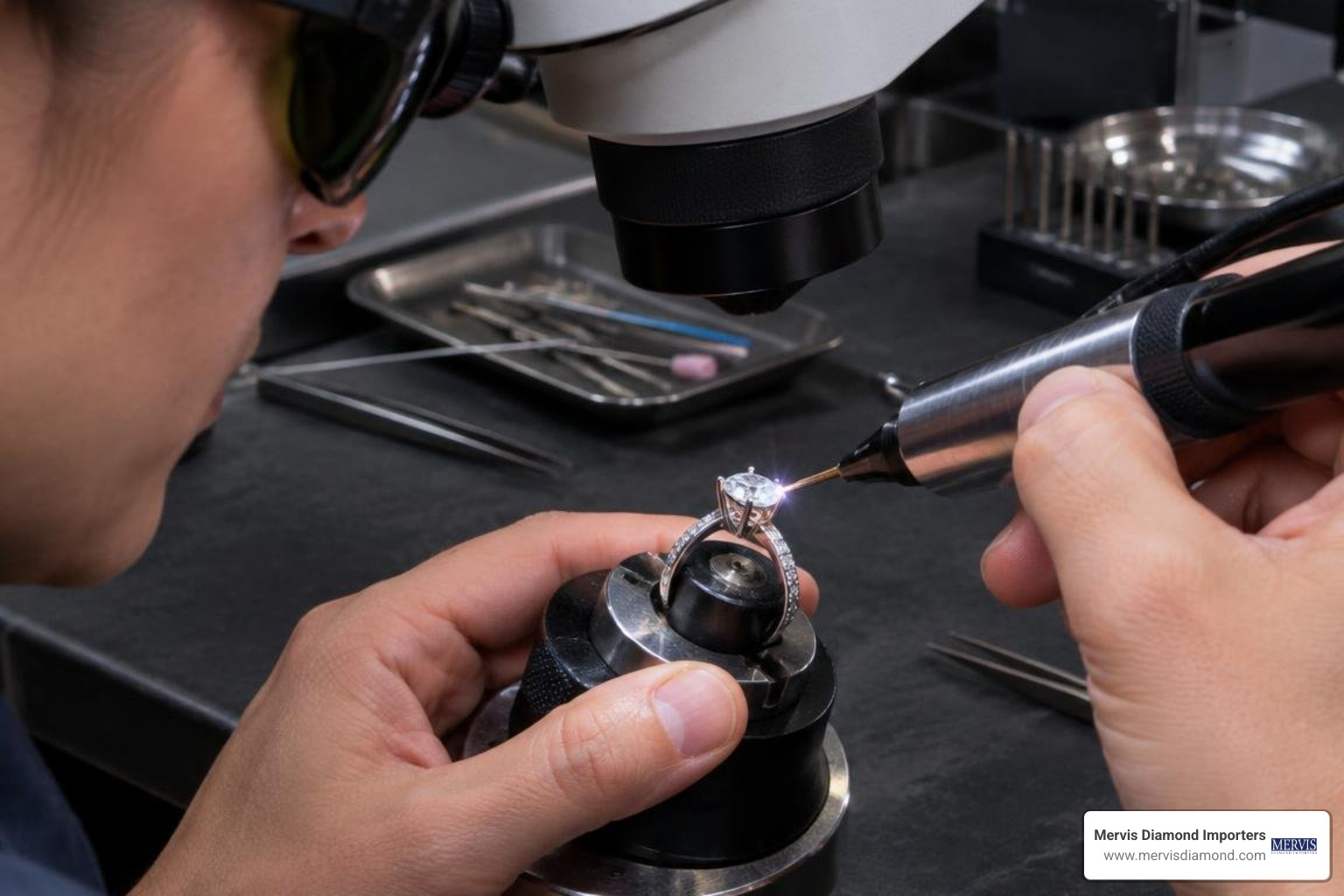
Entrusting an irreplaceable engagement ring or family heirloom to a jeweler should never feel uncertain. A reputable restoration follows a transparent diagnostic protocol:
- Intake & Microscopic Inspection: The jeweler evaluates your ring under a Leica microscope, checking stone security, prong thickness, and gallery stability.
- Macro Documentation: High-resolution 40x macro-photos record the exact condition of the piece upon arrival.
- Itemized Estimate & Approval: You receive a detailed breakdown of needed repairs and metallurgy specs before any bench work starts.
- Bench Restoration: Master jewelers complete laser welding, retipping, shank reconstruction, or stone resetting.
- Multi-Stage Finishing: The ring undergoes ultrasonic cleaning, progressive emery polishing, and electroplated rhodium finishing for white gold.
- Final Quality Control Audit: Every prong and seat undergoes mechanical stress testing before the ring is returned to your finger.
If you are looking for trusted in-person evaluations across the DC metro area, stop by our jewelry store in Tysons Corner, VA or visit our master jewelers at our jewelry store in Rockville, MD. Clients seeking experienced care can also find dedicated fixing jewelry near me services at our showroom locations.
Understanding Diamond Ring Repair Costs and Timelines
Diamond ring repair costs vary depending on the metal type, gemstone complexity, and extent of structural wear:
- Simple Cracked Shank Solder: Starts at approximately $44.00.
- Bridal Set Fusing (Soldering Bands Together): Starts at $74.00.
- Half Shank Replacement: Starts at $149.00.
- Full Shank Replacement: Starts at $249.00.
- Individual Prong Retipping: Typically ranges from $35 to $75 per prong, depending on metal type.
Standard ring soldering and basic repairs are often completed in 3 to 5 business days after quote approval. More extensive laser retipping and multi-stone seat rebuilding protocols generally require 10 to 14 days at the bench. Complex antique restorations requiring custom alloy milling or structural casting replication can take up to 21 days. If you need accelerated turnaround times for an upcoming event, explore fast jewelry repair near me options with our staff.
How to Verify the Quality of a Diamond Ring Repair
When you collect your repaired ring, inspect it thoroughly before leaving the showroom:
- Smooth, Snag-Free Prongs: Run a microfiber cloth or silk scarf over the top of the ring. It should glide across the prongs without catching threads.
- Invisible Seams: The repair joint should be entirely invisible to the naked eye, matching the surrounding metal in color and luster with no discoloration.
- Rock-Solid Stone Security: The diamond must sit flat and level, with zero wiggle or rotation in its mounting.
- Intact Hallmarks: Quality repairs preserve or re-engrave original metal stamps (such as "PLAT" or "14K") and custom inscriptions.
- Formal Documentation: For valuable heirlooms or updated insurance coverage, verify the completed restoration against an updated GIA certified diamond appraisal to confirm center stone integrity and current replacement value.
Frequently Asked Questions About Diamond Ring Repair
Can a diamond ring be repaired if it was cut off in an emergency?
Yes. Emergency room personnel or firefighters cut rings along the thinnest point of the bottom band to relieve swelling. A master jeweler cleans the cut edges, rounds the shank back to true shape on a steel mandrel, inserts an exact matching metal bridge, and laser welds the seam. After multi-stage polishing, the repaired joint has full tensile strength and leaves no visible scar.
Will soldering an engagement ring and wedding band together damage the diamonds?
Not when performed using precision laser welding or low-contact bench soldering. The jeweler fuses the bands at localized contact points along the shank rather than near the upper diamond settings. Fusing a bridal set prevents metal-on-metal friction between the two rings, stops the diamonds from twisting out of alignment, and prolongs prong life. If you ever want to wear the rings separately in the future, a jeweler can safely reverse the process.
Is it safe to mail a valuable diamond ring for professional repair?
Mailing fine jewelry is safe when handled through insured, tracked couriers. Use tamper-evident double-boxing, never mention jewelry on the outer label, and ensure the carrier covers the full appraised value. You can reference postal frequency mapping standards regarding secure carrier routing. However, for complete peace of mind, visiting an established local showroom allows you to review your diamonds under a microscope alongside the jeweler during intake and pickup.
Conclusion
Your diamond ring represents life's most meaningful commitments. While daily wear inevitably takes a toll on precious mountings, modern micro-laser welding and forensic alloy matching make it possible to preserve your setting for generations. We recommend scheduling routine prong inspections every six months to catch metal fatigue early.
At Mervis Diamond Importers, our bench craftsmen combine generational artistry with micro-laser technology to protect your heirloom's structural integrity. Whether you need a simple prong retip, a shank replacement, or custom restoration, stop by our jewelry store in Washington, DC or contact our master jewelers today. To keep your setting sparkling and secure between showroom visits, explore our comprehensive guide on how to care for a diamond ring.