

Don't Guess the Value of Your Sparkle
Why a GIA Certified Diamond Appraisal Matters Before You Buy or Insure
Getting a GIA certified diamond appraisal is one of the smartest steps you can take to protect your investment — but there's a critical distinction most people miss before they start looking.
Quick answer for those in a hurry:
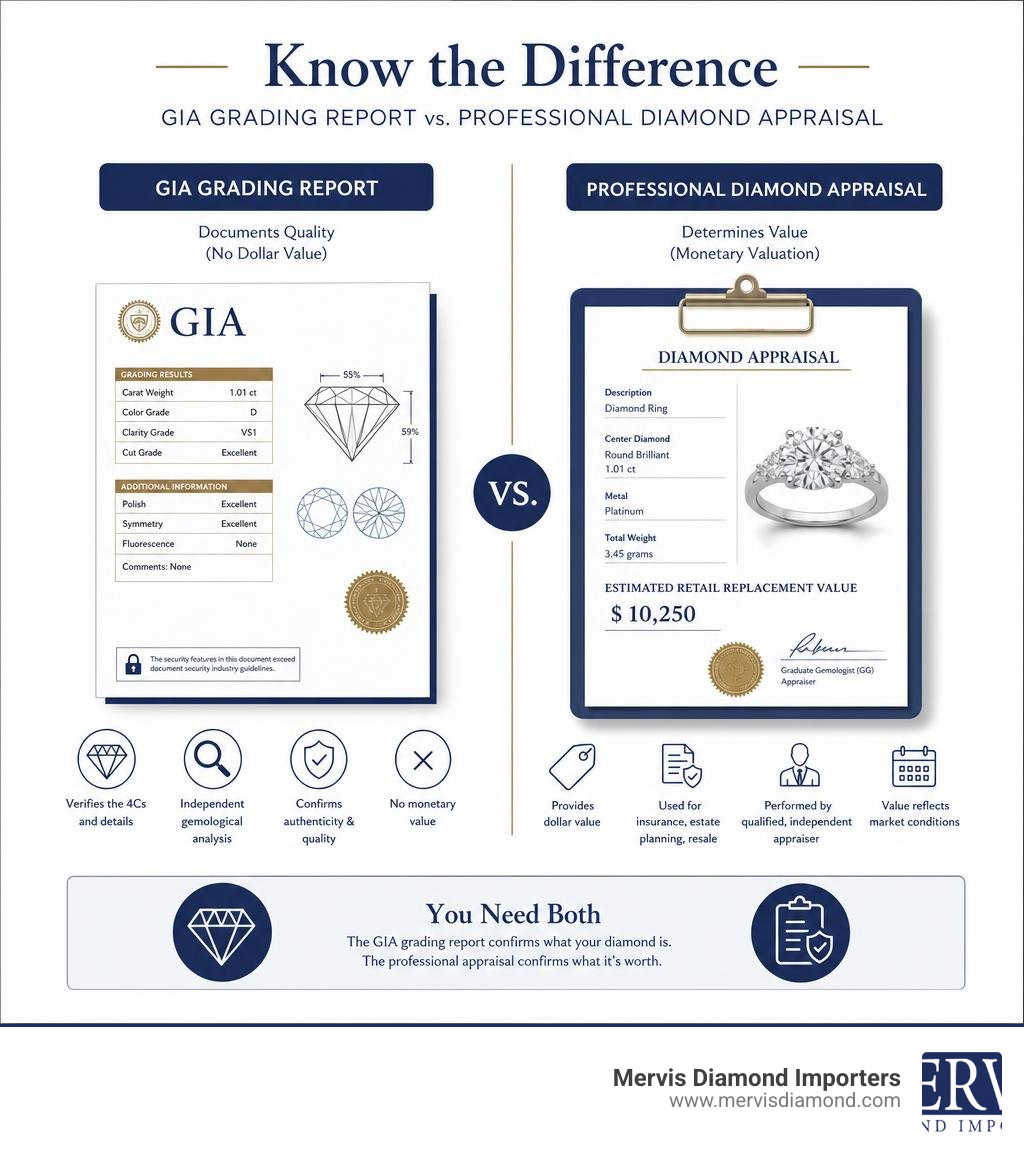
- A GIA grading report is not an appraisal. It documents a diamond's quality (the 4Cs) but assigns no dollar value.
- GIA does not perform appraisals. They only issue grading reports.
- A GIA certified diamond appraisal refers to a monetary valuation performed by an independent appraiser — ideally one who holds a GIA Graduate Gemologist (GG) diploma plus formal appraisal training.
- You need both: a GIA report to verify quality, and a professional appraisal to establish value for insurance, estate planning, or resale.
Here's why this matters to you directly.
Imagine paying a premium for a diamond you believe is a VS1, D-color stone — only to find out later the quality was never independently verified. Or imagine your diamond ring is lost or stolen, and your insurance company can't confirm what they're replacing. Without documented quality and a current monetary valuation, you're left guessing.
A GIA grading report eliminates the quality guesswork. A professional appraisal built on that report protects your financial interest. Together, they give you the full picture.
Understanding the GIA Certified Diamond Appraisal
When people search for a "GIA certified diamond appraisal," they are usually trying to solve one of two problems: they want to verify that the diamond they bought is real and of high quality, or they need an official document stating what the jewelry is worth in dollars.
To navigate this process smoothly, you must understand how these two documents work together.
Before you hand over your hard-earned savings, it is essential to equip yourself with the right knowledge. If you are preparing to propose or buy a significant piece of jewelry, reading up on the Four Things You Need to Know Before Buying a Diamond will save you from common pitfalls and ensure you make a confident decision.
GIA Grading Report vs. GIA Certified Diamond Appraisal
The Gemological Institute of America (GIA)—established in 1931 as a nonprofit research and educational institute—is the world’s foremost authority on gemology. In 1953, GIA issued its very first diamond grading report, setting the global standard for how diamonds are evaluated.
However, GIA has a strict policy: they do not appraise diamonds.
- The GIA Grading Report: This is a scientific, unbiased quality assessment. It acts like a diamond's passport, detailing its physical dimensions, weight, and quality characteristics. Because market values fluctuate constantly, GIA does not include any monetary value on its reports. To learn more about this scientific evaluation, you can explore the official breakdown of GIA Diamond Grading | GIA 4Cs.
- The GIA Certified Diamond Appraisal: This is a legal document prepared by an independent jewelry appraiser. The appraiser takes the scientific data from the GIA report, examines the complete piece of jewelry (including the metal setting and craftsmanship), and assigns a current monetary value based on active market conditions.
In short, GIA tells you what you have; the appraiser tells you what it is worth today in July 2026.
What a GIA Grading Report Includes
A GIA grading report provides the foundation for any accurate appraisal. If an appraiser attempts to value a diamond without an independent laboratory report, they are essentially guessing the internal grades.
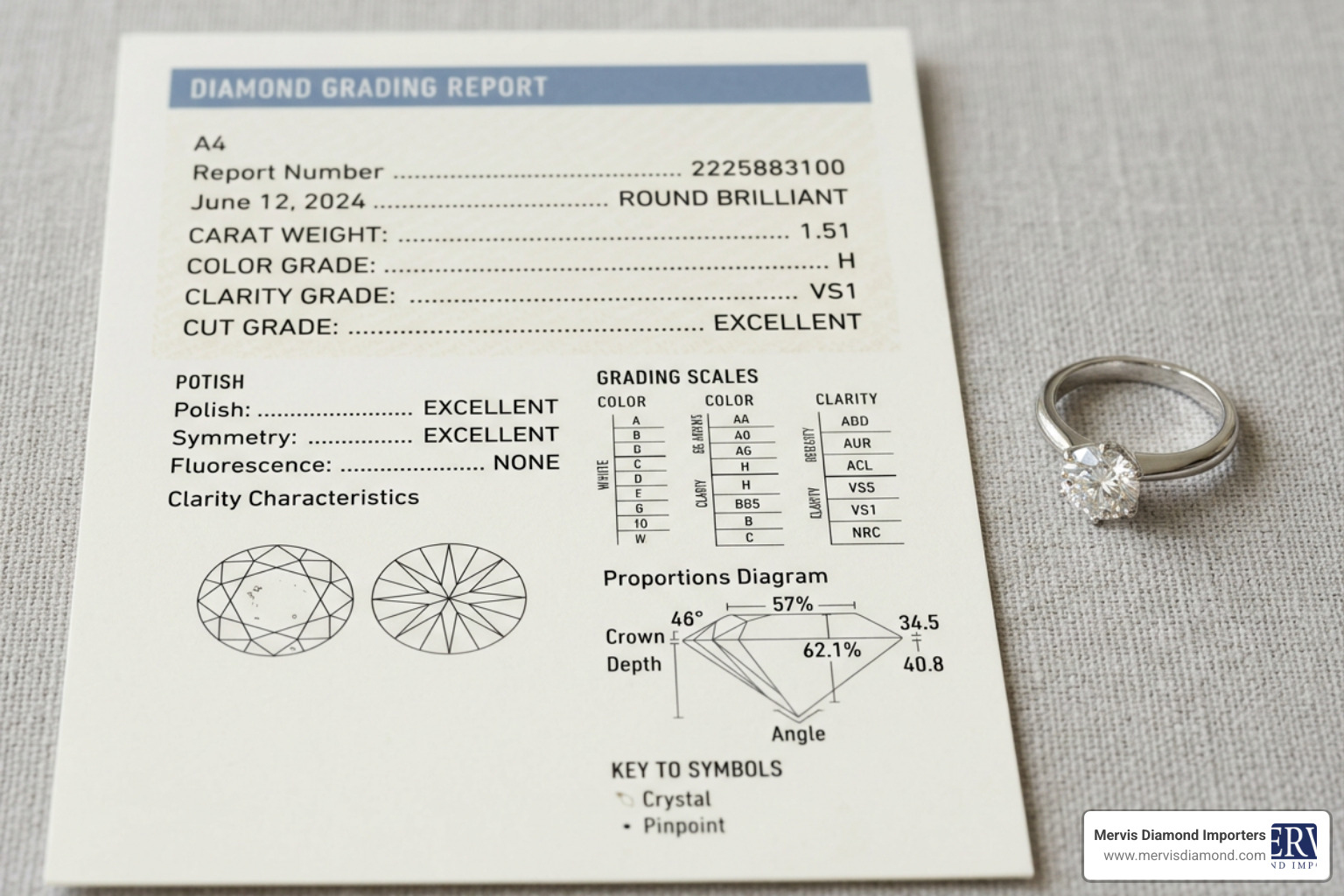
A standard GIA grading report includes:
- The 4Cs Assessment: An authoritative evaluation of the diamond's Color, Clarity, Cut, and Carat Weight. Understanding these factors is key to knowing why two diamonds of the same size can have vastly different price tags. You can dive deeper into these metrics in our guide on Understanding the Four Cs.
- Proportions Diagram: A graphic showing the diamond’s actual measurements, table percentage, depth percentage, and crown angles.
- Clarity Plot: A visual map of the diamond's unique internal characteristics (inclusions) and external features (blemishes). This acts like a fingerprint—no two plots are exactly alike. For a visual representation of how these clarity grades affect the stone, refer to our Diamond Clarity Chart Best to Worst.
- Security Features: Microprint lines, security screens, and a hologram that exceed document security industry standards to prevent tampering.
The Appraisal Process and Appraiser Credentials
Because a jewelry appraisal is a legal document often used for insurance policies or estate division, the credentials of the person writing it are incredibly important. You wouldn't hire a house painter to inspect your home's foundation; similarly, you shouldn't hire a general jeweler without specialized training to value your diamond.

Before seeking an appraisal, you might want to perform a few quick checks at home to verify your jewelry’s basic characteristics. Learn more about simple verification techniques in our article on How to Tell if a Diamond Ring is Real.
Who is Qualified to Perform a GIA Certified Diamond Appraisal?
A qualified jewelry appraiser must possess two distinct skill sets: advanced gemological training and formal appraisal training.
- GIA Graduate Gemologist (GG) Diploma: This is the prestigious credential awarded by GIA. A Graduate Gemologist has undergone rigorous hands-on laboratory training to identify and grade diamonds and colored gemstones.
-
Appraisal Association Credentials: Gemological training teaches you how to identify a stone, but it doesn't teach you how to calculate market value, write legal documents, or understand tax law. For that, an appraiser must belong to a respected professional organization, such as:
- The National Association of Jewelry Appraisers (NAJA): Serving the industry since 1981, NAJA is the only appraisal association in the United States devoted solely to fine gems, jewelry, and timepieces.
- The American Society of Appraisers (ASA)
- The International Society of Appraisers (ISA)
If you are located in the Washington DC metro area, finding a local, highly qualified expert is key. For those looking for reliable services in Maryland and Northern Virginia, you can find trusted guidance through resources like Jewelry Appraiser Rockville Maryland and Northern VA.
Types of Jewelry Appraisals
Not all appraisals are written for the same purpose. The value assigned to your diamond ring will vary depending on the type of appraisal requested:
- Insurance Appraisal (Retail Replacement Value): This is the most common type of appraisal. It calculates what it would cost to replace the item with a brand-new equivalent at a retail jewelry store in the event of loss, theft, or damage. This value is typically higher than resale value because it accounts for retail markups, labor, and inflation. If you've recently purchased or received an engagement ring, you should read our guide on Should I Have Engagement Ring Insured.
- Estate Appraisal (Fair Market Value): Required for estate tax purposes, inheritance division, or probate. Fair Market Value (FMV) is defined as the price a willing buyer and a willing seller would agree upon in an open, non-forced market. This represents the item's value in its current, used condition.
- Liquidation Value: This is a "forced sale" value, representing what you could expect to receive if you needed to sell the jewelry immediately (such as to a pawn shop or wholesale buyer) within a very short timeframe.
Cost, Frequency, and Verification of Diamond Valuations
The jewelry market is dynamic. Precious metal prices fluctuate daily, and diamond values shift based on global supply and demand. Consequently, an appraisal is not a "once-and-for-all" document.
Many people wonder if their jewelry will hold its purchase price over time. To understand the financial realities of diamond ownership, read our detailed analysis on Do Diamond Rings Hold Value.
Comparing Costs: GIA Reports vs. Appraisals
Obtaining a GIA grading report and getting a professional appraisal are two separate services with distinct pricing structures.
GIA charges a flat fee based on the carat weight of the loose diamond. For example, a basic GIA Diamond Dossier for a small diamond (0.15 to 0.22 carats) starts around $48, while a full Diamond Grading Report for a standard 1.00-carat diamond costs approximately $113.
Independent appraisers, on the other hand, typically charge a flat fee per item or an hourly rate. Never hire an appraiser who charges a percentage of the jewelry’s appraised value. This is a major conflict of interest, as it incentivizes them to inflate the value of your item to earn a higher fee.
| Service Type | Provider | Estimated Cost | What You Receive |
|---|---|---|---|
| GIA Diamond Dossier (0.15 - 0.22 ct) | GIA Laboratory | ~$48 | 4Cs quality grading, proportions, laser inscription (loose stones only) |
| GIA Diamond Grading Report (1.00 - 1.19 ct) | GIA Laboratory | ~$113 | Full 4Cs grading, clarity plot diagram, proportions (loose stones only) |
| Professional Appraisal (Per Item) | Independent Appraiser | $100 - $150+ | Detailed jewelry description, metal verification, current monetary valuation |
How Often to Update Your Appraisal
Most professional appraisers and insurance companies suggest updating your jewelry appraisals every two to three years.
If your appraisal is ten years old, your insurance coverage is likely outdated. If the market value of diamonds and gold has risen, your current policy might not pay out enough to cover a replacement of identical quality. Conversely, if market values have dropped, you could be paying unnecessarily high insurance premiums.
For those considering selling their jewelry or wanting to know what their piece might fetch on the open market, check out our insights on How Much Can You Resell a Diamond Ring For.
Verifying GIA Report Authenticity
Because GIA reports are highly valued, counterfeit reports do exist. Fortunately, GIA makes it incredibly easy to verify the authenticity of any report:
- GIA Report Check: You can input the unique GIA report number and carat weight directly into the secure database at GIA.edu to view a digital copy of the original grading results.
- Inspect the Paperwork: Genuine GIA reports feature advanced security elements. Look for the microprint lines, a security screen, and a reflective hologram. You can view an example of an official document format by looking at this sample GIA Diamond Dossier.
Frequently Asked Questions about Diamond Appraisals
Does GIA appraise diamonds directly?
No. GIA is a scientific, non-profit research institution. Their sole mission is to provide unbiased gemological grading. To maintain strict objectivity, GIA does not buy, sell, or appraise gems, nor do they ever assign a retail or wholesale monetary value to any stone.
Can you appraise a diamond set in a ring?
Yes, a professional appraiser can value a diamond that is already mounted in a setting. However, they must estimate certain characteristics (like exact carat weight and pavilion depth) because the metal prongs and bezel block parts of the stone.
For a 100% accurate GIA laboratory grading report, the diamond must be unmounted (loose). GIA only grades loose natural diamonds weighing 0.15 carats or more.
Where can I find independent appraisers?
The safest way to find a reputable appraiser is to search through professional gemological networks. You can look up credentialed professionals in your area through the National Association of Jewelry Appraisers (NAJA) or use localized directories such as Virginia Jewelry Appraisers, Gemologists & Gem Labs to find independent experts serving Tysons, Rockville, and the broader Washington DC region.
Conclusion
A diamond is more than just a beautiful, sparkling gemstone—it represents a significant financial and emotional investment. Protecting that investment requires a clear understanding of the difference between a scientific GIA grading report and a professional monetary appraisal. By securing both, you ensure peace of mind, accurate insurance coverage, and confidence in your diamond's true value.
At Mervis Diamond Importers, we specialize in offering hand-selected, exceptionally cut natural and lab-grown diamonds. Our expert team is dedicated to providing pressure-free, transparent guidance to help you find the perfect stone. If you already own a cherished diamond ring, keeping it beautiful is just as important as protecting its value. Learn how to keep your ring looking brand new with our expert advice on How to Care for a Diamond Ring.
Have questions about GIA reports, or looking to select a stunning, certified diamond for your next milestone? Visit us at one of our convenient showrooms in Tysons, VA, Rockville, MD, or Washington, DC, and let our specialists guide you every step of the way!