

Synthetic, Cultured, or Fake? Decoding Lab Diamond Terminology
Another Word for Lab Grown Diamonds: Cutting Through the Confusion
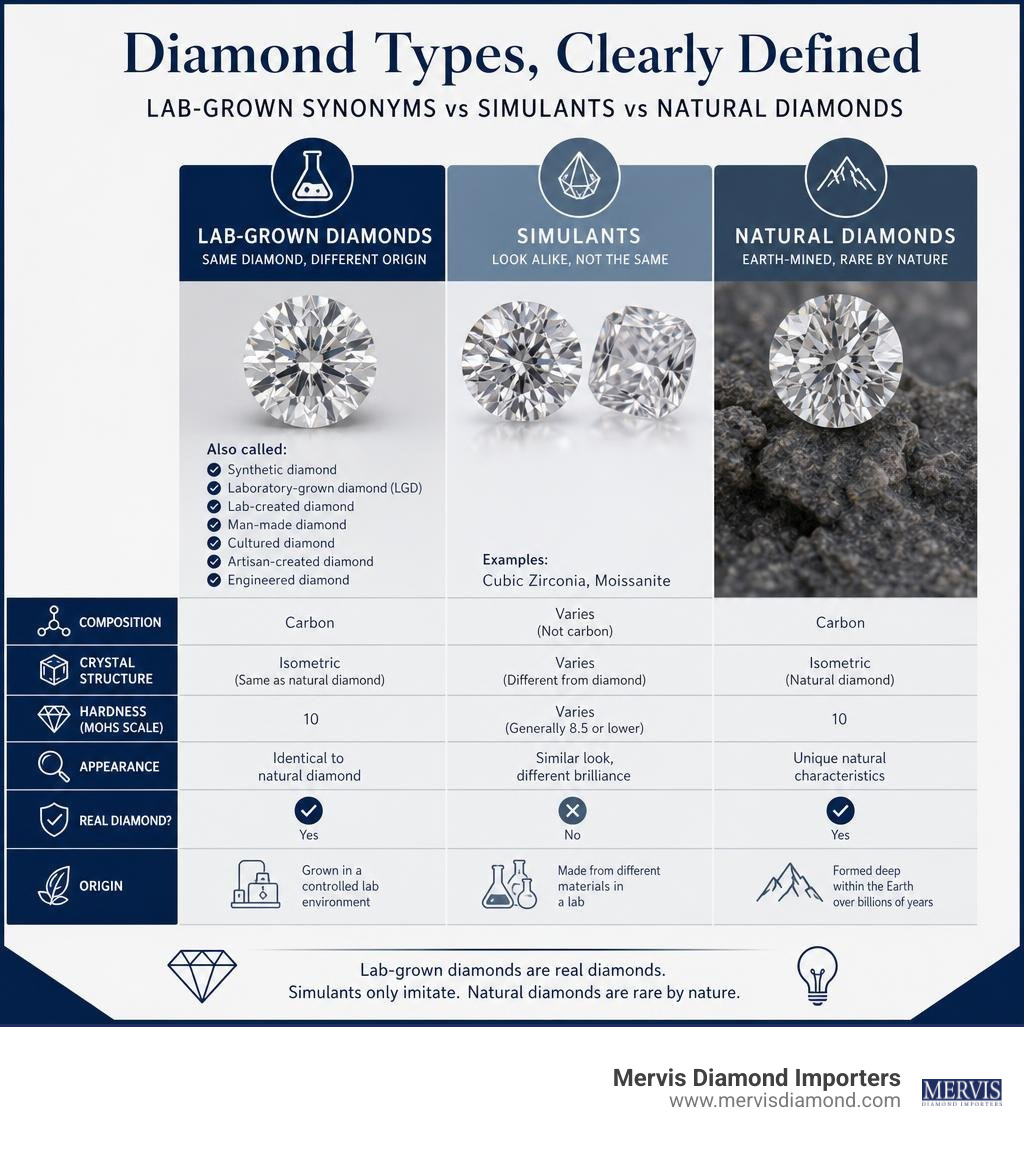
If you've ever searched for another word for lab grown diamonds, you're not alone — and the answer is that there are actually many terms used to describe the same stone. Here's a quick reference:
| Term | Used By |
|---|---|
| Synthetic diamond | Scientists, gemologists |
| Laboratory-grown diamond (LGD) | Gemological institutes, FTC |
| Lab-created diamond | Retailers, certification labs |
| Man-made diamond | Jewelry marketers |
| Cultured diamond | Luxury-focused brands |
| Artisan-created diamond | Premium retailers |
| Engineered diamond | Technical and industrial contexts |
All of these terms describe the same thing: a real diamond grown in a controlled lab environment rather than mined from the earth. They share the same chemical composition, the same crystal structure, and the same hardness (10 on the Mohs scale) as natural diamonds.
These terms are not the same as "simulant," "imitation," or "fake diamond." Those words refer to entirely different materials — like cubic zirconia or moissanite — that merely look like diamonds but aren't.
The terminology can be genuinely confusing, especially when you're shopping for something as important as an engagement ring and every retailer seems to use a different word. I'm Morris Mervis, and in this guide I'll walk you through exactly what each term means, where it comes from, and how to use that knowledge to shop with confidence.
Finding Another Word for Lab Grown Diamonds: The Industry Synonyms
When searching for the perfect center stone, you will quickly realize that the jewelry industry does not agree on a single name. The Federal Trade Commission (FTC) has stepped in to regulate this space, guiding how retailers can market these stones to prevent consumer deception. According to the FTC, if a diamond is not mined from the earth, its name must clearly disclose its laboratory origin.
The most widely accepted, legally compliant terms include "laboratory-grown," "laboratory-created," and "[manufacturer name]-created." Over the years, marketing teams have come up with elegant alternatives to make these high-tech gems sound as romantic as their natural counterparts. To see just how many terms exist in modern language, you can explore this list of LAB-CREATED DIAMOND Synonyms: 20 Similar Phrases .
Why Consumers Search for Another Word for Lab Grown Diamonds
Most consumers search for another word for lab grown diamonds because they are trying to figure out if the different terms they see online refer to the exact same physical product. If you see one jeweler offering a "man-made" diamond and another offering a "lab-created" stone, you might wonder if there is a difference in quality, durability, or beauty.
This confusion often peaks when looking at specific carat weights. For instance, a couple looking for a classic 1 Ct Man Made Diamond might see it labeled as a "cultured diamond" on one boutique's website and an "artisan-created diamond" on another. Rest assured, these are simply different names for the same physical object: a beautiful, pure carbon diamond grown by humans.
Is "Synthetic" Just Another Word for Lab Grown Diamonds?
In technical and scientific circles, the term "synthetic diamond" is the standard. However, in the retail jewelry world, we tend to avoid it. Why? Because to the general public, the word "synthetic" sounds like "fake" or "artificial"—like synthetic leather or synthetic syrup.
But in chemistry and material science, "synthetic" has a highly precise definition: it means a substance that has been synthesized by humans to replicate a natural material exactly. It refers to the origin of the stone, not its substance. As a result, a synthetic diamond is physically, chemically, and optically identical to a natural diamond. For a deeper look into why this scientific distinction matters for your fine jewelry purchase, you can read more about it here: Is Synthetic The Same As Lab Grown? Yes, And Here's Why It Matters For Your Diamond Choice. - Kintek Solution .
Marketing Terms: Cultured, Man-Made, and Artisan-Created
To bypass the negative connotations of the word "synthetic," the jewelry trade embraced terms that sound much more appealing:
- Cultured Diamonds: This term borrows from the pearl industry. Just as a cultured pearl is grown by introducing a bead into an oyster in a controlled environment, a cultured diamond is grown from a tiny diamond "seed" in a controlled laboratory chamber.
- Man-Made Diamonds: This straightforward term highlights the human ingenuity behind the stone. It appeals directly to buyers who love the intersection of advanced technology and classic romance.
- Artisan-Created / Engineered: Often used by high-end luxury brands, these terms emphasize the precision, craftsmanship, and sophisticated engineering required to grow a gem-quality crystal.
Lab-Grown Diamonds vs. Diamond Simulants: Spotting the Difference
While lab-grown diamonds go by many names, they must never be confused with diamond simulants. Simulants are materials that merely imitate the look of a diamond.
To help clarify the differences, let's look at how real diamonds (both natural and lab-grown) compare to popular alternatives:
| Property | Natural Diamond | Lab-Grown Diamond | Moissanite | Cubic Zirconia (CZ) |
|---|---|---|---|---|
| Chemical Composition | Pure Carbon (C) | Pure Carbon (C) | Silicon Carbide (SiC) | Zirconium Dioxide ($ZrO_2$) |
| Mohs Hardness | 10 | 10 | 9.25 | 8.0 to 8.5 |
| Refractive Index | 2.42 | 2.42 | 2.65 to 2.69 | 2.15 |
| Dispersion (Fire) | 0.044 | 0.044 | 0.104 | 0.058 |
| Thermal Conductivity | Extremely High | Extremely High | High | Low |
For those looking to explore non-diamond choices, you can read a detailed breakdown of What Alternatives To Lab-Grown Diamonds? Compare Natural Diamonds, Moissanite & More - Kintek Solution .
Why Diamond Simulants Are Not Real Diamonds
The key difference lies in the atomic structure. A lab-grown diamond is a real diamond because it consists of carbon atoms arranged in an isotropic 3D crystal lattice.
Simulants, on the other hand, are made of entirely different chemical compounds. Cubic Zirconia is a synthetic zirconium oxide that is cheap to produce but lacks durability. It scores an 8 to 8.5 on the Mohs scale, meaning it will scratch, chip, and turn cloudy or "milky" within a year or two of daily wear.
Moissanite is silicon carbide. While it is highly durable (9.25 on the Mohs scale), its optical properties are vastly different from a diamond. It has a much higher refractive index, which produces an intense, rainbow-colored "fire" that some describe as a flashy "disco-ball effect."
How to Distinguish Real Diamonds from Imitations
Because they look so similar to the untrained eye, telling them apart requires specialized testing:
- Thermal Conductivity: Real diamonds (both natural and lab-grown) are incredible heat conductors. In fact, isotopically pure diamonds can conduct heat up to 7.5 times better than copper! A simple handheld thermal probe will instantly separate a real diamond from Cubic Zirconia.
- Refraction: Moissanite is doubly refractive, meaning light splits into two rays as it passes through the gem. Under a jeweler’s loupe, this creates a distinct doubling of the stone's facet junctions, whereas diamonds are singly refractive.
- UV Light and Spectroscopy: To tell a lab-grown diamond apart from a natural one, gemologists use advanced UV fluorescence imaging and spectrometers.
For a complete look at the science of identifying these gems, check out this guide on How to Make Fake Diamonds: Lab-Grown vs. Simulants - ScienceInsights . If you are shopping on a budget and want to see how these options fit into your ring search, our Best Cheap Man Made Diamond Engagement Rings Guide is an excellent resource.
The History and Science of Diamond Synthesis
Humans have tried to replicate the earth's diamond-growing process for centuries. In the late 19th and early 20th centuries, scientists like Henri Moissan and Sir Charles Algernon Parsons spent decades trying to synthesize diamonds using extreme heat and electric arc furnaces, but they ultimately failed to produce reproducible results.
The real breakthrough came down to understanding carbon crystallization. Under extreme geological pressure and heat, carbon atoms form incredibly strong covalent bonds in all directions, creating an isotropic 3D structure. To mimic this, scientists had to build machines capable of generating tens of thousands of atmospheres of pressure.
From Tracy Hall to Modern HPHT and CVD Methods
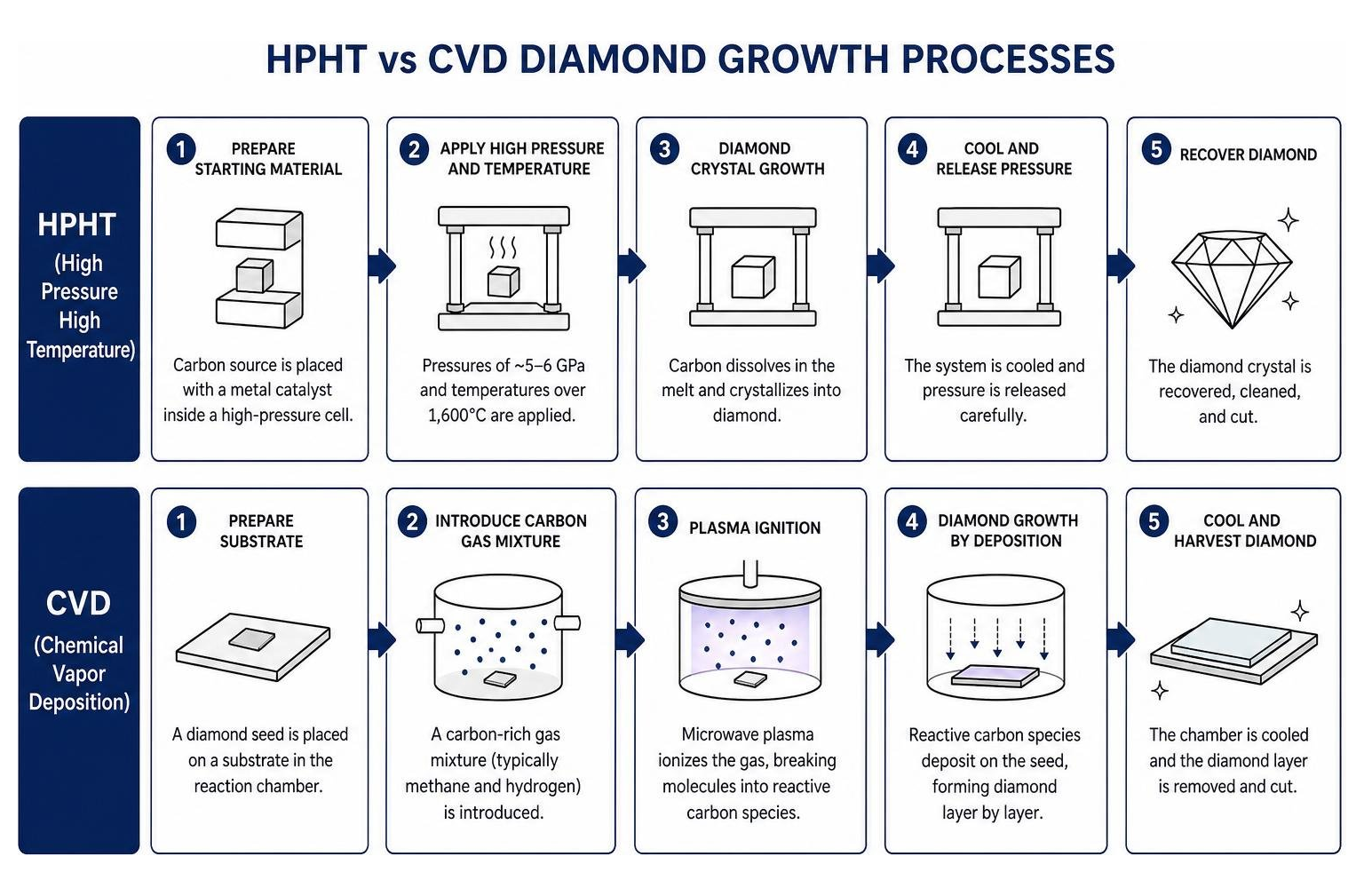
In December 1954, physicist H. Tracy Hall and his team at General Electric successfully created the first reproducible synthetic diamond using a custom-built "belt" press. This press generated pressures of 5.0 to 5.5 gigapascals and temperatures exceeding 1,600°C, mimicking the conditions deep within the Earth. This became known as the High Pressure High Temperature (HPHT) method.
Today, we also use a second, highly sophisticated method: Chemical Vapor Deposition (CVD). Instead of using raw pressure, a CVD reactor uses a vacuum chamber filled with a carbon-rich gas mixture (typically a 1:99 methane-to-hydrogen ratio). A microwave plasma generator ionizes the gas, causing carbon atoms to rain down and deposit onto a tiny diamond seed layer by layer.
Energy Consumption and Environmental Trade-offs
Growing diamonds requires an immense amount of energy, and the two methods have very different power profiles:
- HPHT Production: This method is relatively energy-efficient for diamond growth, consuming around 28 to 36 kilowatt-hours (kWh) of energy per carat.
- CVD Production: Because CVD reactors must maintain a stable plasma state over days or weeks, they are more power-hungry, requiring 77 to 215 kWh of energy per carat depending on the equipment used.
When evaluating the environmental impact, we always encourage buyers to ask where the laboratory's power comes from. A lab powered by clean, renewable energy (like solar or hydroelectric power) has a dramatically lower carbon footprint than one tied to a traditional coal-fired grid.
Market Trends: Pricing, Certification, and Value in 2026
The market for lab-grown diamonds has evolved rapidly. In 2013, synthetic diamonds made up a mere 2% of the gem-quality diamond market. By 2023, that number had surged to 17%. As we move through July 2026, lab-grown diamonds have officially become a mainstream staple for engagement jewelry.
Price Drops and Market Share Shifts
As manufacturing technologies have scaled, the cost of producing these stones has plummeted. By the beginning of 2025, laboratory-grown diamonds had dropped in price by a staggering 74% since 2020. Today, in 2026, lab-grown diamonds cost 80 to 85 percent less than natural diamonds of the same grade.
To put this in perspective:
- A classic 2 Carat Man Made Diamond Complete Guide shows how buyers can now secure a stunning, eye-clean 2-carat ring for a fraction of what a 1-carat natural diamond cost just a few years ago.
- If you are looking for even more presence, options like a 3 Carat Man Made Diamond Ring Guide or an Ultimate 4 Carat Man Made Diamond Guide illustrate how accessible ultra-premium carat weights have become.
For a complete overview of what to expect to pay, visit our guide on the Average Cost of Lab Grown Diamonds.
The Role of Grading Laboratories
Just like natural diamonds, high-quality lab-grown diamonds receive official grading certificates from leading gemological organizations like the Gemological Institute of America (GIA) and the International Gemological Institute (IGI).
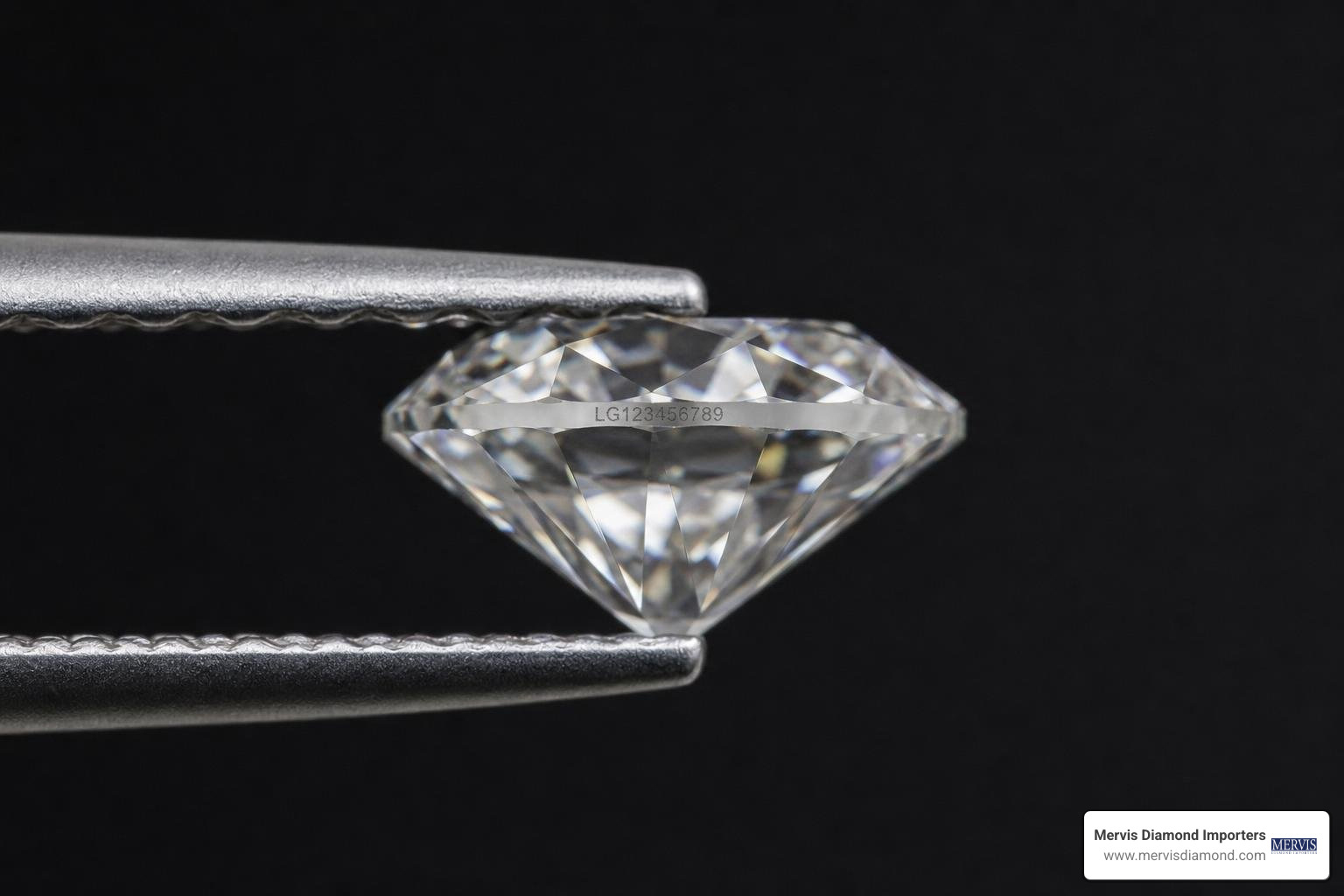
These reports grade the stone on the traditional 4Cs: Cut, Color, Clarity, and Carat Weight. To ensure transparency, grading labs laser-inscribe a microscopic serial number on the diamond's girdle, alongside the words "LAB GROWN" or "LABORATORY CREATED." This ensures that no one can ever pass a lab stone off as a mined stone, or vice-versa. Additionally, most CVD-grown diamonds are classified as Type IIa—the chemically purest type of diamond, which accounts for only 2% of all natural diamonds mined.
Frequently Asked Questions about Diamond Terminology
Are synthetic diamonds real diamonds?
Yes. Physically, chemically, and optically, synthetic (lab-grown) diamonds are 100% real diamonds. They consist of pure carbon crystallized in an isotropic 3D structure, scoring a perfect 10 on the Mohs hardness scale. They are not fake; they simply have a different place of origin than mined diamonds.
What is the difference between a lab-grown diamond and a diamond simulant?
A lab-grown diamond is made of pure carbon and shares the exact same properties as a natural diamond. A diamond simulant (like Cubic Zirconia or Moissanite) is made of non-carbon materials. Simulants do not have the same hardness, brilliance, or longevity, and they are prone to scratching and clouding over time.
Do lab-grown diamonds have resale value?
Because lab-grown diamonds can be manufactured in unlimited quantities, they do not carry the same rarity value as natural diamonds. Consequently, their secondary market resale value is very low. If long-term financial asset retention is your primary goal, a natural mined diamond remains the traditional choice.
Conclusion
Whether you prefer the term "lab-grown," "man-made," "cultured," or "synthetic," the beauty of these modern marvels is undeniable. They offer a brilliant, durable, and budget-friendly way to celebrate your love story.
At Mervis Diamond Importers, we specialize in helping you find the perfect stone. Our unique selling proposition is simple: we offer hand-selected, exceptionally high-quality natural and lab-grown diamonds, paired with expert, pressure-free service. Our experienced consultants will guide you through the pros and cons of each option, helping you make an informed decision that fits your personal values and budget.
If you are located in the Virginia, Maryland, or Washington DC metro areas, we invite you to visit us at one of our convenient locations in Tysons, VA, Rockville, MD, or Washington, DC. Ready to see the difference in person? Explore our curated selection of trending lab-grown diamonds in the Washington DC area and schedule your personalized consultation with us today!