

From Edwardian to Retro: A Collector's Guide to Older Style Wedding Rings
What Defines Authentic Older Style Wedding Rings?
When we talk about authentic older style wedding rings, we are describing jewelry born from individual bench jewelers rather than modern computerized casting machines. Before the advent of modern mass production, master goldsmiths shaped every curve, bezel, and detail by hand. This human touch gives antique and vintage wedding bands a distinctive presence that modern rings often try to replicate.
Several signature manufacturing techniques define these historic pieces:
- Hand Fabrication and Die-Striking: Rather than using lost-wax casting, jewelers often hand-forged metals or used heavy steel dies to strike patterns under intense pressure. Die-struck rings boast dense, durable metal with crisp edges that hold up remarkably well across decades.
- Hand-Applied Milgrain: Derived from the French mille-grains (a thousand grains), milgrain consists of tiny, beaded metal borders that frame stones and band edges. Unlike modern cast milgrain, which can appear soft or uneven, historic milgrain was rolled on with specialized knurling tools, yielding razor-sharp, light-catching texture.
- Intricate Filigree Work: Filigree involves bending, twisting, and soldering delicate threads of precious metal—typically platinum or gold—into lace-like openwork. This technique reached its peak when torch technology evolved to handle platinum's high melting point.
- Natural Patina and Hand Engraving: Decades of gentle contact with skin and fabrics impart a soft, glowing luster to the metal that cannot be faked. Vintage hand-engraved motifs—ranging from wheat sheaves (symbolizing prosperity) to orange blossoms (symbolizing fertility)—display subtle, artistic variations from the engraver's chisel.
If you appreciate these classical details but want the peace of mind that comes with brand-new structural integrity, modern craftsmanship can incorporate these heritage elements beautifully. For instance, a classic low dome comfort fit wedding band with delicate milgrain detailing combines time-tested beaded edges with an ergonomic, modern profile built for daily wear.
| Design Category | Age / Era | Typical Craftsmanship | Key Structural Attributes |
|---|---|---|---|
| Antique | 100+ years old (Victorian, Edwardian, early Art Deco) | Hand-forged, die-struck, pierced filigree | Old Mine or Old European cuts, unrefined platinum, soft natural patina |
| Vintage | 20 to 99 years old (Mid-Century, Retro, late Deco) | Early casting, die-striking, machine-assisted engraving | Transitional cuts, round brilliants, yellow/rose gold, palladium |
| Vintage-Inspired | Contemporary (Present day) | Precision CAD modeling, laser assembly, modern comfort-fit | Modern brilliant cuts, conflict-free stones, reinforced prongs for longevity |
Exploring Iconic Eras in Vintage Wedding Jewelry
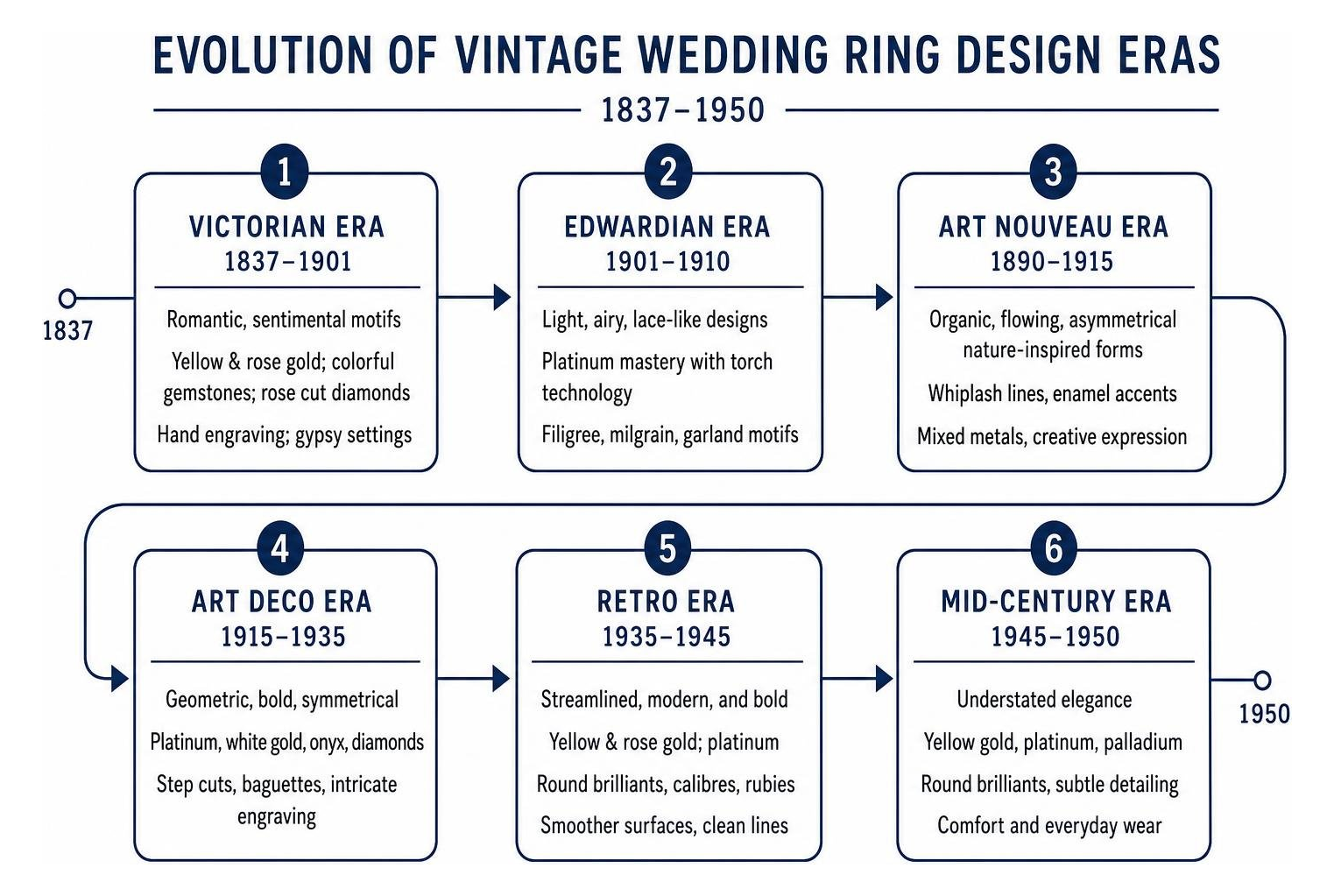
The journey of vintage wedding jewelry mirrors the cultural, industrial, and artistic shifts of the late 19th and 20th centuries. Each design era arrived with its own distinct personality, palette, and worldview.
Victorian and Edwardian Elegance in Older Style Wedding Rings
The Victorian Era (1837–1901) was deeply sentimental, heavily influenced by Queen Victoria's life and tastes. Early Victorian rings featured romantic, nature-inspired motifs: serpents (representing eternal love), hearts, flowers, and celestial stars. Jewelers favored warm yellow gold and rose gold, often accenting bands with colorful gemstones like rubies, sapphires, and pearls alongside rose cut diamonds. As the Industrial Revolution progressed, the Grand and Late Victorian periods introduced more substantial gold bands with dramatic hand engraving and gypsy-set gems.
The Edwardian Era (1901–1910) ushered in light, airy, and aristocratic aesthetics under King Edward VII. The major breakthrough of this period was the mastery of the oxyacetylene torch, which allowed jewelers to work with pure platinum for the first time. Edwardian artisans created rings that resembled fine lace, silk ribbons, and garlands (guirlandes).
These bands embraced openwork filigree, scalloped borders, and delicate diamond accents. If you adore this botanical, feminine quality, designs like a floral curved wedding band with milgrain marquise diamond petals capture the flowing, organic lines that Edwardian royalty cherished.
Art Deco and Retro Flair in Older Style Wedding Rings
The Art Deco Era (1915–1935) was a deliberate departure from the soft curves of the past. Influenced by modern architecture, Cubism, and the machine age, Art Deco rings celebrate symmetry, geometry, and bold contrast. Jewelers set white diamonds into platinum, framing them with calibrated step-cut colored gemstones or black onyx. Clean, stepped bezels and architectural lines replaced floral openwork.
Settings from this period focused on sleek framing. For a Deco-inspired aesthetic with balanced geometry, a platinum vintage cushion cut diamond bezel set band provides clean lines and substantial protection. Similarly, a platinum vintage cushion cut diamond east west bar set band highlights horizontal, linear symmetry that feels right at home in a 1920s jazz lounge.
The Retro Era (1935–1950) arrived amid the economic pressures of the Great Depression and World War II. Platinum was declared a strategic wartime metal, leading jewelers to return enthusiastically to gold—particularly warm rose and rich yellow alloys. Retro wedding bands are bold, sculptural, and expressive. They feature ribbons, scrollwork, woven mesh patterns, and substantial metal presence, often balancing glamour with a touch of Hollywood modernism.
Historic Gemstone Cuts and Precious Metals
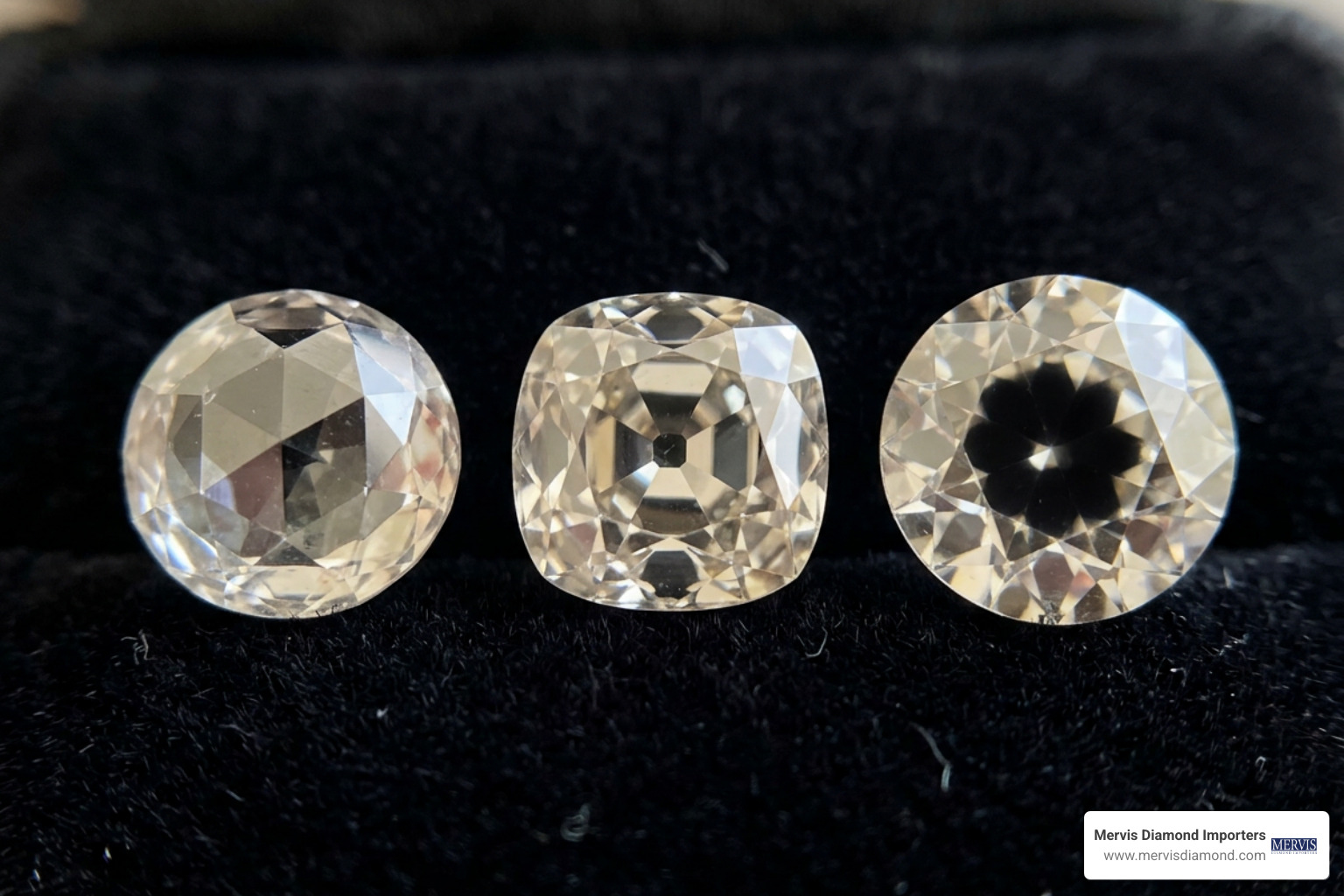
The brilliance of an older style ring comes down to its diamond cuts. Before modern computer-guided lasers calculated proportions for maximum white sparkle ("brilliance"), diamond cutters cleaved and polished gems entirely by hand under candlelight. As detailed in GIA research on historic diamond cuts, their goal was to maximize carat weight retention and produce broad, fiery flashes of colorful light ("fire").
- Rose Cut (1500s–1800s): Characterized by a flat base and a domed top covered in triangular facets (resembling an unfolding rosebud). If you are understanding what is a rose cut diamond, you will notice it emits a subtle, watery glow rather than intense modern scintillation.
- Old Mine Cut (1700s–late 1800s): A predecessor to the cushion cut, featuring a squarish outline, high crown, small table, deep pavilion, and an open culet (a flat facet at the bottom point).
- Old European Cut (late 1800s–1930s): The ancestor of the modern round brilliant. It features a round perimeter, 58 hand-proportioned facets, a small table, and a visible culet that creates a distinctive floral pattern when viewed through the top.
- Transitional Cut (1930s–1940s): A bridge between Old European and modern brilliant cuts, sporting lower crowns and shorter pavilion facets as cutting tools became mechanized.
The precious metals used in older eras also have unique characteristics:
- Unrefined Platinum: Early 20th-century platinum often contained natural traces of iridium, creating a remarkably dense alloy that developed a soft gray, velvety patina over time.
- Palladium Alloys: Used extensively during the 1940s as a lightweight, white-metal substitute when platinum was reserved for military use.
- Two-Tone Gold Formulations: Blending yellow, white, and rose gold allowed jewelers to achieve warmth and contrast. This balance is well represented today in rings like a two-tone gold milgrain edge men's wedding band, which pairs traditional yellow gold warmth with crisp white metal detailing.
Authenticating, Inspecting, and Caring for Heirlooms
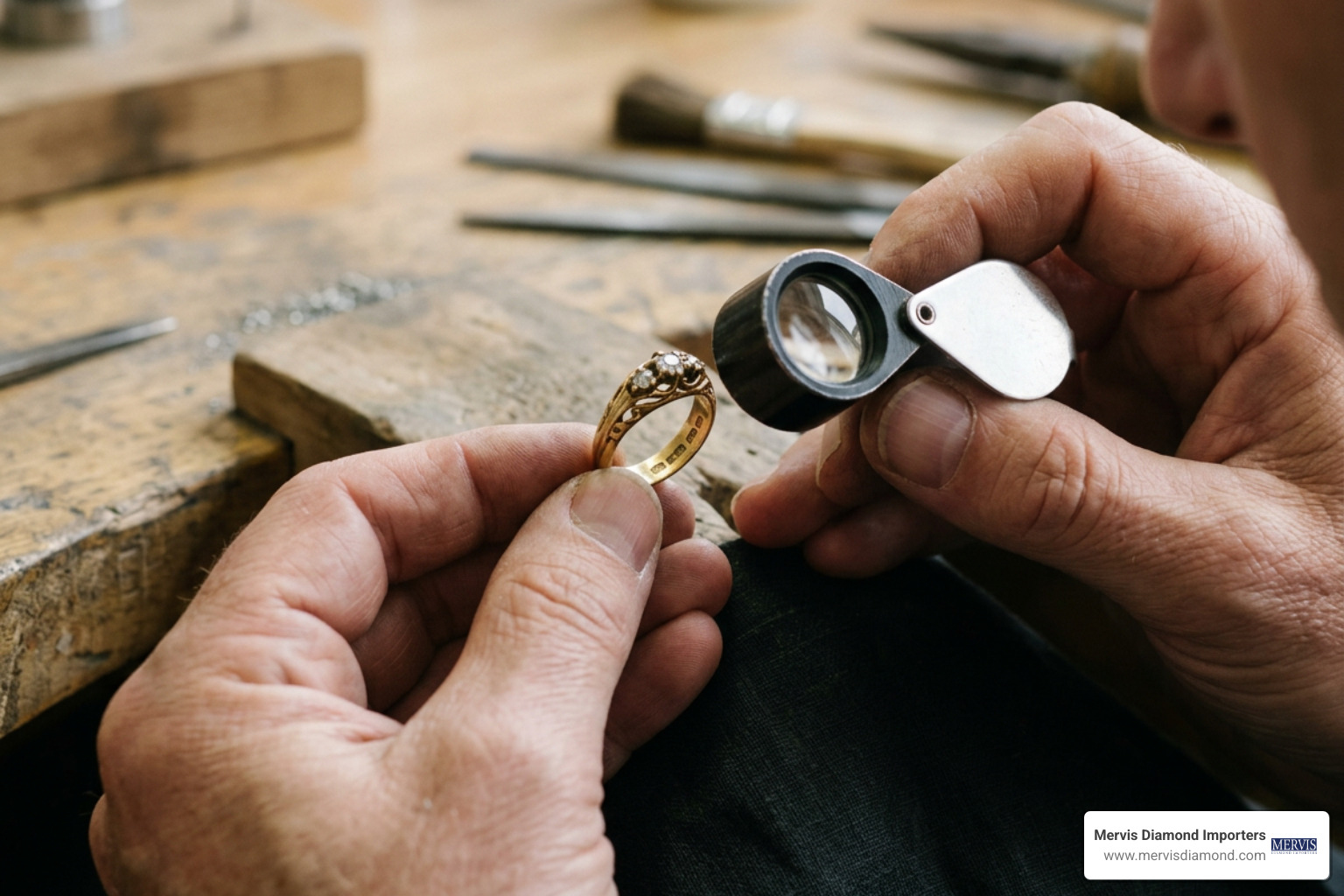
Whether you are inheriting a family heirloom or hunting through estate collections, proper evaluation protects you from buying a modern reproduction presented as an original antique.
Authentication Markers
Start by examining the inner shank with a 10x jeweler's loupe. Look for:
- Assay and Purity Marks: Stamping such as "18K," "14K," "PLAT," or national assay hallmarks (common in British and European pieces) helps establish the metal's origin and period.
- Maker's Marks: Registered initials or symbols from historic design houses provide traceable provenance.
- Consistent Wear Patterns: Authentic vintage rings show gentle, uneven wear on the bottom of the band and along high-relief engraving. Uniformly pristine engraving on an allegedly century-old ring often points to a modern replica.
Structural Inspection Checklist
Before committing to an antique band for daily wear, check these structural trouble spots:
- Prong Retipping: Antique prongs wear down over time. Worn or flattened prongs must be rebuilt (retipped) by an experienced bench jeweler to keep diamonds secure.
- Shank Thinning: Decades of wear thin the lower half of the band. If the metal has worn paper-thin, the ring may need a "half-shank" replacement to prevent bending or cracking.
- Filigree and Bezel Gaps: Look closely for cracked openwork or bezels that have lifted away from the stone edges.
Cleaning and Maintenance Rules
- Avoid Ultrasonic Cleaners for Fragile Stones: Never place antique emeralds, opals, pearls, or heavily included old-cut diamonds in an ultrasonic cleaner; the vibrations can crack delicate stones.
- Stick to Mild Soap and Warm Water: Use a soft-bristled baby toothbrush with mild dish soap and warm water for routine home cleaning.
- Annual Checkups: Have your setting inspected by a bench jeweler once a year to confirm that stones remain tight within their mountings.
Frequently Asked Questions About Vintage Wedding Rings
How do I know if an antique wedding band is authentic?
True authenticity comes down to a combination of metal hallmarks, fabrication techniques, and wear patterns. Authentic pieces show signs of hand-tooling under magnification rather than the porous, uniform surfaces typical of modern mass casting. Having an independent gemologist or experienced jeweler evaluate the piece will verify whether the metal composition, gemstone cutting style, and maker's marks align with the claimed era.
Can older wedding rings be resized safely?
Most solid gold and platinum vintage bands can be resized, but complexity varies:
- Plain or partially engraved bands are straightforward to size up or down.
- Full eternity bands (with diamonds wrapping all the way around) generally cannot be resized without altering the design.
- Elaborate filigree or continuous hand engraving may require careful laser welding and re-engraving across the sizing seam. If a ring is slightly too large, adding internal sizing beads is a safe, non-invasive way to achieve a snug fit without cutting into the original metal.
Are older style wedding rings durable enough for daily wear?
Yes, provided they are structurally sound. Platinum and gold are resilient precious metals, and diamonds register at a top-tier 10 on the Mohs hardness scale. However, delicate filigree, thin shanks, and exposed antique prongs require mindful wear. If you work extensively with your hands or lead an active lifestyle, vintage-inspired rings made with modern metal densities and protective bezel settings offer vintage aesthetics with worry-free durability.
Finding Your Perfect Heirloom
Older style wedding rings carry a romantic charm that stands apart from fleeting modern trends. Whether you fall in love with the lacy drama of the Edwardian era, the tailored geometry of Art Deco, or the bold warmth of Retro gold, these rings celebrate a rich legacy of fine jewelry artistry.
If you are exploring the right silhouette for your ceremony, browse our guide to exploring different styles of wedding bands or visit our master jewelers in Tysons, VA, Rockville, MD, or Washington, DC. We will gladly help you find or custom-craft a piece that honors the best of historic design while standing strong for a lifetime of love.