

Cushion Cut Diamonds: Depth, Tables, and How to Maximize Brilliance
The Best Cut for a Cushion Diamond: What You Need to Know Before You Buy
Finding the best cut for a cushion diamond is trickier than it sounds — and that's not your fault.
Unlike round brilliant diamonds, cushion cuts don't receive an official cut grade from GIA. That means you can't just look for "Excellent" on a grading report and move on. You have to know what to look for yourself.
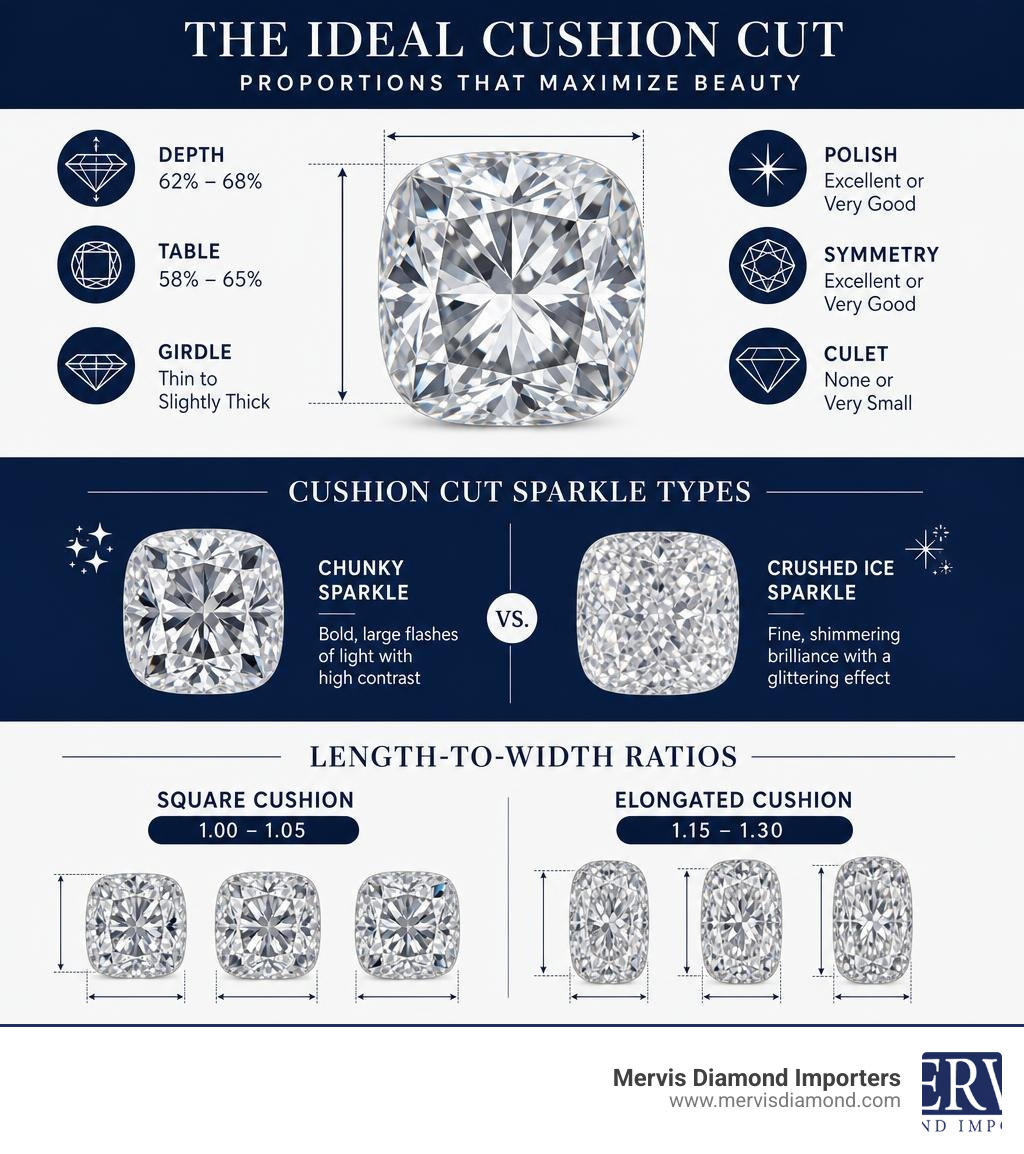
Here's a quick-reference summary of what makes a well-cut cushion diamond:
| Factor | Ideal Range |
|---|---|
| Depth % | 62% – 68% |
| Table % | 58% – 65% |
| Polish | Excellent or Very Good |
| Symmetry | Excellent or Very Good |
| Length-to-Width (square) | 1.00 – 1.05 |
| Length-to-Width (elongated) | 1.15 – 1.30 |
| Girdle | Thin to Slightly Thick |
| Culet | None or Very Small |
These numbers are your starting point — but they're not the whole story.
Cushion cuts are the third most popular shape for engagement rings, and it's easy to see why. They carry a romantic, vintage character rooted in the old mine cuts of the 1700s, while still delivering serious sparkle in modern settings. Famous examples — from the Hope Diamond to Meghan Markle's engagement ring — show how timeless this shape really is.
But cushion cuts also come in dramatically different styles. A chunky cushion throws bold, sweeping flashes of light. A crushed ice cushion looks more like shimmering, fine glitter. Both can be beautiful — but they perform very differently, and knowing which one you're buying matters.
Cushion cuts also run 25% or more less expensive than comparable round brilliants, making them a smart choice for buyers who want maximum quality without overpaying.
This guide will walk you through every factor that separates a stunning cushion cut from a dull one — so you can buy with confidence.
Why Cushion Diamonds Lack an Official GIA Cut Grade
When you shop for a classic round brilliant diamond, the Gemological Institute of America (GIA) does the heavy lifting for you. They evaluate the stone's light return, fire, and contrast, assigning a neat, standardized cut grade from "Excellent" to "Poor."
For fancy shapes—which include cushion, oval, pear, and emerald cuts—the GIA does not issue a formal cut grade.
This isn't laziness on the GIA's part. Round diamonds have a highly standardized geometry designed to maximize light return mathematically. Cushion cuts, on the other hand, are incredibly diverse. They can be square or rectangular, have steep or shallow crowns, and feature entirely different faceting arrangements. Because there is no single "perfect" blueprint, a standardized formula simply doesn't work. One person might love a vintage-style cushion with a high crown, while another prefers a modern, sleek look.
Instead of a single cut grade, GIA reports for cushion cuts only grade Polish and Symmetry. While these are important indicators of how carefully the diamond was crafted, they do not tell you if the stone actually sparkles or leaks light from its center. To understand how cut quality fits into the overall value of your diamond, it helps to start by Understanding Four Cs to see how cut interacts with color, clarity, and carat.
How to Evaluate the Best Cut for Cushion Diamond Quality Manually
Because you cannot rely on a grading report to tell you if a cushion cut is beautiful, you must evaluate the stone manually. This involves a mix of reviewing the proportion percentages on the certificate and conducting a thorough visual inspection.
When analyzing a grading report, your first line of defense is checking the depth and table percentages. However, numbers on a page only tell half the story. Two cushion cut diamonds can have identical depth and table percentages on paper yet look completely different in person. One might be bright and full of life, while the other looks dark or glassy.
To find the best cut for cushion diamond brilliance, you need to look at the stone under proper lighting. Here is a quick visual evaluation checklist:
- Look for Even Contrast: A beautiful cushion cut should have a balanced mix of bright white flashes (brilliance) and dark reflections (contrast). If a stone is completely white with no dark areas, it will lack depth and sparkle. If it is too dark, it will look dead.
- Check for Light Leakage: Hold the diamond over a dark background. If you can see right through the center of the stone like a window, it is leaking light.
- Verify the Silhouette: Ensure the corners are elegantly rounded and the sides have a gentle, appealing curve rather than looking too flat or overly bulged.
If you are researching online, we highly recommend utilizing interactive 3D video viewers. Better yet, visiting a physical showroom—whether you are looking for a trusted jewelry store near Tysons, VA or visiting our consultants in Rockville, MD or Washington, DC—allows you to see how the diamond behaves under real-world movement. For more expert advice on navigating these structural nuances, you can read our comprehensive tips for buying a cushion cut diamond.
Ideal Proportions: Depth, Table, and Symmetry Ranges
While visual beauty is paramount, staying within recommended proportion ranges dramatically increases your chances of finding a spectacular stone. The depth and table percentages dictate how light enters the diamond and whether it bounces back to your eye or escapes through the bottom.
The depth percentage is calculated by dividing the total depth of the diamond (from table to culet) by its width. If a cushion cut is too deep (over 70%), much of its carat weight will be hidden in the bottom of the stone, making it look smaller face-up than it actually is. If it is too shallow (under 60%), light will pass right through the bottom, resulting in a dull, lifeless appearance.
The table percentage measures the width of the large flat facet on the very top of the diamond relative to the stone's total width. A table that is too large prevents the diamond from showing "fire" (colorful flashes of light), while a table that is too small can restrict overall brightness.
To make your search easier, we have compiled the ultimate proportion guidelines for evaluating cushion cuts:
| Proportion Element | Ideal (Excellent) | Very Good | Poor (Avoid) |
|---|---|---|---|
| Depth % | 62% – 68% | 59% – 61.9% or 68.1% – 70% | Under 59% or Over 70% |
| Table % | 58% – 65% | 56% – 57.9% or 65.1% – 69% | Under 56% or Over 70% |
| Polish / Symmetry | Excellent | Very Good | Good, Fair, or Poor |
| Girdle Thickness | Thin to Slightly Thick | Very Thin to Thick | Extremely Thin or Extremely Thick |
| Culet Size | None to Very Small | Small | Medium to Large |
Finding the Best Cut for Cushion Diamond Brilliance
Achieving maximum brilliance and fire is a delicate balancing act. Fire refers to the rainbow-colored flashes of light produced when a diamond acts like a prism, while brilliance refers to the white light reflections. Cushion cut diamonds are celebrated for having the highest dispersion—or fire—of any diamond shape.
To unleash this fire, the diamond needs a slightly higher crown angle and a smaller table facet. If the table is too flat and wide, the light doesn't bend enough to create those beautiful rainbow flashes. This is why understanding that Diamond Cut is the Most C is so critical; a superior cut is what transforms a rough piece of carbon into a breathtaking, light-dispersing masterpiece.
When you evaluate a stone, look for a balanced distribution of light across the entire face of the diamond. The center should be just as lively as the edges, with no dead zones or dark patches.
The Battle of Sparkle: Chunky vs. Crushed Ice Facet Patterns
One of the most exciting—and sometimes confusing—aspects of shopping for a cushion cut is choosing between the two primary faceting styles: "Chunky" (traditional) and "Crushed Ice" (modified). These styles create two completely different visual personalities.
The Chunky Cushion (often classified on certificates as a standard "Cushion Brilliant") features large, distinct facets that mimic the historic Old Mine Cuts. Because the facets are larger, they reflect light in broad, intense flashes. If you love a romantic, vintage look with slow, dramatic bursts of colorful fire, the chunky cushion is your match.
The Crushed Ice Cushion (typically classified as a "Cushion Modified Brilliant") features an extra row of small facets on the pavilion (the lower half of the stone). These tiny, needle-like facets break up the light into microscopic reflections, creating a look reminiscent of shimmering glitter or clubbed ice. This style is highly popular in modern jewelry designs, offering a uniform, energetic sparkle.
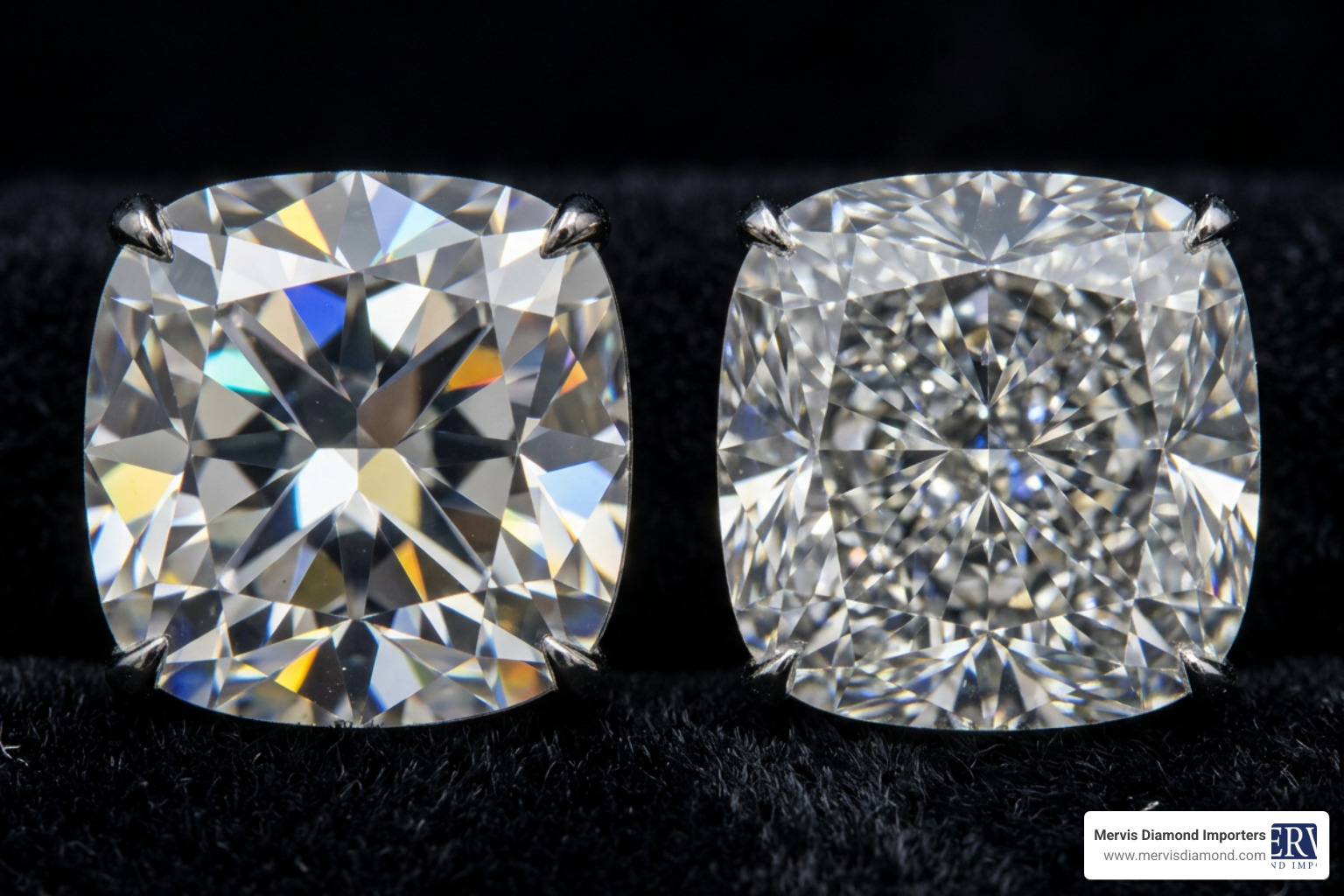
Neither style is objectively "better" than the other; it is entirely a matter of personal taste. However, you should know what you are buying. To see how these patterns stack up against other shapes in terms of pure light performance, check out our guide on Which Diamond Cut Sparkles the Most.
Finding the Best Cut for Cushion Diamond Silhouettes: Length-to-Width Ratios
The length-to-width (L/W) ratio determines the physical silhouette of your cushion cut diamond. By dividing the length of the diamond by its width, you can find out exactly how square or rectangular the stone will look on your finger.
- Classic Square (1.00 to 1.05): This is the traditional pillow shape. It offers a perfectly balanced, symmetrical look that sits beautifully in classic solitaire and halo settings.
- The "Awkward Zone" (1.06 to 1.10): We generally recommend avoiding this range. These diamonds are not quite square, but not elongated enough to look intentionally rectangular. They often end up looking like a square diamond that was poorly cut.
- Elongated Cushion (1.15 to 1.30): This rectangular silhouette has soared in popularity. It offers a flattering, finger-lengthening effect similar to an oval cut but with the soft, rounded corners of a cushion.
Your choice of ratio will influence how large the diamond appears. Elongated cushions distribute their carat weight across a longer surface area, often giving them a larger face-up appearance than square cushions of the exact same carat weight. To explore how these different silhouettes look in elegant, handcrafted settings, browse our curated collection of cushion cut engagement rings.
Red Flags: Visual Signs of a Poorly Cut Cushion Diamond
Because there is no GIA cut grade to protect you, you must be vigilant against the common visual defects that plague poorly cut cushion diamonds.
- Windowing: This occurs when a diamond is cut too shallow. If you look down through the top of the stone and can clearly see your finger or the metal setting underneath, the diamond has a "window." This means light is escaping straight through the bottom instead of bouncing back to your eyes, leaving a dead, transparent zone in the center.
- Fisheyes: If a diamond's pavilion is cut too shallow and combined with a specific girdle angle, a gray, dull ring will reflect inside the stone. This ring is actually a reflection of the diamond's own girdle, and it severely detracts from the stone's beauty.
- The Bow-Tie Effect: While more common in pear and oval cuts, elongated cushions with ratios above 1.20 can display a dark, bow-tie-shaped shadow across the center. A faint bow-tie is normal, but a heavy, dark shadow that ruins the sparkle is a major red flag.
- Light Leakage: Poorly placed facets can cause light to leak out of the sides or corners of the diamond, leaving those areas looking dark and lifeless.
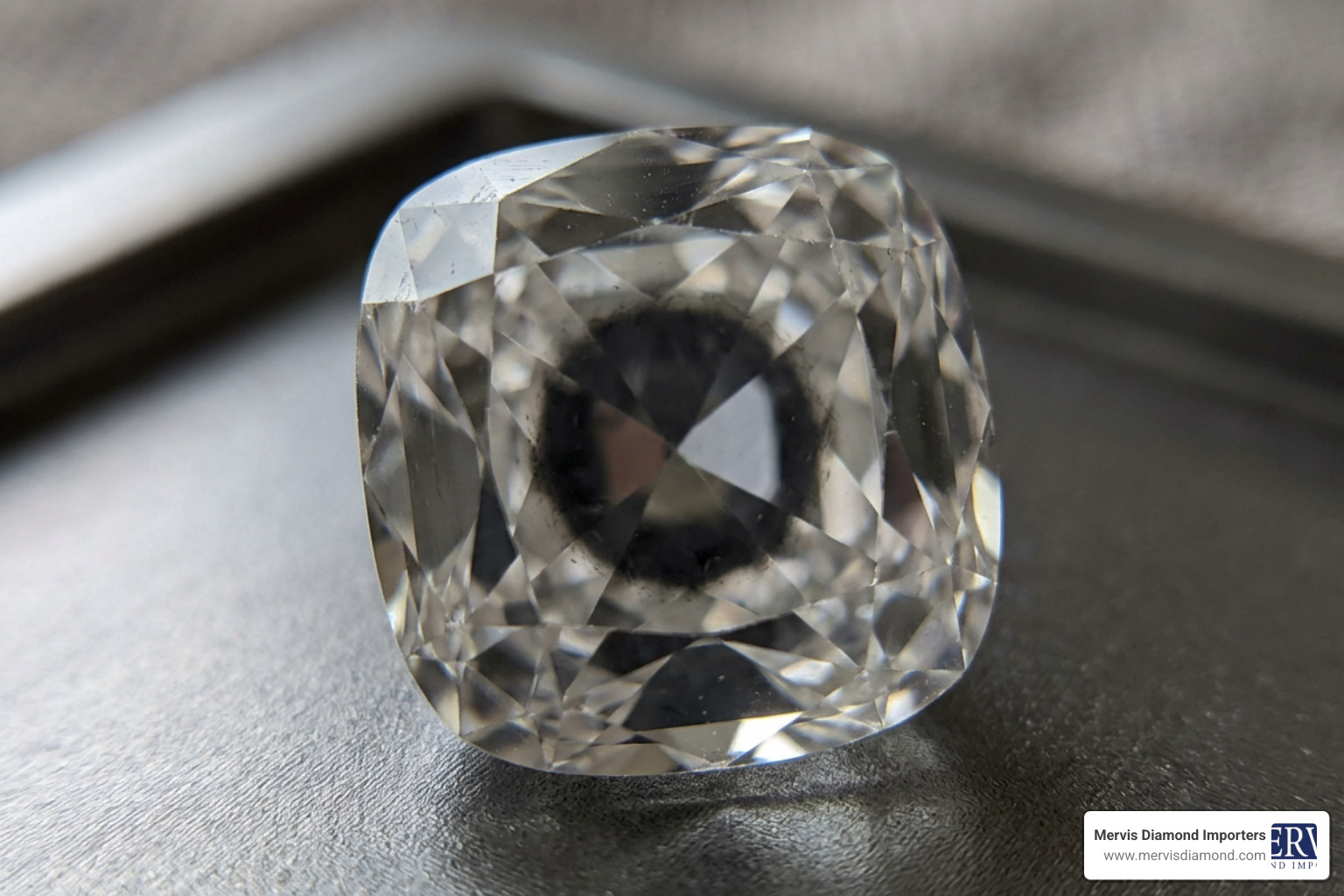
To avoid these pitfalls, we recommend working with a jeweler who can provide high-definition 360-degree videos of the diamond under different lighting conditions. You can also look at advanced light performance diagnostics, such as ASET (Angular Spectrum Evaluation Tool) imaging, which maps exactly where a diamond is reflecting light and where it is leaking. For a deeper dive into avoiding these common structural errors, read our guide on cushion cut mistakes to avoid.
Cushion Cut vs. Round Brilliant: Value and Size Comparison
If you are torn between a classic round brilliant and a cushion cut, the financial differences are worth noting. Cushion cut diamonds are significantly more affordable than round diamonds of equivalent quality.
On average, a cushion cut diamond costs 25% to 40% less than a round brilliant of the same carat weight, color, and clarity. Why such a massive price difference? It comes down to the yield from the rough diamond crystal.
When cutting a round brilliant, diamond cutters must discard up to 60% of the original rough stone. This waste is factored into the final price of the round diamond. Cushion cuts, however, naturally mimic the octahedron shape of raw diamond crystals. Cutters can retain a much higher percentage of the rough stone, passing those savings directly on to you.
However, there is a catch: face-up size perception.
Because cushion cut diamonds are naturally deeper than rounds, they carry more of their weight in their bellies (the bottom half of the stone). Consequently, a 1.00-carat cushion cut will measure slightly smaller in millimeter surface area than a 1.00-carat round brilliant. To get the same visual face-up size as a round, you may need to buy a slightly higher carat weight in a cushion—but because of the 25%+ price savings, you will still likely save money overall.
To learn more about balancing carat weight with visual size across different shapes, refer to our guide on The 4Cs When Purchasing Diamond Engagement Rings. For a broader look at the history and enduring market appeal of this shape, you can also explore this luxury buyer's guide for cushion cuts.
Frequently Asked Questions About Cushion Cut Diamonds
Do cushion cut diamonds look smaller than round diamonds?
Yes, cushion cut diamonds generally look slightly smaller face-up than round brilliant diamonds of the identical carat weight. This is because cushions are cut deeper, meaning more of their physical weight is hidden beneath the girdle. To maximize the visual size of a cushion cut, look for a stone with a depth percentage on the shallower side of the ideal range (62% to 65%) or consider an elongated ratio, which spreads the weight over a longer surface area.
What is the best color and clarity for a cushion cut diamond?
Because cushion cuts have a large, open table facet and tend to retain body color more than round diamonds, we recommend the following sweet spots for maximum value:
- Color: If you are setting the diamond in white gold or platinum, aim for a G or H color to ensure it looks bright and icy white. If you prefer yellow or rose gold, you can safely drop to an I or J color, as the warm metal will mask any slight warmth in the stone.
- Clarity: A VS2 or SI1 clarity grade is typically the best value. This range ensures the diamond is "eye-clean" (meaning inclusions cannot be seen with the naked eye) without paying the premium price of a VVS or Flawless grade. For more technical tips on choosing specifications, read our cushion cut diamond guide.
Are cushion cut diamonds durable for daily wear?
Absolutely. In fact, cushion cuts are one of the most durable fancy shapes available. Unlike princess cuts or pear shapes—which feature sharp, pointed corners prone to chipping—cushions have softly rounded corners. This makes them highly resistant to impact and snagging, making them an excellent choice for individuals with active lifestyles, healthcare professionals, or anyone who works with their hands.
Conclusion
Finding the best cut for a cushion diamond requires looking beyond the grading certificate. Because the GIA does not assign an official cut grade to these fancy shapes, you have to play the role of the expert—or partner with a jeweler you trust.
By keeping your search within our recommended depth (62%–68%) and table (58%–65%) ranges, deciding whether you prefer the bold flashes of a chunky cushion or the glittery shimmer of crushed ice, and visually inspecting the stone for red flags like windowing, you are guaranteed to find a diamond that sparkles beautifully for a lifetime.
At Mervis Diamond Importers, we specialize in hand-selecting high-quality natural and lab-grown diamonds, ensuring every cushion cut in our collection meets our rigorous standards for light performance and beauty. If you would like to see these stunning sparkle patterns in person, we invite you to visit one of our local showrooms in Tysons, VA, Rockville, MD, or Washington, DC. Our non-commissioned consultants are here to provide expert, pressure-free guidance to help you find your dream ring.
Ready to start your search? Read our foundational guide on What is a Cushion Cut Diamond or schedule an appointment with one of our diamond experts today!