

Demystifying the Cushion Brilliant Diamond and Its Vintage Charm
The Brilliant Cushion Cut Diamond: A Timeless Shape Worth Understanding
A brilliant cushion cut diamond is one of the most romantic and historically rich diamond shapes you can choose — blending centuries-old charm with modern sparkle technology.
Here's a quick summary for buyers in a hurry:
- Shape: Soft square or rectangular with rounded corners, like a pillow
- Facets: Typically 58, arranged to maximize light return and brilliance
- Sparkle style: Bold flashes of light (traditional) or glittery shimmer (crushed ice/modified)
- Price: Generally 25%+ less expensive than a comparable round brilliant diamond
- Best for: Vintage-inspired and modern engagement rings alike
- Popular sizes: Most commonly purchased between 1 and 2 carats
- Key consideration: Can appear slightly smaller face-up than other shapes at the same carat weight
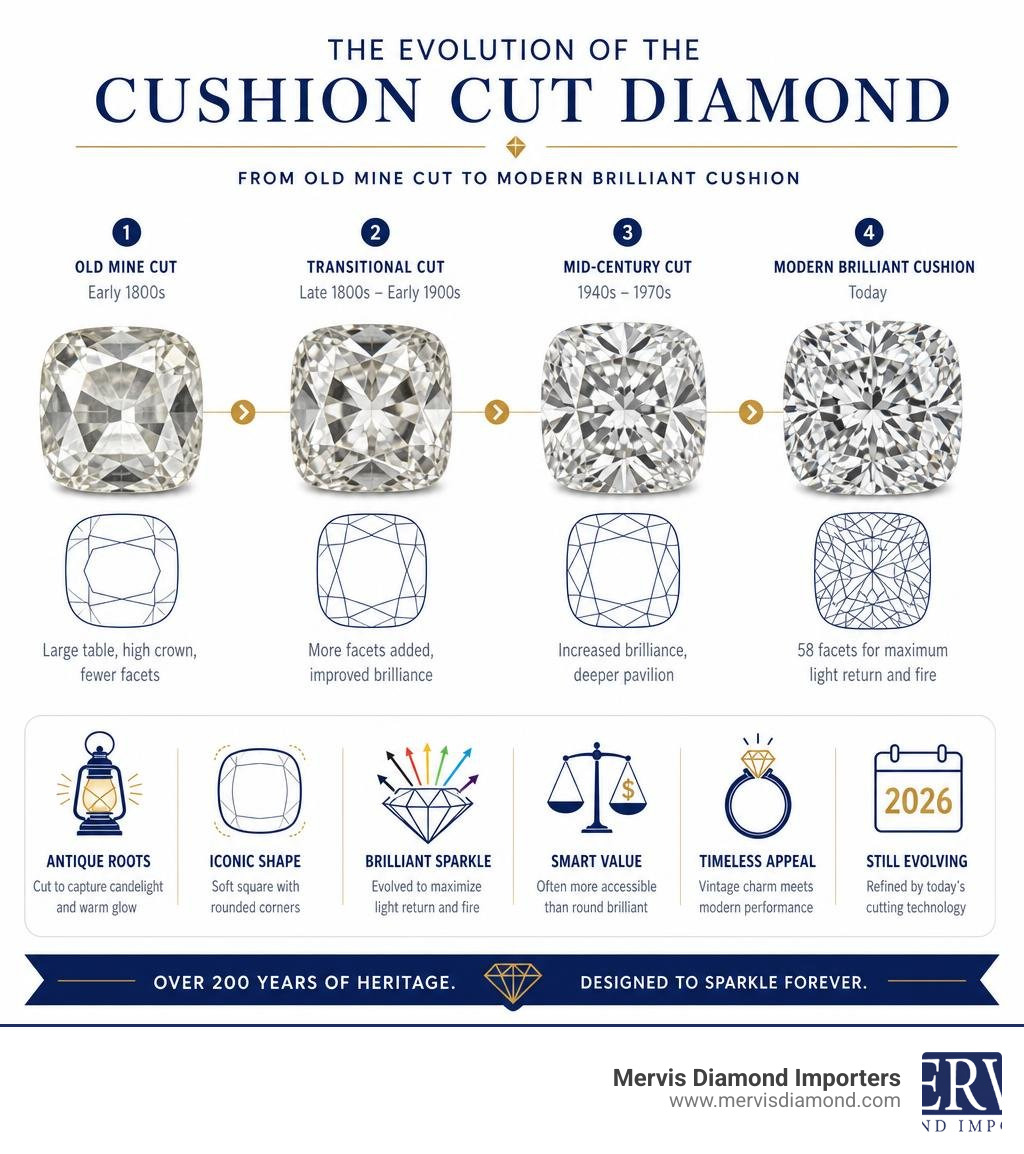
Cushion cuts have been around since the 1800s — descended from the Old Mine cut, one of the earliest diamond faceting styles ever developed. Back then, cutters worked by candlelight, so they shaped stones to catch and hold as much warm, flickering light as possible. That heritage is baked into every cushion cut diamond sold today.
What makes the cushion brilliant variation so compelling in 2026 is that it keeps that antique soul while delivering light performance that rivals contemporary cuts. It's a shape that draws compliments without being flashy, feels personal without being niche, and offers real value without sacrificing beauty.
But cushion cuts are not all the same. There are key differences in facet styles, proportions, and cut quality that dramatically affect how a stone looks on the finger — and how much you pay for it.
This guide breaks all of that down in plain language, so you can shop with confidence.
What is a Brilliant Cushion Cut Diamond?
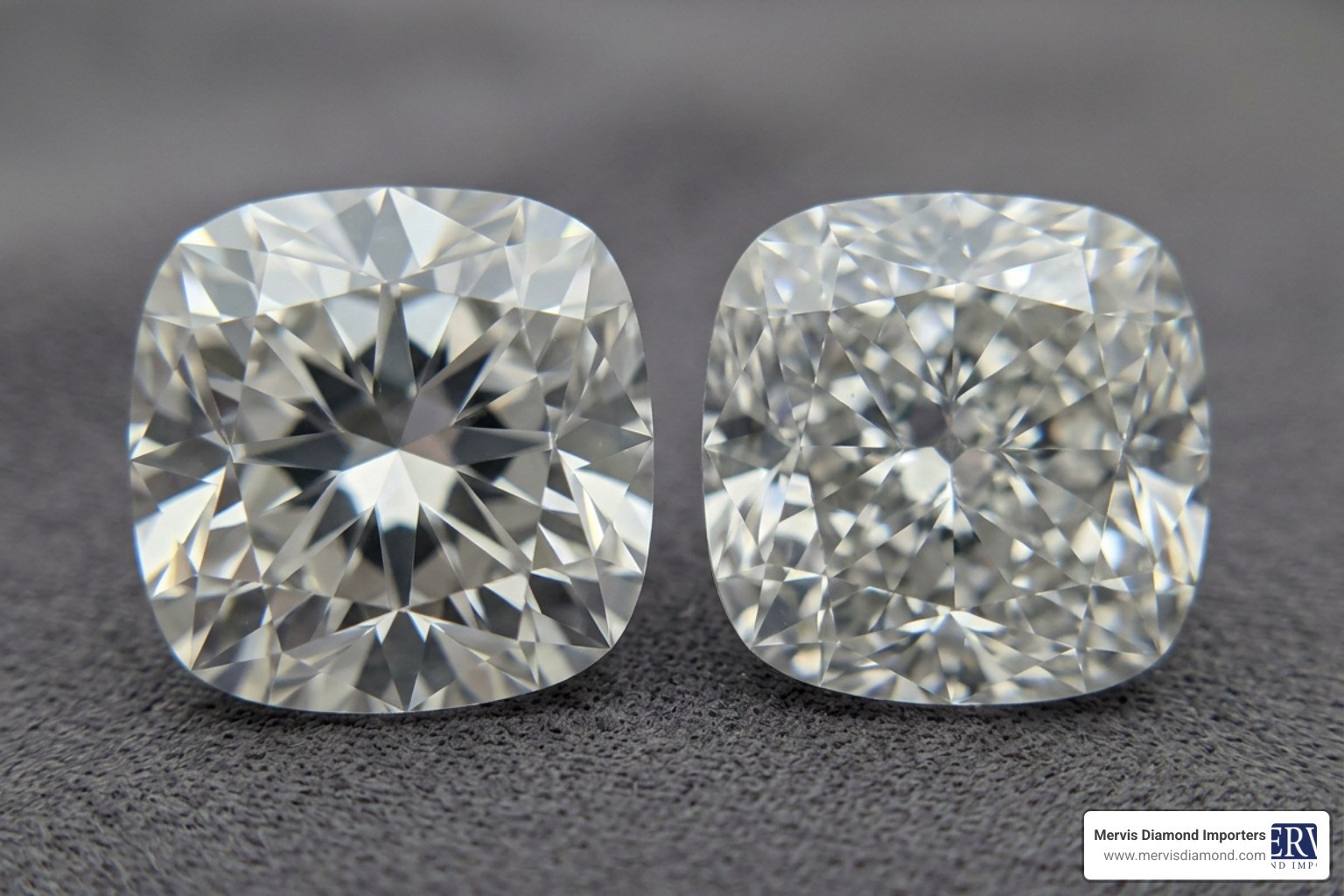
To understand the brilliant cushion cut diamond, it helps to look at its silhouette. Often referred to as the "pillow cut" due to its soft, rounded corners and gently curved sides, this shape occupies a beautiful middle ground between a crisp square princess cut and a classic round brilliant.
While it feels incredibly modern on a contemporary band, its history is deeply rooted in the antique world. If you look back at the history of diamond cutting, the cushion cut is a direct descendant of the Old Mine cut, which dates back to the 1700s and 1800s. To explore this fascinating history in more detail, you can read our comprehensive guide on What is a Cushion Cut Diamond.
The modern cushion cut has undergone several technical adjustments over the decades to enhance its optical performance. Today, cutters use advanced technology to align the facets so they reflect maximum light, transforming what was once a chunky, candle-lit relic into a blazing, high-performance center stone. For an official breakdown of how gemologists categorize these shapes, you can refer to the GIA Cushion Cut Guide.
Anatomy of a Standard Cushion Brilliant Cut
A standard cushion brilliant cut is engineered with a facet arrangement very similar to that of a round brilliant diamond. It typically features 58 facets, including triangular and kite-shaped facets that radiate outward from the center of the stone.
This specific orientation of facets is what dictates how the stone interacts with light. To understand the physics of this sparkle, check out our article on What Makes a Diamond Sparkle.
In a standard cushion brilliant, you will find:
- A relatively small table percentage (usually between 58% and 66%)
- A steeper crown height, which helps disperse white light into rainbow-colored flashes (known as fire)
- Larger, more open facets that create distinct, bold reflections rather than a chaotic shimmer
These proportions ensure that the diamond behaves like a round brilliant but retains that soft, romantic square border.
Cushion Brilliant vs. Modified Cushion Cuts
When shopping for a cushion cut, you will quickly notice two terms on grading reports: "Cushion Brilliant" and "Cushion Modified Brilliant." The difference lies entirely in the facet blueprint and the resulting visual texture.
- Cushion Brilliant: This cut features facets that extend all the way from the culet (the bottom point) to the girdle (the outer edge). This creates large, distinct windows of light. The sparkle is characterized by bold, slower flashes of light and high contrast.
- Cushion Modified Brilliant: Cutters add an extra row of needle-like facets just below the girdle. This alters the path of light, breaking it up into hundreds of tiny reflections. This configuration creates the famous "crushed ice" look. It behaves similarly to a radiant cut, offering a highly active, glittery shimmer.
While neither option is objectively "better," they offer completely different aesthetics. If you prefer a clean, classic look with deep contrast, the standard cushion brilliant is your go-to. If you love a hyper-active, icy twinkle, you will likely gravitate toward the modified cut. To see how these variations stack up against other sparkling shapes, read our breakdown of Which Diamond Cut Sparkles the Most.
Light Performance and Shape Comparisons
When choosing an engagement ring, light performance is everything. How a diamond handles light determines its brilliance (white light return), fire (rainbow flashes), and scintillation (the sparkle when the stone moves).
To help visualize how the cushion cut stacks up against other popular shapes, we have compiled a quick comparison:
| Diamond Shape | Facet Count | Sparkle Style | Perceived Face-Up Size | Price per Carat (Relative) |
|---|---|---|---|---|
| Cushion Brilliant | 58 | Bold, blocky flashes & high fire | Slightly smaller | Moderate (25% less than Round) |
| Round Brilliant | 57-58 | Maximum balanced brilliance | True to size | Premium (Most expensive) |
| Radiant Cut | 70 | Intense, crushed-ice shimmer | Appears slightly larger | Moderate |
To dive deeper into the science of light return, you can read our guide on What is Diamond Brilliance.
Comparing the Brilliant Cushion Cut Diamond to Round Brilliants
The round brilliant is the undisputed king of sparkle, accounting for roughly 75% of all diamonds sold. However, the brilliant cushion cut diamond makes an incredibly compelling alternative.
Because round diamonds are in incredibly high demand and waste a significant amount of the rough diamond crystal during the cutting process, they carry a steep price premium. By contrast, cushion cuts retain more of the original rough crystal, making them roughly 25% to 30% less expensive than a round diamond of the exact same carat weight, color, and clarity.
The trade-off is face-up size. Because cushion cuts are cut deeper, more of their weight is hidden in the belly of the stone. A 1-carat cushion will generally have a slightly smaller face-up surface area than a 1-carat round. However, the cushion’s superior fire and lower price tag allow you to easily size up in carat weight to achieve the same visual impact for less money. For a deeper look at why cut quality matters so much in this equation, read our article explaining why Diamond Cut is the Most C.
Cushion Cuts vs. Oval and Radiant Shapes
If you are drawn to fancy shapes, you might also be considering oval or radiant cuts.
Oval cuts are highly popular because their elongated shape creates an optical illusion of greater size and elegantly elongates the wearer's finger. However, ovals are highly prone to the "bow-tie effect" — a dark, bow-tie-shaped shadow across the center of the stone caused by poor light reflection. Cushion cuts, with their symmetrical, square-leaning proportions, rarely suffer from severe bow-tie shadows.
Radiant cuts, on the other hand, share the cushion's rectangular or square outline but feature straight, geometric edges and blocked corners instead of soft, rounded ones. Radiants are almost always cut with a modified facet pattern, meaning they will always have a "crushed ice" look, whereas cushions offer the choice of traditional, blocky brilliant faceting.
To explore the nuances of fancy cuts, check out the GIA Fancy Cut Diamond Guide.
Key Buying Factors for Cushion Cut Diamonds

Buying a diamond should be an exciting, joyful experience, but it does require a little bit of homework. Because the GIA does not issue an official cut grade for fancy shapes (including cushion cuts), you cannot simply look at a certificate and look for an "Excellent" cut rating. You have to understand how the other grading factors interact with this specific shape.
To build a solid foundation before shopping, we highly recommend reading our guide on Understanding Four Cs.
Selecting the Best Color and Clarity for a Brilliant Cushion Cut Diamond
Cushion cut diamonds have a unique physical profile: they have a large open table (the top flat facet) but also feature deep, complex faceting below. This affects how they display color and clarity.
- Color: Unlike round diamonds, which are excellent at masking slight body color, cushion cuts tend to hold onto color. If you are mounting your diamond in platinum or white gold, we recommend staying within the F to H color range to ensure it looks bright and white. If you prefer yellow gold or rose gold, you can safely drop to an I or J color, as the warm metal will mask any slight warmth in the stone.
- Clarity: Because standard cushion brilliants have larger, more open facets, they do not hide imperfections quite as easily as "crushed ice" modified cushions do. However, you do not need to pay a premium for a Flawless stone. An eye-clean VS2 or SI1 diamond will look absolutely perfect to the naked eye, saving you thousands of dollars that can be redirected toward a larger carat weight.
For a complete breakdown of how to balance these factors on a budget, see our guide on The 4Cs When Purchasing Diamond Engagement Rings.
Understanding Cushion Cut Ratios and Proportions
The length-to-width (L/W) ratio determines whether your cushion diamond looks like a perfect square or a sleek rectangle.
- Square Cushion (1.00 to 1.05 ratio): This is the classic, symmetrical "pillow" look. It is highly balanced and looks stunning in solitaire and halo settings alike.
- Slightly Rectangular (1.06 to 1.11 ratio): A subtle elongation that offers a unique, modern feel.
- Elongated Cushion (1.15+ ratio): This rectangular variation has surged in popularity in 2026. It offers excellent finger coverage and mimics the elegance of an emerald cut but with significantly more sparkle.
In terms of depth, look for stones with a depth percentage between 62% and 68%. Anything deeper than 70% means the diamond is carrying too much hidden weight in its bottom half, making it look smaller face-up than its carat weight suggests.
Natural vs. Lab-Grown Cushion Cut Diamonds
In 2026, one of the most common decisions our clients face is choosing between a natural mined diamond and a lab-grown diamond.
First, let's clear up a common misconception: lab-grown diamonds are real diamonds. They possess the exact same chemical, physical, and optical properties as natural diamonds. Under a jeweler’s loupe, they are completely identical because they are grown from carbon seeds under the same intense heat and pressure found deep within the earth.
Here is how they compare across key categories:
- Price: This is the most significant differentiator. Lab-grown cushion cut diamonds cost a fraction of the price of natural ones. This allows buyers to maximize their budget, often walking away with a stone twice the size of a natural counterpart for the same price.
- Value Retention: Natural diamonds are rare, finite geological treasures. Because of this scarcity, they hold long-term value. Lab-grown diamonds, while beautiful, can be produced in unlimited quantities, meaning their resale value is minimal.
- Ethics and Sustainability: Many modern couples prioritize the environment. Lab-grown diamonds eliminate the need for earth mining, reducing direct land disruption. However, they do require massive amounts of electricity to grow. At Mervis Diamond Importers, we hand-select both our natural and lab-grown stones to guarantee ethical sourcing, conflict-free origins, and the highest standards of integrity.
Frequently Asked Questions About Cushion Diamonds
Do cushion cut diamonds look smaller than round diamonds?
Yes, cushion cut diamonds generally have a slightly smaller face-up surface area (known as the "spread") than round diamonds of the same carat weight. This is because cushions are cut deeper, carrying more of their weight in the pavilion (the bottom half). However, you can easily offset this by choosing a slightly higher carat weight or selecting an elongated cushion ratio, which creates the visual illusion of a larger stone.
Why are cushion cut diamonds less expensive than round cuts?
Cushion cuts are more affordable because the cutting process preserves a much higher percentage of the rough diamond crystal. When cutting a round brilliant, up to 60% of the rough stone is lost as waste. With a cushion cut, the cutter can preserve much more of the original material. This high yield, combined with lower market demand compared to round cuts, results in a price tag that is typically 25% lower per carat.
What is the best setting for a cushion cut diamond?
Because of its versatile shape, the cushion cut looks spectacular in a variety of settings:
- Solitaire: A classic four-prong setting (especially with elegant claw prongs) highlights the soft, romantic silhouette of the stone.
- Halo: Surrounding a cushion cut with a delicate border of smaller round diamonds adds immense volume, making the center stone look significantly larger and boosting its overall sparkle.
- Bezel: For a modern, architectural look, a bezel setting wraps the entire edge of the stone in precious metal, protecting the rounded corners while offering a sleek, low-profile design.
Conclusion
The brilliant cushion cut diamond remains an exceptional choice for anyone seeking a ring that balances historical romance with modern brilliance. Its soft corners, incredible fire, and fantastic value make it a standout option in 2026.
At Mervis Diamond Importers, we believe that choosing a diamond is a highly personal journey. Across our showrooms in Tysons, VA, Rockville, MD, and Washington, DC, we specialize in providing pressure-free, expert guidance. Every natural and lab-grown cushion diamond in our inventory is hand-selected by our experts to ensure superior light performance, eye-clean clarity, and undeniable beauty.
If you are ready to experience the vintage charm of the cushion cut in person, we invite you to book an appointment at one of our local showrooms. Let us help you find a diamond that tells your unique story. To continue your research, revisit our introductory guide on What is a Cushion Cut Diamond.