

Why Your 1-Carat Diamond Might Look Smaller Than You Think
A Carat Weight Diamond Chart Shows Size, Not Just Weight
A carat weight diamond chart helps you compare a diamond's weight with its likely face-up measurements in millimeters. That matters because carat is a measure of mass, not diameter.
For example, a 1-carat round diamond is typically about 6.4 to 6.5 mm wide, while a 2-carat round is about 8.0 to 8.2 mm wide. The 2-carat stone weighs twice as much, but it does not look twice as wide on your finger. Cut depth and shape also change how large a diamond appears.
Before choosing a carat weight, compare:
- Millimeter dimensions for the shape you like
- Cut quality, which affects brightness and how weight is distributed
- Face-up spread, or how much of the finger the diamond covers
A 1-carat oval, pear, or marquise can look larger than a 1-carat round because its longer outline covers more visual space. Meanwhile, a deep-cut stone may carry extra weight below the setting rather than across the top where you see it.
I'm Morris Mervis, and this guide will help you use carat weight and millimeter size together to choose a diamond that looks right, performs well, and fits your budget.
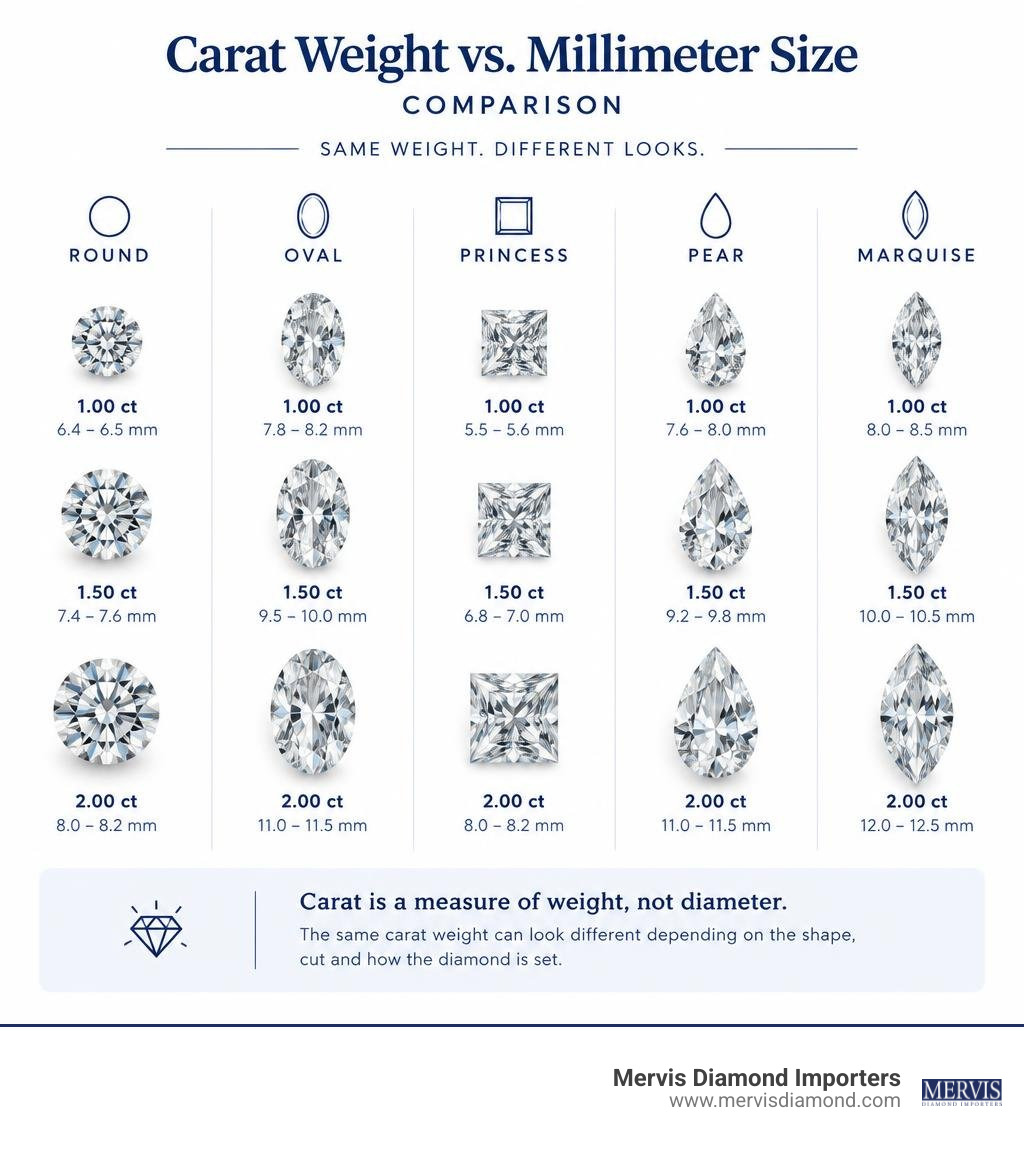
Carat Weight vs. Visible Size: Weight Is Not Diameter
When shopping for an engagement ring, most people start with a specific number in mind: a 1.00-carat, 1.50-carat, or 2.00-carat center stone. However, one of the most common surprises we see in our showrooms across Washington DC, North Bethesda/Rockville, and Tysons is how different two diamonds of the exact same carat weight can look when set side-by-side.
The metric carat is simply a unit of mass. One carat equals exactly 0.20 grams (or 200 milligrams). It tells you how much a gemstone weighs on a precision scale, but it tells you nothing about the stone's physical geometry or surface area.
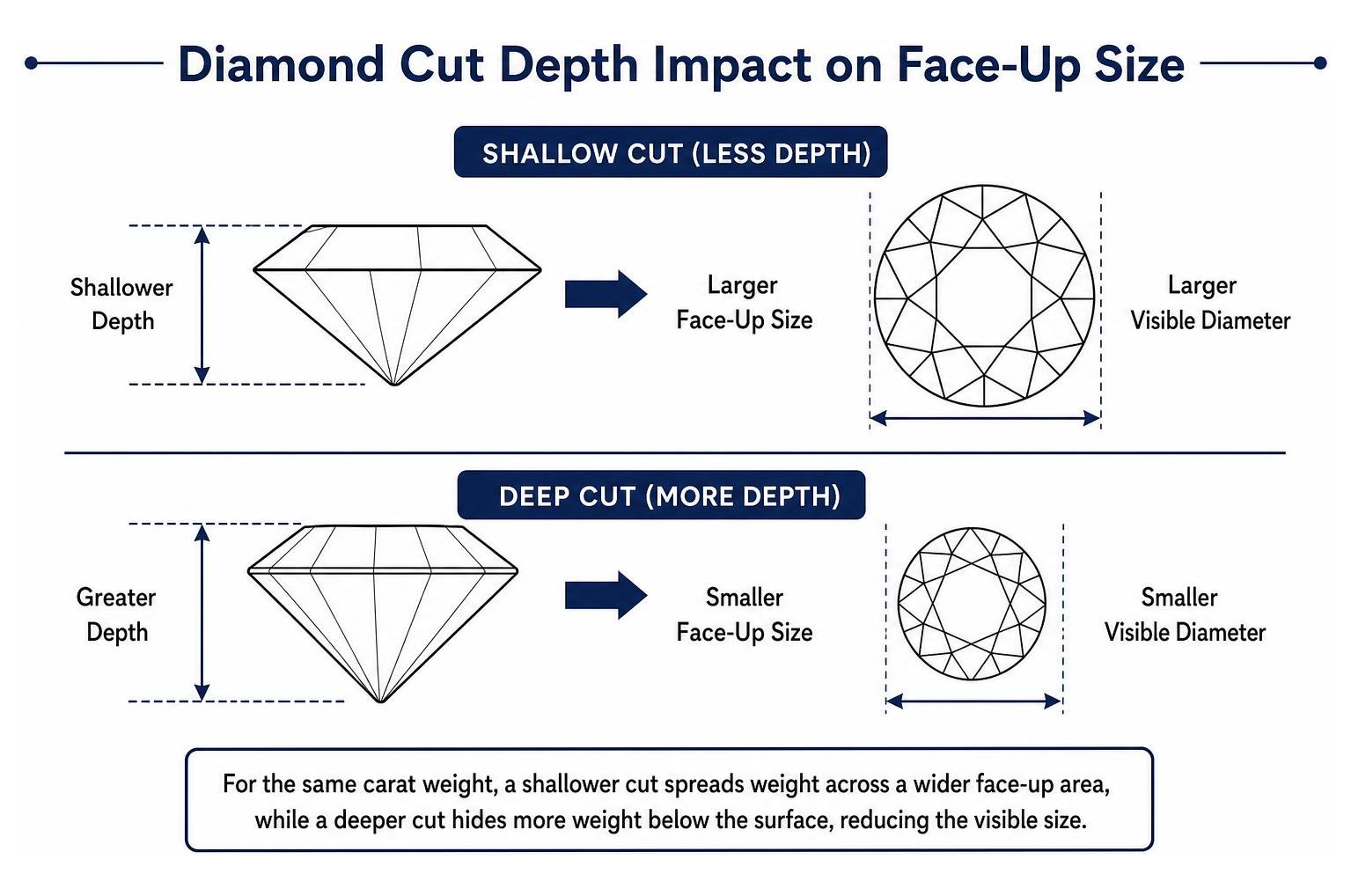
When you look at a diamond on someone's hand, you are viewing its face-up surface area (measured in millimeters), not its weight. A diamond that is cut too deep hides its mass underneath the setting where nobody can see it, while a well-proportioned diamond spreads that weight across the top surface to maximize its visual footprint.
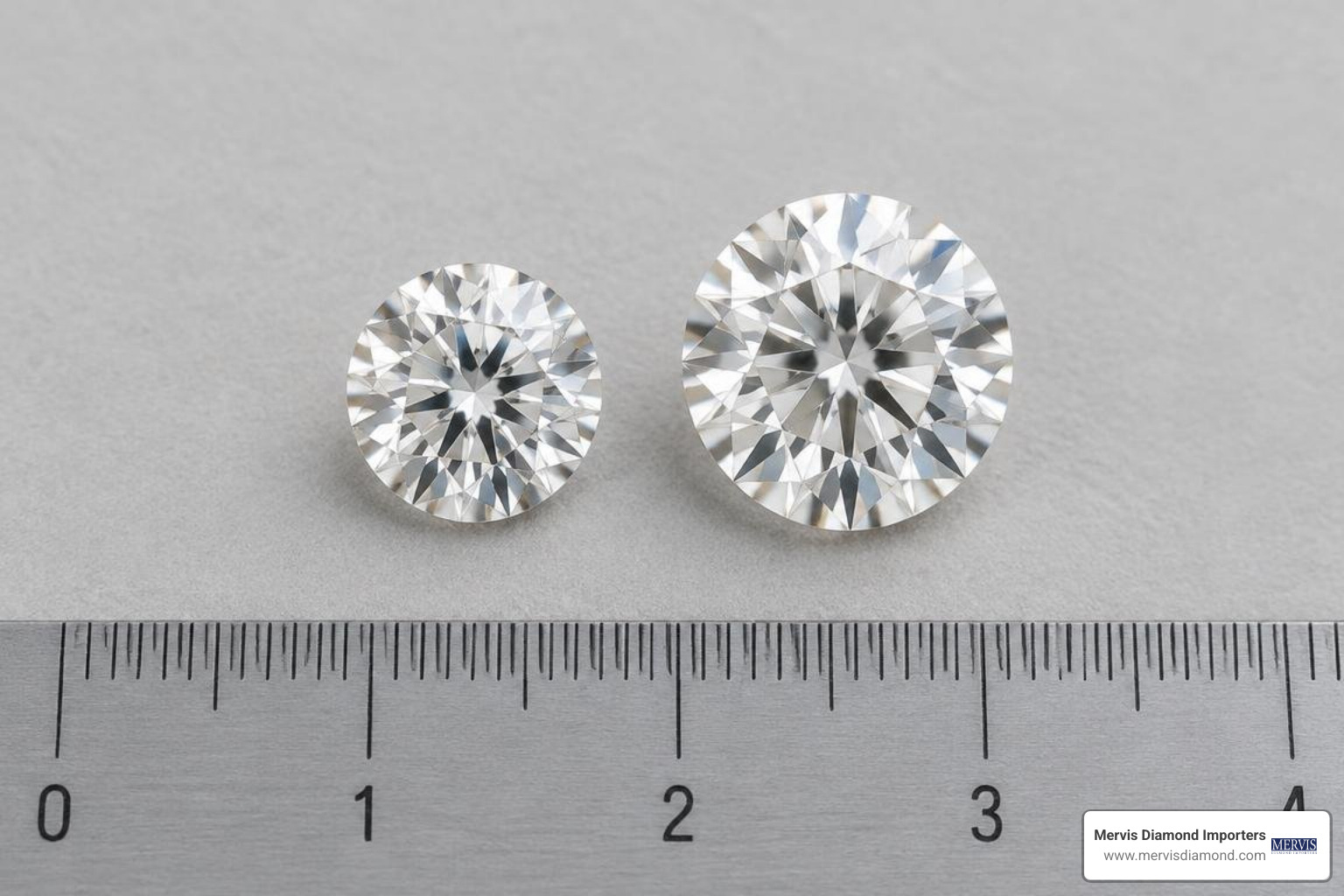
Understanding how physical dimensions interact with mass is a core part of reviewing the 4 Cs of diamonds explained. When evaluating loose diamonds, paying attention to millimeter dimensions alongside carat weight ensures you get the full visual presence you are paying for.
Why Twice the Carat Weight Does Not Mean Twice the Size
It is natural to assume that doubling the carat weight doubles the visible size of the diamond. But diamonds are three-dimensional, volumetric objects, not flat circles.
When a diamond's weight doubles from 1.00 carat to 2.00 carats, that extra mass is distributed across all three dimensions: length, width, and depth. As a result, the diameter increases by only about 25% to 28%, rather than 100%.
| Carat Weight | Ideal Round Diameter | Surface Area Increase vs. 1.00ct |
|---|---|---|
| 0.50 ct | ~5.20 mm | -36% |
| 1.00 ct | ~6.50 mm | Baseline (100%) |
| 1.50 ct | ~7.40 mm | +30% |
| 2.00 ct | ~8.20 mm | +59% |
| 3.00 ct | ~9.40 mm | +109% |
As you can see, jumping from 1.00 carat (6.50 mm) to 2.00 carats (8.20 mm) adds only 1.70 mm to the diameter. While that difference is noticeable to the naked eye, the stone does not take up twice the space on the finger.
To visualize these dimensions accurately, you can reference a printable diamond size chart scaled to 100% on standard paper. Furthermore, selecting a stone with an "Excellent" or "Ideal" rating on the diamond cut quality scale ensures that weight is properly balanced rather than wasted in a heavy, light-leaking pavilion.
Carat vs. Karat: Avoiding Common Terminology Mistakes
Before diving into shape dimensions, let us clear up a frequent point of confusion: carat versus karat. While they sound identical, they measure completely different properties in jewelry:
- Carat (ct): A unit of weight for diamonds and other gemstones (1 ct = 0.20 grams). It is divided into 100 "points" (for example, a 0.75-carat stone is a 75-point diamond).
- Karat (k or kt): A measure of gold purity based on a 24-part scale. Pure gold is 24 Karat (24k). An 18k gold band contains 18 parts pure gold and 6 parts alloy metal (75% purity), while 14k contains 14 parts pure gold (58.3% purity).
Remember: Diamonds are weighed in carats; ring settings are crafted in karats.
The Comprehensive Carat Weight Diamond Chart by Shape
Every diamond shape carries its weight differently. Round brilliants distribute mass symmetrically, while fancy shapes like ovals, marquises, emeralds, and pears concentrate weight along an extended outline, creating the optical illusion of a larger diamond.
The chart below outlines standard millimeter dimensions across the most popular diamond shapes from 0.25 carats to 3.00 carats, serving as a reliable shape comparison reference based on industry data from the diamond millimeter weight reference.
| Shape | 0.25 ct (mm) | 0.50 ct (mm) | 0.75 ct (mm) | 1.00 ct (mm) | 1.50 ct (mm) | 2.00 ct (mm) | 3.00 ct (mm) |
|---|---|---|---|---|---|---|---|
| Round Brilliant | 4.00 – 4.10 | 4.90 – 5.20 | 5.70 – 5.80 | 6.40 – 6.50 | 7.30 – 7.40 | 8.00 – 8.20 | 9.30 – 9.40 |
| Princess Cut | 3.40 – 3.50 | 4.30 – 4.50 | 5.00 – 5.10 | 5.50 – 5.50 | 6.20 – 6.40 | 7.00 – 7.00 | 8.00 – 8.00 |
| Oval | 5.00 × 3.50 | 6.00 × 4.25 | 6.50 × 4.75 | 7.70 × 5.50 | 8.50 × 6.00 | 10.0 × 7.00 | 11.5 × 8.00 |
| Emerald Cut | 4.00 × 3.00 | 5.50 × 4.00 | 6.00 × 4.50 | 6.50 × 5.00 | 7.50 × 5.50 | 8.50 × 6.00 | 9.50 × 7.00 |
| Pear Shape | 5.50 × 3.50 | 7.00 × 4.50 | 7.80 × 5.00 | 8.50 × 5.50 | 9.50 × 6.50 | 10.5 × 7.00 | 12.0 × 8.00 |
| Marquise Cut | 6.00 × 3.00 | 8.00 × 4.00 | 9.00 × 4.75 | 10.5 × 5.50 | 11.5 × 6.00 | 12.5 × 6.50 | 14.0 × 7.00 |
| Cushion Cut | 3.80 × 3.50 | 4.80 × 4.50 | 5.30 × 5.00 | 5.90 × 5.50 | 6.60 × 6.20 | 7.30 × 7.00 | 8.30 × 8.00 |
| Radiant Cut | 3.60 × 3.60 | 4.50 × 4.50 | 5.10 × 5.10 | 5.60 × 5.60 | 6.40 × 6.40 | 7.00 × 7.00 | 8.00 × 8.00 |
| Asscher Cut | 3.50 × 3.50 | 4.50 × 4.50 | 5.00 × 5.00 | 5.50 × 5.50 | 6.20 × 6.20 | 7.00 × 7.00 | 8.00 × 8.00 |
| Trillion Cut | 3.50 × 3.50 | 4.50 × 4.50 | 5.20 × 5.20 | 6.00 × 6.00 | 6.80 × 6.80 | 7.70 × 7.70 | 8.70 × 8.70 |
Note: Millimeter measurements represent well-cut stones. Natural and lab-grown diamonds share identical physical and optical properties, so this chart applies equally to both.
Using a Carat Weight Diamond Chart for Round and Brilliant Cuts
Square and rounded-square cuts like princess, cushion, and radiant diamonds tend to carry more weight in their corners and pavilion depth.
For instance, a 1.00-carat princess cut measures roughly 5.50 mm × 5.50 mm, whereas a 1.00-carat round brilliant measures 6.50 mm. Even though both weigh the same, the round diamond has a larger visible diameter.
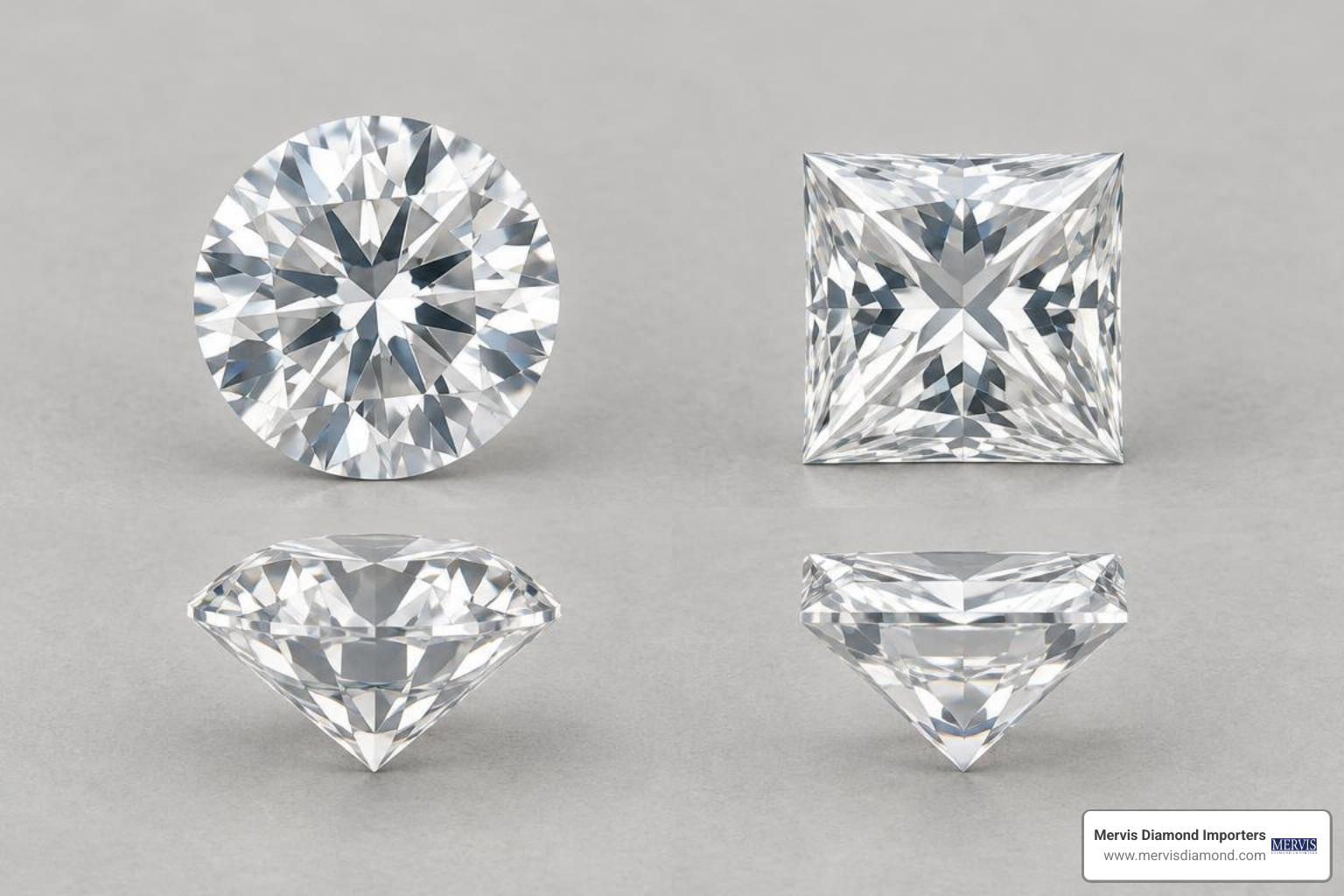
Cushion cuts and radiant cuts behave similarly. If you prefer a square or rectangular outline but want to maximize perceived size, look for a stone with a balanced depth percentage (around 61% to 67%) rather than an overly deep cut that hides diamond weight.
Elongated Shapes in the Carat Weight Diamond Chart
If your goal is maximum finger coverage per carat, elongated fancy cuts are exceptionally efficient:
- Oval Cut: A 1.00-carat oval measures approximately 7.70 mm × 5.50 mm. Its elongated silhouette gives it the visual appearance of a 1.20-carat round diamond.
- Marquise Cut: With an average 1.00-carat measurement of 10.50 mm × 5.50 mm, the marquise boasts the largest surface-area-to-weight ratio of any standard diamond cut.
- Pear Shape: Measuring around 8.50 mm × 5.50 mm at 1.00 carat, the pear shape blends the rounded brilliance of an oval with a tapered point that elongates the wearer's finger.
- Emerald Cut: While step cuts have less internal sparkle, their open rectangular tables (6.50 mm × 5.00 mm for 1.00 ct) offer broad surface coverage.
For shoppers looking to optimize visual spread without sacrificing fire and brilliance, choosing an elongated shape is one of the smartest ways to secure the best value diamond for your budget.
Why Diamond Cut and Proportions Dictate Visual Spread
A diamond's carat weight means very little if the cut grade is compromised. When a cutter processes rough diamond material, they face a choice: cut the rough into a smaller stone with ideal proportions, or leave extra weight in the diamond to sell it at a higher carat tier.
When a diamond is cut too deep (a "steep-deep" cut):
- Light escapes through the bottom and sides instead of reflecting back to the eye, reducing sparkle.
- The diamond looks dark in the center (often called a "nailhead").
- The face-up diameter is significantly smaller than it should be for its weight. A poorly cut 1.00-carat diamond can have the millimeter footprint of a 0.85-carat stone!
Conversely, a diamond cut too shallow ("spread cut") might look wide, but light leaks straight through the center, creating a dull, "fisheye" look that lacks life.
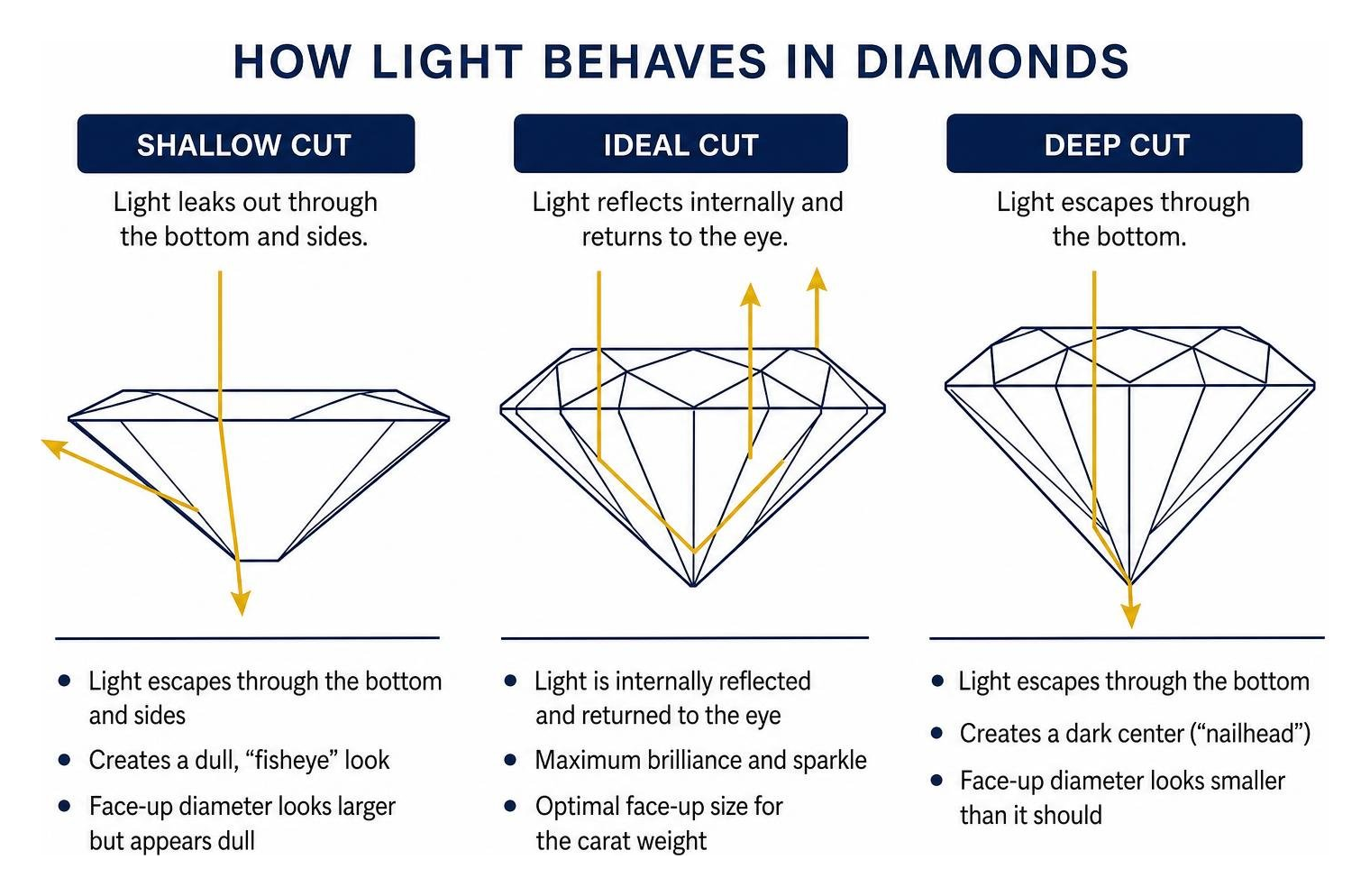
This is why master gemologists emphasize cut above all else. When reviewing the diamond 4 Cs order of importance, cut quality directly controls both sparkle and perceived size. An expertly cut 0.90-carat round diamond will frequently outshine and out-measure a poorly cut 1.00-carat diamond.
Price Jumps at Magic Carat Weights
Diamond prices do not rise on a straight, linear line. Instead, they climb exponentially, featuring sharp price jumps at "magic sizes"—the milestone weights that shoppers love most (0.50 ct, 0.75 ct, 1.00 ct, 1.50 ct, 2.00 ct, and 3.00 ct).
Because larger rough diamonds are much rarer in nature, cutting a clean 2.00-carat diamond is vastly more difficult than finding two 1.00-carat stones. Consequently, a high-quality 2-carat natural diamond can cost four to five times more than a 1-carat natural diamond of identical cut, color, and clarity.
To take advantage of this pricing curve, consider buying "under-size":
- Instead of a 1.00-carat round diamond (6.45 mm), look for a 0.90-carat to 0.95-carat diamond (6.25 mm to 6.35 mm).
- The 0.15 mm difference is invisible to the human eye without precision calipers.
- You can save 15% to 25% on the center stone, freeing up budget for a premium setting or higher cut quality.
You can run your own comparisons and test different carat-weight scenarios using our interactive diamond price calculator.
Frequently Asked Questions About Diamond Carat and Size
Do twice the carats mean twice the visual size on your finger?
No. Carat is a measure of total three-dimensional mass, not surface area. When a diamond's weight doubles (for example, from 1.00 ct to 2.00 ct), that mass expands across height, width, and depth. A 2.00-carat round diamond (approx. 8.10 mm) provides about a 59% increase in top surface area compared to a 1.00-carat round (approx. 6.50 mm)—far less than a 100% increase.
Which diamond shape looks the biggest for its carat weight?
The marquise cut has the largest face-up surface area per carat due to its elongated shape and shallow weight distribution. Oval and pear cuts rank closely behind. Princess, cushion, and asscher cuts appear smallest face-up per carat because a larger percentage of their weight is held in the base and corners of the stone.
Why does a 1-carat round diamond cost so much more than a 0.90-carat?
Diamond pricing is driven by market demand and mineral rarity. When diamond cutters work with raw stones, reaching the 1.00-carat milestone yields a significant price premium. Because the jump to 1.00 ct is a major consumer milestone, market demand spikes, creating a steep price cliff between 0.90 ct and 1.00 ct—even though their millimeter dimensions are almost indistinguishable.
Choosing the Right Diamond for Your Finger and Setting
When selecting an engagement ring or custom piece of jewelry, carat weight is just one part of the equation. A diamond's true presence comes from a harmonious blend of millimeter dimensions, cut precision, and personal proportions.
At Mervis Diamond Importers, our family has hand-selected diamonds for generations. Whether you visit us in Tysons, VA, Rockville, MD, or downtown Washington, DC, our expert diamond consultants provide a relaxed, pressure-free environment to help you compare shapes, millimeter sizes, and cut grades side-by-side.
Ready to discover how different shapes look on your hand? Explore our comprehensive guide to understanding the 4 Cs or book a personalized consultation at a Mervis showroom near you today.