

Estimate Your Stone Value Instantly with a Diamond Price Calculator
Why a Diamond Price Calculator Is the Smartest First Step Before You Buy or Sell
A diamond price calculator gives you an instant estimate of what a loose diamond is worth — based on its carat weight, cut, color, clarity, shape, and certification. Here's what to expect at a glance:
| Diamond | Estimated Retail Value (2026) |
|---|---|
| 1.00 ct, Round, G/VS2, Excellent, GIA | ~$6,200 |
| 1.50 ct, Round, H/SI1, Excellent, GIA | ~$11,500 |
| 2.00 ct, Round, G/VS2, Excellent, GIA | $16,150 – $21,850 |
| 2.00 ct, Lab-Grown, G/VS2, Round | $1,800 – $2,400 |
These are retail estimates. Resale values are significantly lower — often 30–55% of what you paid.
Most people searching for diamond prices share the same worry: am I about to overpay, or am I getting a fair deal? That's a completely reasonable concern. Diamond pricing is not straightforward. A 2.00 carat diamond doesn't simply cost twice as much as a 1.00 carat — it typically costs 2.5x to 3.5x more, because larger diamonds are exponentially rarer in nature. And the gap between what a jeweler charges and what you'd recover at resale can be startling. A diamond purchased for $20,000 at a mall jewelry chain might fetch only $5,000–$7,000 in a private sale.
I'm Morris Mervis, and in this guide I'll walk you through exactly how diamond pricing works — so you can shop or sell with confidence.
How to Use a Diamond Price Calculator to Estimate Value
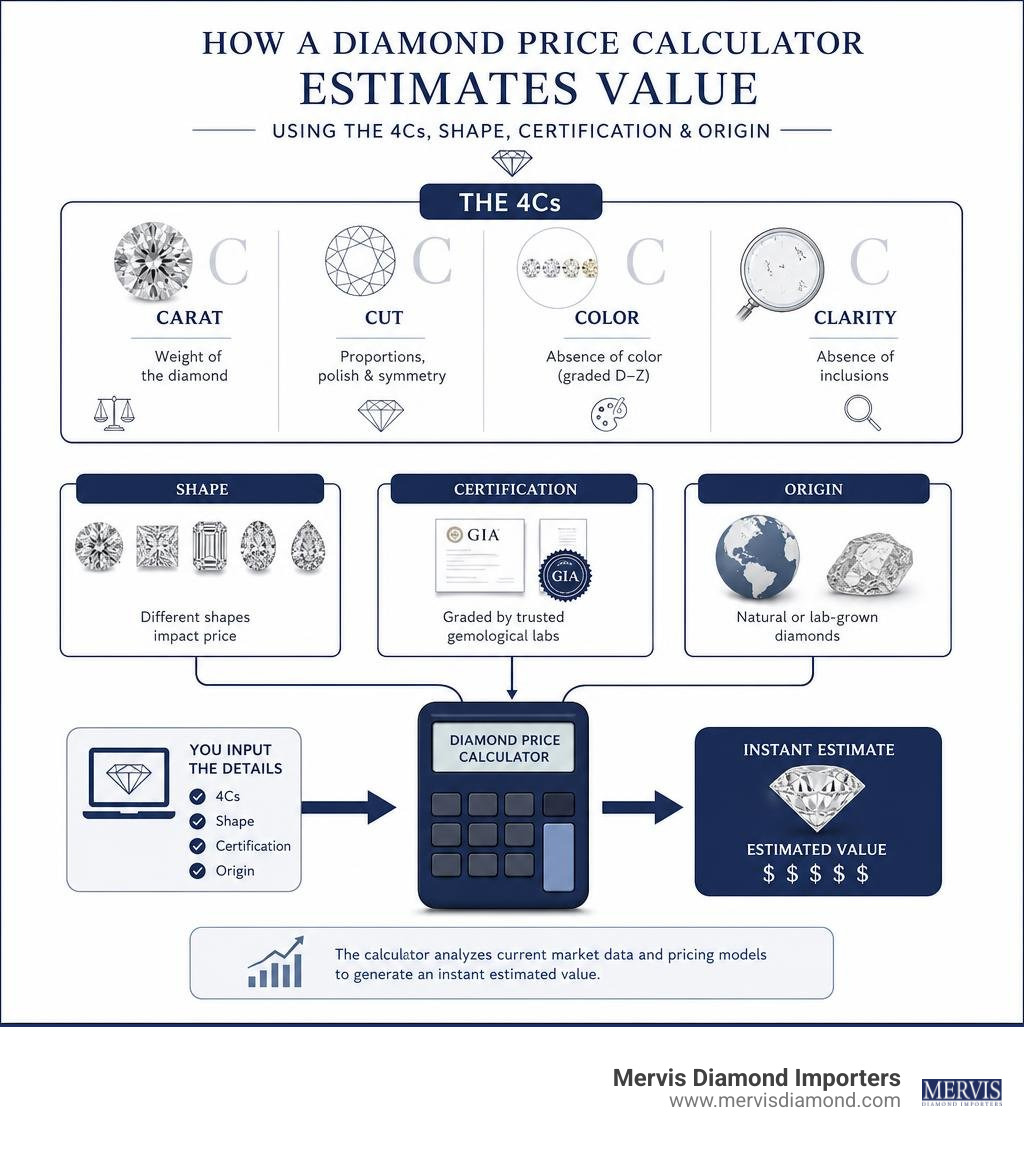
An online diamond price calculator acts as an aggregator of current market data, translating complex gemological grading systems into a digestible dollar figure. Behind the simple interface lies a mathematical model that references baseline pricing lists (historically similar to the Rapaport Price List) and adjusts them using real-time retail and wholesale data.
To get an accurate result, you cannot simply guess. The calculator relies on precise inputs. If you enter incorrect parameters, the output will be wildly off. For example, selecting "Excellent" instead of "Fair" cut can alter the estimated value by up to 45%.
For a reliable estimate of what your loose stone is worth in today's market, you can use the How Much Is a X Carat Diamond Worth? Value Estimator to run your own calculations before heading to a showroom.
Key Inputs Required by a Diamond Price Calculator
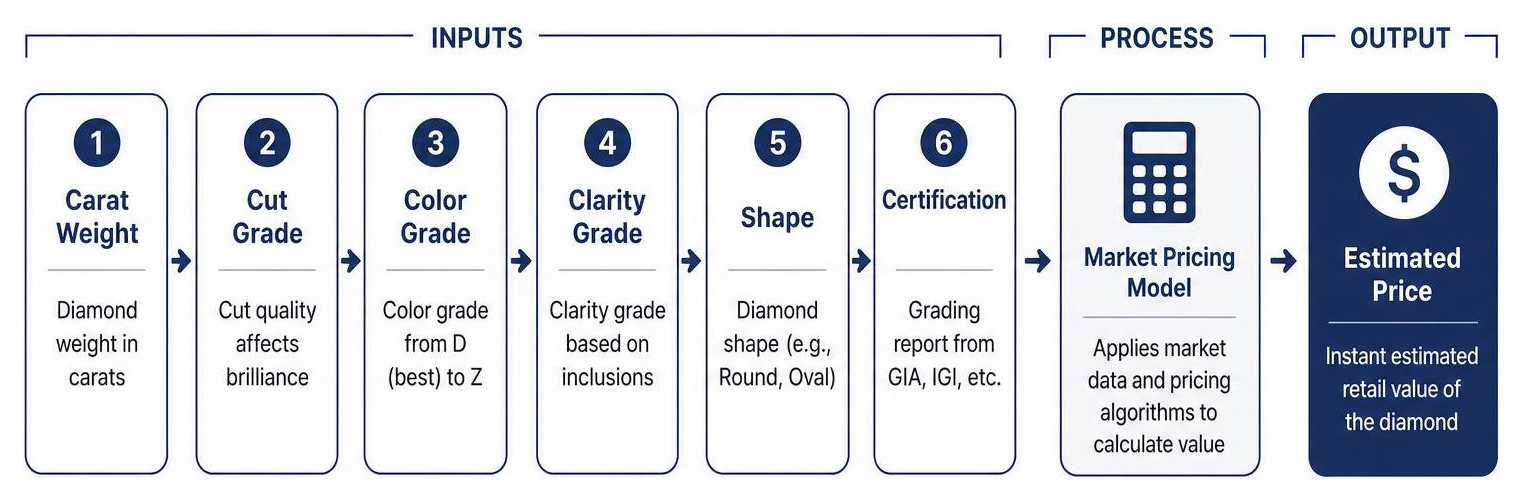
To calculate a realistic value, any reputable diamond price calculator will ask you for six essential pieces of information:
- Carat Weight: The actual weight of the diamond, measured to two decimal places (e.g., 0.95 ct or 1.02 ct).
- Cut Grade: Ranging from Excellent (or Ideal) down to Poor. This dictates how much light the diamond reflects.
- Color Grade: The absence of color, graded on a scale from D (colorless) to Z (light yellow/brown).
- Clarity Grade: The presence of internal inclusions or surface blemishes, graded from Flawless (FL) to Included (I3).
- Shape Selection: Round brilliant, oval, princess, cushion, emerald, pear, marquise, or radiant.
- Certification Type: The grading laboratory that issued the certificate (e.g., GIA, AGS, IGI, EGL).
Without these six inputs, a calculator is simply throwing darts in the dark.
Understanding the 4Cs and Their Impact on Value
Before you start playing with the sliders on a valuation tool, you need a firm grasp of the "Four Cs." These are the international standards for grading diamond quality, and they are the primary dials that turn diamond prices up or down.
To dive deeper into the fundamentals, we recommend reading our comprehensive guide on Understanding Four Cs or reviewing our essential tips on The 4Cs When Purchasing Diamond Engagement Rings.
Let's break down how each "C" affects your wallet:
- Carat Weight: This is the physical weight of the stone, not its visual size. Because larger diamonds are incredibly rare to mine, the price per carat increases exponentially as the stone gets heavier.
- Cut Quality: Often considered the most critical "C" for beauty, the cut determines how the diamond's facets interact with light. A poorly cut diamond will look dull and lifeless, regardless of how white or clean it is. To understand why this is the engine of a diamond's beauty, read our breakdown of the 4 Cs to a Diamond.
- Color Scale: Colorless diamonds (D-F) command massive premiums. As you move down the alphabet to G-H (near colorless) and I-J, the price drops significantly. However, once set in a ring, most people cannot tell the difference between a D and a G color stone.
- Clarity Scale: This measures the "imperfections" inside the stone. While Flawless (FL) or Internally Flawless (IF) stones fetch eye-watering prices, VS1, VS2, and eye-clean SI1 diamonds offer the best value because their inclusions are invisible to the naked eye.
When prioritizing your budget, not all Cs are created equal. We highly recommend checking out our guide on the Diamond 4 Cs Order of Importance to learn where to spend your money and where to cut corners safely.
The Mechanics of Diamond Pricing: Why Value Isn't Linear
The most common point of confusion for diamond buyers is why a 2-carat diamond is not double the price of a 1-carat diamond.
In the diamond world, physical weight does not scale linearly with cost. Instead, pricing is based on rarity. A single 2.00-carat rough crystal that is clean and well-proportioned is vastly rarer than two separate 1.00-carat rough crystals.
| Carat Weight | Cut Grade | Color | Clarity | Average Retail Price (Natural) | Price Factor |
|---|---|---|---|---|---|
| 1.00 ct | Excellent | G | VS2 | ~$6,200 | Baseline (1x) |
| 2.00 ct | Excellent | G | VS2 | $16,150 – $21,850 | 2.5x to 3.5x |
As you can see, doubling the weight from 1.00 ct to 2.00 ct results in a price jump of nearly 300%.
To see how these non-linear jumps play out in real life, you can explore our detailed pricing guides for larger weights:
- Learn about the pricing dynamics of two-carat stones in How Much Is a 2 Carat Diamond Ring.
- See how three-carat pricing scales up in How Much Is a 3 Carat Diamond Ring and Three Carat Diamond Cost.
- Understand the rarity premium for even larger stones in How Much Is a 4 Carat Diamond Ring and the ultra-rare How Much Is a 10 Carat Diamond Ring.
Magic Weight Thresholds and Size Premiums
In the diamond industry, there are "magic weights" where prices take sudden, massive leaps. These thresholds occur at round numbers: 0.50 ct, 0.75 ct, 1.00 ct, 1.50 ct, 2.00 ct, and 3.00 ct.
Because everyone wants a "one-carat diamond" or a "two-carat diamond," the demand for stones that hit these exact numbers is incredibly high. Consequently, diamond cutters will often compromise on cut quality just to keep a rough diamond's weight at 1.00 carat instead of 0.96 carat.
The "Shy Weight" Strategy: Smart shoppers can exploit this system by buying "shy weights" — diamonds that fall just under these magic thresholds (e.g., buying a 0.95-carat or a 1.92-carat diamond). A 0.95-carat diamond will look virtually identical in physical size to a 1.00-carat diamond once set in a ring, but it can save you 10% to 15% on the purchase price because it sits just below the magic 1.00-carat boundary.
Shape, Certification, and Origin Multipliers
Beyond the 4Cs, three other major factors act as multipliers on a diamond's calculated price:
1. Diamond Shape
Round brilliant diamonds account for roughly 60% of global diamond demand. Because cutting a round diamond wastes more of the original rough crystal (often up to 60% waste) than cutting fancy shapes (like ovals, cushions, or emerald cuts), rounds carry a 20% to 40% premium over fancy shapes of identical carat weight, color, and clarity. Additionally, fancy shapes like ovals and marquises have a larger "face-up" surface area, making them look bigger than a round diamond of the same carat weight.
2. Lab Certification
A diamond is only as good as the paper it is graded on. The Gemological Institute of America (GIA) and the American Gem Society (AGS) are the gold standards of the industry, known for their strict, consistent grading. Other labs, such as IGI or EGL, are often more lenient. A diamond graded "G color" by EGL might easily be graded an "I color" by the GIA. Because of this grading inflation, you should discount any non-GIA or non-AGS certified natural diamond by 15% to 30% when comparing prices.
3. Diamond Origin: Natural vs. Lab-Grown (2026 Market Update)
The price gap between natural and lab-grown diamonds has widened into a canyon. By 2026, lab-grown diamond wholesale prices have collapsed by roughly 80% since 2020.
While a 2.00-carat natural G/VS2 round diamond retails between $16,150 and $21,850, an identical lab-grown counterpart in 2026 retails for just $1,800 to $2,400. To put this in perspective, lab-grown diamonds are now priced as beautiful fashion jewelry rather than rare assets. To understand this shifting landscape, read our guide on the Average Cost of Lab Grown Diamonds.
Retail vs. Resale: Navigating the Realities of Diamond Valuation
If you use a diamond price calculator to estimate what you can sell your old engagement ring for, prepare yourself for some cold, hard math.
There is a massive difference between what a diamond costs to buy retail and what it will fetch on the secondary market. Retail markups in traditional jewelry stores typically run 100% to 300% above wholesale prices to cover overhead, marketing, commissions, and store operations.
When you sell a diamond back into the trade, jewelry buyers do not pay retail. They buy at wholesale or below. Here is a realistic look at what you can expect to recover if you sell a GIA-certified 1.50 ct H/SI1 excellent-cut round diamond (which retails around $11,500):
- Private Sale (e.g., peer-to-peer): 30% to 45% of retail (~$3,500 – $5,200)
- Consignment (via a jeweler): 40% to 55% of retail (but you must wait for it to sell)
- Professional Diamond Buyers: 25% to 35% of retail (~$2,800 – $4,000)
- Pawn Shops or Quick Cash Trade-ins: 15% to 25% of retail (~$1,700 – $2,800)
To understand this dynamic better, read our deep dive on How Much Can You Resell a Diamond Ring For.
This pricing gap explains why the average retail cost of jewelry can surprise first-time buyers. You can explore how these retail costs stack up across different categories in our resources on:
- Engagement Ring Average Cost
- How Much Is the Average Engagement Ring
- What Is the Average Amount Spent on an Engagement Ring
- How Much Is the Average Wedding Ring
- Diamond Stud Earrings Cost
How Reliable Is an Online Diamond Price Calculator?
Online calculators are fantastic for giving you a ballpark figure, but they have major limitations:
- They cannot see the diamond: Two diamonds with the exact same on-paper grades (e.g., G/VS2) can look completely different in real life. One might have a dark carbon crystal right in the center of its table (making it highly visible), while the other might have its inclusions hidden near the edge under a prong.
- They struggle with fluorescence: Faint or medium blue fluorescence can actually make a slightly yellow diamond (I-K color) look whiter and brighter in sunlight, potentially boosting its visual appeal while keeping its price 5% to 10% lower. However, strong fluorescence in a colorless (D-F) diamond can make the stone look oily or hazy, dropping its value significantly. Calculators rarely account for these nuances.
- They don't assess "eye-cleanliness": An online tool cannot tell you if an SI1 diamond is eye-clean or if it has a hazy, milky appearance that dulls its sparkle.
When to Seek a Professional Appraisal: If you are buying or selling a diamond worth more than $5,000, or if you need an valuation for insurance or estate purposes, an online calculator is not enough. You should always seek a written appraisal from a credentialed GIA Graduate Gemologist who can inspect the stone under a microscope.
Smart Strategies to Maximize Your Diamond Value
Whether you are shopping for a new ring or trying to get the best value for your budget, here are three expert-backed strategies:
- Match Your Metal to Save on Color: If you are setting your diamond in yellow or rose gold, you can safely drop down to an I or J color grade (and save 20% to 30%). The warm tone of the metal will mask any faint yellow tint in the diamond, making it look perfectly white. Reserve D-F grades for platinum or white gold settings.
- Prioritize Cut Above All Else: A diamond's sparkle comes entirely from its cut. Never go below a "Very Good" cut grade on a round brilliant. A well-cut, slightly smaller diamond will always look more beautiful and larger than a poorly cut, larger diamond that leaks light.
- Look for "Eye-Clean" Clarity Sweet Spots: Instead of paying a 55% premium for a Flawless (FL) or VVS stone, target VS2 or eye-clean SI1 diamonds. The inclusions in these grades are invisible without a jeweler's loupe, meaning you get the exact same visual look for a fraction of the price.
For more practical tips, check out our guides on How to Save Money When Buying a Diamond, learn How Mervis Diamond Can Help You Find the Perfect Engagement Ring on a Budget, or explore our philosophy on finding the Best Value Diamond and managing your Money Spend Engagement Ring.
Frequently Asked Questions about Diamond Pricing
Why do diamond prices jump so much at exactly 1.00 or 2.00 carats?
These are "magic weights." Because consumer demand is heavily concentrated on round numbers, diamonds that hit or exceed these thresholds command a massive psychological premium. A 1.00-carat diamond can cost up to 20% more than an identical 0.95-carat diamond, even though their physical dimensions are virtually indistinguishable to the naked eye.
How much value does a diamond lose immediately after purchase?
On average, a diamond loses 50% to 70% of its retail value the moment you walk out of the jewelry store. This is because retail prices include substantial markups to cover retail overhead, marketing, and business margins. When selling, you are selling back at wholesale or below-wholesale scrap prices.
What is the price difference between natural and lab-grown diamonds in 2026?
In 2026, lab-grown diamonds retail for approximately 10% to 15% of the price of a natural diamond of identical quality. Wholesale lab-grown prices have collapsed by about 80% since 2020. Because lab-grown diamonds can be manufactured in unlimited quantities, they hold virtually zero resale or trade-in value on the secondary market.
Conclusion
A diamond price calculator is an invaluable tool for establishing a baseline understanding of diamond value before you enter a showroom or list a stone for sale. However, no algorithm can replace the human eye, the touch of an expert, or the security of a physical inspection.
At Mervis Diamond Importers, we specialize in providing hand-selected, high-quality natural and lab-grown diamonds. Our expert team is dedicated to offering pressure-free, transparent guidance to help you navigate the 4Cs and find a stone that matches both your aesthetic desires and your financial boundaries.
If you're ready to take the next step beyond online estimators, we invite you to visit one of our showrooms in Tysons, VA, Rockville, MD, or Washington, DC for a personalized, hands-on consultation. To prepare for your visit, review our core guide on Understanding Four Cs so you can shop with complete confidence.