

How to Understand the 4 C's of Diamonds Without a Degree in Gemology
Why the 4 C's of Diamonds Explained Everything the Jewelry Industry Was Missing
The 4 C's of diamonds explained in plain terms: every diamond in the world is graded on four qualities — Cut, Color, Clarity, and Carat weight. Together, these four factors determine how a diamond looks and what it's worth.
Here's a quick summary:
| The 4 C's | What It Measures | Why It Matters |
|---|---|---|
| Cut | How well the diamond's facets interact with light | Has the greatest effect on sparkle and beauty |
| Color | How colorless the diamond is (D to Z scale) | Colorless diamonds are rarer and more valuable |
| Clarity | Freedom from internal and external flaws | Affects how "clean" the diamond looks |
| Carat | Physical weight (1 carat = 200 milligrams) | Directly tied to size and price |
Before these four standards existed, buying a diamond was a gamble. Merchants described colorless stones simply as having good "water" and noted clarity as "with or without flaws." There was no shared language, no objective scale — just a seller's word against a buyer's hope.
That changed in the 1940s, when GIA founder Robert M. Shipley coined the phrase "the 4 C's" as a simple memory device for gemology students. By 1953, it had grown into a formal, global grading system. Today, those same four criteria are used by every major gem lab in the world.
Knowing the 4 C's doesn't require a degree in gemology. It just requires knowing what to look for — and what questions to ask.
I'm Morris Mervis, and after decades of helping customers find the right diamond without the confusion or pressure, I want to walk you through exactly what these four factors mean and how to use them to your advantage.
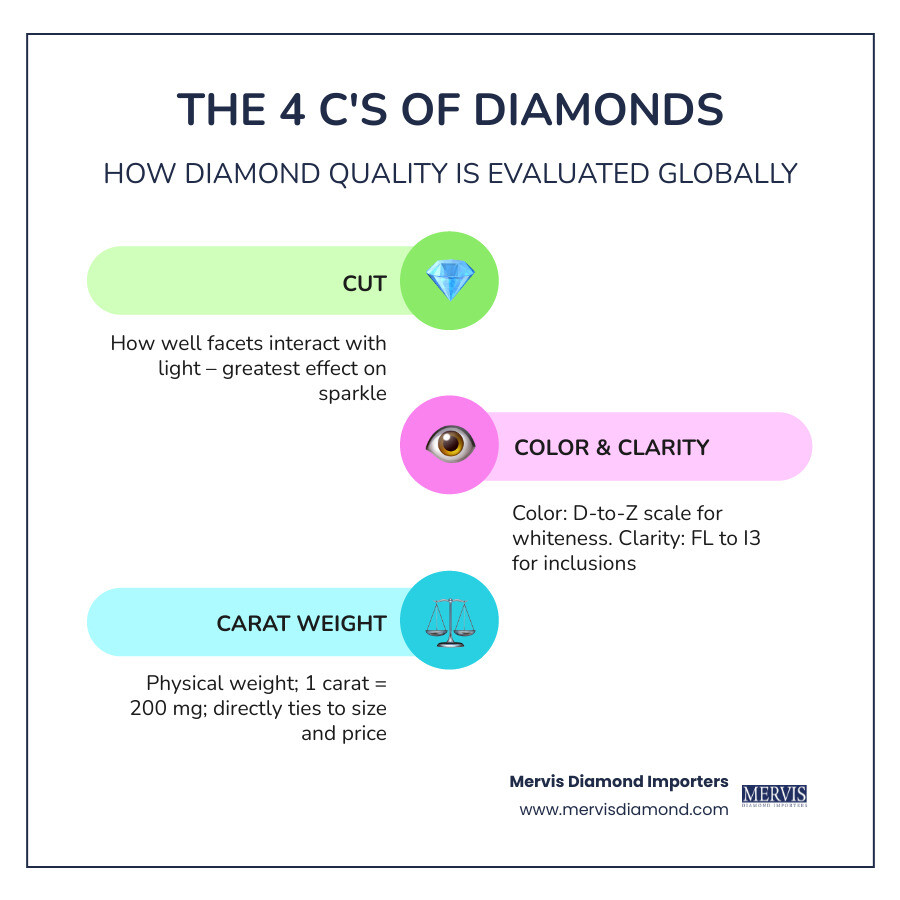
The History of Diamond Grading: How the 4 C's of Diamonds Explained Quality Globally
To truly appreciate the simplicity of the modern grading system, we have to look back at the historical chaos that preceded it. Before the mid-20th century, the diamond market operated on subjective, regional vocabulary. If you walked into a jewelry shop in London, New York, or Paris, you would hear entirely different terms used to justify a stone's price tag.
Colorless diamonds of the highest purity were often referred to as being of the "first water" or "Golconda color." If a stone had slight imperfections, it was labeled "with minor flaws" or "slightly imperfect." Cut quality was barely graded at all; a diamond was simply described as "well-made" or "fairly fashioned." This lack of standardization created massive inconsistencies, leaving buyers vulnerable to inflated claims and subjective pricing.
The turning point came in the 1940s when Robert M. Shipley, the visionary founder of the Gemological Institute of America (GIA), realized that the industry needed a standardized educational framework. He introduced the "4 Cs" as a simple classroom mnemonic to help his students remember the four physical properties that dictate a diamond's value.
In 1953, Richard T. Liddicoat, Shipley’s successor, took this educational concept and turned it into a scientific reality. Liddicoat established the GIA International Diamond Grading System, introducing the highly structured D-to-Z color scale and the standardized clarity scale we use today. This system brought unprecedented order to the market, establishing a global standard that allowed a jeweler in Washington, DC, to trade seamlessly with a diamond cutter in Antwerp or a merchant in Tokyo.
By creating a universal language, the GIA transformed diamond buying from a mysterious, speculative trade into an objective science. Today, whether you are shopping for an engagement ring in Tysons, VA, or Rockville, MD, you can rely on these standardized metrics to know exactly what you are purchasing. For a deeper dive into how this history shapes modern buying, explore our guide on Understanding Four Cs or read more about how these standards protect consumers in The Four Cs of Buying Diamonds—and the Fifth C Defined.
Breaking Down the Four Pillars of Diamond Quality
When we look at a diamond, our eyes register a complex interplay of light, size, and purity. To evaluate this scientifically, gemologists dissect the stone’s physical attributes into four distinct pillars. Each of these pillars represents a specific aspect of the diamond's anatomy and formation.
By understanding how these elements are graded individually, you can demystify the entire diamond evaluation process. Let's look at how the GIA standards divide these characteristics so you can see exactly how the 4 c's of diamonds explained below can help you find your perfect stone. To get started with the basics, check out our quick overview on 4 Cs to a Diamond.
How the 4 C's of Diamonds Explained Cut and Brilliance
It is a common misconception that "cut" refers to the shape of a diamond (such as round, oval, or pear). In gemology, cut refers specifically to how well a diamond’s facets are aligned, proportioned, and polished. Of all the 4 Cs, the cut has the absolute greatest impact on a diamond's overall beauty and visual performance.
A rough diamond looks like a dull, cloudy pebble when it is pulled from the earth. It is the master cutter's skill that unlocks its fiery potential. The most famous shape and cut, the round brilliant, features exactly 57 facets (or 58 if the tiny flat point at the bottom, called the culet, is counted). Each of these microscopic mirrors must be cut at precise angles to maximize the way light travels through the stone.
When a diamond is cut with excellent proportions, light enters through the top (the table), reflects off the pavilion facets at the bottom, and bounces back out through the top in a spectacular display of three optical effects:
- Brilliance: The total amount of white light reflected from both the surface and the interior of the diamond.
- Fire: The dispersion of light into flashes of rainbow colors (like a prism).
- Scintillation: The pattern of light and dark areas, along with the sparkling flashes produced when the diamond, the light source, or the observer moves.
If a cutter attempts to save too much weight from the rough stone and cuts the diamond too deep, light leaks out of the sides. If they cut it too shallow, light escapes through the bottom before it can reflect. In both cases, the diamond loses its life and appears dull, dark, and lifeless.
The GIA introduced its official Diamond Cut Grading System for round brilliant cut diamonds in 2006, grading them on a scale of:
- Excellent
- Very Good
- Good
- Fair
- Poor
At Mervis Diamond Importers, we always advise prioritizing cut quality above all else. A diamond with perfect color and clarity will still look disappointing if it is poorly cut. Conversely, a diamond with a slightly lower color or clarity grade can look absolutely breathtaking if it possesses an Excellent cut.
To learn more about how cut proportions influence value, read about the Diamond Cut Quality Scale. If you want to understand the physics of sparkle, explore our articles on What Is Diamond Brilliance and What Makes a Diamond Sparkle. To compare different shapes, see Which Diamond Cut Sparkles the Most and discover why certain cuts command a premium in What Is the Most Expensive Diamond Cut.
Diamond Color: Navigating the D-to-Z Scale
When gemologists talk about diamond color in white diamonds, they are actually referring to the absence of color. The ideal white diamond is chemically pure and structurally perfect, acting like a pristine pane of glass that allows light to pass through without any filtration.
The GIA D-to-Z color scale evaluates this absence of color by comparing loose diamonds under highly regulated lighting conditions against a set of "masterstones" of established color grades. The scale begins with the letter D (representing completely colorless) and descends to Z (representing a light yellow, gray, or brown tint).
You might wonder: why does the scale start with D instead of A? The GIA chose to start with D to completely distance their new scientific scale from the arbitrary "A, B, and C" or "AA, AAA" systems that merchants used subjectively in the past.
Here is how the color scale is broken down:
- Colorless (D–F): Extremely rare and visually icy white. These command the highest prices.
- Near-Colorless (G–J): To the untrained eye, these diamonds look completely white when set in jewelry, but they cost significantly less than colorless stones.
- Faint (K–M): A warm yellow or brownish tint is often visible, especially when viewed from the side.
- Very Light to Light (N–Z): The yellow or brown tint is easily noticeable, even to casual observers.
It is worth noting that "fancy colors" — such as deep yellows, blues, pinks, and reds — do not fall on this D-to-Z scale. They are graded on a completely different system that measures color intensity. Interestingly, while brown diamonds were historically considered low quality, creative marketing campaigns rebranded them with appealing names like "champagne," "cognac," or "chocolate" to increase consumer demand. However, in the traditional white diamond range, colorless stones remain the rarest and most expensive.
For practical buying advice, many clients ask us: Is I Color Diamond Too Yellow? The short answer is no, especially when set in yellow or rose gold, which naturally masks subtle warmth. To explore how color impacts pricing and earrings, take a look at What Color Diamond Is the Most Expensive and What Is Good Color and Clarity for Diamond Earrings.
Diamond Clarity: Understanding Inclusions and Blemishes
Diamonds are born deep within the earth under immense heat and pressure. Because of this chaotic natural growth process, almost every natural diamond contains tiny internal "birthmarks" called inclusions, as well as external surface flaws called blemishes.
Clarity is the measure of the purity of a diamond, evaluated under 10x magnification. Inclusions can include tiny trapped crystals of other minerals, microscopic cracks (called feathers), or clouds of tiny pinpoint imperfections. Blemishes include scratches, nicks, or polish lines left behind during the cutting process.
The GIA Clarity Scale is divided into six categories, spanning eleven specific grades:
- Flawless (FL): No inclusions or blemishes visible under 10x magnification. These are incredibly rare.
- Internally Flawless (IF): No inclusions visible under 10x magnification, with only minor surface blemishes.
- Very, Very Slightly Included (VVS1 and VVS2): Inclusions are so microscopic that they are extremely difficult for even skilled gemologists to find under 10x magnification.
- Very Slightly Included (VS1 and VS2): Minor inclusions that are clearly visible under magnification but remain completely invisible to the naked eye (known as "eye-clean").
- Slightly Included (SI1 and SI2): Inclusions are easily seen under 10x magnification and may occasionally be visible to the naked eye if you look closely.
- Included (I1, I2, and I3): Inclusions are obvious under magnification and are typically visible to the naked eye, sometimes affecting the diamond's brilliance or durability.
When buying a diamond, you do not need to pay a premium for a Flawless stone to have a beautiful ring. VS2 and SI1 diamonds often offer the best value because they look identical to Flawless diamonds when viewed without magnification, saving you thousands of dollars.
To visualize these differences, consult our Diamond Clarity Chart Best to Worst and discover how to find the sweet spot in our article on What Diamond Clarity Is Best.
Carat Weight: More Than Just Physical Size
Carat weight is often the most talked-about of the 4 Cs because it is the most visible indicator of a diamond's presence on the hand. However, it is important to clarify that carat refers to weight, not size.
One metric carat is equal to exactly 200 milligrams (or 1/5 of a gram). This unit of measurement has been used consistently since the 1500s, originating from the ancient practice of using carob seeds to balance scales because of their uniform weight.
To allow for highly precise measurements, each carat is subdivided into 100 "points." For example:
- A 0.25-carat diamond is referred to as a "25-pointer."
- A 0.50-carat diamond is a "50-pointer" (weighing 100 milligrams).
- A 1.00-carat diamond is a "100-pointer" (weighing 200 milligrams).
Because large rough diamonds are mined far less frequently than small ones, diamond prices do not increase linearly with weight. Instead, they climb exponentially. A 2.00-carat diamond will cost significantly more than two 1.00-carat diamonds of identical quality because the larger stone is much rarer.
Furthermore, cut quality directly affects how large a diamond looks. A poorly cut 1.00-carat diamond that is too deep may store its weight in its "belly," making it look like a 0.85-carat stone from the top. A well-proportioned 1.00-carat diamond will have the correct diameter, maximizing its visual footprint.
Here are the most common carat weight milestones that buyers target:
- 0.50 Carats: A delicate, classic size.
- 0.70 - 0.90 Carats: Excellent "under-the-radar" value sizes that look similar to a full carat but cost much less.
- 1.00 Carats: The most popular milestone for engagement rings.
- 1.50 Carats: Offering a noticeable presence with great brilliance.
- 2.00 Carats and up: Bold, luxurious, and highly valuable.
To find the perfect balance for your budget, explore What Diamond Carat Size Is Right for You and read our local insights on How Many Carats Should an Engagement Ring Be.
How to Prioritize Your Purchase and Maximize Value
Now that you understand how each of the 4 Cs works individually, you can use this knowledge to make smart, calculated trade-offs. Unless you have an unlimited budget, buying a diamond is an exercise in balance. The secret to getting the best value is knowing which qualities to prioritize and where you can compromise without sacrificing the diamond's beauty.
Our philosophy is simple: prioritize Cut first, then look for an eye-clean Clarity grade, and finally choose a near-colorless Color grade. This strategy ensures you get a diamond that sparkles intensely, looks white, and is free of visible flaws, all while keeping your budget under control.
Smart Budgeting: How the 4 C's of Diamonds Explained Can Help You Make Trade-offs
To get the most visual impact for your money, you can look for "under-the-size" options. For example, buying a 0.90-carat diamond instead of a 1.00-carat diamond can save you up to 20% to 30% in cost, yet the physical size difference is virtually indistinguishable to the naked eye.
Similarly, shifting from a D color to a G or H color, and from a VVS1 clarity to a VS2 clarity, will dramatically lower the price while leaving you with a stone that looks identical in everyday wear.
Here is a quick reference table comparing common trade-off scenarios to help you maximize your budget:
| Buying Goal | What to Prioritize | Where to Compromise | The Result |
|---|---|---|---|
| Maximum Sparkle & Fire | Excellent/Ideal Cut | Lower Clarity (VS2/SI1) & Color (H/I) | A breathtakingly bright diamond that hides color and minor flaws through intense light reflection. |
| Largest Visual Size | Carat Weight & Excellent Cut (for proper spread) | Lower Clarity (SI1) & Color (I/J set in yellow gold) | A massive, impressive stone that remains within budget by utilizing warm metal and eye-clean inclusions. |
| Pristine Ice-White Look | Color (D–F) & Excellent Cut | Lower Clarity (VS2) & slightly lower Carat Weight | A highly rare, bright white diamond that looks completely pure to the naked eye. |
To master these strategies, read our guide on choosing the Best Value Diamond. We also recommend reviewing Four Things You Need to Know Before Buying a Diamond and mastering these Must Know Diamond Terms before you shop.
The Fifth C: Why Conflict-Free Sourcing Matters
While the traditional 4 Cs focus entirely on the physical characteristics of a stone, modern buyers have introduced a crucial "Fifth C": Confidence through Conflict-Free Sourcing.
Historically, rough diamond mining in certain politically unstable regions was used to fund military conflicts. To combat this, the international diamond industry established the Kimberly Process Certification Scheme (KPCS) in 2003. This rigorous system tracks diamonds from the mine to the market, ensuring that only ethically sourced, conflict-free stones enter the global trade.
At Mervis Diamond Importers, we believe that a diamond's beauty should not be compromised by its history. We strictly source our natural diamonds from partners who adhere to the Kimberly Process, ensuring that every stone we offer is clean, ethical, and conflict-free. This commitment gives our clients in Tysons, Rockville, and Washington, DC, complete peace of mind. To see how ethical sourcing factors into the ring-buying journey, explore The 4Cs When Purchasing Diamond Engagement Rings.
Frequently Asked Questions About Diamond Grading
What is the most important of the 4Cs?
Cut is indisputably the most important of the 4Cs. It has the greatest impact on a diamond's light performance, brilliance, and sparkle. A diamond with an Excellent cut can mask a lower color grade and hide minor inclusions by reflecting an immense amount of light back to your eyes. For an in-depth breakdown of this hierarchy, read our post on the Diamond 4 Cs Order of Importance.
How can I verify a diamond's grading report?
You can easily verify a diamond's grading report by using the official online verification tools provided by independent gemological laboratories. For GIA-certified diamonds, you can use the GIA Report Check tool on their website. By entering the unique report number engraved microscopically on the diamond's girdle, you can instantly view the digital certificate to confirm that the cut, color, clarity, and carat weight match the jeweler's description.
Do lab-grown diamonds use the same 4Cs grading system?
Yes, lab-grown diamonds use the exact same 4Cs grading system as natural diamonds. Because lab-grown diamonds share the identical chemical, physical, and optical properties as mined diamonds, they are evaluated under the same criteria. They are graded on the same D-to-Z color scale, the same clarity scale, and the same cut standards by leading laboratories like the GIA and IGI.
Conclusion
Understanding the 4 Cs is the key to making an informed, confident purchase. By knowing how cut, color, clarity, and carat weight interact, you can easily navigate the diamond market and find a stone that perfectly balances beauty and value.
At Mervis Diamond Importers, we specialize in helping you make this decision in a warm, educational, and pressure-free environment. Whether you visit our showrooms in Tysons, VA, Rockville, MD, or Washington, DC, our expert team is here to guide you through our hand-selected collection of natural and lab-grown diamonds.
Ready to see these concepts in person? Learn more by visiting our pillar page on Understanding Four Cs or schedule a consultation with us today to find your perfect diamond.