

Download Your Free 4Cs Diamond Cheat Sheet Today
Download a Printable 4 Cs of Diamonds Chart PDF
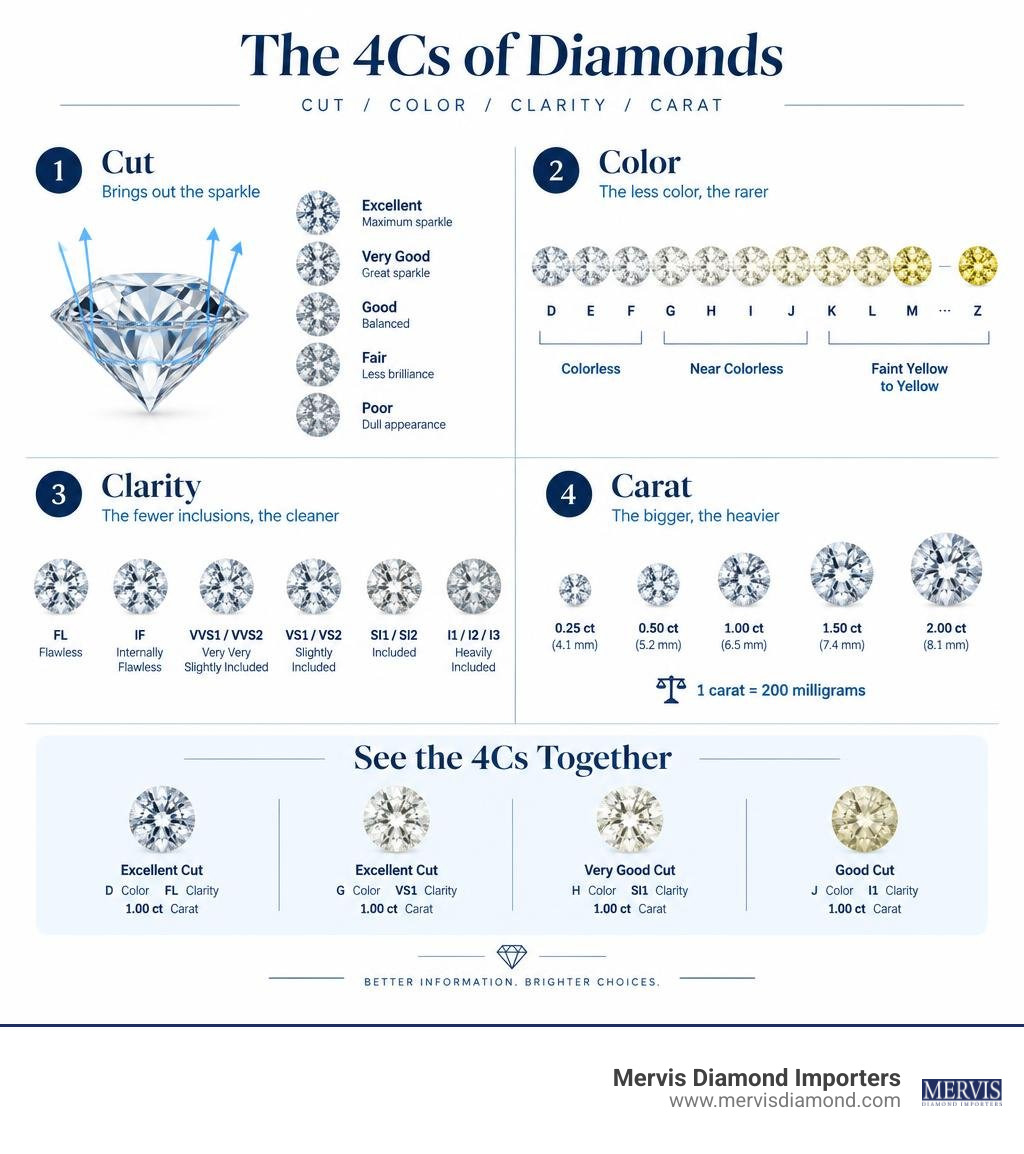
A 4 cs of diamonds chart pdf gives you a fast way to compare diamonds before you buy. Download or print the cheat sheet, then use it to check each diamond's cut, color, clarity, and carat weight side by side with its grading report.
Use it to:
- Put the diamond's grades in context, from D-to-Z color and FL-to-I3 clarity.
- Compare two stones with the same budget but different strengths.
- Prioritize cut for sparkle, then choose color, clarity, and carat weight that look right to you.
- Ask clear questions without relying only on a sales description.
The 4Cs are the shared language of diamond quality. Carat measures weight, with one carat equal to 200 milligrams. Color and clarity describe how colorless and how clean a diamond appears. Cut controls how well it returns light, which is why it has such a large effect on brightness, fire, and sparkle.
A chart is a useful shopping tool, not a substitute for an independent grading report. Bring it with you, compare the report details, and focus on the trade-offs you can actually see.
I'm Morris Mervis, and this guide will help you use the 4Cs to choose confidently without paying for qualities that do not matter to you.
Why You Need a 4 Cs of Diamonds Chart PDF When Shopping
Walking into a showroom or browsing thousands of stones online can quickly feel overwhelming. Diamond terminology involves technical scales, subtle color variances, and fractional measurements that directly dictate pricing. Having a reference sheet transforms a complex purchase into a structured, objective process.
When you bring a quick-reference guide along, you gain immediate pricing transparency. Instead of wondering why two diamonds of the exact same carat weight carry radically different price tags, you can instantly see how cut precision or a single grade jump in clarity shifts market value.
Before committing to a purchase, understanding the four things you need to know before buying a diamond ensures you focus on what visibly elevates a stone's beauty. Reputable organizations make these standards accessible through tools like GIA's Download Diamond Guide | PDF Charts, giving shoppers an objective baseline to evaluate gems on the spot.
How to Read and Interpret the 4 Cs of Diamonds Chart PDF
A diamond chart organizes the four core pillars into clear tiers. Reading it effectively means understanding how gemological laboratories classify each parameter:
- Carat Weight & Points: Standardized mass where 1 carat equals 100 points (e.g., a 0.75-carat stone is 75 points).
- Color Scale: Evaluated from D (completely colorless) to Z (noticeable light yellow or brown tint).
- Clarity Scale: Categorized from Flawless (FL) down to Included (I1–I3) based on microscopic characteristics visible under 10× magnification.
- Cut Grade: Ranging from Excellent to Poor for standard round brilliant stones, evaluating how facet geometry handles light.
Familiarizing yourself with the foundational 4 Cs to a diamond allows you to translate lab abbreviations—such as VVS1, VS2, or SI1—into practical, real-world visual expectations.
Diamond Grading Reports vs. a Quick-Reference Chart
It is essential to distinguish between a general educational chart and a stone-specific grading report. A reference chart outlines the universal grading tiers, while a certified grading dossier from an independent laboratory documents the precise, verified characteristics of an individual gem.
Only about 20% of all rough diamonds extracted globally meet the gem-quality threshold required for fine jewelry. When assessing authentic mined diamonds, an independent grading dossier provides critical security details, microscopic laser inscription numbers, and a detailed plotting diagram that maps out every internal inclusion and external blemish. Use your printable chart to understand the grading tiers, and rely on the laboratory report to confirm the exact specifications of the stone you are inspecting.
Breaking Down the 4 Cs: Cut, Color, Clarity, and Carat
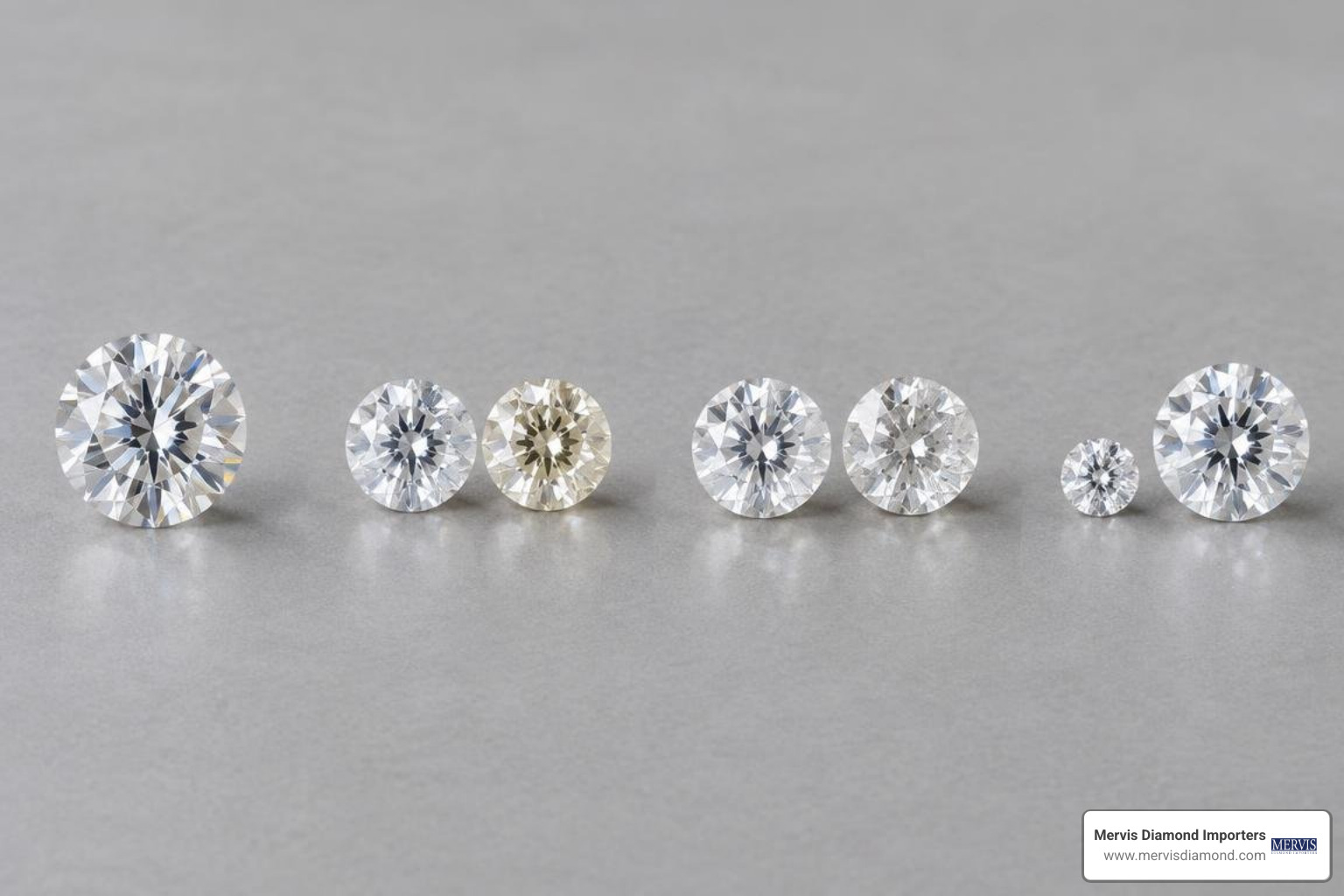
Every diamond's personality and market value stem from the interplay of its four foundational attributes. Understanding how each "C" contributes to the stone's overall presence ensures you never overpay for invisible traits.
Diamond Cut: The Primary Driver of Sparkle
Of all four parameters, cut has the greatest impact on a diamond's visual performance. While nature determines a diamond's raw color, clarity, and rough size, cut is the only human-crafted element.
A master diamond cutter angles each facet to act as a complex series of mirrors. Cut quality evaluates three primary optical components:
- Brilliance: The total amount of white light reflected back to the viewer's eye.
- Fire: The scattering of white light into vivid spectral rainbow colors (dispersion).
- Scintillation: The pattern of light and dark flashes, along with the dynamic sparkle produced when the stone or light source moves.
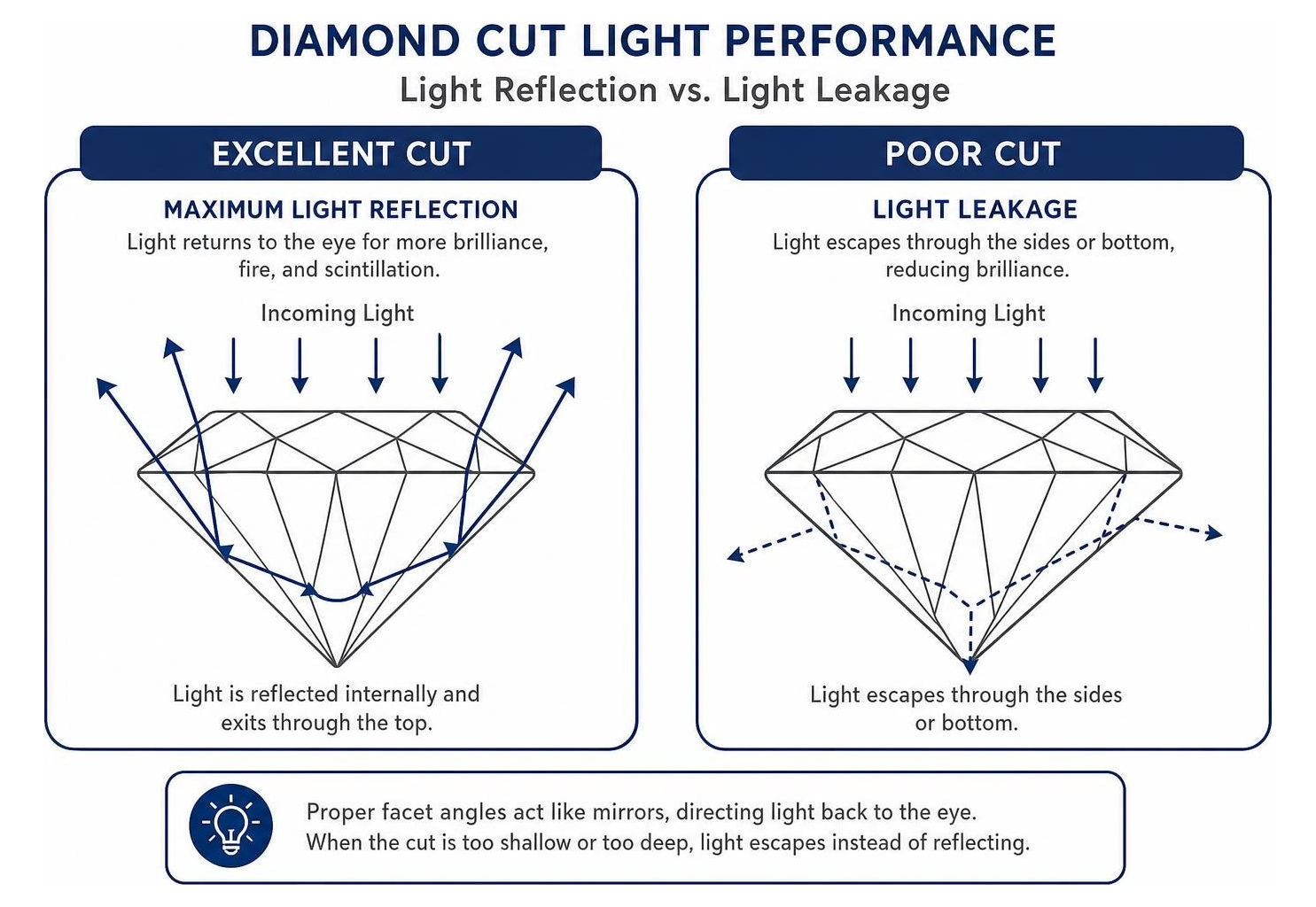
To understand which diamond cut sparkles the most, look closely at facet proportions. When a diamond is cut too shallow or too deep, light escapes through the sides or bottom of the pavilion rather than reflecting back up through the crown table. Examining the relationship between cut and light leakage shows why an Excellent cut grade can make even an average-color stone look vibrant and luminous.
Diamond Color: From D-Colorless to Z-Tinted
The industry-standard color grading scale measures the absence of color in white diamonds. Laboratories evaluate loose stones face-down against standardized master stones under controlled lighting environments.
- Colorless (D–F): Exceptionally rare with no discernible body color. D is the purest grade.
- Near Colorless (G–J): Appears bright white to the naked eye, especially once set in jewelry, while offering exceptional value.
- Faint to Light Tint (K–Z): Displays progressively noticeable yellow, grey, or warm brown hues.
When discovering what is a white diamond, keep in mind that pure colorlessness commands a steep premium. While natural fancy colored stones—such as vivid blues, pinks, and greens—belong to an entirely different grading structure where saturated color is prized, discerning buyers often ask what color diamond is the most expensive to understand why D-color natural stones sit at the top of the standard price pyramid.
Diamond Clarity: Identifying Inclusions and Blemishes
Diamond clarity grades the purity of a stone by assessing internal inclusions (crystals, feathers, clouds, pinpoints) and external surface blemishes. Formed 150 to 200 kilometers beneath the Earth's surface under extreme heat and pressure, nearly all natural diamonds carry microscopic geological fingerprints.
The clarity scale includes 11 specific grades evaluated under 10× magnification:
- FL / IF (Flawless / Internally Flawless): Zero internal characteristics visible under 10× magnification.
- VVS1 / VVS2 (Very, Very Slightly Included): Inclusions are extremely difficult for a trained gemologist to locate under 10× magnification.
- VS1 / VS2 (Very Slightly Included): Minor inclusions that are difficult to locate under magnification and completely invisible to the naked eye.
- SI1 / SI2 (Slightly Included): Noticeable under magnification; SI1 diamonds are typically eye-clean, offering outstanding value.
- I1, I2, I3 (Included): Inclusions are obvious under magnification and often visible to the unaided eye, which can affect durability and brilliance.
For rings and fine jewelry, selecting an "eye-clean" stone—where inclusions cannot be seen without a jeweler's loupe—lets you avoid paying for Flawless grades without sacrificing visual appeal. When selecting everyday pieces, evaluating good color and clarity for diamond earrings illustrates why smart clarity choices keep costs balanced.
Diamond Carat Weight: Points, Milligrams, and Value Impact
Carat is strictly a measure of physical weight, not diamond dimensions. One metric carat equals 200 milligrams (0.2 grams). For smaller diamonds, gemologists divide a carat into 100 points, so a 50-point stone weighs exactly 0.50 carats.
Because larger rough crystals are mined far less frequently than smaller ones, diamond pricing increases exponentially rather than linearly. A single 2.0-carat diamond costs significantly more than two 1.0-carat diamonds of identical color, cut, and clarity.
Physical dimensions can also vary depending on the diamond's shape and proportion. For example, elongated shapes like ovals or marquise cuts spread their carat weight across a larger surface area, appearing visually larger than a standard round brilliant of identical weight. Consulting a 2ct oval diamond ring guide or reviewing a three carat diamond cost breakdown illustrates how carat weight, shape, and cut depth combine to determine market value and face-up appearance.
Smart Trade-Offs: How to Balance the 4 Cs on Any Budget
Optimizing your budget requires strategic trade-offs across the 4Cs. Rather than aiming for top-tier grades in every category, you can prioritize the attributes that directly impact beauty and choose cost-effective grades elsewhere.
| Priority Tier | Target Cut Grade | Target Color Grade | Target Clarity Grade | Best Setting Match | Visual & Value Impact |
|---|---|---|---|---|---|
| Max Sparkle & Value | Excellent / Ideal | G – H (Near Colorless) | VS2 – SI1 (Eye-Clean) | Platinum / White Gold | Looks identical to flawless stones to the unaided eye while maximizing budget. |
| Warm Metal Savings | Excellent / Ideal | I – J (Near Colorless) | SI1 (Eye-Clean) | Yellow / Rose Gold | Warm metal masks slight warmth in the diamond, allowing budget to shift toward higher carat. |
| Ultra-Premium | Excellent / Ideal | D – F (Colorless) | VVS1 – VS1 | Platinum / White Gold | Highest rarity and prestige tier; premium pricing for collector-grade purity. |
| Budget Carat Maximizer | Very Good to Excellent | H – I (Near Colorless) | SI1 – SI2 (Eye-Clean) | Solitaire / Halo | Provides the largest visual surface area while maintaining solid light return. |
Deciding how to balance these parameters comes down to understanding diamond 4C: which is most important? for your personal preferences. Cut should always remain non-negotiable, as an Excellent cut masks slight color tints and minor inclusions by flooding the stone with brilliant light reflection.
Maximizing Sparkle While Saving on Color and Clarity
You can optimize your spend by pairing your center stone with the right precious metal and mounting style. While D-F colorless stones require white gold or platinum to avoid picking up reflected metal warmth, G-J stones blend seamlessly into warm settings.
Learning how to choose a diamond ring setting is one of the most effective ways to maximize your investment. For instance, exploring an oval diamond ring rose gold guide demonstrates how the natural warmth of rose gold complements near-colorless diamonds, allowing you to reallocate savings toward a larger carat weight or an exceptional cut grade.
Diamond Treatments and Lab-Grown Alternatives
When shopping for diamonds, verify whether a stone has undergone artificial enhancements:
- Laser Drilling: Microscopic channels drilled into a diamond to reach and bleach dark inclusions.
- Fracture Filling: Injecting glass-like resin into surface-reaching cracks to improve apparent clarity (can degrade under heat or repair work).
- HPHT Processing: High Pressure, High Temperature treatment used to permanently enhance or alter color.
Industry standards require full disclosure of all treatments on grading reports, as artificial enhancements reduce market value compared to untreated stones.
Many modern couples also explore lab-grown diamonds, which possess the exact same physical, optical, and chemical properties as mined diamonds. If you are evaluating modern options, reviewing are lab diamonds worth it in 2026? provides useful context on modern price structures. Because lab-created stones are pure carbon crystal, asking do lab diamonds pass a diamond tester? confirms that standard thermal testers register them as authentic diamond material.
How to Download and Use Your Printable Diamond Cheat Sheet
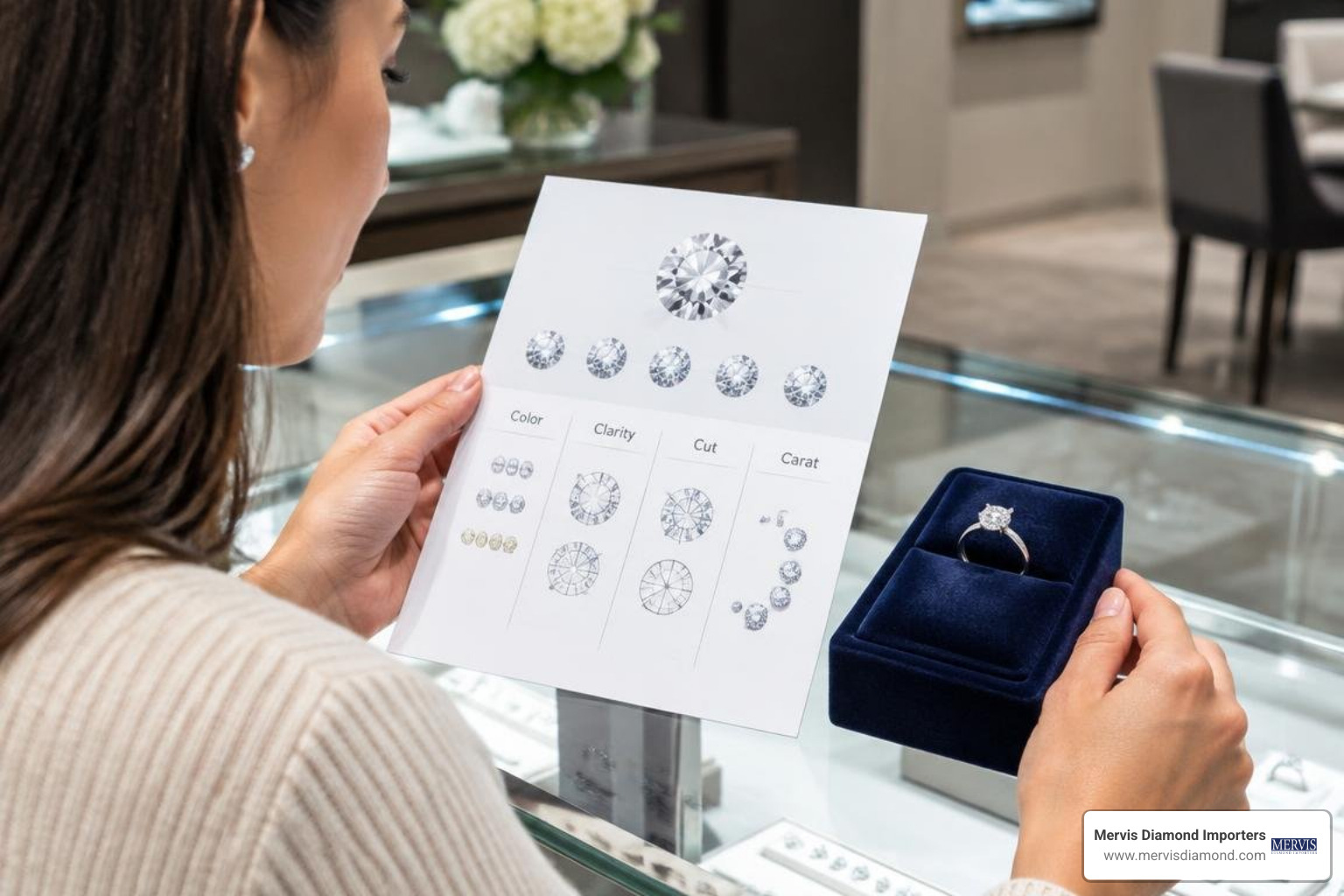
Having a physical or digital cheat sheet during your shopping appointments keeps your evaluation grounded in objective criteria.
Where to Download an Official 4 Cs of Diamonds Chart PDF
To build an accurate reference kit, rely on international gemological grading standards. Download official materials such as the Diamond 4Cs Guide: Carat, Color, Clarity, & Cut Charts alongside GIA documentation. These charts give you standard millimeter-to-carat sizing conversion tables, color comparison spectrums, and clarity mapping symbols.
Step-by-Step Guide to In-Store Diamond Evaluation
When viewing stones in person, use this step-by-step checklist:
- Request the Official Grading Certificate: Confirm the grading report matches the laser inscription number on the diamond's girdle.
- Evaluate Under Varied Lighting: Jewelry showroom spotlights are designed to amplify sparkle. View the stone in neutral, indirect daylight and ambient indoor light to observe true brilliance.
- Inspect with a 10× Loupe: Check the location of inclusions mapped on the grading report to confirm the diamond is eye-clean.
- Assess Shape Proportions: Review how to choose a diamond shape to ensure the stone's length-to-width ratio and table spread match your preferred aesthetic.
Frequently Asked Questions About Diamond Grading Charts
Which of the 4 Cs should I prioritize the most?
Diamond Cut is universally recognized as the most critical C. Even a diamond with flawless clarity and perfect D color will appear dull and lifeless if cut poorly. An Excellent or Ideal cut maximizes light return, giving the stone its sparkle, fire, and brilliance.
Does a 4 Cs diamond chart apply equally to lab-grown diamonds?
Yes. Lab-grown diamonds are graded on the exact same 4Cs scales for cut, color, clarity, and carat weight by major independent gemological laboratories. To see how these grading standards translate into larger modern stones, read our 3 carat lab grown diamond guide.
What is the difference between carat weight and diamond size?
Carat is a measure of weight (1 carat = 200 milligrams), whereas size refers to physical visual dimensions measured in millimeters across the top surface (table spread). A poorly cut diamond may hide excess weight in a deep pavilion, making it look smaller than a properly proportioned stone of the same carat weight.
Conclusion
A printable 4Cs cheat sheet is one of the most effective tools for navigating the diamond market with clarity and confidence. By understanding how cut, color, clarity, and carat weight balance one another, you can focus on the qualities that create true visual beauty while staying comfortably within your budget.
At Mervis Diamond Importers, we believe finding the perfect stone should be an enjoyable, pressure-free experience. Our master diamond specialists hand-select each natural and lab-grown diamond to ensure exceptional cut precision, light return, and eye-clean purity.
To explore our curated collection and learn more about understanding the four Cs, schedule a personalized consultation at one of our showrooms in Tysons, VA, Rockville, MD, or Washington, DC. We look forward to helping you find a diamond you will treasure for a lifetime.