

From Halo to Solitaire: Finding the Best Cushion Cut Settings
The Best Cushion Cut Settings at a Glance
From Halo to Solitaire: Finding the Best Cushion Cut Settings
The best cushion cut settings balance the stone's soft, rounded shape with a mounting that protects it, maximizes its light, and matches your personal style. Here are the top options:
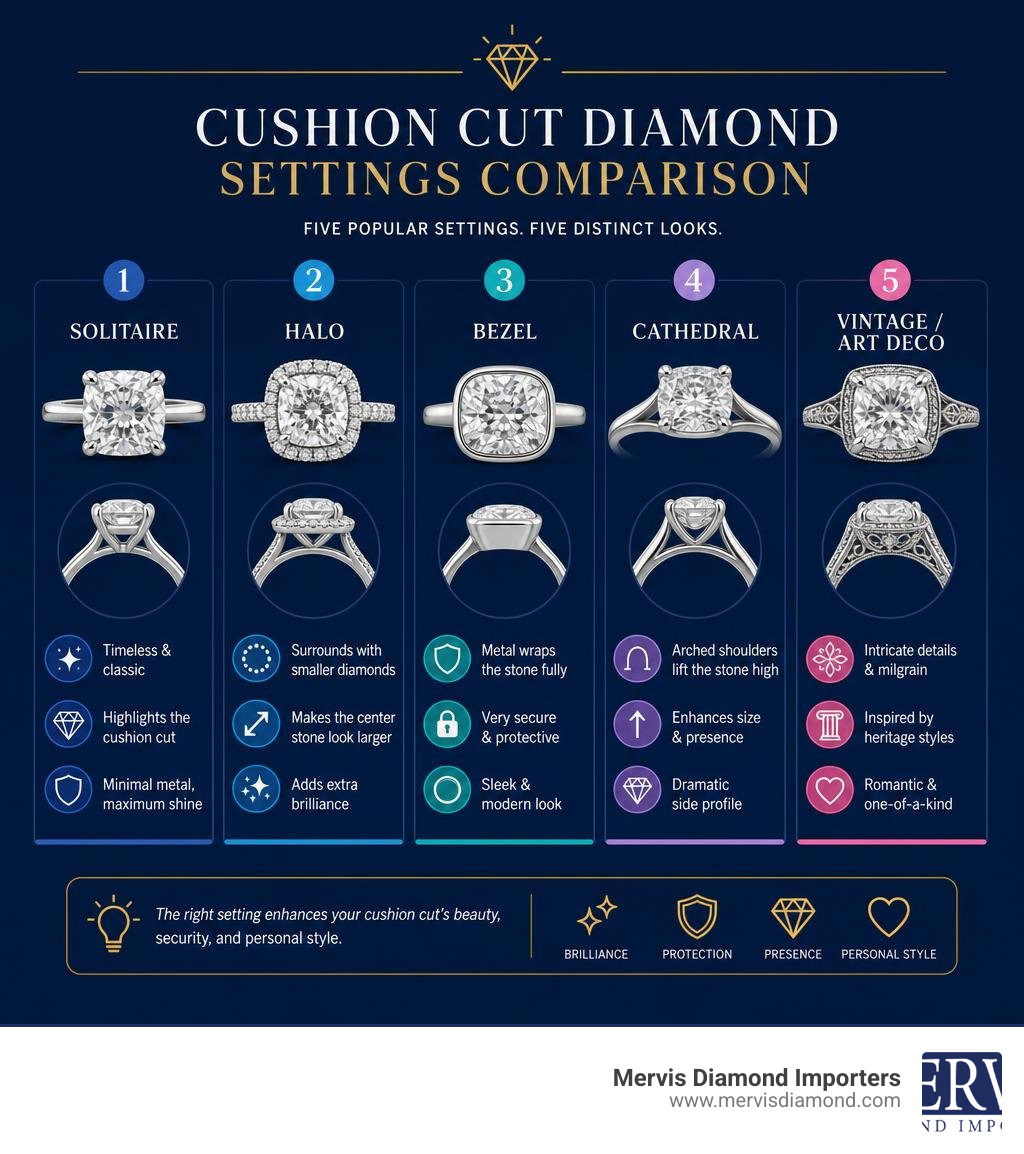
- Classic Solitaire - Clean, timeless, lets the cushion shine on its own
- Halo - Surrounds the stone with smaller diamonds; makes it look larger
- Hidden Halo - Subtle sparkle visible only from the side; modern and personal
- Micropavé - Tiny diamonds along the band; adds brilliance without overpowering
- Double Halo - Two rings of accent diamonds for maximum presence
- Split Shank - Divided band adds drama and visual width
- Bezel - Metal wraps the stone fully; sleek, modern, and very secure
- Cathedral - Arched shoulders lift the stone high; dramatic side profile
- Vintage / Art Deco - Filigree and milgrain detailing echo the cut's historical roots
There's a reason cushion cut diamonds have stayed popular for so long. Their pillow-shaped silhouette — soft corners, generous facets, a warm glow — sits somewhere between vintage heirloom and modern statement piece. They're sometimes called candlelight diamonds because of the way they scatter light in a soft, romantic way.
But here's the thing most buyers don't realize: the setting matters more for cushion cuts than almost any other shape. Unlike round brilliants, cushion cuts don't have a standardized GIA cut grade. That means the setting you choose does a lot of the heavy lifting — it affects how much light the stone gets, how large it appears, how secure it is, and how well it holds up to daily wear.
Whether you're drawn to a simple four-prong solitaire or a bold double halo, this guide walks you through every major option — what each setting does for the stone, who it's best for, and what to watch out for.
Why Cushion Cut Diamonds Require Special Setting Considerations
To choose the best cushion cut settings, we first need to understand the unique anatomy of this beautiful shape. A cushion cut diamond is essentially a square or rectangular stone with gently rounded corners. It has a rich history, evolving from the classic "old mine cut" that dominated the 1800s.
Because early cushions were designed to catch the soft glow of candlelight rather than harsh electric bulbs, they possess a distinct visual personality. They display larger, chunkier flashes of fire rather than the tiny, uniform needle-sparkles of a round brilliant. To learn more about this shape's background, you can read our guide on What is a Cushion Cut Diamond.
However, because cushion cuts sit deeper than other shapes, they require careful setting considerations. A cushion cut carries a significant portion of its weight in its pavilion (the lower half). If a cushion is cut too deep, it will "hide" its carat weight, looking smaller from the top than a round diamond of the identical weight.
To help visualize how the cushion cut stacks up against other popular choices, we have put together a comparison:
| Diamond Shape | Sparkle Style | Size Perception | Corner Profile | Best Setting Match |
|---|---|---|---|---|
| Cushion Cut | Warm, fiery, chunky flashes | Faces up slightly smaller due to depth | Rounded (low risk of chipping) | Solitaire, Halo, Bezel, Cathedral |
| Round Brilliant | Maximum white light brilliance | Faces up true to size | None (circular) | Solitaire, 4-Prong, 6-Prong |
| Oval Cut | Elongated, modern brilliance | Faces up larger than actual weight | Rounded ends | Solitaire, Hidden Halo, 4-Prong |
| Princess Cut | Sharp, geometric brilliance | Faces up true to size | Sharp 90-degree corners (high chip risk) | V-Prongs, Bezel |
| Radiant Cut | Crushed-ice, intense sparkle | Faces up slightly larger | Beveled corners | 4-Prong, Split Shank |
As you can see, the rounded corners of a cushion make it inherently more durable and less prone to chipping than a princess or marquise cut. This durability opens up a world of design possibilities, from ultra-minimalist bands to intricate vintage mountings, making these romantic silhouettes a highly sought-after choice for modern engagement rings.
The Best Cushion Cut Settings for Every Style
Finding the perfect ring is all about matching the setting to your personal aesthetic and lifestyle. The mount you select acts as the frame for your diamond artwork.

Whether you prefer a clean, modern look or something with antique flair, we recommend exploring our A Comprehensive Guide to Engagement Ring Settings and learning How to Choose a Diamond Ring Setting to understand the technical details. Let’s dive into the most popular settings for cushion cuts and how they impact the diamond's overall appearance.
Classic Solitaire: The Best Cushion Cut Settings for Minimalists
For the purist, nothing compares to a classic solitaire. It places the focus entirely on the center stone. Because a solitaire uses minimal metal, it allows maximum light to enter the diamond from all angles, amplifying its natural fire.
When opting for a solitaire cushion cut, we highly recommend a four-prong basket with claw prongs. Claw prongs taper to a fine point, which minimizes the appearance of the metal on the stone and accentuates the cushion's soft, rounded corners.
That "solitaire" doesn't have to mean plain or boring. As we explain in our post, Solitaire Doesnt Mean Single Stone, you can add hidden personality to a solitaire through unique metal choices or subtle design tweaks. For instance, pairing a platinum basket with a warm 18k yellow gold band creates a beautiful mixed-metal contrast that makes the diamond pop.
Hidden Halo and Micropavé: The Best Cushion Cut Settings for Modern Sparkle
If you want a ring that feels contemporary but still packs a serious punch of sparkle, a hidden halo paired with a micropavé band is an outstanding combination.
- The Hidden Halo: Unlike a traditional halo that sits flush around the perimeter of the diamond, a hidden halo wraps around the base of the prongs, just beneath the center stone. It is a delightful, private detail that is visible primarily from the side profile. It catches light beautifully without altering the face-up silhouette of your cushion.
- Micropavé Bands: Micropavé settings utilize highly precise, scalloped metal work to hold tiny accent diamonds in place with almost invisible prongs. This allows light to flood the accent stones, creating a continuous ribbon of light along the band.
To understand how pavé bands differ from other accent styles, check out Pave and Channel Set Engagement Rings Whats the Difference. The combination of a delicate pavé band and a hidden halo is highly favored because it adds brilliance while maintaining a sleek, modern profile. You can explore this design further in our article on Halo Style Engagement Rings Beauty Innovation.
Bold Halos and Split Shanks: Maximizing Size and Presence
For those who believe there is no such thing as too much sparkle, a traditional halo or a double halo setting is the ultimate choice.
A standard halo surrounds the cushion cut diamond with a seamless frame of smaller pavé diamonds. Because the soft corners of a cushion blend naturally into a circular or softly squared halo, it creates a gorgeous "blurring" effect that can make your center stone look up to a full carat larger than its actual weight.
If you want to take this look to the next level, a double halo adds a second tier of diamonds, delivering dramatic presence on the hand. To balance the visual weight of a larger halo, we often recommend pairing it with a split shank band. A split shank divides into two as it approaches the center head, drawing the eye inward and creating an elegant, balanced frame for a show-stopping center diamond.
Architectural Romance: Cathedral, Bezel, and Vintage Settings
If you love structural elegance or historical romance, these settings offer incredible character and durability:
- Cathedral Settings: A cathedral setting uses graceful metal arches rising from the band to support the center stone's basket. This architectural design lifts the diamond 2 to 3 millimeters higher than a standard low-profile mount. This elevation creates a stunning side profile and allows "ventilation channels" underneath, which can boost light return by nearly 8% for well-proportioned cushions.
- Bezel Settings: The bezel setting is incredibly popular heading into 2026. Instead of prongs, a thin rim of precious metal completely wraps around the diamond's edge. This creates a highly secure, snag-free, and ultra-modern look. It is perfect for active lifestyles and highlights the cushion's pillow-like silhouette in a bold, sculptural way.
- Vintage and Art Deco Settings: Given the cushion cut’s historic roots, it pairs naturally with vintage-inspired mountings. These settings often feature intricate hand-engraving, milgrain (tiny metal beads), and delicate filigree work.
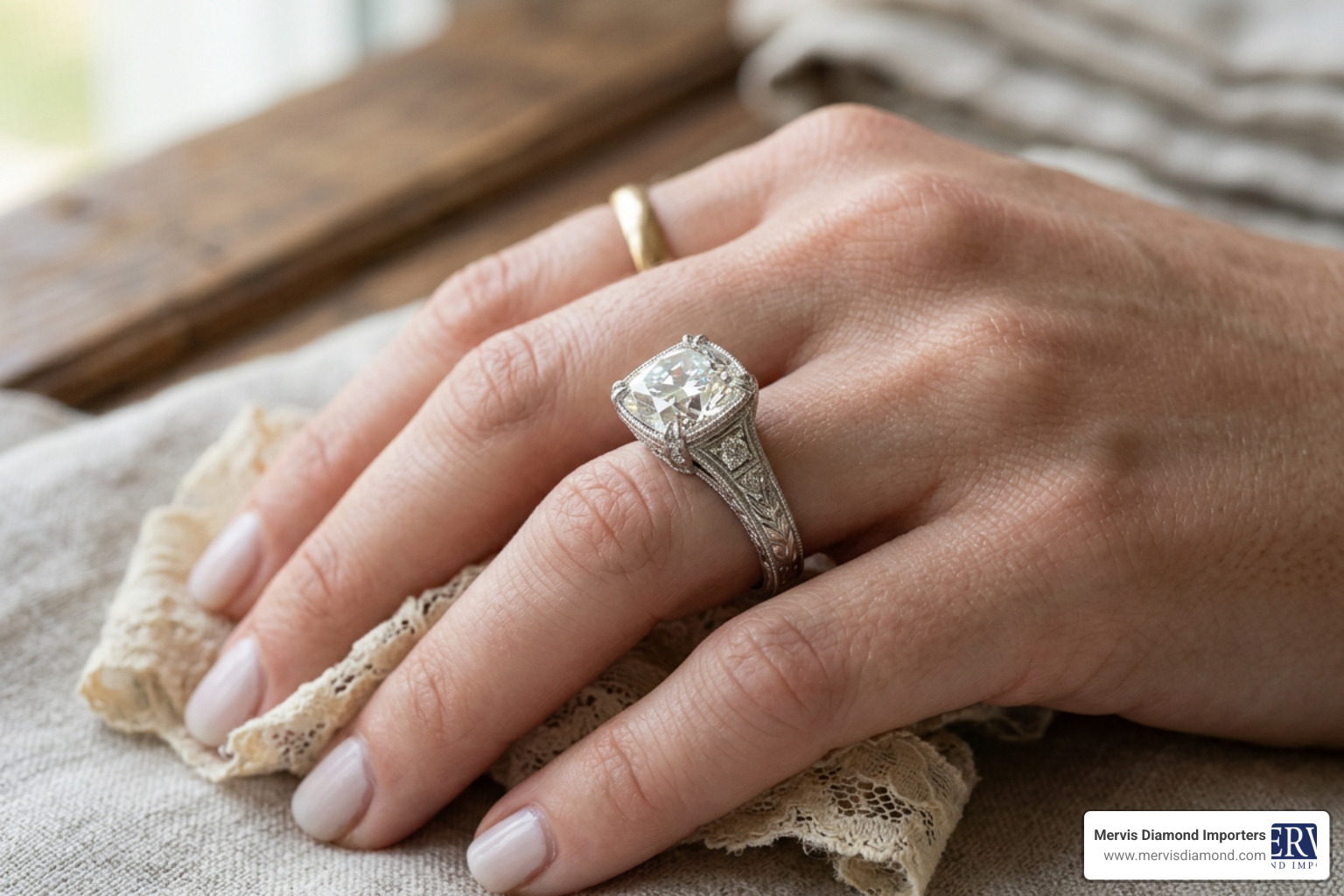
These design elements pay tribute to the classic "old mine" era while offering the structural integrity of modern jewelry manufacturing. This makes vintage-inspired settings an exceptional choice for showcasing the unique character of a cushion cut diamond.
Evaluating Cushion Cut Quality: Cut, Color, and Clarity
Because the Gemological Institute of America (GIA) does not assign an official "Cut Grade" to fancy shapes like cushion cuts, you must look at specific proportions and quality factors to find a stone that performs beautifully in your chosen setting.
Here are the key metrics we recommend keeping in mind:
- Depth and Table Percentages: To ensure your cushion cut has excellent light return and doesn't look too small, aim for a depth of 62% to 68% and a table size of 58% to 66%. Cushions with a depth exceeding 70% hold too much weight in their bottom half, making them appear significantly smaller from the top.
-
Length-to-Width Ratio: This is entirely a matter of personal preference, but it changes the look of your setting completely:
- For a classic square cushion, look for a ratio under 1.05.
- For an elongated cushion (which mimics the lengthening effect of an oval), look for a ratio between 1.10 and 1.20.
- Clarity Sweet Spots: Cushion cuts are excellent at dispersing light, which helps mask minor inclusions. VS1 clarity accounts for roughly 27% of cushion purchases, and VS2 accounts for 25%. These two grades represent the absolute sweet spot for value—they are completely eye-clean to the naked eye while costing far less than VVS or Flawless stones.
-
Color Retention and Metal Pairing: Unlike round brilliant diamonds, cushion cuts hold onto their body color more easily due to their larger facets. Therefore, your choice of metal matters:
- White Metals (Platinum/White Gold): To keep the stone looking icy white, prioritize D-F color grades.
- Warm Metals (Yellow/Rose Gold): You can comfortably drop to a G-I (or even J) color grade. The warm metal will complement the natural undertones of the diamond, saving you a significant amount of your budget.
Understanding these proportions and how they interact with light will help you avoid common buying mistakes and ensure you select a cushion cut diamond that performs beautifully in your chosen setting.
Practical Considerations: Security, Comfort, and Budget
Designing your dream ring isn't just about aesthetics; it also has to fit your everyday life and budget.
- Prong Security and Daily Wear: Because the cushion cut has rounded corners, it is highly durable. However, we always want to make sure your stone is held securely. A four-prong setting is excellent for stones under 1.5 carats, but for larger diamonds, a six-prong basket or a bezel setting provides extra peace of mind.
- Wedding Band Compatibility: If you want your wedding band to sit completely flush against your engagement ring, look for a "flush-fit" solitaire or a cathedral setting. Low-profile halo settings often require a curved or contoured wedding band to avoid a gap. You can explore how to coordinate your set in our guide on Wedding Band Engagement Ring Match.
- Budget and Diamond Type: One of the greatest advantages of choosing a cushion cut is the price. Cushion cuts typically cost 20% to 30% less per carat than comparable round brilliants. This is because diamond cutters retain more of the rough diamond crystal during the cutting process.
- Natural vs. Lab-Grown: If you want to maximize your budget, lab-grown cushion diamonds are chemically, physically, and optically identical to natural diamonds but cost 60% to 80% less. This allows you to allocate more of your budget toward a highly detailed, luxurious setting.
Frequently Asked Questions about Cushion Cut Settings
Do cushion cut diamonds look smaller than round diamonds?
Yes, cushion cut diamonds of the identical carat weight can appear slightly smaller than round diamonds. This is because cushion cuts are a deeper shape, meaning more of their weight is held in the bottom of the stone. To ensure your cushion has a great visual spread, look for a depth percentage between 62% and 68%, and avoid stones with a depth over 70%.
What is the most secure setting for a cushion cut diamond?
The bezel setting is the most secure option because a solid band of metal completely surrounds the edge of the stone, protecting it from any potential bumps or snags. If you prefer a classic prong look, a four-prong basket with thick claw prongs provides exceptional security for daily wear.
Which metal color looks best with a cushion cut diamond?
It depends on your diamond's color grade. If you have a colorless diamond (D-F), platinum or white gold will highlight its icy white brilliance. If you choose a nearly colorless diamond (G-J), yellow gold or rose gold looks spectacular because the warm metal complements the diamond's natural warmth, making any slight body color virtually invisible.
Conclusion
At Mervis Diamond Importers, we believe that choosing an engagement ring is a deeply personal journey. The cushion cut diamond offers an unmatched blend of historic romance and modern performance, but finding the best cushion cut settings requires a thoughtful balance of proportions, security, and personal style.
Whether you are looking to explore a classic, minimalist solitaire or a custom-designed cathedral setting, our team is here to guide you with expert, pressure-free service. We hand-select only the highest-quality natural and lab-grown diamonds to ensure your ring sparkles for a lifetime.
If you are ready to take the next step, we invite you to visit us at one of our convenient showrooms in Tysons, VA, Rockville, MD, or Washington, DC. You can also read more about this classic shape in our blog post, What is a Cushion Cut Diamond, or book a personalized consultation with us today to start designing your dream ring.