

How to Choose Flawless Emerald Cut Diamond Proportions Every Time
Why Emerald Cut Diamond Proportions Make or Break Your Stone
Emerald cut diamond proportions are the single biggest factor controlling how beautiful — or disappointing — your stone looks in real life.
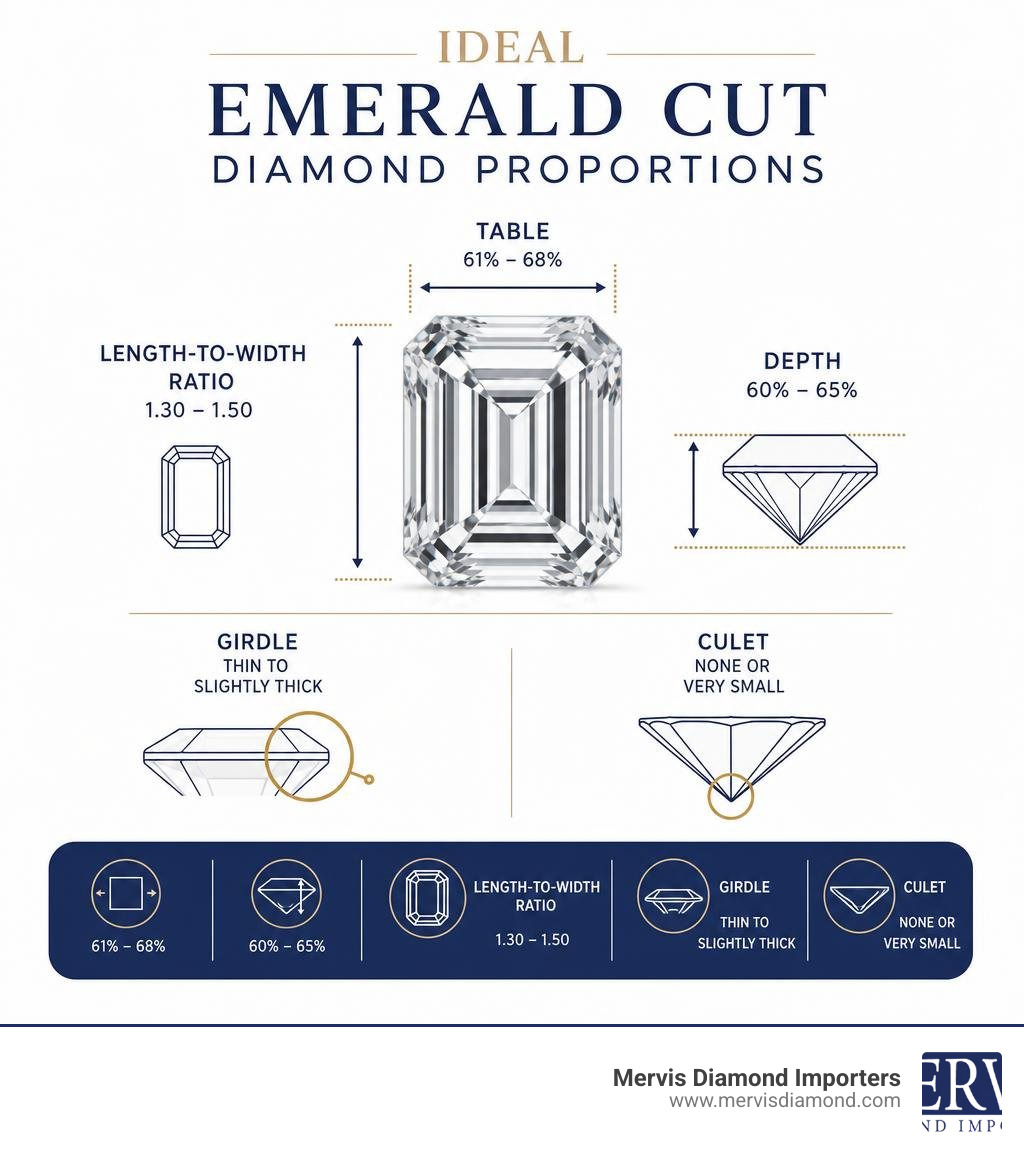
Here's a quick-reference summary of ideal proportions before we dive deeper:
| Proportion | Excellent Range | Avoid |
|---|---|---|
| Table % | 61–68% | Below 59% or above 70% |
| Depth % | 60–65% | Below 57% or above 68% |
| Length-to-Width Ratio | 1.30–1.50 | Below 1.20 or above 1.60 |
| Girdle Thickness | Thin to Slightly Thick | Extremely Thin or Very Thick |
| Culet | None or Very Small | Large or Extremely Large |
| Polish & Symmetry | Excellent or Very Good | Good or below |
Unlike round brilliant diamonds, emerald cuts are step-cut stones. They produce long, elegant flashes of light — the famous "hall of mirrors" effect — rather than the continuous sparkle of a round. That beauty is entirely dependent on getting the proportions right.
The challenge? The GIA does not assign a cut grade to emerald cuts. That means there's no single certificate number to rely on. You have to know what to look for yourself.
Emerald cuts have surged in popularity — searches have grown 95% since 2020 — and they now represent roughly 12% of the diamond market. More buyers are choosing them, but many are still selecting stones with proportions that quietly kill the light performance.
This guide will show you exactly what to look for.
Understanding Ideal Emerald Cut Diamond Proportions
To truly appreciate how emerald cut diamond proportions impact your ring, we must first understand the anatomy of a step cut. Unlike brilliant cuts (such as rounds, ovals, or cushions) which feature triangular and kite-shaped facets designed to scatter light in every direction, the emerald cut relies on long, rectangular facets arranged parallel to the girdle.
Because there are fewer facets to break up light, any structural deviation in the diamond is immediately visible. A poorly proportioned brilliant cut might lose a bit of its sparkle, but a poorly proportioned emerald cut will look completely lifeless, resembling a flat piece of glass.
When you look at a grading report from the Gemological Institute of America (GIA), you will notice there is no overall "Cut Grade" listed. While the GIA provides an official cut grade for round brilliants, it does not do so for fancy shapes like emerald cuts. Instead, the report only grades Polish and Symmetry. While these two metrics are highly important, they do not tell you if the stone's physical dimensions are balanced enough to produce beautiful light return. To make an educated choice, you must learn to navigate these proportions yourself. If you are still deciding on the perfect silhouette for your ring, you can read our guide on Selecting the Right Diamond Shape to see how the step cut compares to other popular options.
How Table and Depth Percentages Define Emerald Cut Diamond Proportions
The two most critical percentages on any diamond grading report are the table percentage and the depth percentage. Together, they dictate how light enters the stone, bounces off the interior pavilion facets, and exits back to your eye.
The table percentage is calculated by dividing the width of the large, flat top facet (the table) by the overall width of the entire diamond. For an emerald cut, the ideal table percentage should fall between 61% and 68%. Interestingly, market data from June 2026 shows that the most popular table percentage selected by buyers is a tie between 64% and 65%. If the table is too wide (over 70%), the diamond will lose its crown height, resulting in a flat, glass-like appearance. If the table is too narrow (under 59%), the stone can look bulky and fail to showcase the clean, geometric lines that define the shape.
The depth percentage is calculated by dividing the physical depth of the stone (from the table to the culet) by its overall width. The recommended depth percentage for an excellent cut is 60% to 65%. However, many beautiful stones stretch up to 68% or 69% while still maintaining exceptional beauty. In fact, retail sales data indicates that the most popular depth percentage for emerald cuts is a tie between 68.4% and 68.5%.
If the depth percentage falls outside these optimal ranges, you run into two major optical issues:
- Windowing: This occurs when the stone is cut too shallow (usually under 58% depth). Instead of reflecting light back to your eye, the flat pavilion facets allow light to pass directly through the bottom of the diamond. If you hold a windowed diamond over your finger, you will be able to see the color of your skin directly through the center of the stone.
- Extinction: This happens when the stone is cut too deep (often over 70%). Light becomes trapped inside the diamond and leaks out the sides, creating dark, dead zones that look completely black from the face-up view.
By sticking to verified emerald cut guidelines, you can ensure your diamond strikes the perfect balance between light reflection and depth.
How Length-to-Width Ratios Impact Emerald Cut Diamond Proportions
The length-to-width (L/W) ratio determines the overall footprint and visual personality of your diamond. To find this ratio, simply divide the millimeter length of the stone by its millimeter width. For example, an emerald cut that is 8.00 mm long and 5.70 mm wide has an L/W ratio of 1.40.
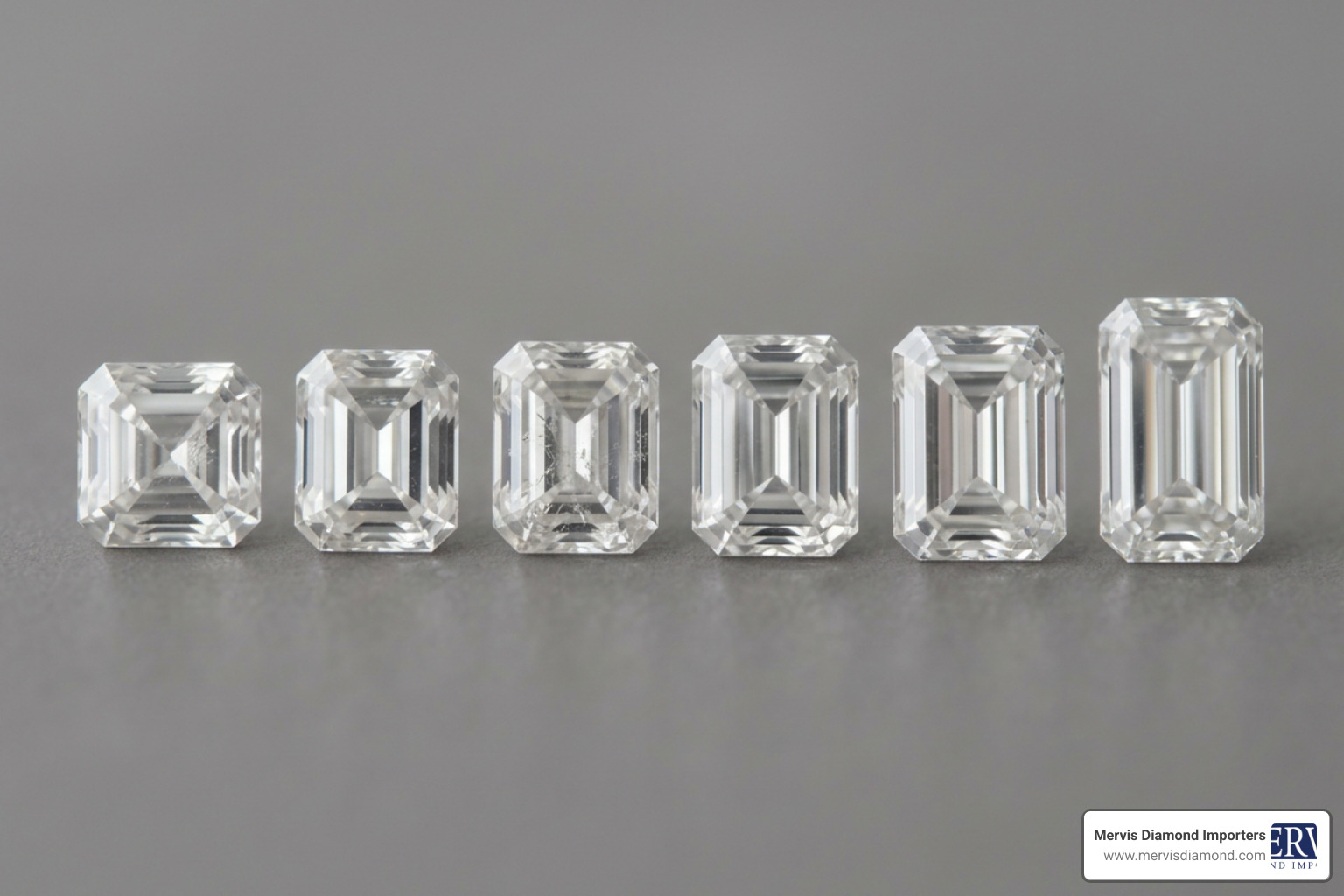
There is no single "correct" ratio, as this is largely a matter of personal style. However, the ratio you choose will completely alter how the stone sits on the finger:
- 1.25 to 1.35 (Compact and Squarish): These stones have a bolder, more compact look. The most popular ratio in this range is 1.35, which is the single most sought-after ratio on the market. It offers a subtle elongation without feeling too narrow.
- 1.40 (The Classic Proportion): Historically considered the "golden ratio" for emerald cuts, a 1.40 ratio provides the perfect balance of length and width. It is highly recognizable and looks stunning in almost any setting style.
- 1.50 (Noticeably Elongated): This ratio offers a sleeker, more modern silhouette. It is incredibly flattering on the hand because it creates an elegant, lengthening illusion.
- 1.55 to 1.65 (Dramatic and Finger-Flattering): These highly elongated stones make a bold statement. However, you must be careful; stones in this range can sometimes appear too narrow if they are set in thick metal bands, and they require highly precise cutting to avoid light leakage in the center.
When selecting a ratio, consider the shape of the wearer's hand. Shorter fingers are beautifully complemented by more elongated ratios (1.45 to 1.55) because they create a slimming visual effect. Conversely, longer, slender fingers look exceptional with classic or slightly wider ratios (1.30 to 1.40). For a deeper dive into how these ratios look in real life, you can explore detailed resources on emerald cut ratios explained.
Recommended Girdle Thickness and Culet Size
Two often-overlooked metrics on a GIA report are girdle thickness and culet size. Both have a massive impact on the diamond’s durability and face-up beauty.
The girdle is the narrow outer edge of the diamond that separates the crown (top) from the pavilion (bottom). It acts as the primary setting edge where the prongs grip the stone. For an emerald cut, we recommend a girdle thickness of Thin, Medium, or Slightly Thick.
- Avoid Extremely Thin girdles: Because emerald cuts have sharp, blocked corners, an extremely thin girdle makes the stone highly vulnerable to chipping during the setting process or during daily wear.
- Avoid Thick or Very Thick girdles: A thick girdle adds dead weight to the diamond. You will end up paying for carat weight that is hidden along the side of the stone rather than contributing to its face-up physical size.
The culet is the tiny facet at the very bottom tip of the diamond. In modern cutting practices, the ideal culet size is None or Very Small. Because the emerald cut has a large, clear table facet, a larger culet will look like a dark, distracting point right in the middle of your stone, completely ruining the clean geometric symmetry of the step cuts.
Light Performance and the Hall of Mirrors Effect
The visual magic of an emerald cut is entirely different from a round brilliant. Brilliant cuts are designed to produce "fire" (rainbow flashes) and "scintillation" (sparkle). An emerald cut, however, produces a mesmerizing hall of mirrors effect.
This effect relies on the alternating play of light and dark bands across the long, parallel facets. When you move the stone, these concentric rectangles should flash "on" and "off" in a crisp, rhythmic pattern.
To achieve this distinct optical performance, the crown height and pavilion depth must work in perfect harmony. Specifically, a crown height of 11% to 14% paired with a pavilion depth of 42% to 45% creates the absolute sharpest contrast and light return. If either of these measurements is off, the reflections will appear blurry, washed out, or completely dark.
Why Cut Quality is Paramount for Step Cuts
With brilliant cuts, a skilled cutter can hide minor structural flaws or tiny inclusions beneath a sea of sparkling facets. Step cuts offer no such luxury. Every facet is a flat, polished mirror. If the angles are off by even a fraction of a degree, the light performance collapses.
This is why cut quality is the single most important factor when choosing an emerald cut. A poorly cut stone will suffer from severe windowing, making it look cheap and lifeless.
To test for windowing yourself, you can perform a simple "finger test." Hold the loose diamond flat over your hand. If you can clearly see the outline of your finger or the lines of your skin through the top table facet, the diamond is acting like a window rather than a mirror. A well-cut emerald cut should reflect enough light to completely obscure whatever is directly beneath it. If you love the look of step cuts but prefer a square silhouette, you might also want to read about What is an Asscher Cut Diamond, which shares this beautiful geometric faceting but in a symmetrical square shape.
Selecting the Best Color and Clarity Grades
Because the emerald cut features a broad, open table and long, unobstructed facets, it is incredibly revealing. Inclusions and body color cannot hide.
When it comes to clarity, we generally recommend a minimum grade of VS2 for stones under 1.5 carats. This is often considered the "Goldilocks" grade because it offers an eye-clean appearance without the heavy price premium of higher grades. For stones over 2.0 carats, we recommend stepping up to VS1 or VVS2 because the larger table facet acts like a magnifying glass, making even tiny inclusions visible to the naked eye. To learn more about how to balance clarity with your budget, check out our guide on What Diamond Clarity is Best.
Color is also highly visible in step cuts. While brilliant cuts scatter light to mask slight yellow tints, step cuts gather and reflect light in broad sheets, showcasing the diamond's true body color.
- If you plan to set your diamond in Platinum or White Gold, we recommend a color grade of G or H to ensure it looks icy white.
- If you prefer Yellow Gold or Rose Gold, you can comfortably drop to an I or J grade, as the warm metal will naturally mask the slight warmth in the stone.
Comparing Emerald Cuts to Other Diamond Shapes
To understand why so many buyers are drawn to the emerald cut, it helps to see how it compares directly to other popular options on the market in terms of dimensions, light performance, and value.
| Diamond Shape | Facet Style | Visual Size Illusion | Average Price (Relative to Round) | Primary Optical Effect |
|---|---|---|---|---|
| Emerald Cut | Step Cut | Looks ~5% Larger | 20% to 33% Cheaper | Hall of Mirrors / Flash |
| Round Brilliant | Brilliant Cut | Standard | Base Price (Most Expensive) | Intense Sparkle / Fire |
| Cushion Cut | Modified Brilliant | Looks Slightly Smaller | 25% to 35% Cheaper | Soft Sparkle / Crushed Ice |
As you can see, the emerald cut offers a highly sophisticated alternative to traditional shapes. To see how these shapes rank in overall popularity, you can read our breakdown of The 3 Most Popular Diamond Shapes.
Value and Visual Size Advantages
One of the greatest benefits of choosing an emerald cut is the incredible value it offers. Because cutting a round brilliant diamond wastes a significant portion of the rough diamond crystal, round diamonds carry a heavy price premium. Emerald cuts, on the other hand, closely mimic the natural cubic shape of rough diamond crystals, meaning far less weight is lost during the cutting process. As a result, an emerald cut diamond typically costs 20% to 33% less than a round brilliant of equivalent carat weight, color, and clarity.
Furthermore, emerald cuts offer a fantastic visual illusion. Because they are cut shallower than rounds and feature an elongated shape, they distribute their weight horizontally. This means an emerald cut will actually appear about 5% larger face-up than a round brilliant of the exact same carat weight. To understand how physical dimensions translate to different carat weights, you can consult this helpful Emerald Cut Diamond: Size Chart (Actual Sizes in mm) . For a detailed comparison of which shapes offer the most presence on the hand, see our article on Which Diamond Shape Looks the Biggest.
Emerald Cut vs. Other Step Cuts and Brilliants
If you love the clean, architectural lines of step cuts, you have a few options. The most common companion to the emerald cut is the baguette. While baguettes are also step cuts, they are typically smaller, have simpler faceting, and are primarily used as side accent stones rather than central showstoppers. You can read more about this in our guide to What is a Baguette Diamond.
If you are torn between the clean look of a step cut and the intense sparkle of a brilliant cut, you might find your perfect match in a cushion cut. Cushions feature rounded corners and brilliant-style faceting, offering a romantic, vintage-inspired sparkle. To explore this option further, see our article on What is a Cushion Cut Diamond.
Common Proportion Mistakes to Avoid
Buying an emerald cut solely "on paper" by looking at a GIA certificate is one of the easiest ways to end up with a disappointing stone. Because fancy shapes lack an official cut grade, some cutters will intentionally compromise the stone's proportions to maximize carat weight.
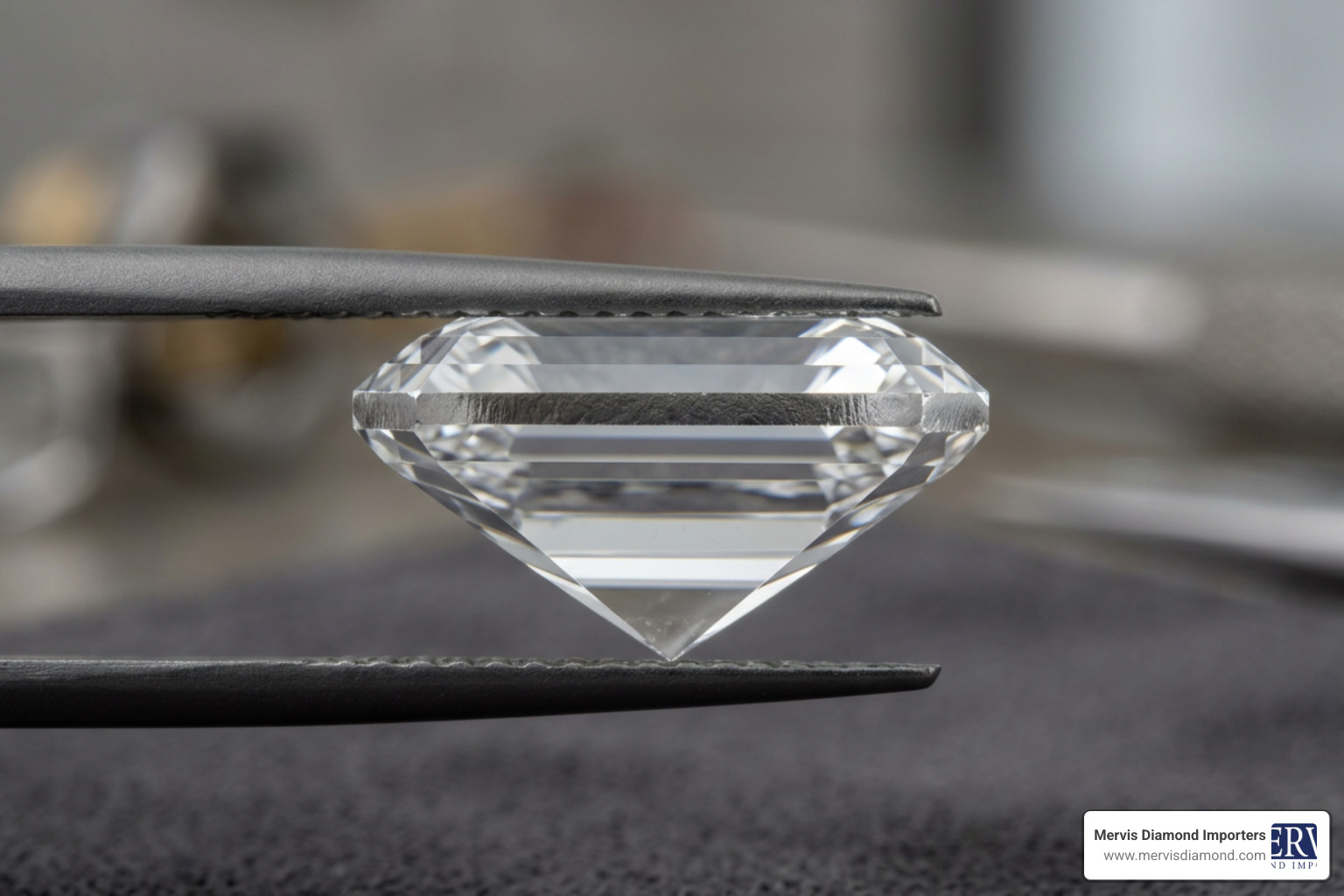
The most common defect to watch out for is the pavilion bulge. This occurs when the cutter leaves extra, unnecessary weight on the underside of the diamond. From the profile view, the pavilion facets will look bowed out and thick rather than straight and clean. This hidden weight does absolutely nothing to make the stone look larger from the top; instead, it traps light, causes severe extinction (the "black box" effect where the center looks dark), and forces you to pay for carat weight you cannot even see.
The Danger of Hidden Carat Weight
A poorly proportioned, deep-cut emerald diamond might weigh 1.50 carats on the scale but have the physical face-up millimeter measurements of a well-cut 1.20-carat stone. This is because the extra weight is buried deep in the bottom of the pavilion. To avoid this trap, always compare the physical millimeter dimensions of the diamond to standard size charts. You want a stone that carries its weight on the surface, not hidden underneath. To learn more about how carat weight interacts with cut, color, and clarity, read our comprehensive guide on Understanding the Four Cs.
How to Inspect a Diamond Beyond the Grading Report
Because grading reports have their limits, you must use visual inspection tools to verify a stone’s light performance:
- High-Definition 360-Degree Video: This is essential. Watch the diamond rotate under neutral lighting to ensure there are no dead, black zones (extinction) or completely transparent areas (windowing).
- ASET (Angular Spectrum Evaluation Tool) Maps: An ASET map uses red, green, and blue colors to show exactly how a diamond manages light. Red indicates strong light return, green indicates reflected light, and blue indicates contrast. A well-cut emerald cut should show a balanced, symmetrical pattern of red and blue across its facets.
- In-Person Inspection: Nothing beats seeing the stone with your own eyes. We invite you to visit one of our physical showrooms in Tysons, VA, Rockville, MD, or Washington, DC, where our non-commissioned experts can pull stones for you to compare side-by-side under natural and spotlighting conditions.
Frequently Asked Questions about Emerald Cut Proportions
What is the single most important proportion for an emerald cut?
While all proportions work together, the balance between table percentage (61% to 68%) and depth percentage (60% to 65%) is the most critical factor for light performance. However, for overall visual style, the length-to-width ratio is the most important metric because it defines whether your stone looks squarish, classic, or highly elongated on your finger.
Why doesn't the GIA give a cut grade for emerald cut diamonds?
The GIA only grades cut quality for round brilliant diamonds because round stones have a mathematically standardized formula for optimal sparkle. Fancy shapes like emerald cuts are highly subjective. Because there is no industry-wide consensus on whether a 1.30 ratio is "better" than a 1.50 ratio, the GIA leaves the cut evaluation to the buyer, only grading the technical execution of Polish and Symmetry.
Do emerald cut diamonds look larger than round diamonds of the same carat weight?
Yes! Because emerald cuts are shallower and have an elongated rectangular shape, they distribute more of their physical weight on the face-up surface. This causes them to appear roughly 5% larger than a round brilliant diamond of the exact same carat weight.
Conclusion
Choosing the perfect emerald cut diamond is an art form. Because these elegant step-cut stones do not come with a pre-packaged GIA cut grade, finding a stone with spectacular light performance requires looking beyond the numbers on a certificate. By keeping your table and depth percentages within the sweet spot, selecting a length-to-width ratio that flatters your hand, and keeping an eye out for hidden pavilion bulges, you can secure a breathtaking diamond that will turn heads for generations.
At Mervis Diamond Importers, we specialize in hand-selecting only the highest-quality natural and lab-grown diamonds. Our expert, pressure-free team is ready to guide you through the selection process at any of our convenient locations in Tysons, VA, Rockville, MD, and Washington, DC.
Ready to begin your journey? Take the first step by mastering Understanding the Four Cs or booking a personalized consultation with us today!