

What a 3 Carat Diamond Actually Looks Like on Your Hand
What a 3 Carat Diamond Actually Measures on Your Hand
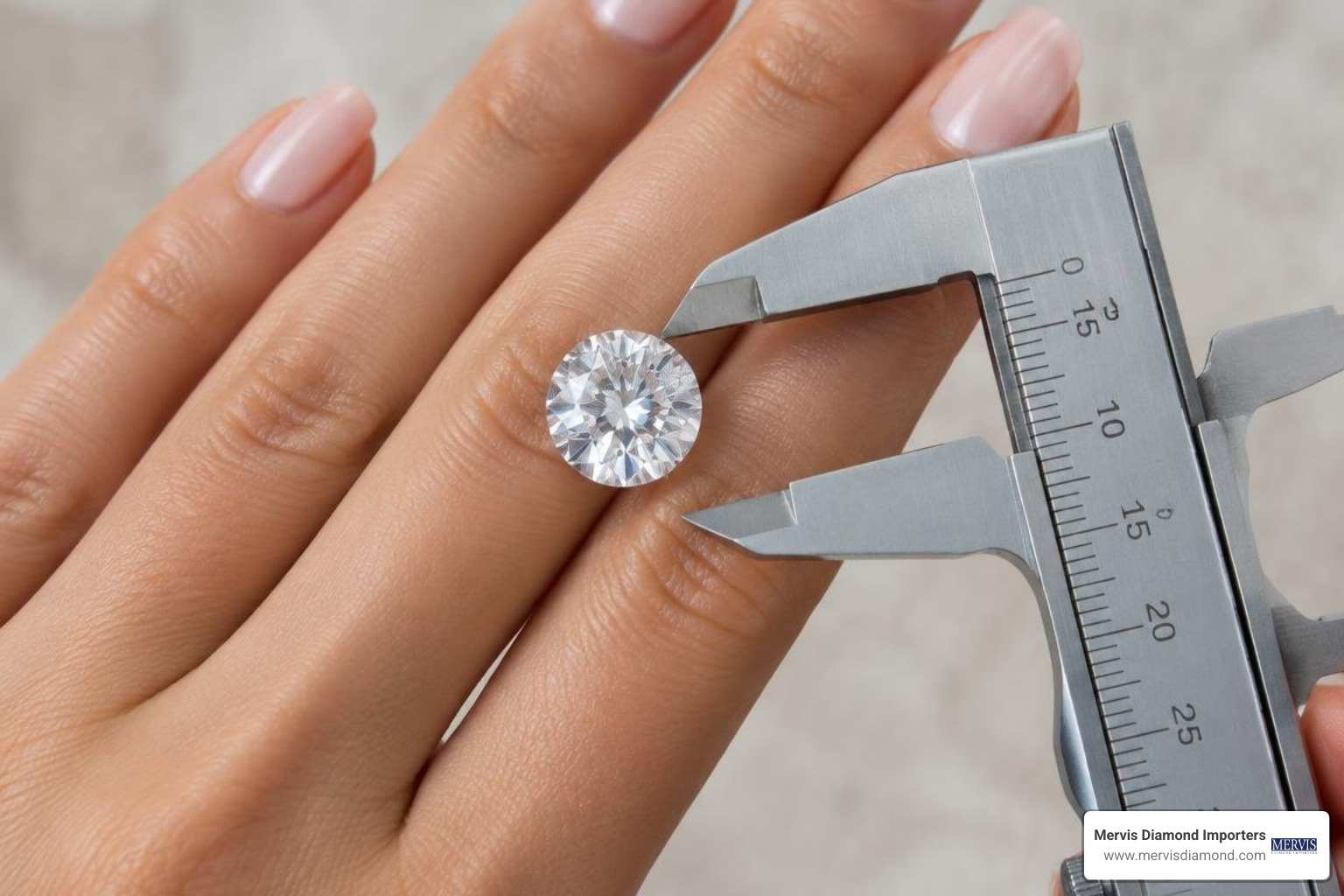
A typical 3.03 carat round diamond measures about 9.32 x 9.35 x 5.73 mm. From the top, it has an average diameter of 9.34 mm and a face-up area of roughly 68.44 mm2. That is the measurement you will notice most when the ring is on your hand.
Its 61.4% depth is also in the recommended 58% to 62.5% range, so this example carries its weight well rather than hiding too much of it below the setting. In plain terms: it looks its weight.
Carat tells you how much a diamond weighs, not exactly how wide it appears. Two 3 carat diamonds can look different in size if one is cut too deep or too shallow. The best way to judge visual impact is to check the millimeter diameter, face-up area, and cut quality alongside carat weight.
I am Morris Mervis, and I will help you use these measurements to choose a 3 carat diamond with confidence, not sales pressure.
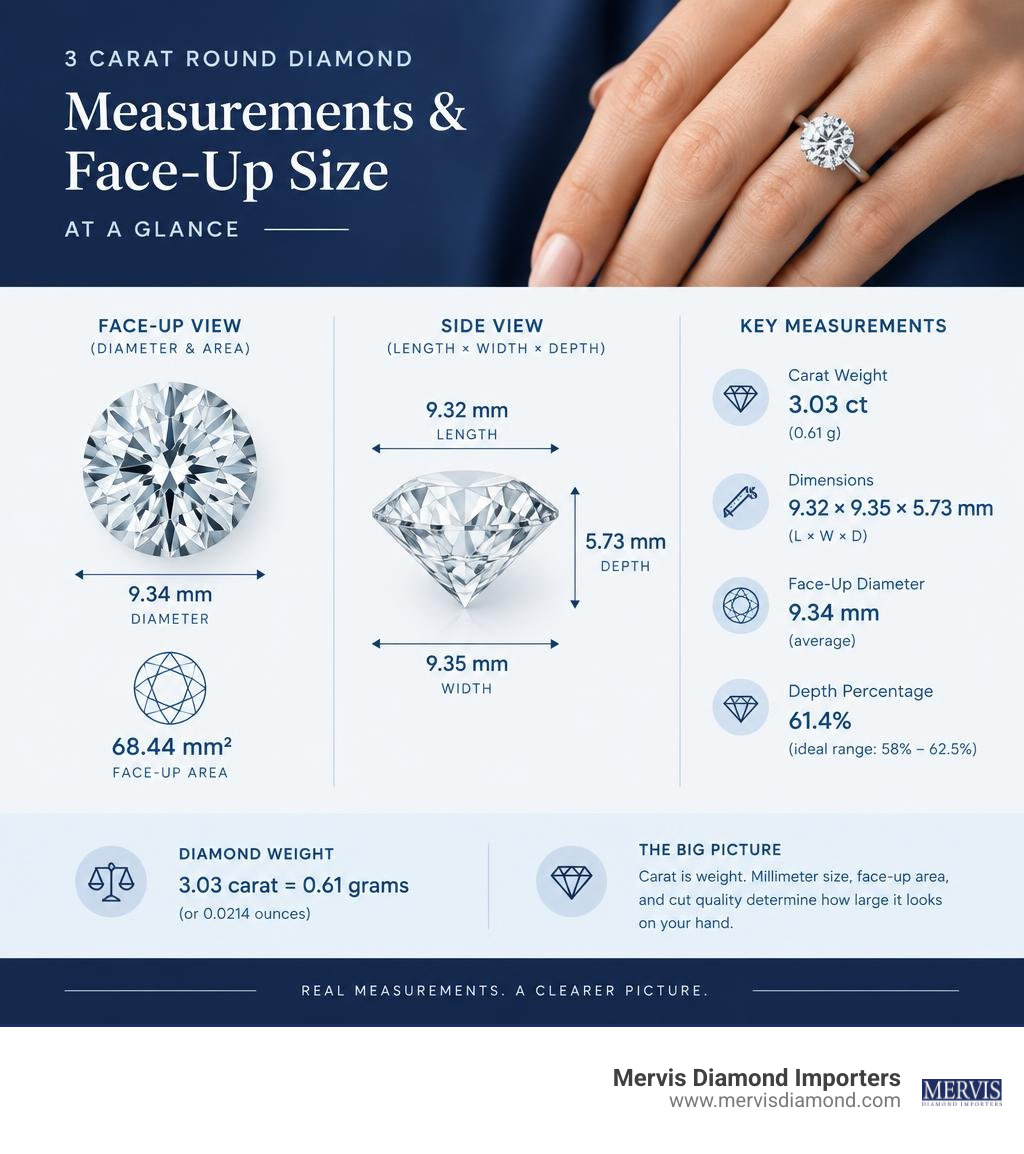
Exact 3 Carat Diamond Measurement and Dimension Breakdown
When evaluating a diamond of this scale, understanding the exact physical geometry ensures you do not overpay for weight tucked away where no one can see it. Carat weight is simply a unit of mass: 1 carat equals 0.2 grams. Therefore, a standard 3.03 carat diamond weighs exactly 0.61 grams (or 0.0214 ounces).
How that mass is distributed determines its physical volume and visible profile. A properly cut 3.03 carat stone occupies a physical volume of approximately 172.16 mm³.
The table below outlines the dimensional benchmarks for an ideally proportioned 3.03 carat round brilliant stone:
| Metric | Ideal Benchmark / Range | Specific 3.03ct Example | What It Means for You |
|---|---|---|---|
| Length × Width × Depth | ~9.20 to 9.45 mm (Diameter) | 9.32 × 9.35 × 5.73 mm | The true millimeter spread across your finger |
| Average Diameter | 9.30 – 9.40 mm | 9.335 mm (approx. 9.34 mm) | Visible face-up width |
| Length-to-Width Ratio | 1.00 to 1.02 | 1.00 | Perfect circular symmetry |
| Depth Percentage | 58.0% to 62.5% | 61.4% | Balances total height with maximum light return |
| Table Percentage | 53.0% to 58.0% | 56.0% | The flat top facet capturing incoming light |
| Face-Up Surface Area | ~67.0 to 69.5 mm² | 68.44 mm² | Total visible surface visible from above |
| Face-Up Area Per Carat | 22.0 to 23.0 mm²/ct | 22.59 mm²/ct | Spread efficiency relative to mass |
| Total Diamond Weight | 3.00 – 3.05 carats | 0.61 grams (3.03 ct) | Exact physical mass |
| Diamond Volume | ~170 to 175 mm³ | 172.16 mm³ | Three-dimensional space displaced |
Understanding the 3 Carat Diamond Measurement in Millimeters
Relying entirely on carat weight when shopping can lead to disappointment. Diamond cutters can manipulate proportions to retain carat weight, often cutting the diamond too deep so extra weight sits in the pavilion (the bottom cone) where it remains hidden in a ring setting.
Reviewing a precise 3.03ct round cut diamond actual size measurements profile reveals how millimeter dimensions tell the real story. An ideal 3.03 carat round diamond should span approximately 9.32 mm in length by 9.35 mm in width, with an overall vertical depth of 5.73 mm. This creates an outline with a 1.00 length-to-width ratio—a geometrically round profile with zero visible distortion.
When reviewing a 3 carat diamond guide, you will find that a well-cut 3 carat diamond measurement ensures you are paying for real surface spread rather than "dead weight" underneath.
Depth Percentage, Table Width, and Ideal Proportions
Depth percentage is calculated by dividing the total depth of the stone by its average diameter:
$$\text{Depth Percentage} = \left( \frac{\text{Total Depth}}{\text{Average Diameter}} \right) \times 100$$
For our 3.03 ct benchmark ($5.73 \text{ mm} \div 9.335 \text{ mm}$), the depth percentage is 61.4%, which sits comfortably within the golden window of 58% to 62.5%.
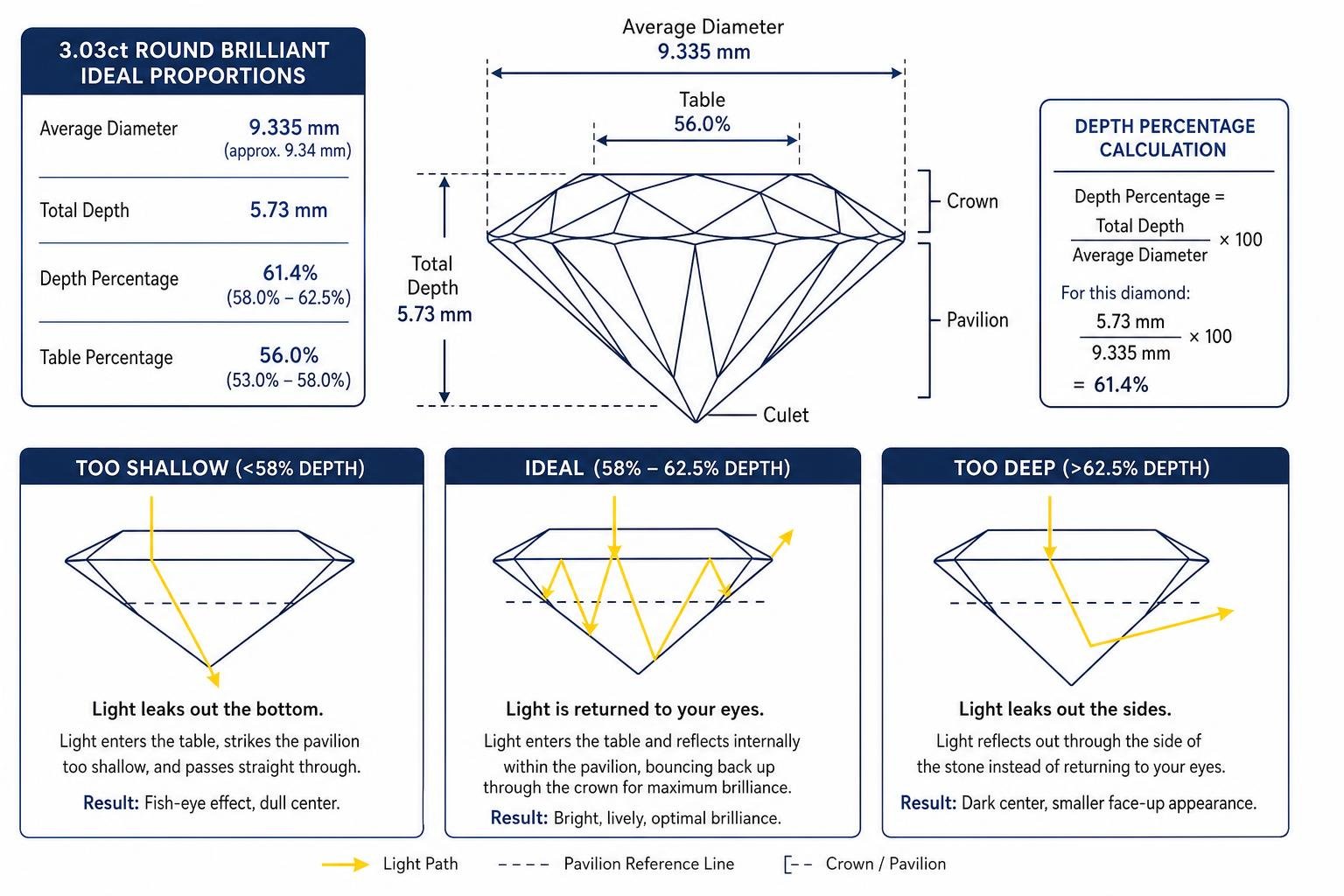
Why do these proportions matter so much?
- Shallow Cuts (<58% Depth): Light enters the table facet, strikes the pavilion at an angle too shallow for total internal reflection, and passes straight through the bottom. This causes a "fish-eye" effect, making the center look lifeless and dull despite a wide diameter.
- Deep Cuts (>62.5% Depth): Light bounces out through the side of the stone instead of reflecting back to your eyes. These diamonds look smaller than their weight implies and feature dark centers.
- Ideal Table Percentage (53% to 58%): The flat top facet allows optimal light entry while leaving adequate room for crown facets to break white light into colored fire (dispersion).
Mastering these proportions is an essential part of understanding how the 4 cs of diamonds explained translate from paper specs to physical brilliance.
Evaluating Visual Size, Spread, and Finger Coverage
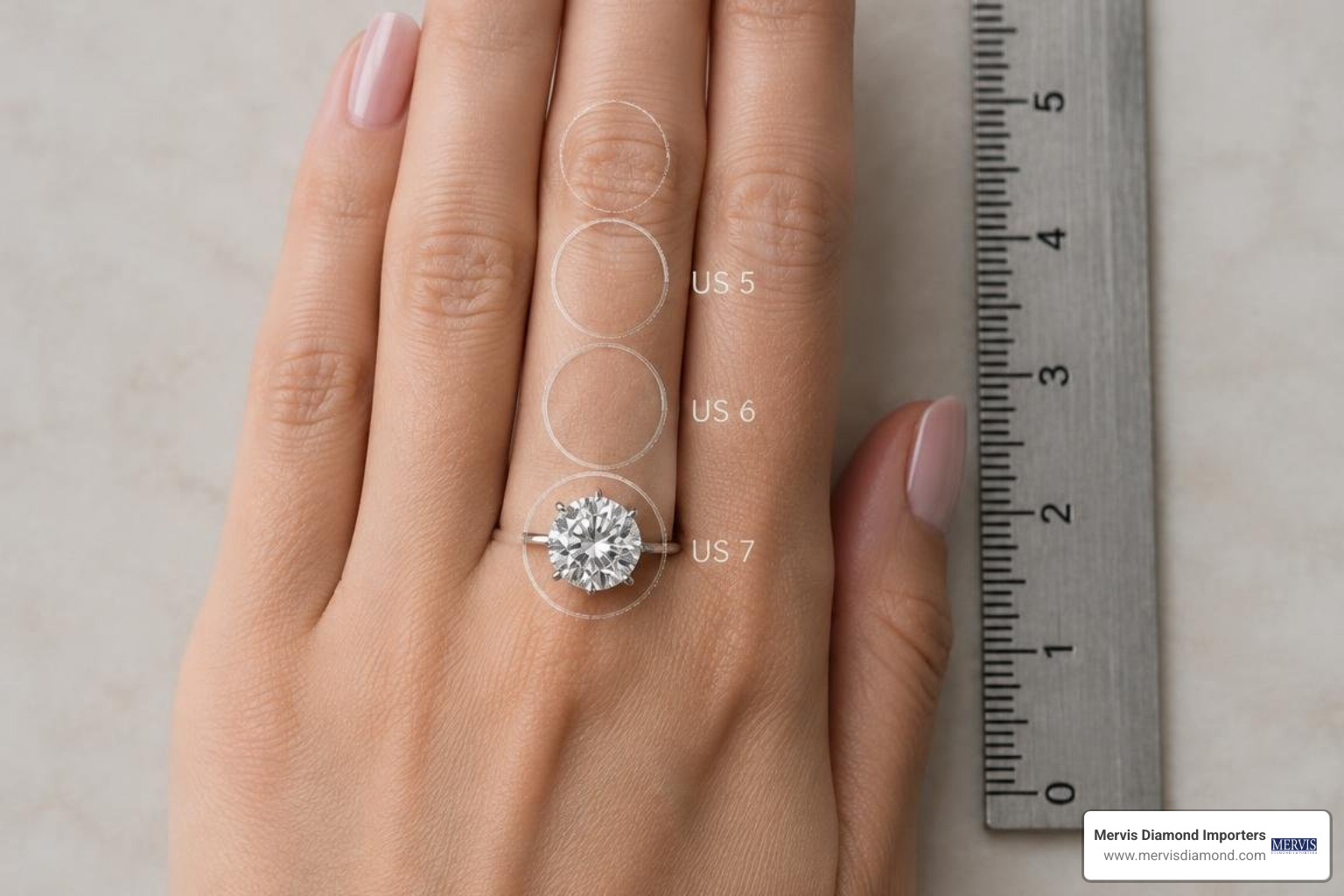
A standard 3 carat round brilliant diamond covers roughly 68.44 mm² of surface area. On a standard US size 6 finger (which measures roughly 16.5 mm across the base), a 9.34 mm diamond spans well over 55% of the total finger width.
However, visual prominence is also influenced by the face-up area per carat. For a 3.03 carat diamond, this ratio is 22.59 mm²/ct. Interestingly, as diamonds increase in carat weight, their surface area per carat naturally decreases because carat weight scales with three-dimensional volume rather than two-dimensional surface area:
- A 1.00 ct round (~6.4 mm) yields ~32.2 mm²/ct
- A 2.00 ct round (~8.1 mm) yields ~25.8 mm²/ct
- A 3.00 ct round (~9.3 mm) yields ~22.6 mm²/ct
Because larger diamonds require more internal volume to support their proportions, every millimeter of spread becomes exponentially more valuable.
How Cut Quality Impacts 3 Carat Diamond Measurement and Spread
A diamond's cut grade directly determines how much of its carat weight translates into visible spread. Major laboratories like the GIA (Gemological Institute of America) and AGS (American Gem Society) award their highest grades—GIA Excellent and AGS 0 Ideal—only to stones meeting strict dimensional criteria.
When cutters sacrifice cut precision to save rough diamond weight, they create a "steep-and-deep" cut. A poorly cut 3 carat diamond may have the diameter of an average 2.5 carat stone (around 8.8 mm) because its mass is trapped beneath the girdle.
To review how cutting grades interact with carat weight, consult our diamond 4 cs chart guide. Selecting an Excellent or Ideal cut guarantees the maximum diameter for your stone's carat weight along with edge-to-edge sparkle.
Comparing Round Diamonds to Fancy Shapes at 3 Carats
While the round brilliant is the industry benchmark for brilliance and symmetry, fancy shapes distribute their 3 carats of weight differently:
- Oval Cut: An elongated oval can measure roughly 11.5 × 7.8 mm. This delivers a larger face-up surface area than a round brilliant of the same weight, creating the illusion of a bigger stone. Learn more in our 3 carat oval diamond cost guide.
- Emerald Cut: Featuring clean step-cut facets, a 3 carat emerald cut often measures around 9.5 × 7.0 mm. While it has less fire than a round cut, it offers an elegant, hall-of-mirrors look. See our 3 carat emerald cut diamond guide 2026 for styling ideas.
- Stepping Up in Scale: If you find yourself wanting even more presence, a 4 carat round diamond ring reaches an average diameter of 10.2 mm, covering the majority of the finger span.
Practical Buying Strategies for a 3 Carat Diamond
Buying a 3 carat diamond represents a significant investment. Getting the most value comes down to understanding which specifications impact visual beauty and which simply inflate the price tag. For deeper financial planning, explore our 3 carat diamond deal guide.
The "Buying Shy" Strategy to Maximize Value
Diamond prices rise sharply at full-carat and half-carat milestones (e.g., 1.00 ct, 2.00 ct, 3.00 ct). Diamond cutters intentionally cut stones to hit these threshold numbers because they command higher market premiums.
You can take advantage of this pricing structure by "buying shy"—selecting a diamond that weighs just below the benchmark, such as 2.90 to 2.97 carats.
A 2.92 carat round diamond typically measures around 9.20 mm in diameter, compared to 9.34 mm for a 3.03 carat diamond. That 0.14 mm difference is practically invisible to the naked eye, yet choosing the 2.92 carat stone can save you 10% or more. For more tips on finding the sweet spot, see our 3 carat diamond affordable guide.
Color and Clarity Recommendations by Metal Type
Because a 3 carat diamond has a large table facet (spanning over 5.2 mm across), color and inclusions are more noticeable than in smaller stones. However, you do not need a Flawless, D-color diamond to achieve a stunning ring.
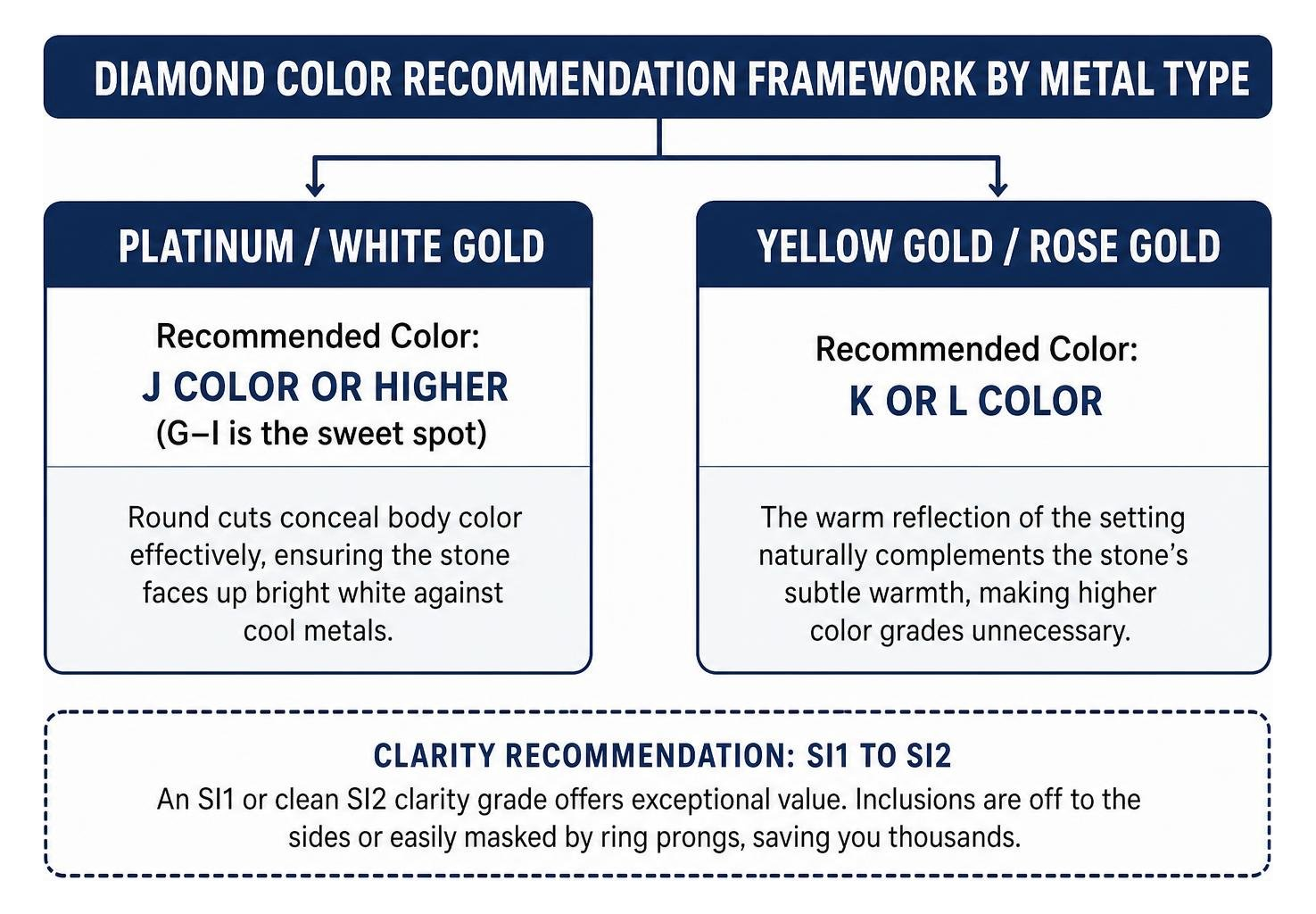
- Clarity (SI1 to SI2): An SI1 or clean SI2 clarity grade offers exceptional value. At Mervis Diamond Importers, our gemologists hand-select eye-clean SI stones where inclusions are off to the sides or easily masked by ring prongs, saving you thousands compared to VS1 or VVS grades.
-
Color by Metal Setting:
- Platinum / White Gold: We recommend a J color or higher (G–I is the sweet spot). Round cuts conceal body color effectively, ensuring the stone faces up bright white against cool metals.
- Yellow Gold / Rose Gold: You can safely drop to a K or L color. The warm reflection of the setting naturally complements the stone's subtle warmth, making higher color grades unnecessary.
For a full breakdown of color tiers, read our overview of 3 carat diamond color and explore the primary three carat diamond cost factors.
Certification Standards and Fluorescence Considerations
Never purchase a 3 carat diamond without an independent certificate from a respected laboratory:
- GIA (Gemological Institute of America) and AGS (American Gem Society) are the global gold standards for consistency. A diamond graded "F / VS2" by a lower-tier lab may actually grade as an "H / SI2" under strict GIA standards, causing you to overpay.
-
Blue Fluorescence: Around 25% to 35% of natural diamonds exhibit fluorescence under UV light.
- In I to K color diamonds, medium blue fluorescence can actually make the stone look whiter in natural daylight, offering a great visual benefit at a discount.
- In D to F color diamonds, strong or very strong fluorescence can occasionally cause a hazy or milky appearance. Always evaluate fluorescent diamonds in various lighting conditions before purchasing.
If you are exploring modern options, our 3 carat lab grown diamond guide covers how lab-created stones share these exact physical dimensions at an accessible price point.
Frequently Asked Questions About 3 Carat Diamonds
How wide is an ideal 3 carat round diamond across the top?
An ideally cut 3 carat round brilliant diamond measures between 9.30 mm and 9.40 mm across the top girdle plane. A 3.03 ct stone with a 61.4% depth percentage measures approximately 9.34 mm in diameter, covering more than half the width of most ring sizes.
Does a 3 carat diamond look twice as large as a 1.5 carat diamond?
No. Carat measures weight (volume), not surface area. While a 3 carat diamond has twice the mass of a 1.5 carat diamond, its face-up diameter increases from roughly 7.3 mm to 9.34 mm—about a 28% increase in diameter and roughly a 63% increase in surface area. However, that difference is immediately striking on the hand.
Can you see inclusions in a 3 carat SI1 or SI2 diamond?
Because a 3 carat stone has large, open facets, some SI1 and SI2 inclusions may be visible if they are dark crystals located dead center beneath the table. However, many SI1 and SI2 stones feature dispersed, white inclusions toward the edges that remain completely invisible to the naked eye. Viewing the stone in person or via high-resolution imagery is essential.
Finding Your Perfect 3 Carat Diamond
A 3 carat diamond is a timeless showstopper, but achieving that perfect look on your hand requires balancing carat weight with cut precision and millimeter dimensions. When you focus on a 58% to 62.5% depth percentage, an Excellent cut grade, and an eye-clean clarity tier, you ensure every millimeter delivers brilliant light return.
At Mervis Diamond Importers, our family has hand-selected diamonds for generations across our showrooms in Tysons, VA, Rockville, MD, and Washington, DC. We invite you to visit us in person or schedule a consultation to view these stones side by side in a relaxed, pressure-free environment.
Ready to take the next step? Explore current market pricing and setting options in our complete guide to find out how much a 3 carat diamond ring costs.