

Everything You Need to Know About the 4 Cs of Engagement Rings
The 4 C's of Engagement Rings, Explained
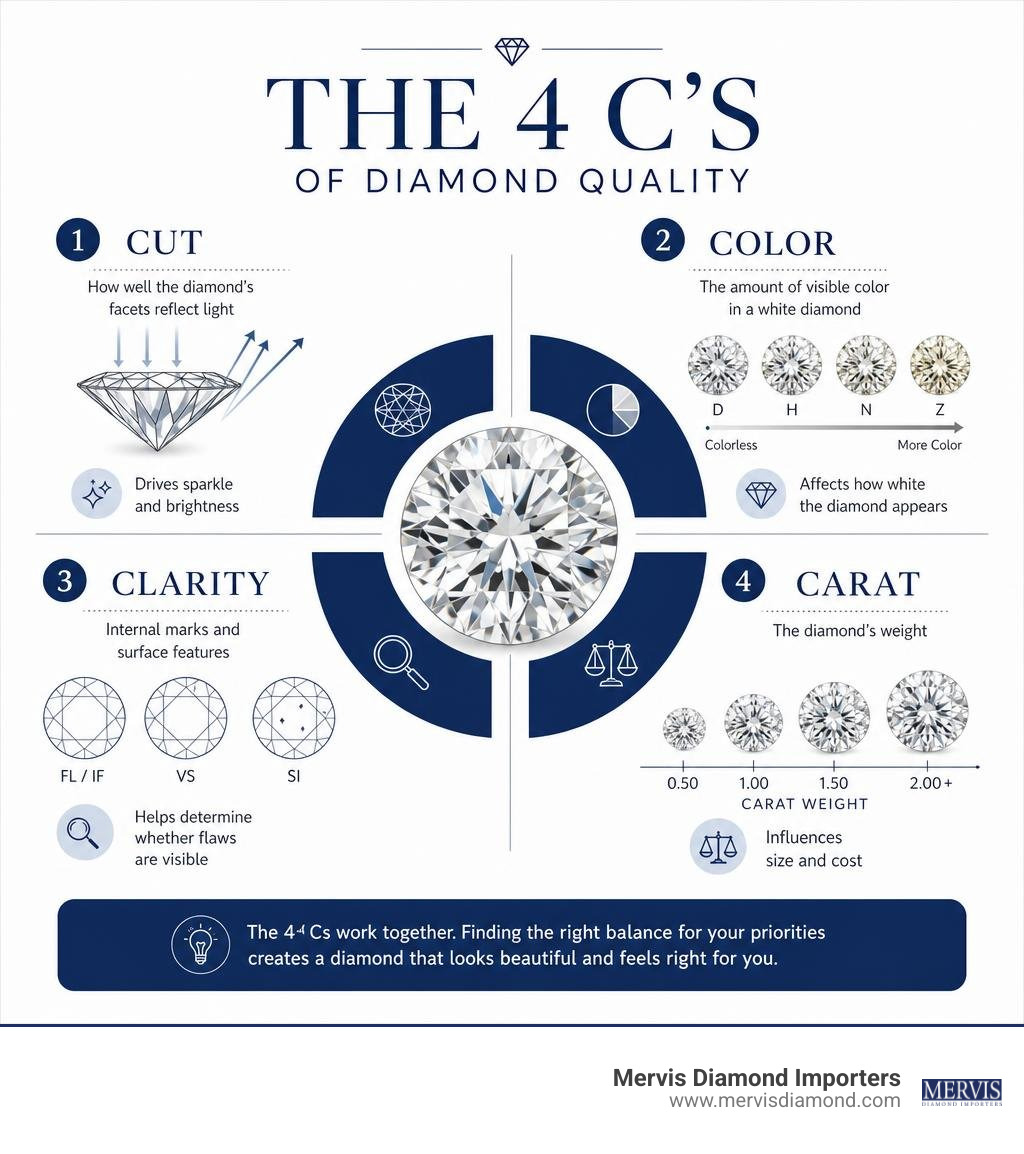
The 4 c's of engagement rings are Cut, Color, Clarity, and Carat Weight. Together, they provide a shared standard for judging a diamond's beauty, quality, and price.
| Diamond C | What it means | Why it matters |
|---|---|---|
| Cut | How well the diamond's facets reflect light | Drives sparkle and brightness |
| Color | The amount of visible color in a white diamond | Affects how white the diamond appears |
| Clarity | Internal marks and surface features | Helps determine whether flaws are visible |
| Carat | The diamond's weight | Influences size and cost |
The key is not to chase the highest grade in every category. A well-chosen diamond can look stunning without paying for differences that are hard to see once it is set in a ring. The 4 Cs work more like connected dials than a checklist: putting more of your budget toward one area may mean making a smart adjustment in another.
I’m Morris Mervis, and I’ll walk you through what each grade means so you can choose a diamond with confidence, not sales pressure.
What Are the 4 c's of engagement rings?
When you begin shopping for an engagement ring, the sheer volume of terminology can feel overwhelming. Fortunately, the global diamond industry relies on an authoritative grading framework created by the Gemological Institute of America (GIA) in the mid-20th century. This universal evaluation standard allows jewelers and buyers alike to speak a common language when assessing natural and lab-grown diamonds.
The 4 c's of engagement rings stand for Cut, Color, Clarity, and Carat Weight. Together, these four parameters dictate every diamond's visual brilliance, rarity, and financial market value. Understanding how these factors interact is essential to mastering understanding four cs and getting the absolute best ring for your budget.
Before diving into each specific metric, it is important to clarify one frequent point of confusion: the difference between diamond cut and diamond shape.
- Diamond Shape refers to the external geometric outline of the stone—such as Round Brilliant, Oval, Emerald, Princess, Pear, or Cushion. Shape is purely an aesthetic choice based on personal style.
- Diamond Cut refers to the precision of a diamond's proportions, symmetry, polish, and facet arrangement. Cut determines how efficiently light travels through the stone to reflect back to your eyes as dazzling sparkle.
Whether you prefer a timeless round stone or a modern fancy shape, learning how to balance Explaining the 4 Cs for Your Engagement Ring Choice will help you discover a diamond that shines brightly on your partner's finger.
Deconstructing Cut, Color, Clarity, and Carat
To navigate the diamond selection process with ease, we need to explore how each of the four individual metrics works, how grading authorities evaluate them, and how they impact what you actually see with the naked eye.
Cut: The Key to Diamond Sparkle and Light Performance
If there is one absolute rule in diamond buying, it is this: Cut is king. Cut is widely considered the most critical of the four Cs because it directly governs a diamond's light performance. Even a stone with perfect clarity and flawless color will appear dull, glassy, or dark if it is poorly cut.
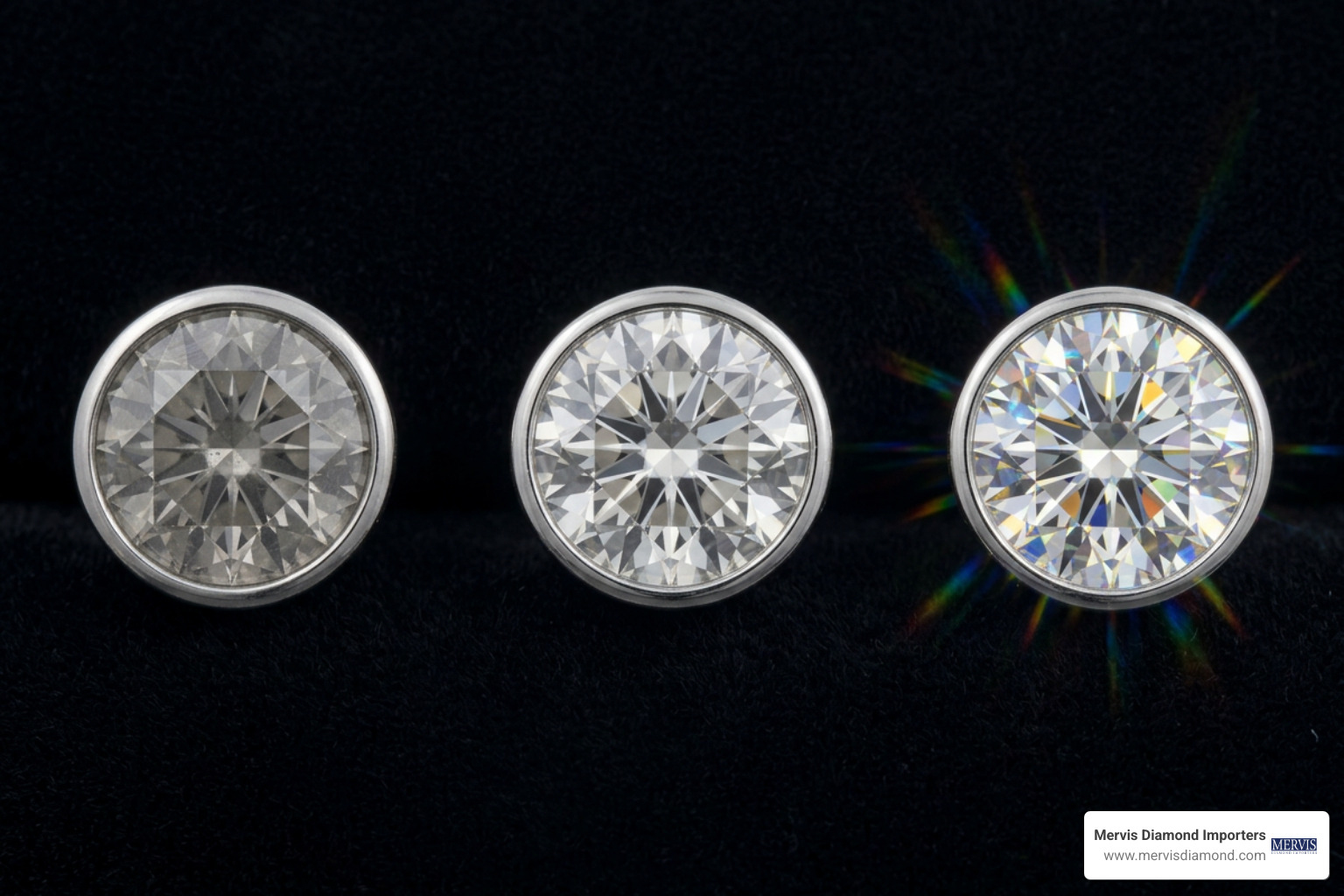
When light enters a masterfully proportioned diamond, it bounces off the interior mirror-like facets and bounces directly out through the top (the table) into the viewer's eye. This light interaction generates three distinct elements:
- Brilliance: The internal and external white light reflected from the diamond, creating bright radiance.
- Fire: The dispersion of light into striking flashes of spectral rainbow colors.
- Scintillation: The pattern of light and dark areas that flash dynamically as the ring or light source moves.
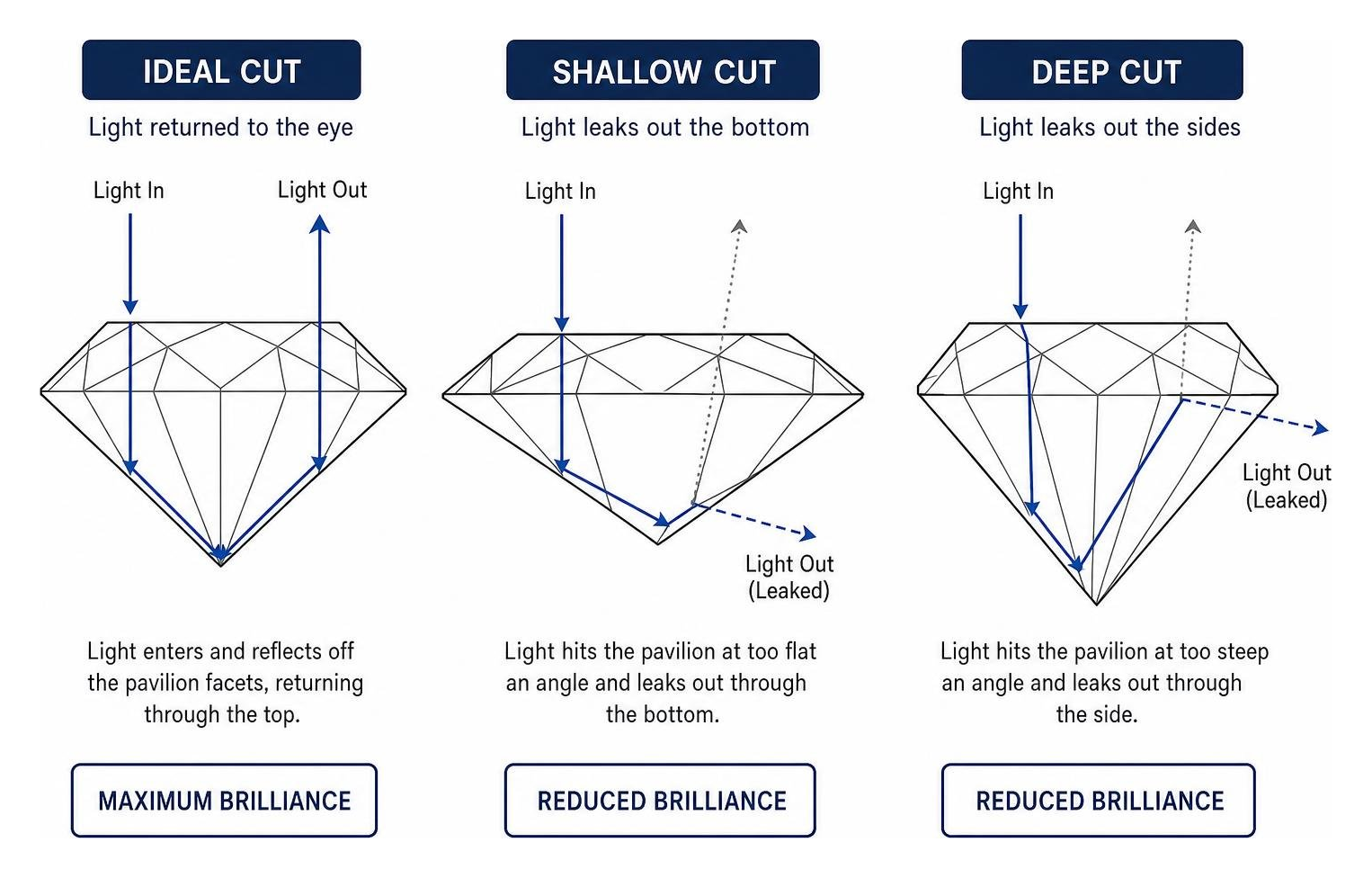
When cutters attempt to save weight from the rough stone rather than optimizing beauty, they create cut flaws:
- Shallow Cuts: Light enters through the top, strikes the bottom pavilion facet at too flat an angle, and leaks out through the bottom sides before reflecting back up. The stone looks washed out and lacks contrast.
- Deep Cuts: Light enters through the table but hits the pavilion at too steep an angle, bouncing across to the opposite facet and escaping through the bottom side. This creates a noticeable dark center (a "nailhead" effect). Furthermore, a poorly cut 1.0-carat diamond that is cut too deep concentrates its weight in its belly, making it physically look smaller from the top view than a masterfully cut 0.95-carat diamond!
The official GIA Cut grading scale for standard round brilliant diamonds ranks stones across five categories: Excellent, Very Good, Good, Fair, and Poor. To understand why cut grade should never be compromised, explore our guide on why diamond cut is the most c 2 and how facet geometry powers what makes a diamond sparkle.
Color: D-to-Z Scale and Setting Metal Interaction
When gemologists evaluate diamond color in white diamonds, they are actually measuring the absence of color. The GIA color grading scale ranks diamonds alphabetically from D (completely colorless) to Z (light yellow or brown tint).
- D, E, F (Colorless): Exceptionally rare. These diamonds exhibit no visible body color even when viewed face down against a white background by trained gemologists under controlled lab lighting.
- G, H, I, J (Near Colorless): These diamonds appear virtually colorless to the untrained eye when viewed face-up, especially once mounted in a setting. They offer phenomenal value because they cost dramatically less than D-F stones while looking visually indistinguishable to non-experts.
- K, L, M (Faint Color): Display a slight warm yellow or straw tint that becomes noticeable to most viewers, especially in larger carat sizes.
- N through Z (Very Light to Light Color): Feature obvious yellow or brownish hues.
Can you see the difference between a D-color and a G-color diamond once set? In almost all cases, no! A G-color, VS2 ring can look identical to a D-color, VVS1 ring from a typical viewing distance of a foot away.
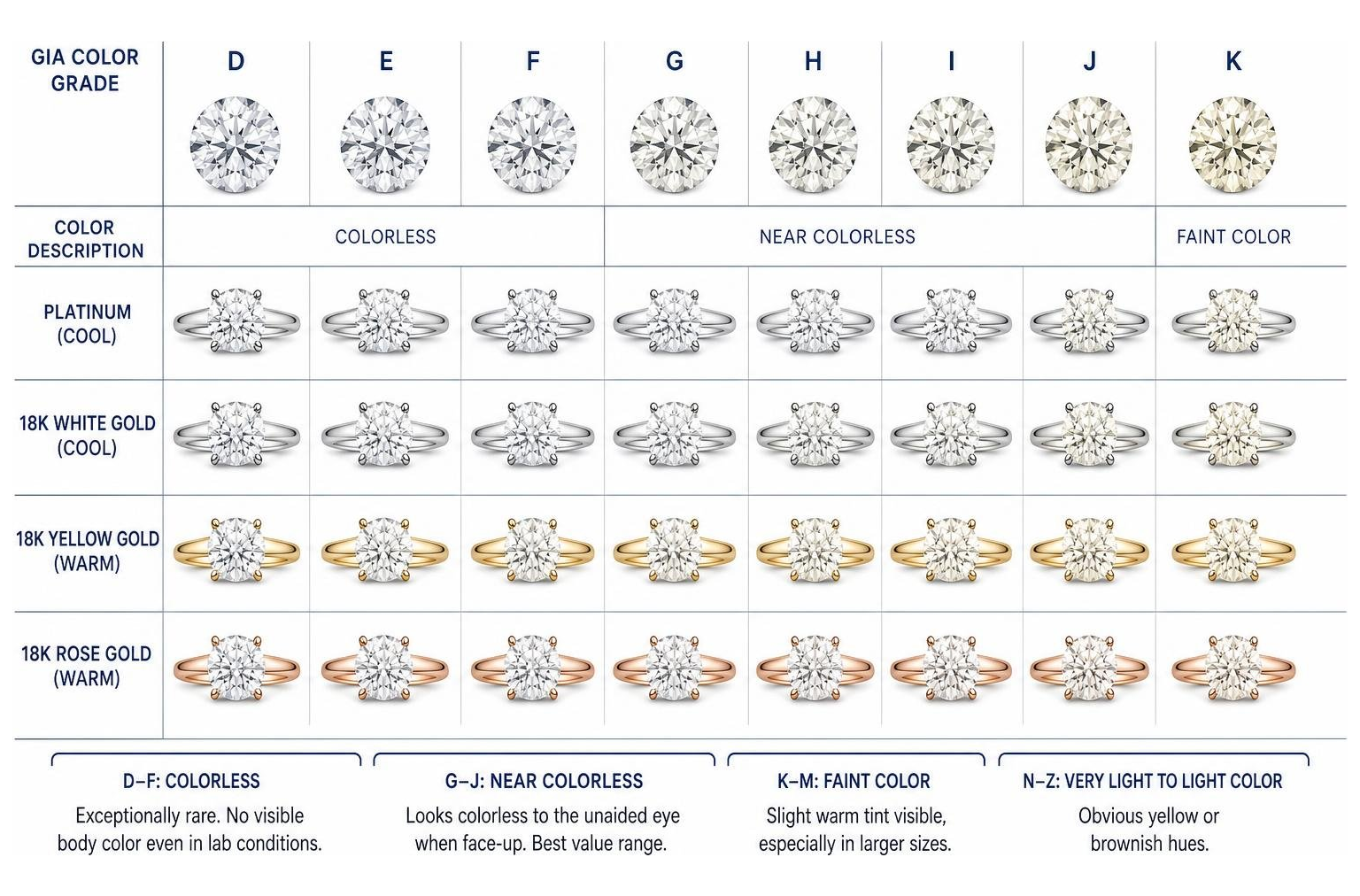
Your choice of ring metal plays a massive role in how white a diamond appears:
- White Metals (Platinum, 18K White Gold): Cool white metals accentuate any yellow tint in a stone. If you select platinum or white gold, we usually recommend staying within the D through H range to keep the stone looking crisp and bright.
- Warm Metals (18K Yellow Gold, Rose Gold): Yellow and rose gold settings naturally project warm reflections through the body of the diamond. Because of this, you can safely drop to an I, J, or even K color stone without it looking yellow. The yellow metal masks subtle warm undertones, allowing you to reallocate your budget toward a larger carat or superior cut. Read our breakdown on whether an is i color diamond too yellow for your personal taste and setting.
Clarity: Inclusions and the Value of 'Eye-Clean' Stones
Formed deep within the Earth under immense heat and pressure over billions of years, natural diamonds almost always harbor microscopic internal traits called inclusions (such as crystals, clouds, or feathers) or surface irregularities called blemishes. Think of clarity flaws as a diamond's unique, natural fingerprint.
The GIA Clarity scale evaluates diamonds under 10x magnification into 6 main categories and 11 specific grades:
- Flawless (FL): No inclusions or blemishes visible under 10x magnification. Extremely rare.
- Internally Flawless (IF): No inclusions, only minor surface blemishes visible under 10x magnification.
- Very, Very Slightly Included (VVS1 and VVS2): Inclusions are so tiny that even experienced gemologists struggle to spot them under 10x magnification.
- Very Slightly Included (VS1 and VS2): Minor inclusions (small crystals or clouds) that are easily seen under 10x magnification but invisible to the naked eye.
- Slightly Included (SI1 and SI2): Inclusions are noticeable under 10x magnification. In SI1 stones (and many SI2 stones), inclusions remain completely hidden from the naked eye.
- Included (I1, I2, and I3): Inclusions are obvious under 10x magnification and typically visible face-up without magnification, affecting transparency or durability.
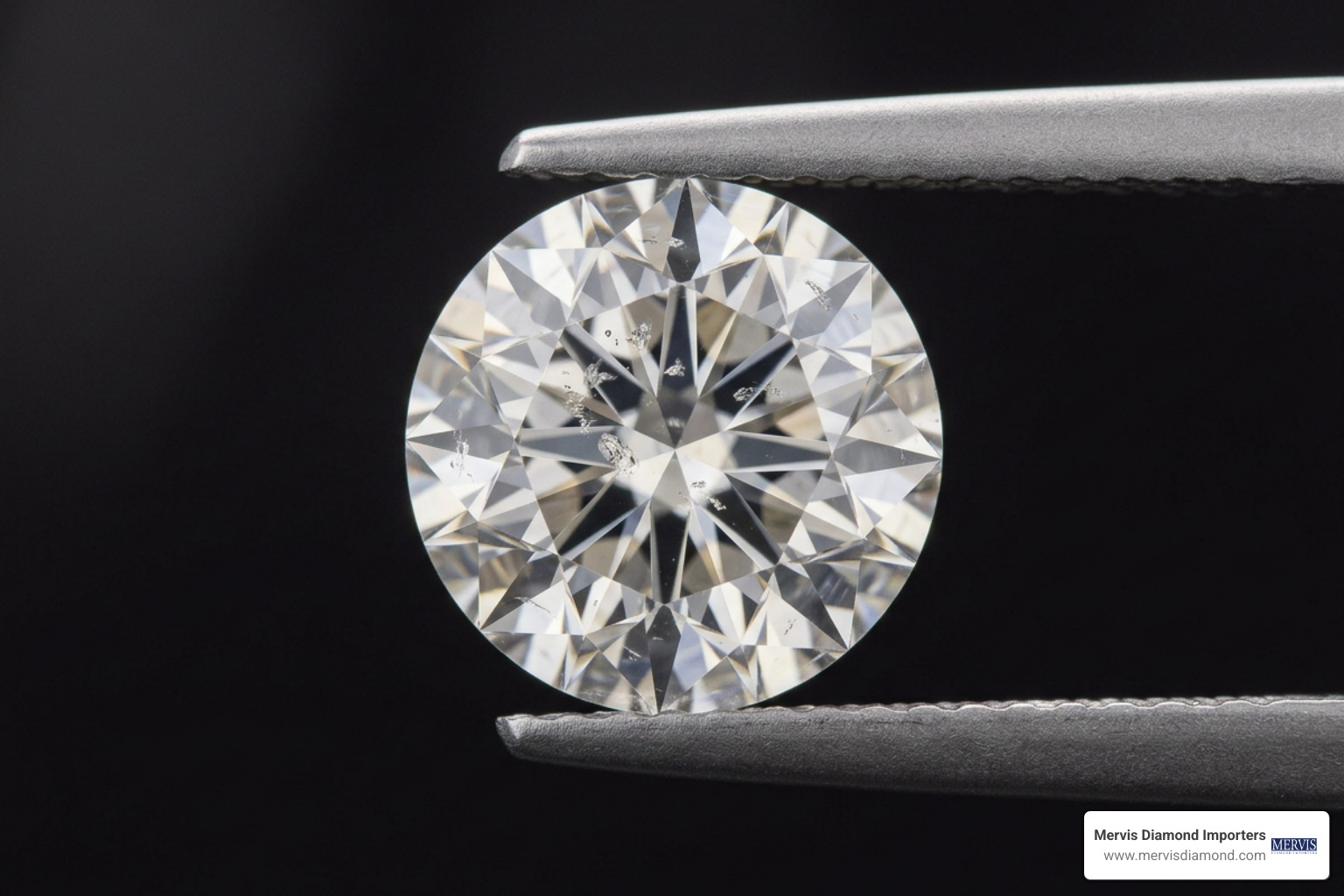
To navigate these options efficiently, review our detailed diamond clarity chart best to worst and consult our gia certified clean diamond guide 2026.
What Does "Eye-Clean" Mean and How Does It Save Money?
In practical terms, "eye-clean" means a diamond has no inclusions visible to the naked human eye when viewed face-up under normal lighting from a standard distance of 6 to 12 inches.
Prioritizing an eye-clean stone rather than a collector's purity grade like Flawless or VVS is one of the single best ways to save money without sacrificing beauty. An eye-clean SI1 diamond can look identical to a Flawless stone to anyone admiring your ring, yet cost thousands of dollars less!
For example, we recently helped a client save nearly $3,000 on a 1.2-carat diamond by choosing an eye-clean SI1 stone featuring a tiny pinpoint inclusion located near the edge (which was easily hidden under a ring prong) instead of paying a premium for a VVS1 stone.
Carat Weight: Magic Weights and Surface Dimensions
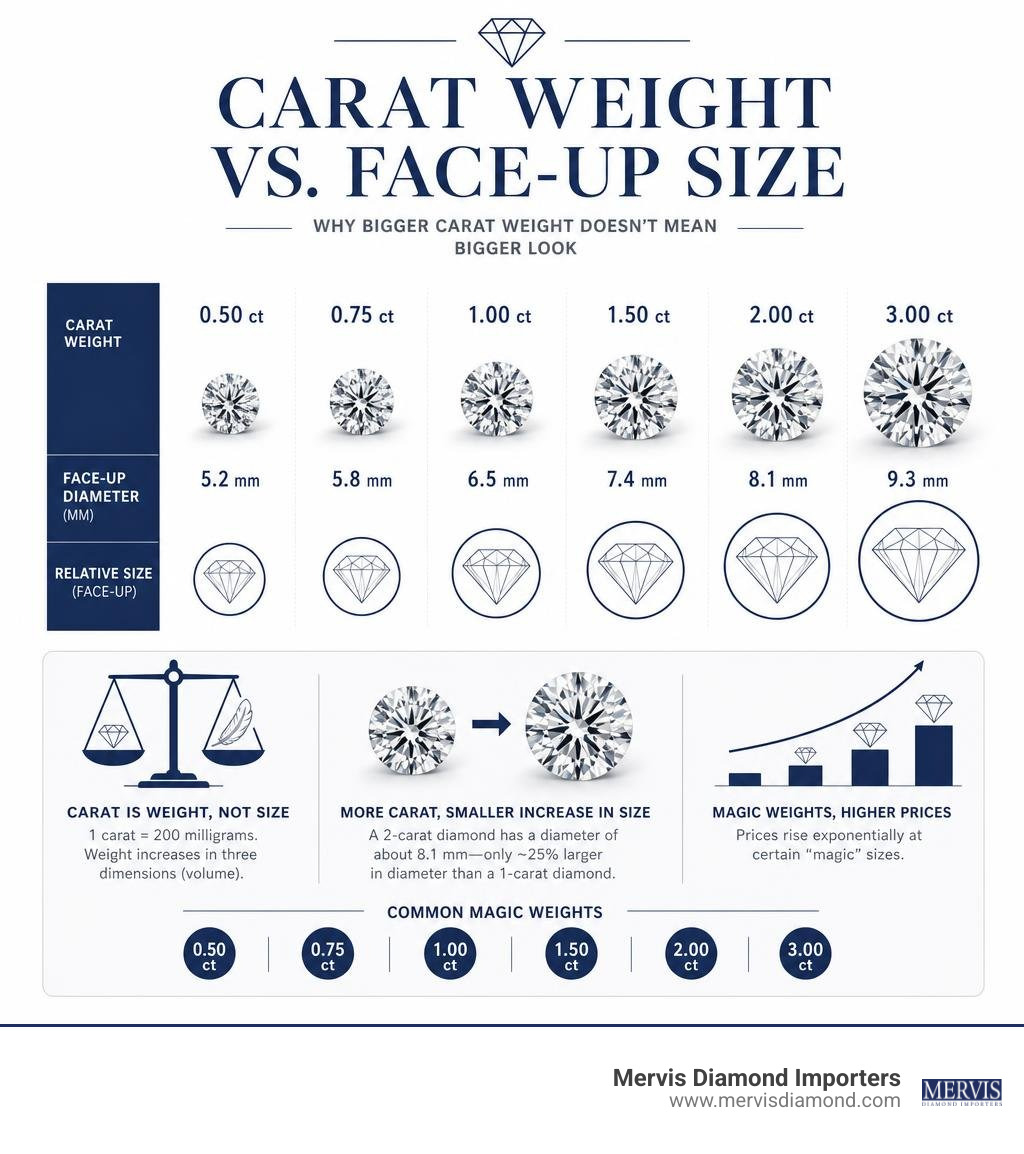
Carat is often misunderstood as a measurement of physical size, but it is strictly a measurement of weight. One metric carat equals exactly 200 milligrams (0.200 grams). Each carat is divided into 100 points, so a 0.75-carat diamond is often referred to as a "75-pointer."
Because diamond weight increases in three dimensions (volume), physical dimensions do not scale linearly with carat weight:
- Is a 2-carat diamond twice as big as a 1-carat diamond? No! While a 2-carat diamond weighs twice as much as a 1-carat diamond, its surface diameter only increases from roughly 6.5 mm to approximately 8.1 mm (roughly a 25% increase in visual face-up diameter).
"Magic Weights" and Exponential Pricing
Diamond prices do not increase linearly per carat—they rise exponentially. Standard wholesale diamond pricing charts feature dramatic cost jumps at round numbers known in the trade as magic sizes or magic weights:
- 0.50 ct, 0.75 ct, 1.00 ct, 1.50 ct, 2.00 ct, and 3.00 ct.
A diamond weighing 1.00 carat commands a massive price premium over a stone weighing 0.98 carats simply because it crossed that psychological 1-carat milestone. However, visually, a 0.90-carat or 0.95-carat diamond costs significantly less than a 1.0-carat diamond, while the visual difference in face-up size is virtually impossible to detect with the human eye!
Visual Size by Shape
If maximizing visual appearance is a high priority, consider diamond shape alongside carat weight. Elongated fancy shapes—such as Oval, Pear, Marquise, and Emerald cuts—distribute their weight across a larger surface area than round brilliant cuts of the exact same carat weight. An oval diamond, for instance, can look up to 10% to 15% larger face-up than a round diamond of identical carat weight. Explore our guide on what diamond carat size is right for you and learn what diamond shape looks the biggest.
How to Balance Diamond Quality and Value
Buying an engagement ring isn't about buying the highest numbers on a grading report—it's about creating maximum visual appeal within your comfortably defined budget. Think of the 4 Cs as interconnected dials on an audio mixing board: adjusting one dial allows you to balance the others perfectly.
How to Prioritize the 4 c's of engagement rings for Best Value
To get the absolute best value for your money, we recommend prioritizing the 4 Cs in a clear strategic order:
- First Priority — Cut Grade: Never compromise on Cut. Always choose an Excellent (or Ideal) cut grade for round diamonds, or top-tier proportions for fancy shapes. A well-cut diamond reflects maximum light, hiding faint color and disguising microscopic clarity inclusions while looking larger than its actual weight.
- Second Priority — Carat Weight: Decide on the visual size range or carat weight target that best fits your partner's style preferences.
- Third Priority — Color Grade: Target the Near Colorless range (G to I) for white gold/platinum settings, or I to K for yellow/rose gold settings. Paying for D-F color rarely offers noticeable visual benefits once mounted.
- Fourth Priority — Clarity Grade: Target VS2 or eye-clean SI1. Anything higher pays for purity visible only under a microscope.
Here is a handy summary comparison of smart prioritization strategies tailored by shopping goals:
| Shopping Goal | Recommended Cut | Recommended Color | Recommended Clarity | Target Carat Strategy |
|---|---|---|---|---|
| Maximum Sparkle & Beauty | Excellent / Ideal | G - H | VS2 | Standard Magic Weights |
| Best Overall Value (Sweet Spot) | Excellent | H - I | SI1 (Eye-Clean) | "Buy Below" Thresholds (e.g. 0.90 ct, 1.40 ct) |
| Maximum Size on a Budget | Very Good - Excellent | I - J (Yellow Gold) | SI1 - SI2 (Eye-Clean) | Elongated Shapes (Oval, Pear, Marquise) |
| Ultra-Pure Collector's Choice | Excellent / Ideal | D - F | VVS1 - VVS2 | Exact Target Carat |
For deeper insights into strategic purchasing, read our guide on diamond 4 cs order of importance.
Insider Budget Hacks for the 4 c's of engagement rings
By utilizing these trade tips, you can stretch your ring budget significantly without sacrificing visual impact:
- Buy Just Shy of Magic Weights: Look for diamonds in the 0.88-0.95 ct range rather than 1.00 ct, or 1.40-1.48 ct rather than 1.50 ct. You save 15% to 30% while getting a stone that looks identical on the finger.
- Hide Inclusions Under Setting Prongs: Inspect loose diamonds in person or via high-definition 360-degree video. If an SI1 or SI2 diamond has a black crystal or feather near its outer edge (girdle), instruct your jeweler to orient the diamond so a setting prong directly covers the flaw!
- Pair Diamond Color to the Mounting: Setting a G or H color diamond into a yellow gold band wastes color performance; drop to an I or J color stone instead and apply the savings toward a larger carat weight.
- Consider Fancy Elongated Shapes: Elongated shapes often cost less per carat than traditional round diamonds while covering a larger percentage of the finger.
For even more expert tips on saving money on your ring purchase, read our full article on how to save money when buying a diamond.
Frequently Asked Questions About Diamond Quality
Which of the 4 Cs is the most important?
Cut is unequivocally the most important of the 4 Cs. Cut directly governs how light reflects through the diamond's facets to produce brilliance, fire, and scintillation. A diamond with perfect D color and Flawless clarity will look lifeless, dull, and dark if it is poorly cut. Conversely, a masterfully cut diamond with an Excellent cut grade will mask color tints and hide inclusions, maximizing sparkle and visual presence.
Can you see the difference between a D and a G color diamond?
When unmounted diamonds are placed side-by-side face-down on a plain white surface under specialized laboratory lighting, a trained gemologist can spot the subtle difference between D (Colorless) and G (Near Colorless).
However, once the diamonds are set into an engagement ring mounting and viewed face-up under everyday lighting conditions from normal viewing distances (12 inches or more), the difference is virtually imperceptible to non-experts. Because G-color diamonds cost significantly less than D-color diamonds, choosing G or H color represents one of the best value choices in diamond shopping.
Is a 2-carat diamond twice as big as a 1-carat diamond?
No. Carat is a measure of weight (1 carat = 200 milligrams), not surface surface area or physical length. While a 2-carat diamond weighs exactly twice as much as a 1-carat diamond, its visual face-up surface area does not double.
For instance, a standard 1.0-carat round brilliant diamond measures approximately 6.5 mm in diameter, whereas a 2.0-carat round diamond measures approximately 8.1 mm in diameter. Because the weight expands in three dimensions across volume, the surface area increases by only about 25% to 30%, not 100%.
Conclusion
Understanding the 4 c's of engagement rings gives you the knowledge needed to navigate ring shopping with complete clarity. By prioritizing Cut quality first, seeking eye-clean Clarity (VS2-SI1), choosing Near-Colorless grades (G-J) tailored to your ring metal, and taking advantage of smart carat weight thresholds, you can craft a breathtaking ring that maximizes your budget.
At Mervis Diamond Importers, our passion is guiding you through every step of this journey. We specialize in hand-selected, high-quality natural and lab-grown diamonds offered with expert, pressure-free service. Whether you visit us in Tysons, VA, Rockville, MD, or Washington, DC, our master gemologists are ready to help you discover the perfect diamond.
Ready to explore exceptional diamonds tailored to your budget and personal style? Visit our comprehensive guide to understanding four cs or schedule a private consultation at your nearest Mervis Diamond Importers showroom today!