

Baguette Diamond Buying Guide: Compare Options
The Baguette Diamond: What It Is and Why It's Worth Knowing
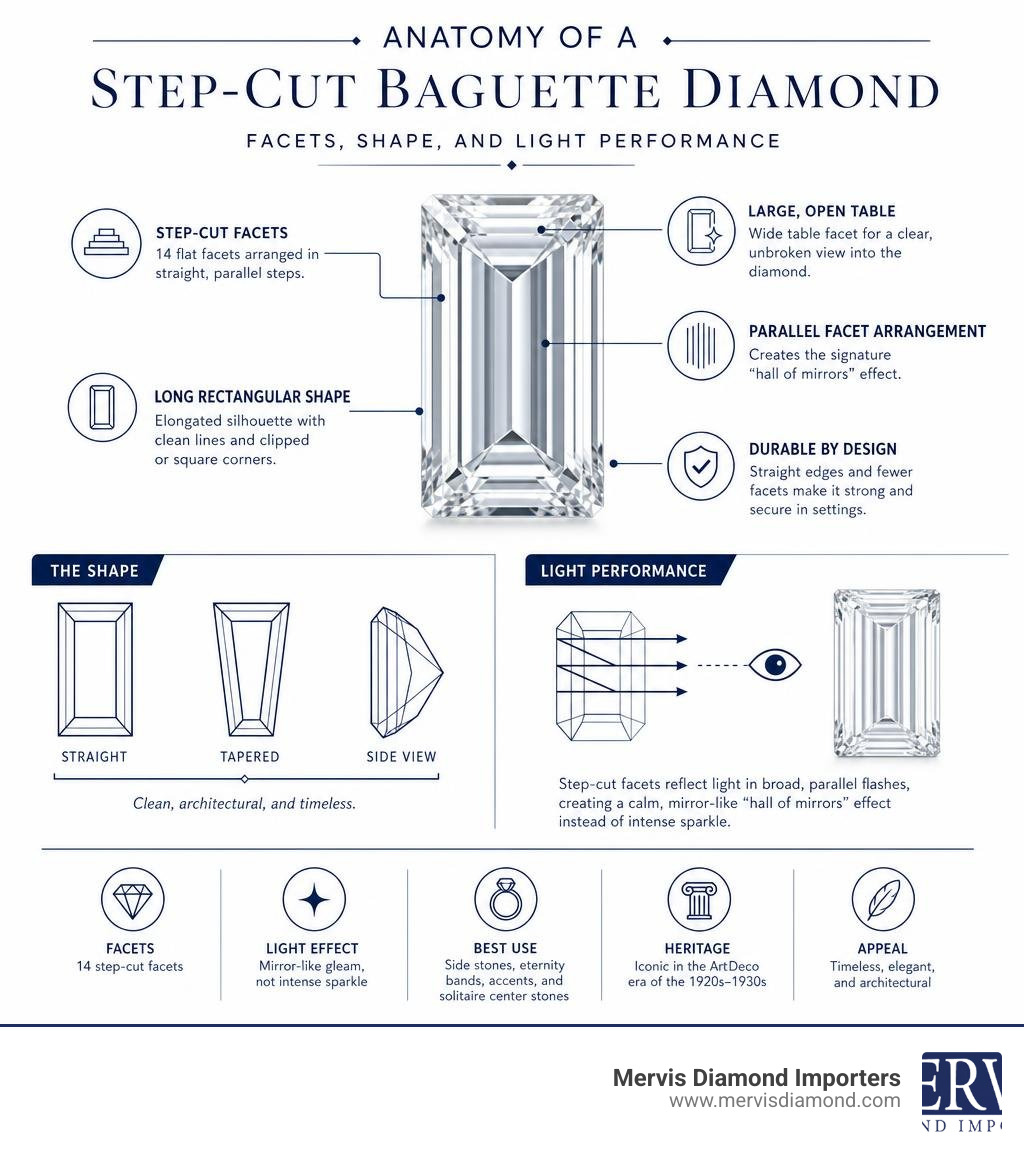
A baguette diamond is a long, rectangular step-cut stone with just 14 flat facets — far fewer than the 58 facets found in a round brilliant. Instead of intense sparkle, it produces a calm, mirror-like "hall of mirrors" effect that many buyers find quietly sophisticated.
Here's what you need to know at a glance:
| Feature | Baguette Diamond |
|---|---|
| Shape | Long rectangle (straight or tapered) |
| Facets | ~14 step-cut facets |
| Light effect | Mirror-like gleam, not intense sparkle |
| Most common use | Side stones, eternity bands, accents |
| Price vs. round | 12%–42% more affordable per carat |
| Lab-grown savings | 55%–75% less than natural equivalents |
| Key quality priority | Clarity (VS1–VS2 or better) |
| Era of origin | Art Deco, 1920s–1930s |
The name comes from the French word for a thin loaf of bread — fitting for a stone that is long, narrow, and elegant by design.
Baguette diamonds are most often used as accent or side stones, framing a center diamond in engagement rings or flowing across eternity bands. But a growing trend in 2026 is using larger baguettes as solitaire center stones — a bold, architectural choice that's gaining real momentum. Demand for baguette-cut diamonds rose 28% in 2025, driven by buyers who want structure and intention in their jewelry, not just maximum flash.
If you're weighing a baguette diamond for an engagement ring, wedding band, or another piece, this guide walks you through everything — cuts, quality factors, settings, pricing, and care — so you can buy with confidence.
What is a Baguette Diamond?
To truly appreciate the baguette diamond, we must look back at its architectural origins. While its roots trace back to the 16th-century "hogback" cut used for monograms, the modern baguette cut was popularized during the Art Deco movement of the 1920s and 1930s. Jewelry designers of the era reintroduced this geometric shape to break away from the traditional rounded designs of the Victorian era.
Unlike brilliant cuts that are designed to maximize light dispersion, a baguette belongs to the step-cut family. If you want to understand the fundamental design philosophy behind this cut, we recommend reading our detailed breakdown in What is a Baguette Diamond.
Because it features only 14 facets arranged in parallel lines, it behaves like a sleek, polished mirror. Instead of a sparkling "disco ball" effect, it produces a highly sophisticated "hall of mirrors" look, characterized by broad, clean flashes of light.
Baguette Cut Characteristics and Facets
A standard baguette diamond features a long, rectangular profile with parallel facets running along its length and width. These step-cut facets are arranged in parallel rows resembling a terrace or staircase.
While a classic round brilliant diamond features 57 or 58 facets designed to bounce light in every direction, the baguette's 14 facets prioritize transparency and clean geometric lines. The length-to-width ratio of a baguette typically ranges from 1.5:1 to 5:1, depending on the specific jewelry application.
This unique structural makeup impacts how the stone handles light. To understand how this differs from other shapes, you can explore our guide on What Makes a Diamond Sparkle. Instead of fire and scintillation, the baguette offers a quiet, icy brilliance that highlights the pure clarity of the crystal.
Baguette vs. Emerald and Round Cuts
It is common to confuse the baguette with other popular shapes, particularly the emerald cut. However, there is a key structural difference:
- Emerald Cuts have beveled (cut) corners, giving them an octagonal silhouette, and typically feature 50 to 58 facets.
- Baguette Cuts have sharp, 90-degree squared corners and only 14 facets. This makes the baguette look sleeker and more geometric, but also means its corners are more vulnerable to chipping if not set correctly.
When compared to round brilliant cuts, the difference is night and day. Round diamonds are highly focused on fire and brilliance, making them excellent for disguising minor internal flaws. Baguettes, on the other hand, act like magnifying glasses. Any internal inclusion or hint of color is immediately visible through the open table of a step cut.
To see how these visual profiles compare when choosing a ring, check out our guide on Selecting the Right Diamond Shape. Additionally, if you are evaluating alternative stones, it helps to understand What is a Diamond Simulant to ensure you are purchasing genuine natural or lab-grown diamonds. For those who want to maximize visual impact, we also compare Which Diamond Shape Looks the Biggest to help you balance dimensions and carat weight.
Straight vs. Tapered Baguettes: Key Differences
When shopping for baguette diamonds, you will quickly encounter two primary styles: straight and tapered. Choosing between them depends entirely on the design of the jewelry and the visual flow you want to achieve.
When to Choose a Straight Baguette Diamond
Straight baguettes are perfect rectangles with parallel sides of equal width. They are the ideal choice for designs that require clean, continuous lines and geometric symmetry.
You will most commonly find straight baguettes used in:
- Eternity bands and wedding rings where they are set end-to-end to create a continuous, unbroken river of light.
- Channel settings where they sit flush against one another within metal walls.
- Modern minimalist jewelry, such as a single horizontally set baguette on a delicate gold band.
A classic straight baguette diamond band demonstrates how straight baguettes create a sleek, modern, and low-profile wedding band, offering a clean and continuous line of brilliance.
When to Choose a Tapered Baguette Diamond
Tapered baguettes are narrower at one end than the other, forming a subtle trapezoidal shape. This tapering creates a natural visual gradient, making them incredibly effective at drawing the eye inward toward a central point.
Tapered baguettes are the gold standard for:
- Flanking a center stone in three-stone or trilogy engagement rings. The tapered end points toward the center stone, creating a seamless visual transition.
- Ballerina settings, where multiple tapered baguettes are arranged in a circular, radiating pattern around a central gem, mimicking the tutu of a ballet dancer.
- Curved or contoured wedding bands designed to hug the contours of an oval, pear, or round center stone.
To explore how these elegant side stones can elevate a classic ring design, read the GIA's insights on being Hungry for a Baguette Diamond Engagement Ring? .
Quality Factors: Evaluating the 4Cs for Step Cuts
Buying a step-cut diamond requires a different strategy than buying a brilliant-cut diamond. Because of the open facet pattern, you cannot rely on a sparkling cut to hide imperfections.
To build a solid foundation before shopping, we recommend reading The 4Cs When Purchasing Diamond Engagement Rings as well as our comprehensive guide to Understanding Four Cs.
Clarity and Color Priorities
For a baguette diamond, Clarity is your absolute top priority. In brilliant cuts, you can often drop to an SI1 or SI2 clarity grade because the multiple facets scatter light and mask tiny inclusions. In a baguette, a central inclusion will be magnified by the open, flat facets.
- Recommendation: We strongly recommend choosing a clarity grade of VS2 or higher (VS1 or VVS2 is ideal) to ensure the stone is completely eye-clean. Read more about selecting the right clarity in our guide What Diamond Clarity is Best.
Color is also highly visible in step cuts. While brilliant cuts can mask slight yellow tints, step cuts hold onto color, especially in white metal settings like platinum or white gold.
- Recommendation: Aim for a color grade of G–H or better for white metal settings to maintain an icy, colorless look. If you are setting the diamonds in yellow or rose gold, you can safely drop to an I–J color grade, as the warm metal will mask any slight warmth in the stone.
- Consistency: If you are buying a matching pair of side stones or an eternity band, ensure all the baguettes are within one color grade of each other and match the color of your center stone.
Carat Weight and Size Chart
With baguette diamonds, physical dimensions (length and width in millimeters) are far more important than carat weight. Because they are often used in matching sets, a visual match in size is critical. Two baguettes with the exact same carat weight can have completely different proportions, making them look mismatched side-by-side.
When you are learning How to Buy a Loose Diamond, you will find that step-cut dimensions must be calibrated to the millimeter. Below is a reference chart mapping common baguette dimensions to their approximate carat weights:
| Length (mm) | Width (mm) | Approx. Carat Weight (ct) | Common Jewelry Use |
|---|---|---|---|
| 3.00 | 1.50 | 0.05 – 0.07 | Delicate eternity bands, halo accents |
| 3.50 | 1.75 | 0.08 – 0.10 | Accent stones, minimalist stackable rings |
| 3.90 | 2.00 | 0.12 – 0.14 | Classic three-stone side accents |
| 4.50 | 2.25 | 0.18 – 0.22 | Prominent side stones, bold wedding bands |
| 5.00 | 2.50 | 0.25 – 0.30 | Solitaire accent bands, larger trilogy rings |
Popular Settings and Jewelry Styles
The setting you choose for a baguette diamond is not just an aesthetic choice — it is also a vital protective measure. Because baguettes have sharp, 90-degree corners, they are more prone to chipping than rounded cuts if left exposed.
To help you decide on the safest and most beautiful mounting for your lifestyle, read our guide on How to Choose a Diamond Ring Setting.

Engagement Rings and Side Stones
Baguette diamonds are legendary side stones. They provide a beautiful architectural frame that draws attention to the center stone without competing with its sparkle.
- Three-Stone Trilogy: A classic design featuring a round, oval, or emerald-cut center stone flanked by two tapered baguettes. This style has a timeless, vintage appeal.
- Ballerina Settings: Popularized in the mid-century and trending again in 2026, this style uses a fan of tapered baguettes surrounding a center gem (like a ruby, sapphire, or diamond) to create a dramatic, sunburst effect.
When designing a custom ring, the size of your side stones should scale proportionally with your center stone. For budget and design context on larger center diamonds, explore our pricing guides:
- How Much is a 2 Carat Diamond Ring
- How Much is a 3 Carat Diamond Ring
- How Much is a 4 Carat Diamond Ring
- How Much is a 10 Carat Diamond Ring
Eternity Bands and Wedding Rings
Baguette eternity bands offer a sleek, low-profile alternative to traditional round brilliant bands. The flat surface of the stones sits flush against the finger, making them incredibly comfortable for daily wear.
When choosing a band, the setting style is crucial:
- Channel Setting: The diamonds are nestled between two parallel walls of precious metal. This is the most secure setting for baguettes because it completely covers and protects the vulnerable corners of the stones.
- Pavé Setting: While pavé settings offer more visible diamond and less metal, they do not protect the edges of the baguettes as effectively as a channel setting.
To understand these structural differences in depth, read our comparative guides:
- Pave and Channel Set Engagement Rings What's the Difference
- Channel Setting or Pave Setting
- Tips Selecting Channel Set Rings
For those seeking a continuous band of modern, geometric sparkle, a classic baguette diamond eternity band is an exceptional choice that pairs beautifully with both step-cut and brilliant-cut engagement rings.
Pricing, Care, and 2026 Trends
As we move through 2026, we are seeing a massive resurgence in Art Deco-inspired jewelry and clean, geometric lines. The 28% increase in demand for baguette diamonds over the past year highlights a shift toward structured, deliberate luxury.
Natural vs. Lab-Grown Price Comparison
One of the most appealing aspects of the baguette diamond is its value proposition. On average, natural baguette diamonds are 12% to 42% more affordable per carat than round brilliant diamonds of equivalent quality. This is because the rectangular shape yields a higher retention of the rough diamond crystal during the cutting process, resulting in less wasted material.
For buyers looking to maximize their budget, lab-grown baguette diamonds offer even greater savings. Lab-grown baguettes are typically 55% to 75% less expensive than their natural counterparts. This allows you to opt for higher clarity and color grades (which, as we discussed, are crucial for step cuts) without exceeding your budget.
When deciding between natural and lab-grown options, many clients ask about long-term value. To help you navigate this decision, we have put together several resources on the investment aspects of diamonds:
Maintenance and Resizing Limitations
Because of their unique shape and settings, baguette jewelry requires specific care:
- Cleaning: Dirt and oils easily accumulate underneath flat step-cut diamonds, quickly dulling their mirror-like shine. Clean your ring regularly using warm water, mild dish soap, and a soft-bristled toothbrush. Avoid harsh chemicals or ultrasonic cleaners if the stones are held in delicate micro-prong settings.
- Protection: Always store your baguette jewelry separately from other pieces to prevent the sharp, exposed corners of the diamonds from scratching other metals or stones.
- Resizing Limitations: This is a critical factor when buying a baguette eternity band. Because the diamonds are set continuously around the band, full eternity bands cannot be resized. When purchasing a channel-set or eternity baguette band, look for designs that feature a small, solid metal "sizing bar" at the back of the band, which allows a professional jeweler to adjust the size slightly if needed in the future.
Frequently Asked Questions
Are step-cut stones more fragile?
The diamond material itself is just as hard as any other diamond (a 10 on the Mohs scale), but the shape of a baguette makes it more vulnerable. Because they have sharp, 90-degree corners rather than rounded or beveled edges, those corners can chip if they sustain a direct, hard impact. To mitigate this risk, we highly recommend choosing protective settings like channel or bezel mountings for daily-wear jewelry like engagement rings or wedding bands.
Do step-cut diamonds sparkle as much as round cuts?
No, they do not. Round brilliant cuts are designed to maximize "fire" and "scintillation" (the rainbow-colored sparkles). Baguettes have fewer facets (~14) and are designed to produce a "hall of mirrors" effect, resulting in elegant, broad flashes of white light. To learn more about how facet structure influences light performance, see our guide on What Makes a Diamond Sparkle.
Can you resize a channel-set ring?
It depends on the design. If the channel-set baguettes go all the way around the band (a full eternity), it cannot be resized. However, if the diamonds only cover the top half of the ring (a half-eternity) or if the ring features a solid metal sizing bar at the bottom, a skilled jeweler can resize it. Always consult with a professional before purchasing to understand the sizing limitations of your specific ring.
Conclusion
The baguette diamond is a masterclass in understated elegance. Whether you are drawn to its vintage Art Deco heritage or its clean, modern geometric lines, it offers a sophisticated alternative to traditional brilliant-cut diamonds.
At Mervis Diamond Importers, we specialize in helping you find the perfect jewelry to tell your story. Our hand-selected collection features both high-quality natural and lab-grown diamonds, curated to meet the highest standards of clarity and symmetry. We pride ourselves on offering expert, pressure-free service to help you navigate your buying journey with ease.
If you are located in the Washington metropolitan area, we invite you to visit one of our convenient showrooms:
- Tysons, VA
- Rockville, MD
- Washington, DC
To learn more about this beautiful cut, explore our primary resource on What is a Baguette Diamond, or schedule a private consultation with one of our diamond experts today to view our stunning collection in person.