

Understanding Artificial Diamond Costs and Pricing Trends
Artificial Diamond Cost: The Quick Answer
Artificial diamond cost is usually far lower than the price of a comparable natural diamond, but it depends on carat weight, color, clarity, cut, certification, and the ring setting. As of 2026, lab-grown diamond prices remain under pressure as production becomes faster and more widely available.
- Comparable lab-grown diamonds often cost substantially less than natural diamonds. In April 2022, a one-carat lab-grown round diamond could cost up to 73% less than a natural diamond with the same qualities.
- Prices have fallen sharply over time. By early 2025, lab-grown diamond prices had declined about 74% from 2020 levels.
- Bigger and higher-grade stones still cost more, especially for larger carat weights and rare colorless, high-clarity grades.
- Lab-grown diamonds are real diamonds, with the same carbon crystal structure and core physical properties as mined diamonds. They are not cubic zirconia or moissanite.
- Lower upfront cost does not guarantee strong resale value. Expanding supply can continue to affect future resale prices.
The important comparison is not simply "lab-grown versus natural." It is whether two diamonds truly match in size, cut, color, clarity, certification, and overall appearance. Manufacturing methods such as HPHT and CVD, plus treatments and grading, also shape what you pay.
For many engaged couples, the appeal is clear: a larger or higher-quality diamond may fit the same budget, while conflict and environmental concerns can also influence the choice. At the same time, natural diamonds and lab-grown diamonds follow very different supply and long-term value dynamics.
I am Morris Mervis, and next we will break down the practical factors that determine what an artificial diamond should cost.
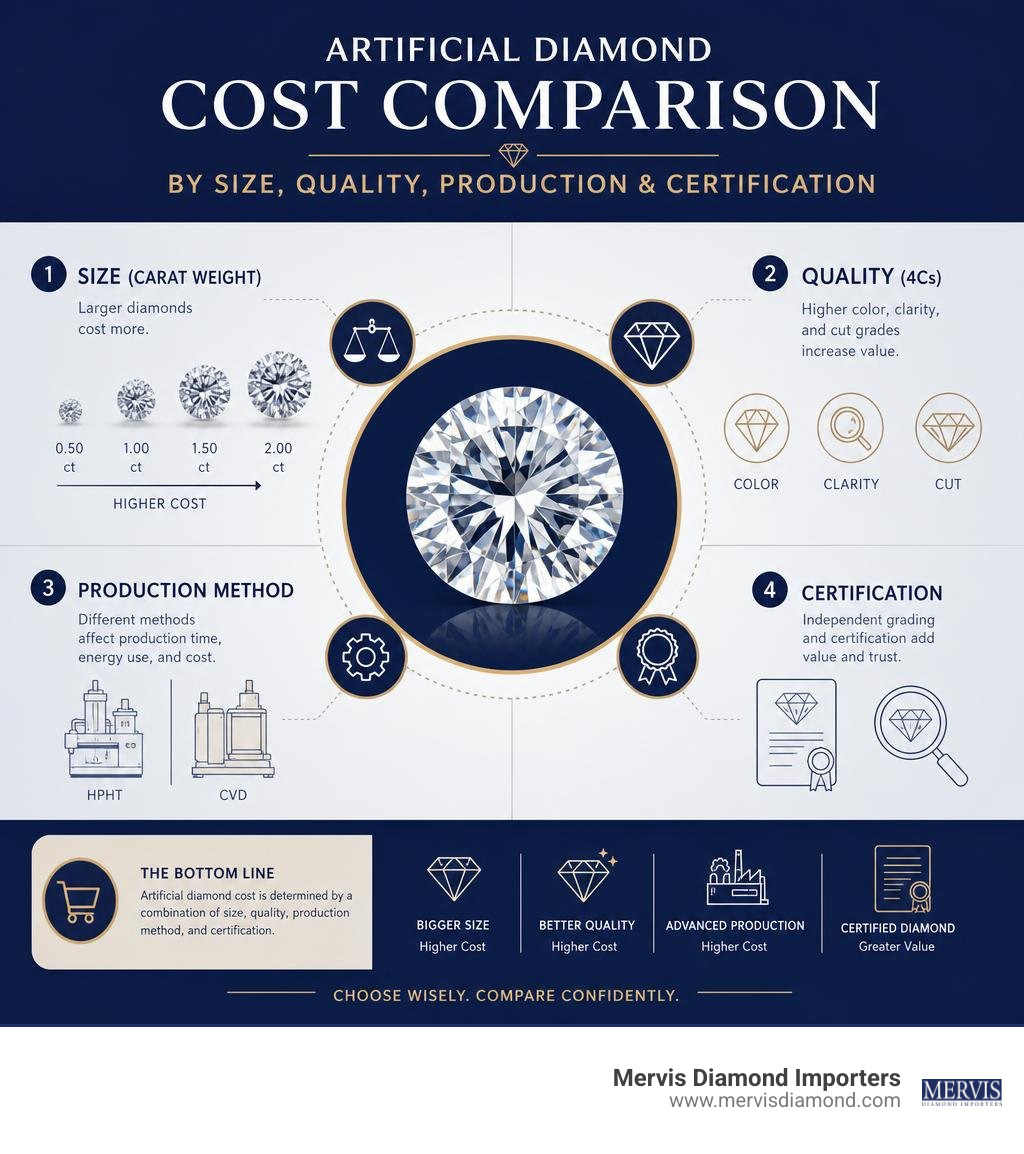
Key Factors Influencing Artificial Diamond Cost
When buyers first explore the market for lab-created gems, they are often surprised by the pricing variance. How can two stones that look virtually identical carry vastly different price tags? The artificial diamond cost is governed by advanced technology, energy consumption, yield rates, and market dynamics.
Unlike earth-mined diamonds—whose supply is constrained by geological rarity and mining operations—man-made diamonds are produced in high-tech facilities. However, high-tech machinery and specialized oversight still carry substantial operational costs.
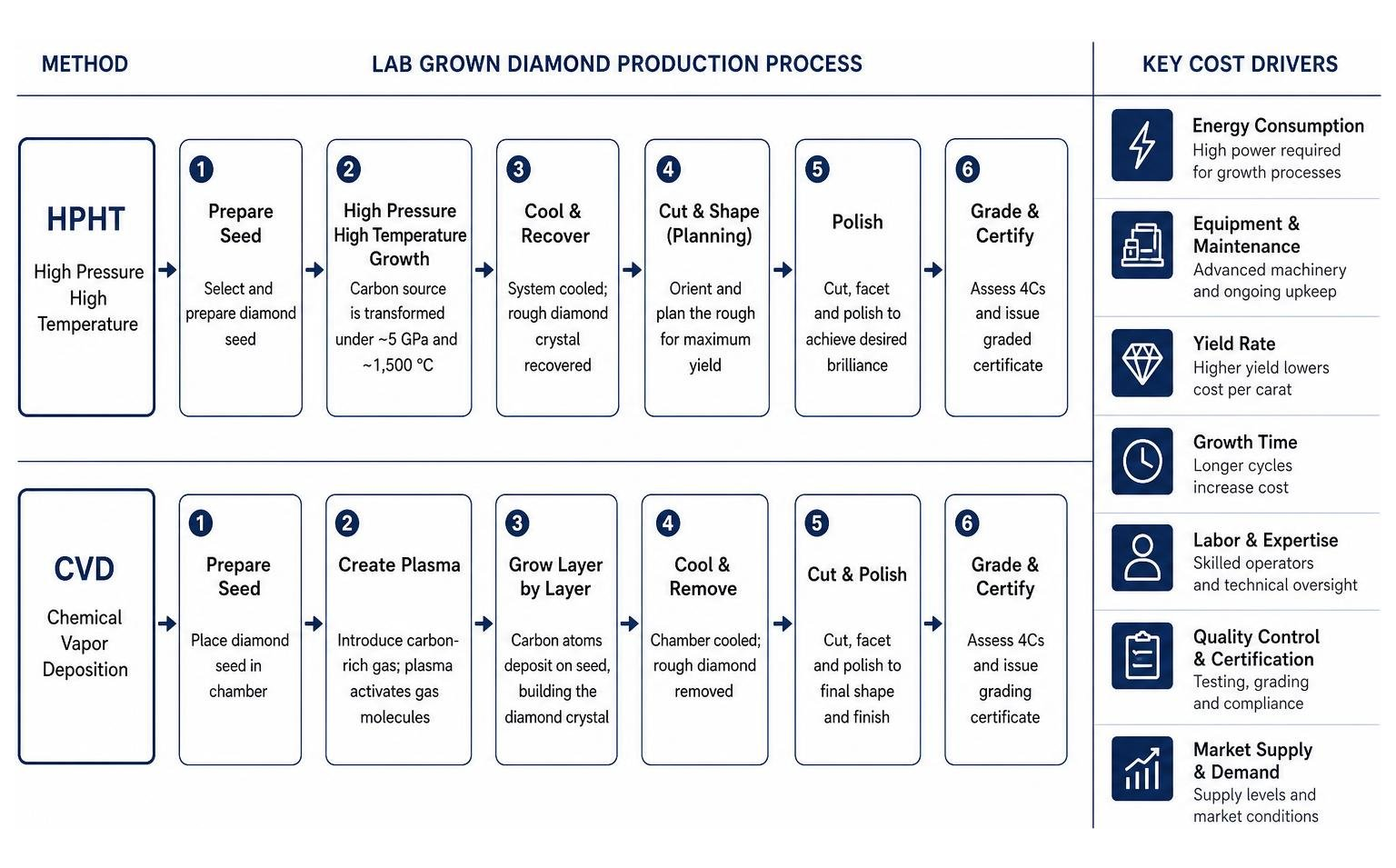
HPHT vs CVD Manufacturing Costs
The two primary manufacturing techniques used to create gem-quality synthetic diamonds are High Pressure High Temperature (HPHT) and Chemical Vapor Deposition (CVD). Each method requires distinct machinery, energy inputs, and timeframes, directly impacting production costs and final retail pricing. Learn more about how these methods compare in our detailed Lab Grown Diamonds Guide Synthetic Natural.
- HPHT Synthesis: This method replicates the extreme geological conditions found deep within the Earth's mantle. HPHT equipment subjects carbon seed crystals to pressures around 5 GPa (approximately 730,000 pounds per square inch) and temperatures near 1,500 °C (2,730 °F). Maintaining these extreme environments demands significant electrical energy and massive multi-anvil or belt presses. Historically, HPHT was famous for growing yellow or brownish stones due to airborne nitrogen impurities, though modern gas-filtering techniques now allow facilities to produce brilliant colorless stones.
- CVD Synthesis: CVD operates under vacuum conditions at lower pressures but requires specialized plasma reactors. A hydrocarbon gas mixture (such as methane and hydrogen) is ionized into plasma using microwave energy. The released carbon atoms deposit layer by layer onto a diamond substrate. While CVD allows for precise growth over large surface areas, it requires continuous microwave power and specialized hydrogen gas etching to prevent non-diamond carbon from forming.
Because both techniques involve substantial energy consumption and expensive equipment maintenance, production efficiency directly impacts wholesale prices. As reactors become faster and yield rates improve, growers produce gem-quality rough diamonds at a lower cost per carat.
How Carat Weight Impacts Artificial Diamond Cost
Carat weight significantly influences pricing for both mined and lab-created gemstones, though the price curve differs between the two. Growing larger diamond crystals requires keeping a complex reactor stable for weeks without a single thermal fluctuation or plasma disruption.
If a power dip or technical glitch occurs halfway through a multi-week growth cycle, an entire batch of large rough diamonds can be ruined. Consequently, single large rough crystals carry a higher risk factor and longer growth duration, keeping their price per carat higher than smaller melee stones.
- 1 Ct Man Made Diamond: A popular entry point for solitaire engagement rings. Increased manufacturing yields make 1-carat stones exceptionally affordable today.
- 2 Carat Man Made Diamond Complete Guide: Offers a dramatic visual upgrade on the hand while remaining far below the price of a 2-carat mined equivalent.
- 3 Carat Lab Grown Diamond Cost: Growing a 3-carat polished gem requires a large, high-purity rough stone. While still accessible compared to natural diamonds, the price per carat steps up due to lower yield rates.
- Ultimate 4 Carat Man Made Diamond Guide: Represents a impressive technical achievement. Four-carat stones showcase the pinnacle of modern CVD and HPHT engineering.
Color, Clarity, and Certification Expenses
Just like mined gems, lab-grown diamonds are evaluated using the traditional 4Cs: Cut, Color, Clarity, and Carat weight. Obtaining top-tier color grades (D, E, F) and clarity grades (VVS1, VVS2) requires strict growth chamber controls and meticulous post-growth processing.
- Impurities and Color Grading: Microscopic inclusions of nitrogen can give synthetic diamonds a yellowish hue, while boron inclusions produce blue hues. Achieving pure, colorless single-crystal diamonds requires ultra-pure source gases and strict chamber isolation, increasing overall costs.
- Post-Growth Treatments: Many CVD diamonds undergo high-pressure, high-temperature annealing after initial growth to improve their color grade. This extra processing step adds cost but ensures optimal visual brilliance.
- Independent Certification: To guarantee quality, reputable jewelers submit lab-grown gems to independent gemological laboratories such as the International Gemological Institute (IGI) or the Gemological Institute of America (GIA). Lab grading fees, laser inscription of report numbers, and insured transport add a modest baseline cost to every certified gem. For tips on choosing the best grade combinations for your budget, review our guide on selecting the Best Value Diamond.
Historical Price Evolution and Market Dynamics
The market for artificial diamonds has experienced dramatic structural changes over the past decade. Back in 2013, synthetic diamonds accounted for just 0.28% of rough diamond production for gemstone use, representing roughly 2% of the total gem-quality market. Fast forward to 2023, and synthetic diamonds captured approximately 17% of the global diamond jewelry market.
This rapid expansion has reshaped pricing structures across retail showrooms nationwide, including our local stores in Tysons, VA, Rockville, MD, and Washington, DC.
| Diamond Category | 1.00 Carat (Approx. Retail Range) | 2.00 Carat (Approx. Retail Range) | 3.00 Carat (Approx. Retail Range) | Market Dynamic & Supply Drivers |
|---|---|---|---|---|
| Natural Diamond | $4,500 – $9,000+ | $12,000 – $28,000+ | $25,000 – $65,000+ | Geological scarcity, global mining caps, steady long-term value retention. |
| Lab-Grown Diamond | $800 – $1,800 | $1,500 – $3,200 | $2,800 – $5,500 | Scalable technology, continuous yield improvements, declining production cost. |
Historical Trends in Artificial Diamond Cost
The historical trajectory of the artificial diamond cost is a classic study in technological disruption. Early efforts to synthesize diamonds date back to 1953, when Swedish company ASEA successfully ran a top-secret project code-named QUINTUS. Shortly after, in 1954, Tracy Hall achieved reproducible diamond synthesis at General Electric using a custom belt press. However, those early gems were industrial-grade grit—far from jewelry quality.
Gem-quality synthesis remained expensive and small in scale until the mid-2010s. Around 2016, the price of 1-carat synthetic diamond gemstones began dropping precipitously—by roughly 30% in a single year—as commercial growers scaled up factory capacity.
By the beginning of 2025, laboratory-grown diamonds had dropped in price by 74% compared to 2020 levels. This rapid price reduction opened high-end luxury looks to broader audiences. To learn more about historical trends and current forecasts, explore the Average Cost of Lab Grown Diamonds and our comprehensive Lab Grown Diamonds Guide 2026.
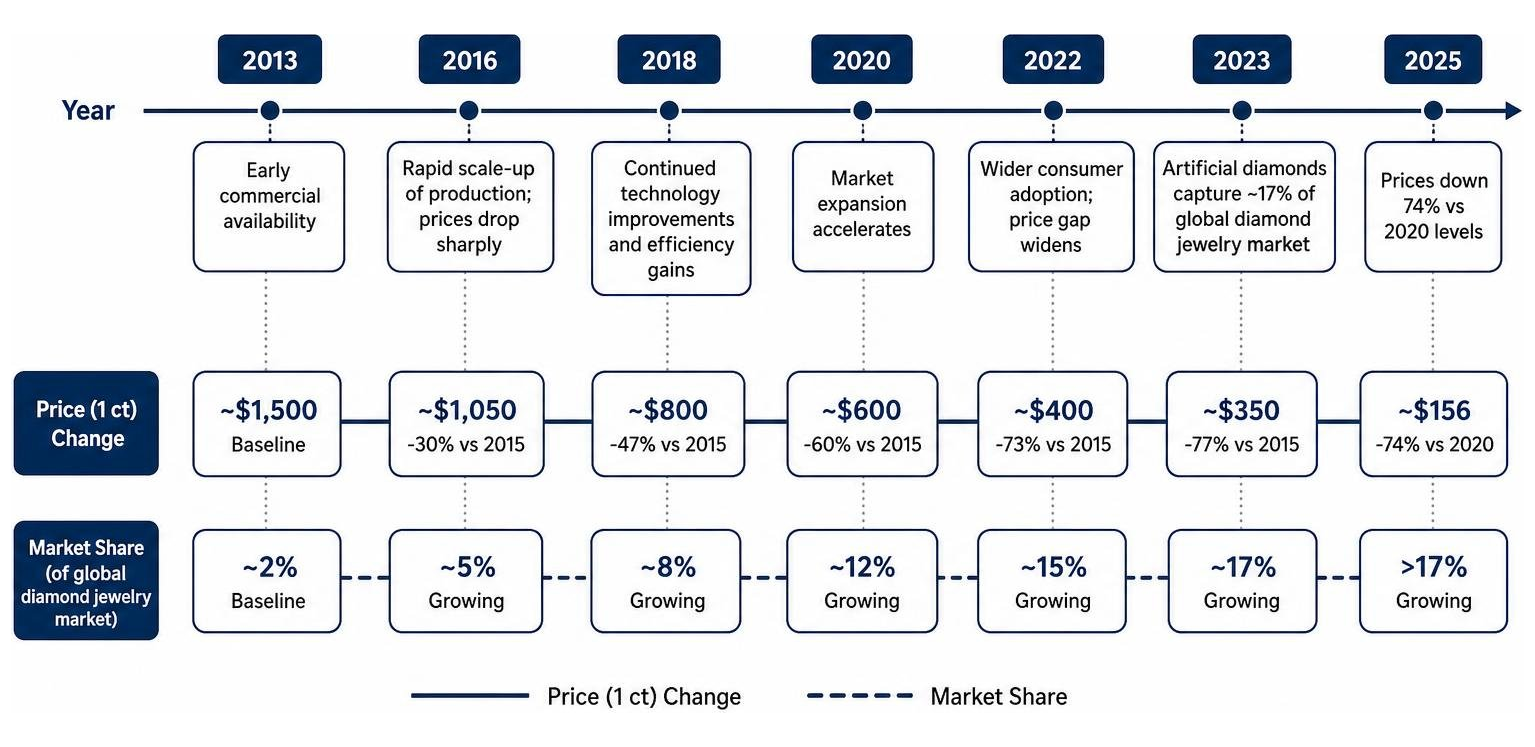
Artificial vs Natural Diamond Price Gap
The price gap between man-made and earth-mined diamonds continues to widen. In April 2022, a synthetic one-carat round diamond was already up to 73% cheaper than a natural diamond with identical 4C specifications. As technology advanced, consumers embraced this value proposition in record numbers.
In 2022 alone, the number of engagement rings featuring a lab-grown diamond jumped 63% compared to the prior year, while sales of rings featuring natural diamonds declined by 25% during that same window. Major diamond producers shifted market dynamics by introducing entry-level lab-grown fashion lines, establishing clear boundaries between luxury mined gems and mass-produced lab stones.
For shoppers looking to stretch their budget without compromising on design elegance, our Best Cheap Man Made Diamond Engagement Rings Guide outlines smart pairing options. You can also evaluate live pricing variations using a interactive tool like our Diamond Price Calculator.
Industrial Applications vs Gemstone Value
While gem-quality diamonds grab retail headlines, the industrial market operates on an even grander scale. Synthetic diamonds dominate heavy industry, accounting for an impressive 98% of total industrial-grade diamond demand worldwide.
Industrial synthetic diamonds differ from retail gem stones in format and application, but their low production costs make modern heavy machinery, electronics, and optical systems possible:
- Machining and Cutting Tools: Polycrystalline diamond (PCD) inserts are integrated into heavy-duty mining drill bits, stone-cutting saws, and precision manufacturing tools due to diamond's unmatched Mohs hardness of 10.
- Thermal Conductors in Electronics: Isotopically pure synthetic diamond enriched with 12C exhibits thermal conductivity up to 7.5 times higher than pure copper. Modern semiconductor manufacturers use synthetic diamond wafers as heat spreaders in high-power laser diodes and high-frequency microprocessors.
- Optical Windows: Chemical Vapor Deposition allows facilities to produce broad-spectrum diamond discs used as protective optical windows in industrial high-power CO2 lasers and specialized scientific sensors.
In industrial uses, synthetic diamonds cost a fraction of natural diamond grit while delivering superior consistency, customized shapes, and tailored chemical purity.
Frequently Asked Questions About Artificial Diamond Costs
Why are artificial diamonds significantly cheaper than natural diamonds?
Artificial diamonds are less expensive primarily because their supply chain is scalable and technology-driven rather than geologically constrained. Mined diamonds require massive capital investment in deep-earth mining infrastructure, heavy earth-moving equipment, global transport, and environmental remediation.
By contrast, lab-grown diamonds are grown inside high-tech reactors over weeks rather than billions of years. As semiconductor-style manufacturing techniques mature, the cost per carat to produce synthetic diamond rough continues to decrease.
Do artificial diamonds hold resale value over time?
Unlike natural diamonds, which possess inherent geological rarity and established secondary trading networks, lab-grown diamonds currently hold limited resale value. Because factory output continues to expand and manufacturing costs drop year after year, pre-owned buyer demand for lab-grown stones is minimal.
When purchasing a lab-grown diamond ring, we recommend treating it as a beautiful fashion or bridal purchase rather than a financial investment asset.
How much does a lab-grown engagement ring cost in 2026?
In 2026, a complete lab-grown engagement ring—including a certified 1.00-carat center diamond and a premium gold or platinum setting—typically ranges between $1,200 and $2,500 depending on diamond grade and setting complexity. Selecting a 2.00-carat center stone generally brings the total cost to between $2,200 and $4,500.
For an exhaustive breakdown of ring styles, setting options, and pricing tier choices, read our complete Lab Grown Diamond Ring Complete Guide.
Conclusion
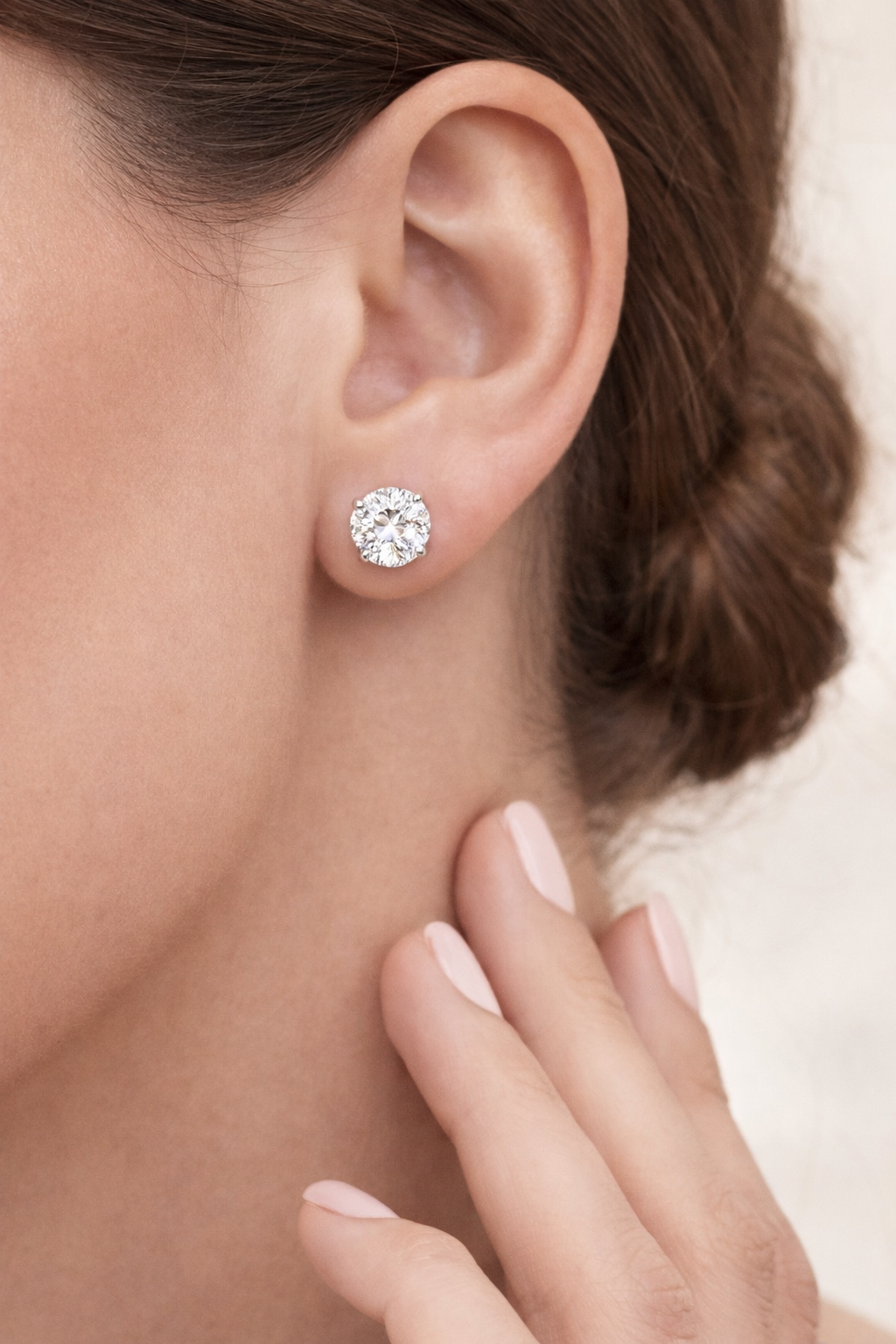
Understanding the factors behind artificial diamond cost empowers you to make an informed, confident purchase tailored to your personal taste and financial goals. Whether you prioritize maximal carat size for your budget or prefer the timeless rarity of an earth-mined gemstone, today's marketplace offers incredible choice.
At Mervis Diamond Importers, we believe in complete transparency and pressure-free guidance. We proudly hand-select both exceptional natural diamonds and top-tier lab-grown gems for our clients throughout the Washington, DC, Northern Virginia, and Maryland areas.
Ready to see the visual difference for yourself? Visit our showrooms in Tysons, VA, Rockville, MD, or downtown Washington, DC, or schedule a personal consultation today. To explore the fundamental differences between earth-mined and lab-created stones in greater detail, explore our comparison guide on Mined vs Lab Grown Diamonds.